Oil & dollar slide on US supply and Israel PM comments

Jamie Dutta >
Jamie Dutta >
Jamie Dutta is a Market Analyst for Vantage. He comes with extensive experience as a full-time trader and financial market commentator, having worked as a trader in top tier investment banks and trading houses.
 Updated Thu, 2026 March 19 09:15

* Israeli PM says war may be over soon than people think; US could do another SPR release
* Hawkish ECB, BoE and BoJ meetings put markets on watch for possible rate hikes
* Dollar dumped as EUR, GBP and JPY strengthen on rising short-end yields
* Stocks retrace losses on whipsaw day amid competing headlines
FX: USD gave back all of its gains and more after the FOMC meeting. That was seen as very mildly hawkish, though in truth we’d say that was in part due to the dollar rising on account of higher oil prices, rather than an outright hawkish central bank. At the margin, Chair Powell introduced a degree of caution to the Fed’s dovish outlook. Strength in the euro and pound drove losses – they are roughly 56% and 12% of the Dollar Index respectively. A soaring oil price initially helped the greenback as gas and oil facilities got hit in the Middle East. But later on, Israeli PM Netanyahu said Iran has no capacity to enrich uranium or make ballistic missiles, sparking optimism that they are close to achieving their goals, and added that the war may be over sooner than people think. That saw the dollar give back more of its war/oil premium gains. Resistance at 100.39 remains strong.
EUR rose sharply on the back of the ECB meeting which left rates unchanged as expected. But President Lagarde’s hawkish change in tone and language saw markets price in a 60% chance of a hike by April, rather than May, and roughly 70bps of hikes for 2026. That was around 50bps prior to today. ‘Monitor closely’ was back as a watchword for high alertness on policy action/rate hikes. That said, the bar still seems higher than markets have priced in. Prices really need to get above 1.17 to slow the downtrend in the major. The 200-day SMA sits at 1.1674.
GBP outperformed all of its peers apart from the yen and kiwi as the BoE left rates unchanged with a 9-0 vote, but opened the door to future hikes if energy prices stay elevated. It was thought the vote would likely see two officials request a rate cut. It seems wise for the MPC to keep its options open and keep assessing events at the next meeting in April. Major second round effects will be watched closely, though if the Middle East crisis gets worse, then higher employment may be more of the problem.
JPY outperformed as the major pulled back from previous highs from January around 159.46 after the hawkish BoJ meeting. Governor Ueda hinted at the chance of an April rate hike. Inflationary pressures are intensifying and the 8-1 vote (hold/hike) signalled how officials are positioned. Robust spring wage negotiations alongside a continued cycle of wage growth and increased consumer spending will likely cement more policy tightening.
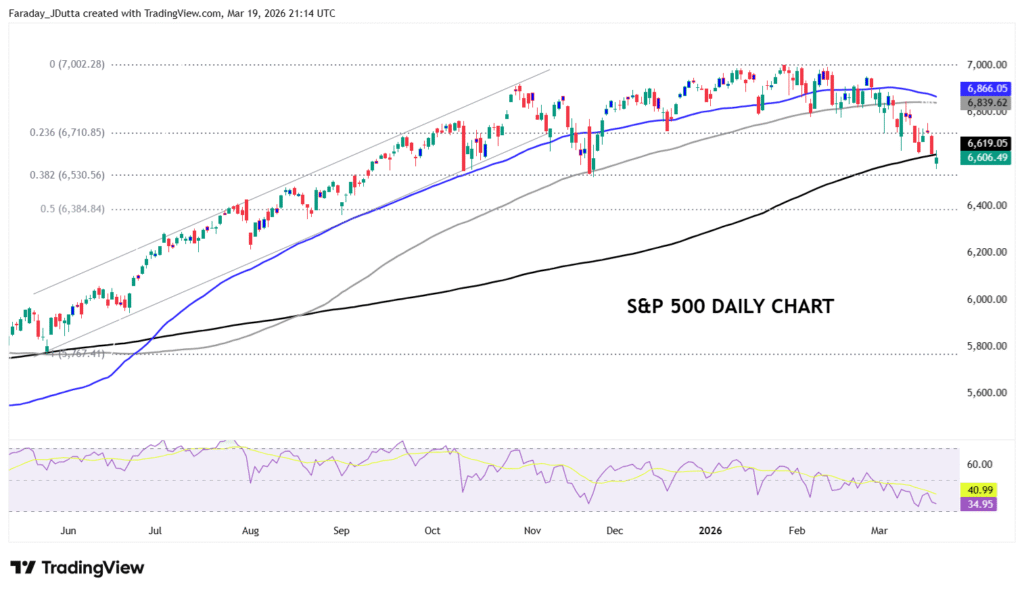
US stocks: The S&P 500 lost 0.27% to close at 6,607, the Nasdaq was 0.29% lower at 24,355 and the Dow Jones settled lower by 0.44% at 46,022. The Dow again underperformed as it remained below the 200-day SMA, likewise the S&P 500, but the tech-heavy Nasdaq bounced off its 200-day. Energy was the big outperformer, with Financials marginally positive. Materials was the big laggard, with Consumer Discretionary and Consumer Staples also big losing sectors. This suggests increasing investor focus on the energy price spike and potential implicit tax on consumption. This kind of price action points to growing concern around the pressure on real disposable income. Comments by the Israeli PM seriously helped risk assets rebound, having looked rather bearish earlier in the day. Micron closed 3.8% lower as big beats were outweighed by questions around margins peaking and pricing trends. Alibaba declined 7.1% as revenue missed estimates and profits slid despite AI growth.
Asian stocks: Futures are mixed. APAC stocks fell after weakness on Wall Street after rising oil prices. The ASX 200 sold off as miners, materials and real estate lagged, while mixed jobs data didn’t help the risk mood. The Nikkei 225 moved lower on higher energy prices and broad risk sentiment. The Hang Seng and Shanghai Composite matched the region’s downbeat mood with weakness in tech and miners.
Gold fell sharply again before later paring losses, as the stronger dollar and Treasury yields overwhelmed any haven buying. Prices dipped below the 100-day SMA at $4,577 to $4,502, a level last seen in early February. Silver fell by a double digit percentage before retracing and copper erased 2026 gains as higher oil prices weighed on global growth expectations and demand.
Chart of the Day – S&P 500 falls below 200-day SMA
The 200-day simple moving average is a widely watched indicator, commonly cited in broad financial circles. It is considered a reliable, long-term indicator for identifying overall trend direction. By averaging the closing price over the last 200 trading days, effectively one year, it smooths out noise and short-term price fluctuations, providing a cleaner picture of investor sentiment. Importantly, it can serve as a ‘line in the sand’ between long-term bulls and bears. The benchmark, broad-based S&P 500 index closed below this SMA, which sits at 6,619. From the May lows to the record high in late January, a major Fib retracement level resides at 6,530, where the October and November swing lows also lie. The midpoint of that move is below at 6,384 with a key level at 6,350. The weekly close could be hugely important and if it closes below the SMA or not.