Tech selloff deepens on spending worries; Brent tops $100

Jamie Dutta >
Jamie Dutta >
Jamie Dutta is a Market Analyst for Vantage. He comes with extensive experience as a full-time trader and financial market commentator, having worked as a trader in top tier investment banks and trading houses.
 Updated Thu, 2026 July 23 08:55

* Trump ‘close’ to decision on “massive attack” against Iran
* ECB hits pause as energy shock strengthens case for September hike
* USD up, gold slips as oil rally brings Fed rate hikes into focus
* Intel rallies after hours after chipmaker posts fastest growth in 15 years
FX: USD broke quite sharply to the upside as worsening US-Iran headline and Houthi strikes in the Red Sea ramped up tensions and saw investors flock to the greenback. Brent crude hit $100 for the first time since May though prices are now overbought on several measures. That has pushed the 10-year Treasury yield close to the high point seen in May (4.68%). The 30-year yield is also grabbing the headline as it has just now spent the longest period above the 5% yield point since 2007 and the start of the GFC. We have started asking where President Trump’s off ramp might be? 4.80% in the 10-year? $100 WTI? We are still thinking of the ‘escalate to de-escalate’ Trump strategy around this. Initial jobless claims dropped to their lowest in nearly 60 years. There’s a 50:50 chance of a second Fed rate hike by year end, with the FOMC meeting next Wednesday.
EUR outperformed most of its peers as the ECB left rates unchanged as predicted but teed up a September rate hike (as expected) with a ‘hawkish hold’. President Lagarde stressed upside risks to inflation and downside risks to growth. In fact, some officials favoured a rate rise at this meeting. September is virtually priced for a 25bps rate hike, so it would be a big surprise if the Governing Council didn’t pull the trigger on another rise. Fresh quarterly staff economic projections will also be published after the summer.
GBP sold off with cable falling to three-week lows as sterling underperformed most of its peers. There’s been a relatively dovish reaction to softer wage growth and mixed inflation data. Focus is turning to next week’s BoE meeting with fresh quarterly forecasts and an unchanged rate decision due. Money markets currently price in two BoE rate hikes by year end.
JPY underperformed all except the kiwi as the major broke to the upside pushing close to 164. US Treasury yields and higher oil prices are heavily impacting the yen at present. There is some focus on next week’s BoJ meeting and Tokyo’s tone and guidance. Meantime, prices can go higher into 164-165 with intervention action likely close at hand.
US stocks: The S&P 500 lost 1.21% to close at 7,408, the Nasdaq closed down 1.87% at 28,455 and the Dow Jones settled lower by 0.97% at 5`1,717. Sectors were split with Industrials, Health, Energy and Utilities in the green while Communication Servies and Consumer Discretionary heavily lagged. Alphabet (-7.1%), and Tesla (-14.5%) led the downsidewith Google’s parent raised 2026 capex plans above $200bn reigniting worries over elevated AI capex. Negative free cash flow for the first time in its history, as GOOG burnt through $5.9 billion this quarter exacerbated cash concerns. The stock dipped below its 200-day SMA. Memory names like Micron (+3.2%) were supported as they stand to benefit from increased tech spending. Tesla’s profit missed on margin pressure while heavy AI and robotics capex outweighed record vehicle deliveries. See below for more. IBM reported a 25% jump in revenue after the close, as the chipmaker recorded the fastest sales growth in almost 15 years. The stock jumped 9% after hours.
Asian Stocks: Futures are mixed. APAC stocks were mostly green on chip strength even as the Middle East conflict escalated and a muted Wall Street handover. The ASX 200 outperformed on materials and commodity strength and strong jobs data. The Nikkei 225 rallied on the open but higher oil prices slowed the bulls. The Shanghai Comp and the Hang Seng were mixed with Hong Kong helped by mining strength while trade-related tensions held back the mainland.
Gold sold off as bond yields climbed for a fourth straight day, boosting the dollar. The downward trendline from the January record high appears to have acted as resistance with higher yields making non-yielding gold less attractive.
Day Ahead – Japan CPI, PMIs
Expectations are for Japan headline inflation to rise to 1.7% from 1.5%, while the BoJ’s preferred inflation measure, core, is seen rising two-tenths to 1.6%. A slowdown in food price inflation could drag on the latter. However, higher crude oil prices are likely to feed into inflation going forward. Core inflation is expected to stay below the BoJ’s 2% target through autumn 2026 before rising to 2.5-3.0% through early 2027. For the BoJ, markets are expecting the Bank to hold rates at next week’s July meeting.
Forward-looking PMI data will cover July, a period marked by persistent geopolitical uncertainty, the closure of the Strait of Hormuz and a strong rebound in energy prices. As PMI surveys typically cover the first two to three weeks of the month, the figures should capture the latest escalation and is likely to point to growing pessimism among European businesses. This follows a solid June PMI release, which suggested the euro zone economy remained resilient enough to avoid recession, albeit with no growth. Manufacturing is losing some of its steam across Europe, but strategic stockpiling is helping in the UK. Services activity is forecast to rise to a three-month high in the eurozone but could see the sharpest drop in three years in the UK.
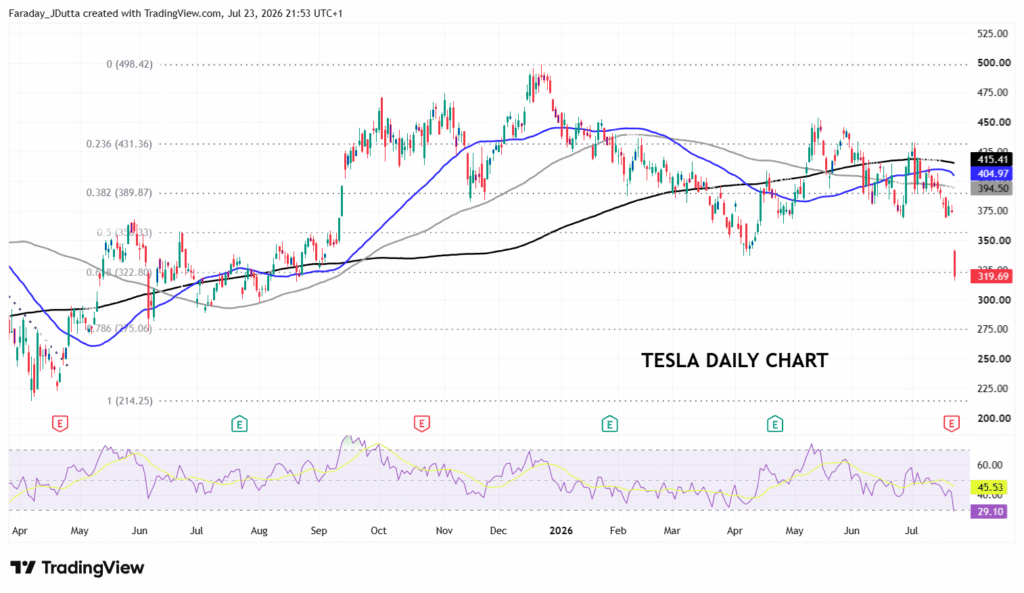
Chart of the Day – Tesla buying opportunity?
Tesla plunged over 14% after it posted a mixed quarter: revenue beat expectations, but profits came in well below forecasts as car margins slipped and AI spending ramped up sharply. The big story was probably that Elon Musk is doubling down on the future. Tesla spent heavily on Robotaxi, Full Self-Driving, AI infrastructure and Optimus, which keeps the long-term growth narrative alive. But it also means more pressure on near-term cash flow, with notably negative free cash flow reported for the first time in over two years.
Ultimately, the core EV business is still under strain, even with solid revenue, with competitors making big strides, while the energy division is becoming increasingly important as a growth engine. Record battery storage helps soften the blow, but Tesla is still being valued on whether it can turn AI and autonomy into real money, not just headlines. And for now, the market is not seeing the jam!
Chartwise, prices have fallen to a major long-term Fib level (61.8%) of the April 2025 to December 2025 move at $332.80. Next support below sits at the minor retracement and June 2025 low around $275.06. The midpoint of that move resides above at $356.33.