
 Updated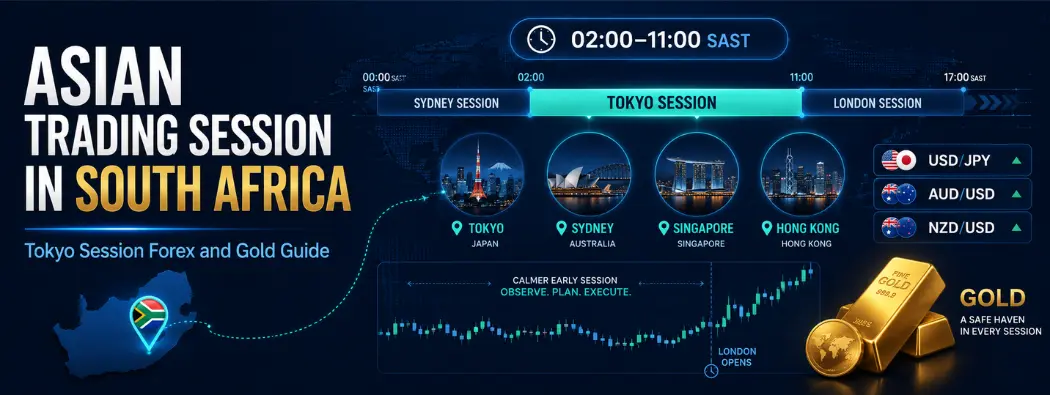
The Asian trading session is one of the first major forex sessions of the trading day. For South African traders, it opens during the night and continues into the morning. Market behaviour during forex sessions is not always consistent, and historical patterns may not repeat under future market conditions.
Many traders focus on London and New York. Those sessions often have stronger volume and faster moves. Yet the Tokyo session still matters, especially for traders who prefer calmer markets.
The Asian session can help South African traders observe price action before the London open. It can also coincide with increased market activity in yen, Australian dollar, and New Zealand dollar pairs, as well as in gold.
Key takeaways
- The Asian trading session in South Africa usually runs from 02:00 to 11:00 SAST.
- The session is often calmer than London and New York. It can be useful for JPY/AUD and JPY/NZD pairs.
- Gold can move during the Tokyo session, but stronger moves often need a clear driver. US dollar sentiment, rate views, inflation data, and risk news can all affect gold.
- South African traders may find it useful to observe the session, note key levels, and monitor the Asian range.
- The focus is typically on risk management and understanding the session’s slower market conditions.
What Is the Asian Trading Session?
The Asian trading session is part of the forex trading day and is driven by Asian financial markets. It includes Tokyo, Sydney, Singapore, Hong Kong, and other key markets.
Tokyo is usually treated as the main Asian forex hub. That is why many traders call it the Tokyo session. Forex trading runs during the Asian session, which runs from 00:00 to 09:00 UTC.
Market movement during the Asian session can vary. Some days are calm and range-bound. Other days may bring sharper moves due to economic news, central bank updates, or changes in market sentiment. Liquidity also plays a role. When fewer traders are active, spreads may widen, and prices may move more slowly.
What time is the Asian session in South Africa?
The Asian trading session in South Africa is commonly placed between 02:00 and 11:00 South African Standard Time (SAST). The timing is based on the widely used Tokyo session window of 00:00 to 09:00 UTC. Since South Africa operates on UTC+2, the Tokyo session converts to 02:00–11:00 SAST.
Tokyo is the main financial center linked with the Asian session. For that reason, the session is often referred to as the Tokyo trading session. Market activity, however, is not limited to Japan. Sydney is active before Tokyo opens, while Singapore and Hong Kong contribute further activity as their trading days begin.
For South African market participants, the session starts during the early morning hours. The latter part of the session, especially from around 07:00 to 11:00 SAST, often overlaps with the start of the local business day. During that period, price action from Asia may help reflect early market sentiment before European markets become fully active.
Currency pairs linked to the Japanese yen, Australian dollar, and New Zealand dollar are often watched during Asian hours. Examples include USD/JPY, AUD/USD, AUD/JPY, and NZD/USD. Gold may also record movement during the session, especially when the US dollar, market sentiment, or Asia-Pacific news affects demand.

Tokyo Session vs Broader Asian Session
The Tokyo session is the main reference point within the broader Asian trading session. It reflects the period when Japan’s financial markets are active and when yen-related pairs may receive more attention.
The broader Asian session includes Tokyo, but it also covers activity from Sydney, Singapore, Hong Kong, and other Asia-Pacific centers. Sydney may influence AUD and NZD pairs earlier in the session, while Singapore and Hong Kong can add liquidity as more regional markets open.
In practice, the Tokyo session is useful for reading yen movement and Japan-related themes. The broader Asian session may provide additional insight into regional sentiment, including risk appetite, China-linked news, and early market positioning ahead of Europe’s open.
Price action during this period is often slower than during London or New York. Still, quiet does not always mean easy. Lower liquidity can lead to false breaks, wider spreads, and weak follow-through.
For South African traders, the key point is context. The Tokyo session is the core reference, while the broader Asian session shows the wider regional flow before Europe opens.
Why South African Traders watch the session
South African traders often pay attention to the Asian session because it gives the market its first real shape for the day. While many traders are still asleep, activity has already started in places like Sydney, Tokyo, Singapore, and Hong Kong.
Tokyo is the main market people think of during this session. That is why it is often called the Tokyo session. But the session is bigger than Japan alone. Sydney can affect AUD and NZD pairs earlier, while Singapore and Hong Kong can add more activity as the morning develops.
The Asian session is also watched because some currency pairs tend to react more during these hours. Pairs like USD/JPY, AUD/USD, AUD/JPY, and NZD/USD often get more attention. They may move in response to news from Japan, Australia, New Zealand, or China.
Gold can also move during the Asian session. Some days are quiet. Other days may bring stronger moves, especially when the US dollar, market fear, bond yields, or major news affects gold demand.
Gold Market Conditions During the Asian Session
Gold, commonly traded as XAU/USD, can still move during the Asian session, but traders must understand its behavior. The metal is priced in US dollars. It can react to the US dollar, bond yields, inflation views, central bank policy, and global risk mood.
Rate expectations, inflation data, geopolitical news, and US policy views can all affect gold sentiment, according to market commentary from the World Gold Council.
That can be relevant during Tokyo hours. Gold may move if Asian markets respond to overnight US news. It may also react to China-related news, Japan data, and risk sentiment.
Yet many strong gold moves happen during London and New York hours. Those sessions often bring more liquidity and more US-linked news.
Quiet markets can still produce sharp moves. A sudden headline, thin liquidity, or stop-loss clustering around key levels may lead to fast price spikes or false breaks. For that reason, Asian-session gold conditions are often studied in relation to volume, spread behaviour, and the broader daily market context.
Forex Pairs Often Watched During the Tokyo Session
The Tokyo session is closely linked to currency pairs connected with Japan, Australia, and New Zealand. During these hours, market activity is often shaped by regional data, central bank updates, shifts in risk sentiment, and the level of liquidity available. Price movement can be slower than during the London or New York sessions, but some pairs may still show clear activity when a strong market driver is present.
USD/JPY
It is one of the most-watched pairs during the Tokyo session. The pair reflects the relationship between the US dollar and the Japanese yen. It can react to Japanese economic data, Bank of Japan policy signals, US dollar strength, and changes in global bond yields. When the yen gains demand, USD/JPY may move lower. When the dollar strengthens against the yen, the pair may move higher.
AUD/USD
AUD/USD is another pair often followed during Asian trading hours. Australia is active during this period, so the pair may respond to local economic releases, including jobs data, inflation figures, and commentary from the Reserve Bank of Australia. China-related news can also influence AUD/USD due to Australia’s strong trade ties with China.
NZD/USD
The NZD/USD pair is linked to New Zealand’s economy and may react to local data, Reserve Bank of New Zealand policy updates, and wider demand for risk-sensitive currencies. The pair can be quieter than some major pairs, but it may become more active during important New Zealand or regional news events.
AUD/JPY
AUD/JPY is popularly traded during the Tokyo session because it combines the Australian dollar with the Japanese yen. The pair is often associated with changes in market sentiment. When risk appetite improves, AUD/JPY may rise. When caution increases, yen demand may place pressure on the pair.
EUR/JPY and GBP/JPY
EUR/JPY and GBP/JPY are also watched during Tokyo hours. These pairs may reflect yen strength or weakness before European markets open. Their activity can increase later in the day when London trading begins, but early movement during Tokyo may still provide useful market context.
Overall, Tokyo session pairs do not behave the same way every day. Some sessions are calm and range-bound, while others become more active after news events or changes in liquidity. For South African readers, these pairs help explain how Asian trading hours can influence early market direction before the European session fully opens.
Asian Session vs London Session
The Asian and London sessions often exhibit different market behaviour.
The earlier (Asian session) often features slower or more range-bound price action, while the later (London session) can bring stronger liquidity and wider price action. In many cases, traders monitor the Asian high and low as reference points once European markets open.
One key difference between the two sessions is how price behaves around support and resistance. During Asian hours, prices may form an early high and low. Traders often refer to this as the Asian range. When London opens, the price may move beyond that range, reject it, or continue the earlier direction.
For South African traders, the Asian session provides early market context, while the London session falls within normal daytime hours and often brings more visible movement.
Learn More about Forex Session Liquidity
Asian Session vs New York Session
The Asian and New York sessions cover different stages of the global forex trading day. The Asian session is centred on Asia-Pacific markets, while the New York session reflects activity from the United States and wider North American financial markets.
The New York session often brings stronger US dollar influence, especially around major US data releases, Federal Reserve comments, and changes in Treasury yields. Gold may react during the Asian session, but stronger fresh US-driven moves often appear during New York hours.
The Asian session may help define the day’s early trading range. The New York session may later influence earlier price movement. Both sessions have distinct market conditions, and their behaviour can change in response to liquidity, news, and broader market sentiment.
Market Conditions to Watch
Market conditions during the Asian session can vary from quiet and range-bound to sharp and news-driven. Price movement is often shaped by liquidity, spreads, economic releases, rollover activity, and the way price behaves before the London session begins.
1. Liquidity
Liquidity is one of the main features of the Asian session. Markets in Tokyo, Sydney, Singapore, and Hong Kong contribute to activity, but overall volume is often lower than during the London and New York sessions. Lower liquidity may lead to slower price movement, weaker follow-through, or sudden price jumps when larger orders enter the market.
2. Spreads
Spreads can also change during Asian trading hours. Some currency pairs may have wider spreads when fewer market participants are active. Pricing may also become less stable around market open, quiet trading periods, or rollover. Pairs linked to the Japanese yen, Australian dollar, and New Zealand dollar may still attract more activity than less session-relevant pairs.
3. News events
News events play an important role during the session. Economic data from Japan, Australia, New Zealand, and China may affect pairs such as USD/JPY, AUD/USD, NZD/USD, and AUD/JPY. Gold may also react when news affects the US dollar, bond yields, or wider market sentiment.
4. Rollover
Rollover is another market condition linked to trading costs and liquidity. Around the daily rollover period, spreads may widen, and price movement may appear uneven. Swap charges or credits may also apply, depending on the instrument, position direction, and broker terms.
5. Session highs and lows
Session highs and lows are often used as reference points. During Asian hours, prices may form an early range before Europe opens. The high and low of that range may later become important when London trading begins.
6. The pre-London context
It is one of the main reasons traders study the Asian session. The session may indicate whether the market is quiet, risk-focused, dollar-driven, or waiting for fresh news before stronger European liquidity enters the market.
Risks of Trading During Asian Hours
Asian trading hours have a different risk profile from the London and New York sessions. The session is often quieter, but quieter conditions do not always mean lower risk. Price movement can be slower, spreads can change, and a single news event may have a stronger effect when liquidity is thin.
A major risk is uneven liquidity. The Asian session includes Sydney, Tokyo, Singapore, and Hong Kong, but activity does not arrive all at once. Liquidity may be lighter before Tokyo becomes active and may change again as other regional markets open.
During these periods, prices can drift without a clear direction or move sharply when larger orders enter the market.
Spreads
Spreads can also be less stable during Asian hours. Some pairs may have wider trading costs when fewer market participants are active. Pairs linked to the Japanese yen, Australian dollar, and New Zealand dollar may have better activity than less relevant pairs, but pricing still depends on the broker, market depth, and time of day.
False breakouts
False breakouts are another common feature of Asian trading. Price may move slightly above the Asian high or below the Asian low, then return to the range. These moves often happen when the market lacks enough volume to support a larger breakout. The risk becomes more visible before London opens, when traders begin watching the Asian range as a reference point.
News risk
News risk is also important during this session. Data from Japan, Australia, New Zealand, and China can affect pairs such as USD/JPY, AUD/USD, NZD/USD, and AUD/JPY. Gold may also react during Asian hours when news affects the US dollar, bond yields, or broader risk sentiment.
Rollover and swap-related costs can affect positions held across the broker’s daily cut-off time. Around rollover, spreads may widen, liquidity may thin, and swap charges or credits may apply. The exact timing and cost depend on the broker and instrument.
Asian hours are often best understood as a lower-volume market phase. The main risks may come from thinner liquidity, changing spreads, news shocks, rollover effects, and price movement that may lack follow-through before London enters the market.
Checklist for South African Traders
A checklist can help South African traders review the Asian session with more structure. The goal is to understand market conditions before reacting to price movement.
1. Confirm the session time:
The Asian session is commonly tracked from about 02:00 to 11:00 SAST. Tokyo is the main reference point, while Sydney, Singapore, and Hong Kong add wider Asia-Pacific activity.
2. Check the active pairs
Currency pairs often watched during this session include:
- USD/JPY
- AUD/USD
- NZD/USD
- AUD/JPY
- EUR/JPY
- GBP/JPY
These forex pairs may sometimes react more during Asian hours due to links to Japan, Australia, and New Zealand, as well as broader regional sentiment.
3. Review liquidity conditions
Asian trading hours often have lower liquidity than London or New York. Price may move slowly, remain range-bound, or react sharply when larger orders enter the market.
4. Watch the spread
Spreads may change during quiet hours, around rollover, or near market open. Wider spreads can affect short-term market conditions, especially on lower-activity pairs.
5. Check economic news:
News from Japan, Australia, New Zealand, and China may affect movement in the Asian session. Gold may also react when news affects the US dollar, bond yields, or market sentiment.
Risk Warning: CFDs are complex financial instruments and carry a high risk of rapid loss of money due to leverage. You should ensure you fully understand the risks involved and carefully consider whether you can afford to take the high risk of losing your money before trading.
Disclaimer: The information is provided for educational purposes only and doesn’t take into account your personal objectives, financial circumstances, or needs. It does not constitute investment advice. We encourage you to seek independent advice if necessary. No representation or warranty is given as to the accuracy or completeness of any information contained within. This material may contain historical or past performance figures and should not be relied on.
Furthermore, estimates, forward-looking statements, and forecasts cannot be guaranteed. The information on this site and the products and services offered are not intended for distribution to any person in any country or jurisdiction where such distribution or use would be contrary to local law or regulation.
References
- https://www.investopedia.com/terms/forex/f/forex-market-trading-hours.asp Forex Market Hours: Can you Trade 7 Days a Week?
- https://www.gold.org/goldhub/gold-focus/2026/04/weekly-markets-monitor-fed-policy-drivers-seat Weekly Market Monitor: Fed’s Policy in the Driver’s Seat
- https://www.boj.or.jp/en/research/wps_rev/rev_2023/data/rev23e04.pdf Developments in and Characteristics of Japan’s FX Market: An Analysis Based on the 2022 BIS Triennial Central Bank Survey
- https://www.investopedia.com/articles/forex/08/3-market-system.asp The Forex 3-Session Trading System
- https://www.dfat.gov.au/geo/china/china-country-brief China country brief: Bilateral relations