
 Updated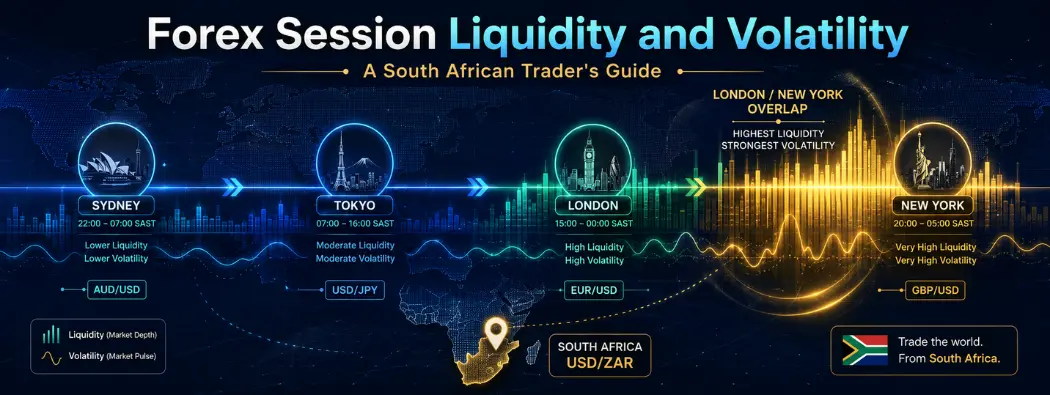
Knowing the names of forex sessions is not enough. A trader still needs to know whether market conditions are liquid, volatile, stable, or risky. EUR/USD, GBP/USD, USD/JPY, AUD/USD, NZD/USD, and USD/ZAR can behave very differently as global market activity shifts from Sydney and Tokyo to London and New York.
For traders in South Africa, session quality matters because local trading decisions often depend on global liquidity, offshore rand flows, dollar strength, and major news events. Market behaviour during forex sessions is not always consistent, and historical patterns may not repeat under future market conditions.
A quiet session may suit patient range traders, while an active session may appeal to traders monitoring stronger price movement. Yet higher volatility does not always lead to better results. It can also mean wider spreads, slippage, false breakouts, and faster losses.
In this guide, we compare session quality across Sydney, Tokyo, London, New York, and the London/New York overlap, helping South African traders understand when market conditions may support clearer market structure and when extra caution may be needed.
Key Takeaways
- A session only matters when the pair, risk plan, and market condition align. Liquidity affects spreads and order quality, while volatility affects movement and risk. The main message is: session quality matters more than session labels.
- Liquidity improves when banks, funds, brokers, institutions, and active trading hubs add depth to the market. Higher liquidity may support tighter spreads, but news, holidays, market stress, and broker conditions can still widen spreads.
- Volatility rises when new information changes market views. Economic data, central bank news, market opens, risk sentiment, US dollar movement, and overlap activity can all increase price movement. News-driven volatility is often sharper than normal session movement.
- Each session has a different market profile. Sydney is thinner, Tokyo is more pair-specific, London has high participation, and New York is heavily shaped by USD activity. The table makes this section easy to scan.

Why Liquidity and Volatility Matter More than Trading Sessions
Sessions can guide traders, but they do not guarantee good trading conditions. A session is only useful when market conditions fit the currency pair, trading style, and risk plan. For example, the London session may offer strong activity on EUR/USD and GBP/USD, while the Tokyo session may suit USD/JPY better. USD/ZAR may also react more during periods of strong dollar flow, global risk shifts, or offshore rand activity.
Liquidity means market depth, strong participation, and the ease of matching buy and sell orders. When liquidity is high, orders are usually filled faster, and spreads may be tighter. Volatility refers to the size and speed of price movement. A volatile pair can move far within a short time, creating both stronger price movement and higher risk.
| Factor | What It Means | Why It Matters |
| Liquidity | Market depth, active buyers and sellers, easy trade matching | Can support tighter spreads and smoother order fills |
| Volatility | How fast and how far the price moves | Can create larger price movement, but also faster losses |
| Low liquidity | Fewer active participants | May lead to wider spreads and slippage |
| High Volatility | Strong price movement | May cause false breakouts and stop-loss spikes |
South African traders should not trade a session just because it is popular. The better approach is to ask whether the pair has enough liquidity, whether volatility suits the setup, and whether the stop-loss can handle the market speed.
What makes a forex session more liquid?
A forex session becomes more liquid when many market participants are active, especially banks, dealers, funds, brokers, and other institutions. Their orders add depth to the market and make it easier for buy and sell orders to match. The FX Global Code describes the forex market as a market supported by a “diverse set of Market Participants” who transact at prices that reflect market information.
Market depth refers to the number of orders available at different price levels. A deeper market can absorb larger orders with less price disruption. Quote stability also tends to improve when liquidity is strong. Bid and ask prices may still change, but they are less likely to shift sharply under normal market conditions.
Major trading hubs play an important role in forex liquidity. London, New York, Tokyo, Sydney, and Singapore all support global currency trading. Their influence varies by session and currency pair. London and New York often see high trading volume because many global banks and institutions are active during those hours.
Session overlaps can also increase liquidity. During an overlap, two major financial centres are active simultaneously. The London/New York overlap is one of the best-known examples, as it combines European and US market activity.
Higher liquidity may support tighter spreads, but spreads are not always low. Major news, public holidays, thin trading periods, market stress, and broker execution conditions can still cause spreads to widen.
Liquidity often differs by currency pair. EUR/USD, USD/JPY, and GBP/USD are heavily traded in major FX centres such as London. AUD/USD and NZD/USD may see more activity when Australian, New Zealand, and Asian markets are active. USD/ZAR may become more active when London flows, dollar strength, South African data, or global risk sentiment affect demand for the rand.
What Makes a Forex Session More Volatile?
A forex session is more volatile when prices move quickly and cover wider ranges within a short period. Volatility usually increases when new information changes expectations about interest rates, inflation, economic growth, or global risk.
Economic data is a common source of FX volatility. Inflation reports, employment numbers, GDP releases, retail sales, and trade figures can affect demand for a currency. Central bank news can have an even stronger effect, especially when rate decisions, policy statements, or official speeches differ from market expectations.
Market openings can also increase price movement. As London or New York begins trading, banks, funds, and other large institutions may adjust open positions. Orders that built up during quieter hours can enter the market together, which may lead to sharper moves.
Risk sentiment plays an important role in currency markets. During stable periods, traders may show greater demand for higher-yielding or emerging-market currencies. During uncertain periods, demand may shift toward currencies seen as more liquid or defensive.
The US dollar movement is another major factor. Many currency pairs include the dollar, so broad dollar strength or weakness can affect both major and emerging market pairs.
Overlap periods may also raise volatility. The London/New York overlap often brings activity from two major financial centres at once. Normal session volatility comes from regular trading flow, while news-driven volatility tends to be faster and less stable. Higher volatility can create more movement but also increase the risk of slippage, wider spreads, sharp reversals, and larger losses.
How Sydney, Tokyo, London, and New York Differ by Market Conditions
City names often describe forex sessions, but each session reflects a different mix of liquidity, participation, and currency focus. Market conditions change as banks, institutions, corporate desks, and regional trading centres become active across the day.
| Forex pair | Session Behavior | Main Market Drivers |
| EUR/USD | Often more liquid during London and the London/New York overlap | Eurozone data, US dollar strength, ECB and Fed policy, risk sentiment |
| GBP/USD | Often more active during London, with stronger moves around UK and US news | UK data, Bank of England policy, US data, dollar movement |
| USD/JPY | Can be active during Tokyo and New York sessions | Japanese market flows, US yields, Bank of Japan policy, dollar strength |
| AUD/USD | May receive more attention during Sydney, Tokyo, and Asian trading | Australian data, China-linked sentiment, commodity demand, and US dollar movement |
| NZD/USD | Often more relevant during Asia-Pacific hours, then reacts again during US activity | New Zealand data, risk sentiment, commodity-linked flows, US dollar strength |
| EUR/GBP | Often more active during London trading | Eurozone and UK data, ECB and BoE expectations, European market flows |
| JPY crosses | May move more during Tokyo and risk-sensitive periods | Japanese yen demand, risk sentiment, carry trade flows, Asian market activity |
| USD/ZAR | Can become more active during the London and New York activity | South African events, offshore rand flows, US dollar movement, liquidity conditions |
Forex Session Liquidity and Volatility Checklist
Forex session quality can be assessed by examining several market signals together. The table below gives a clear framework for comparing liquidity, volatility, and risk conditions across different pairs and sessions.
Forex Session Liquidity and Volatility Table
| Checklist Area | Market Condition to Review |
| Currency pair | Whether the pair is linked to the region currently active in the market |
| Active region | Whether Tokyo, London, New York, or Sydney, activity is shaping price flow |
| Spread behaviour | Know if bid and ask prices look stable, narrow, or unusually wide |
| Scheduled news | Know if economic data or central bank updates may affect the movement |
| Liquidity quality | Whether price action appears smooth, deep, or jumpy |
| Leverage exposure | Whether faster movement could increase the size of gains or losses |
| Demo review | How the same pair has behaved under similar session conditions before |
A checklist format keeps the focus on real market conditions rather than session names alone.
Frequently Asked Questions
Which forex session has the most liquidity?
The London session is often associated with stronger liquidity, especially for major pairs. Liquidity often improves further during the London/New York overlap.
Which forex session is most volatile?
The London/New York overlap is often considered one of the more volatile periods. US data, dollar flows, and European market activity can combine during this window.
Is the London/New York overlap the most active period?
Yes, it is widely considered one of the most active forex periods. Two major financial centres are open simultaneously.
Is high volatility good for forex CFD trading?
High volatility can lead to larger price swings, but it also raises risk. It can lead to slippage, wider spreads, and sharp reversals.
Why do spreads change across forex sessions?
Spreads change because liquidity, market depth, and trading volume vary by session. Spreads may widen during quiet periods, news events, or market stress.
Which session affects EUR/USD the most?
EUR/USD is often most active during London and the London/New York overlap. Data from the eurozone and the US can both affect the pair.
Which session affects USD/JPY the most?
USD/JPY is often active during Tokyo and New York sessions. Japanese flows, US yields, and dollar movement are key drivers.
Which session affects AUD/USD and NZD/USD the most?
AUD/USD and NZD/USD often receive more attention during Sydney, Tokyo, and wider Asian trading. They may also react during New York when the US dollar moves.
Does USD/ZAR move more during certain sessions?
Yes, USD/ZAR may become more active during London and New York. Rand liquidity, US dollar movement, South African events, and global risk sentiment all matter.
Should beginners participate in forex CFD trading during periods of high volatility?
High-volatility sessions can be harder for beginners. Faster price movement may increase emotional pressure and execution risk.
Risk Warning: CFDs are complex financial instruments and carry a high risk of rapid loss of money due to leverage. You should ensure you fully understand the risks involved and carefully consider whether you can afford to take the high risk of losing your money before trading.
Disclaimer: The information is provided for educational purposes only and doesn’t take into account your personal objectives, financial circumstances, or needs. It does not constitute investment advice. We encourage you to seek independent advice if necessary. No representation or warranty is given as to the accuracy or completeness of any information contained within. This material may contain historical or past performance figures and should not be relied on.
Furthermore, estimates, forward-looking statements, and forecasts cannot be guaranteed. The information on this site and the products and services offered are not intended for distribution to any person in any country or jurisdiction where such distribution or use would be contrary to local law or regulation.
References
- https://www.federalreserve.gov/pubs/ifdp/2009/973/ifdp973.htmSemi-Annual FX Turnover Surveys in April 2025 – https://www.bankofengland.co.uk/markets/london-foreign-exchange-joint-standing-committee/results-of-the-semi-annual-fx-turnover-survey-april-2025
- 2025 Foreign Exchange Turnover Report – https://afxc.rba.gov.au/statistics/fx-turnover-reports/2025/apr-2025/list-of-tables.html?
- The Impact of Macroeconomic Announcements on Real Time Foreign Exchange Rates in Emerging Markets – https://www.federalreserve.gov/pubs/ifdp/2009/973/ifdp973.htm
- OTC foreign exchange turnover – https://www.bis.org/statistics/rpfx25_fx.htm
- Semi-Annual Report on Foreign Exchange Turnover – https://afxc.rba.gov.au/statistics/fx-turnover-reports/2025/apr-2025/apr-2025.html
- The Forex 3-Session Trading System – https://www.investopedia.com/articles/forex/08/3-market-system.asp
- Gold and the U.S. Dollar – https://www.cmegroup.com/openmarkets/metals/2025/Gold-and-the-US-Dollar-An-Evolving-Relationship.html