
 Updated
For many traders in South Africa, the journey to consistency often begins with a simple yet critical question: What is the best time to trade Forex in South Africa?
After nearly two decades of trading across global markets, I’ve learned that success isn’t just about indicators or strategies; it’s about determining the ideal time to enter and exit trades.
Before you plan your schedule, read How Forex Trading Tax is Calculated in South Africa.
Here’s a quick summary of what we’ll cover:
- Best overall time: 3:00 PM – 6:00 PM SAST (London–New York overlap).
- Good Window: 10:00 AM – 1:00 PM SAST (London open momentum).
- Quiet Window: 8:00 PM – 2:00 AM SAST (lower activity, wider spreads often).
- Tip: Trade major news releases only with a clear plan in place.
As a seasoned trader myself, I’ve observed unique patterns of the Forex market from a South African perspective, how different sessions behave in SAST, when trading volume typically peaks, and how session timing aligns with certain trading styles.
This article draws from those observations. We’ll explore session overlaps, currency pair behaviour, and local conditions that influence trading windows.
The best time to trade forex in South Africa is between 15:00 and 18:00 SAST, during the London–New York session overlap. This window offers the highest liquidity, tightest spreads, and most significant price moves of the trading day.
The best days to trade are Tuesday, Wednesday, and Thursday, when institutional activity peaks and most major economic data releases occur. Avoid trading on Friday after 18:00 SAST and during the Sunday market open, when liquidity is thin and spreads widen.
You can explore using the Vantage Demo Account. Or grab your Free Vantage Live account to test with real market conditions on the Vantage Markets trading platform, especially on volatile pairs like GBP/USD or EUR/USD.
When does the Forex Market Open in South Africa?
The forex market opens for the week in South Africa on Sunday at 00:00 SAST and closes on Friday at 24:00 SAST. It trades 24 hours a day. There is no central exchange, so the week opens with the Sydney session and ends when New York closes.
Forex runs around the clock because trading moves among four financial centres, not in a single building with set hours. As one centre closes, the next opens. For a trader in South Africa, the useful question is which session is live at a given hour in SAST. The table below converts the four sessions to local time.
Here are the times when each session opens and closes in South African Standard Time.
| Session | Opens (SAST) | Closes (SAST) |
|---|---|---|
| Sydney | 00:00 | 08:00 |
| Tokyo | 02:00 | 11:00 |
| London | 09:00 | 17:00 |
| New York | 14:00 | 22:00 |
The market opens on Sunday at 00:00 SAST and closes on Friday at 24:00 SAST, with no daily open or close in between.
One detail sits behind the 24-hour figure. Trading pauses for a few minutes each day around midnight SAST, at the New York rollover, and spreads can widen during it. Any position held through that point carries an overnight swap, charged or paid depending on the pair and direction.
To see which session is open right now, check the forex market hours clock.
What time does the Forex Market open on Sunday?
The forex market reopens on Sunday at 00:00 SAST, when the Sydney session starts the new trading week. The first hours tend to be quiet, with thinner liquidity and wider spreads than the London or New York sessions. Prices can also gap at the open if news moved markets over the weekend, so that the first move may jump away from Friday’s close.

Trading sessions in UTC and SAST time
| Session | Open(UTC) | Open(SAST) | Key Features |
| Sydney | 10:00 AM | 12:00 AM | Lower volume, slow movement |
| Tokyo | 12:00 AM | 2:00 AM | Active JPY pairs, range moves |
| London | 8:00 AM | 10:00 AM | High liquidity, market trends |
| New York | 1:00 PM | 15:00 PM | Major U.S. news release |
During these hours, market behaviour varies. For instance, the London session often brings the highest volume, particularly when it overlaps with the New York session. On the other hand, the early hours of the Sydney and Tokyo sessions tend to be calmer, especially in terms of volume.
This time-based structure not only helps observe price movements but also highlights how time zone differences affect trading conditions in South Africa.
When viewed through the lens of SAST, these sessions reveal a pattern of when the market tends to become more active and when it tends to slow down. Recognising these fluctuations can support better observation of potential price movements across different pairs.
In the next section, we’ll explore how these session times align with local trading windows and what they mean for South African traders following the global Forex rhythm.
Best Time to Trade Forex in South Africa (Full SAST Breakdown)
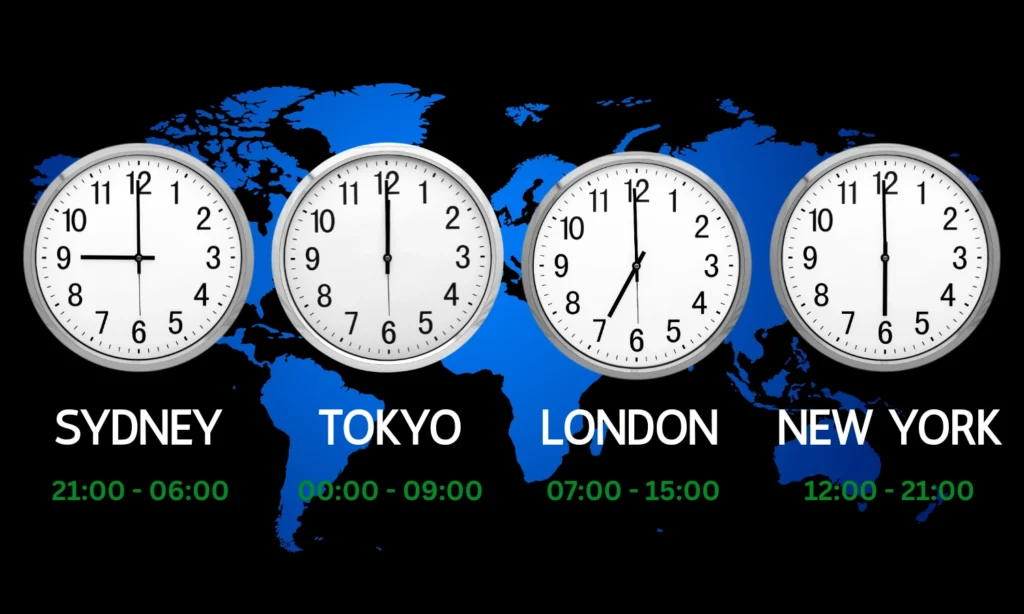
The best time to trade Forex in South Africa is to align with the market’s daily rhythm, which is SAST. Activity usually peaks when London and New York overlap and around major economic releases. The market is open most of the day, but not all hours are equal. Use the SAST breakdown below as a guide; conditions shift in response to news, liquidity, and geopolitical developments.
To capitalise on these overlapping hours, many traders also utilise gold signals in South Africa.
12:00 AM – 8:00 AM SAST (Sydney and Tokyo Sessions)
This part of the trading day is the least active for many major pairs. The Sydney session begins around midnight, followed closely by Tokyo at 2:00 AM. During these hours, market volatility tends to be low, especially for non-JPY pairs.
Traders often use this Window to monitor Asian news, review economic calendars, or analyse price ranges. During this period, currency pairs such as USD/JPY, AUD/JPY, and NZD/JPY often show increased market activity, though wider spreads and range-bound price action are typical.
10:00 AM – 1:00 PM SAST (London Session Opens)
The London Session is typically one of the busiest periods of the day. The London session opens at 10:00 AM SAST, and liquidity across major pairs increases. Market volume expands significantly, and price movements become more pronounced.
European currencies such as EUR/USD and GBP/USD often respond to regional data releases during this Window. This session may also mark a key point at which daily trends begin to emerge. During this period, South African traders watching the charts often observe the highest level of institutional market participation.
3:00 PM – 6:00 PM SAST (London–New York Overlap)
This session is often considered the most active period of the day in Forex. Both the London and New York sessions are currently live, resulting in increased liquidity and sharper price movements. Major U.S. economic data releases typically occur during this overlap, which can lead to rapid changes in market sentiment.
Pairs such as EUR/USD, GBP/USD, and USD/JPY tend to exhibit strong trends or sudden reversals in this Window. While these hours bring greater volatility, they may also carry higher risk. Volume usually peaks during this block.
6:00 PM – 8:00 PM SAST (Late New York Session)
Market activity gradually slows after 6:00 PM. Liquidity drops as the London session closes, and New York traders begin to reduce positions before the end of their trading day. While some price moves may still occur, they are usually less consistent. Spread widening may be noticeable across certain pairs. At this point, most institutional volume has already passed through the market.
8:00 PM – 12:00 AM SAST (Pre-Sydney Window)
The pre-Sydney Window is generally a thin period in the Forex market. Volatility is low, spreads may widen further, and price movement is often slow. It falls between the close of the New York session and the opening of the Sydney session, creating a “dead zone” for activity. South African traders who monitor the charts during this period often notice that patterns become less reliable and that volume is too light for most structured setups.
Best Days to Trade Forex in South Africa (Tuesday to Thursday)
For many traders, the cleanest forex moves tend to occur mid-week. Tuesday through Thursday often deliver steadier volume and clearer direction.
Early in the week, the market is still finding balance. Large players adjust positions after the weekend. By Tuesday, order flow improves. Price starts to move with intent.
Wednesday usually brings the best balance. Liquidity is deep. Trends either confirm or fail with clarity.
Thursday often extends existing moves. If a trend is real, this is where it shows strength. If it weakens, exits become obvious. Still, the weekday itself does not create an opportunity. Participation does. Strong involvement from London and New York matters far more than the calendar day.
When these markets are active, prices better reflect the structure. Mid-week simply aligns more often with full participation.
Key Points to Note
- Tuesday –Thursday are the strongest days: markets have settled from the Monday open, institutional activity is at its peak, and most high-impact economic data releases (US CPI, NFP, SARB decisions) fall midweek
- Monday is slow: liquidity is building, trends aren’t established yet, spreads can be wider at the open
- Friday afternoon is a trap: from around 18:00 SAST onward, traders close positions ahead of the weekend, liquidity drops, and price moves become less reliable
- Sunday open: the market reopens, but with very thin participation; avoid trading the first hour
How Tuesday to Thursday Usually Behave
| Day | Market feel | Best for | Watch-outs |
| Tuesday | Growing momentum | Early trend setups | Leftover Monday ranges |
| Wednesday | High liquidity | Trend follow-through | News-driven spikes |
| Thursday | Directional | Holding winning trades | Late session reversals |
Overview of Best Time To Trade Forex in South Africa (SAST Heatmap Style)
| Time (SAST) | Session(s) | Market Behavior |
| 12:00 AM – 2:00 AM | Sydney | Thin market, early range setups |
| 2:00 AM – 8:00 AM | Tokyo | JPY activity, slower price moves |
| 3:00 PM – 6:00 PM | London/New York Overlap | Peak volume, data-driven volatility |
| 6:00 PM – 8:00 PM | Late New York | Market fades, reduced momentum |
| 8:00 PM -12:00 AM | Low activity window | Thin liquidity, wider spreads |
Each of these time blocks reflects how the Forex market behaves in South Africa’s local time. While sessions can overlap and volume may fluctuate from day to day, these general patterns have remained consistent across years of observation. In the next section, we’ll explore how different trading strategies tend to align with each of these global sessions.
Which Session Fits Which Strategy?
Note: For educational purposes only, this section outlines how some trading styles are commonly associated with different time windows. It is not intended as a recommendation.
The best time to trade Forex in South Africa often depends on your daily routine and the kind of strategy you use. While the market stays open most of the day, not all hours support the same level of price activity, spread stability, or trade setups.
Over the years, I’ve observed that the timing of a session can significantly affect the overall character of a trade, even when the technical setup appears right. Understanding how specific sessions align with different approaches may help traders refine their timing within their chosen framework.
For South African forex traders, understanding the rhythm of each session is key. Some sessions are fast-paced, others calmer. This analysis, from an 18-year veteran, demonstrates how three strategies, swing trading, fundamental analysis, and part-time observation, align with key Forex sessions in SAST.
Swing Trading (Multi-Hour or Multi-Day Setups)
Swing traders prefer clear trends, wide ranges, and structured entries. These conditions typically emerge between 10:00 AM and 6:00 PM SAST, as the London session leads into the New York session.
I’ve observed that USD/ZAR and EUR/USD can set early direction during London hours and then follow through or reverse after U.S. data releases in the afternoon.
➡️ Mini-scenario: “If you work from home and check charts a few times daily, swing trading during the London session could align well with your midday break.”
These hours often reveal support/resistance breaks or continuation moves that span several sessions, making them suitable for traders who want to avoid rapid entries and exits.
News and Event-Based Trades (Fundamental Reactions)
Some traders structure their setups around high-impact news events, such as interest rate announcements or job reports. These usually happen during the New York session, from 3:00 PM to 4:30 PM SAST. This period often sees sharp moves in USD-based pairs, including USD/ZAR, USD/JPY, and USD/CAD. Volatility tends to spike within minutes of data releases.
➡️ Mini-scenario: “If you follow economic updates closely and trade around events, watching the market between 3 PM and 5 PM may align with your focus window.”
While this approach involves sharp price changes, it’s essential to monitor risk tools during this period, as spreads may widen and slippage can occur.
Side Hustle or Evening Market View
Not all traders are available during core hours. For many in South Africa who have 9–5 jobs, 6:00 PM to 8:00 PM SAST may be the most accessible time to engage with the market. During this period, the tail end of the New York session can still yield movement, especially in pairs such as GBP/JPY and EUR/JPY, which often remain active after London closes.
➡️ Mini-scenario: “If you get home from work by 6 PM, the market still has some momentum before tapering off.”
However, by 8:00 PM, liquidity generally drops, and the market enters a slower phase, leading into the Sydney session.
Session Matching Summary Table (SAST)
| Strategy type | Preferred SAST Window | Typical Market Behaviour |
| Swing trading | 10 AM – 6 PM | Clear trend development |
| News/Event Trading | 3 PM – 4:30 PM | Sharp moves, economic data reactions |
| Evening/Side Hustle View | 6 PM – 8 PM | Slower but tradable market for some pairs |
While trading strategies can vary, aligning session timing with your personal schedule and market observations can help you plan trades more systematically. Up next, we’ll examine session overlaps—the windows where liquidity peaks and market behaviour becomes more dynamic.
You can explore using the Vantage Demo Account. Or grab your Free Vantage Live account to test with real market conditions on the Vantage Markets trading platform, especially on volatile pairs like GBP/USD or EUR/USD.
Overlap Zones: Volatility Windows That Change the Game
The best time to trade Forex in South Africa often coincides with session overlaps, when two major markets are open simultaneously, providing optimal trading conditions. These windows usually bring higher volume, tighter spreads, and more decisive moves. Alongside timing and liquidity, it is essential to understand how forex trading is taxed in South Africa.
For SAST, the key overlap is between London and New York, typically from 2:00–5:00 PM (March–October) and 3:00–6:00 PM (November–March). Activity jumps because European and U.S. desks trade simultaneously, and major U.S. data often lands in this Window.
From my 18 years of trading, I’ve seen EUR/USD move ~90 pips in 40 minutes on a U.S. jobs release during this overlap, illustrating the pace, not a guarantee.
Overlap sessions in SAST time
Bottom line: Overlaps concentrate liquidity and can sharpen price movements, although behaviour varies by pair and event.
| Overlap period | Sessions Involved | SAST | Typical Behaviour |
| Tokyo/London | Asia & Europe | 9:00 AM – 10:00 AM | Gradual build-up in momentum |
| London/New York | Europe & U.S. | 8:00 PM – 6:00 PM | Highest volume of volatility |
| Sidney/Tokyo | Australia & Asia | 2:00 AM – 5:00 AM | Low volume, mostly JPY or AUD movement |
Pair behaviour also shifts with overlap. For instance, USD/ZAR, EUR/USD, and GBP/USD tend to move more during the London/New York overlap, driven by increased news flow and global trading volume. In contrast, AUD/JPY or NZD/JPY may find a more rhythmic pattern during the Sydney/Tokyo overlap, although volume is generally lighter.
Each overlap tells its own story. These windows don’t just increase volume; they often compress time, meaning significant price movement can occur over a short span. This volatility, although not guaranteed, is one reason overlap zones are closely monitored by traders worldwide.
As we move forward, we will shift focus to pair-specific timing, particularly the behaviour of USD/ZAR, one of the most closely monitored pairs in South Africa.
What 18 Years of Trading Taught Me About the Best Time to Trade Forex in South Africa (USD/ZAR overview)
Forex trading sessions in South Africa often align with the USD/ZAR‘s busiest trading windows. The pair typically moves most cleanly during the London session (10:00–1:00 SAST) and into the London–New York overlap (3:00–6:00 SAST), when European and U.S. desks are active and primary U.S. data releases occur.
By contrast, the Asian session (2:00–8:00 SAST) is usually quieter for the rand, with fewer participants, wider spreads, and more range-bound action, unless local news breaks. Timing isn’t guaranteed, but monitoring these windows can help you track momentum and manage costs effectively.
Here’s a table that illustrates how USD/ZAR spreads tend to behave across sessions:
| Session(SAST) | Typical Spred(pips) | Market Behaviour |
| Sydney/Tokyo (2 AM–8 AM) | 40 – 60 | Wider spreads, low liquidity |
| London (10 AM–1 PM) | 18- 25 | Higher spreads, more consistent flow |
| London/NY (3 PM–6 PM) | 20 – 30 | Higher volume, sharper movements |
| Late NY (6 PM–8 PM) | 30 – 50 | Spread widens again, volume slows down |
Compared to other major pairs, such as EUR/USD or GBP/USD, USD/ZAR can be more sensitive to local risk factors. Interest rate announcements from the South African Reserve Bank, inflation updates, or geopolitical developments can all quickly shift its trajectory.
But during global session overlaps, the influence of broader market sentiment becomes more visible. This often leads to increased alignment with global trends, especially when the U.S. dollar responds to economic data.
How Conditions Affect the Best Time To Trade in South Africa
Even with a strong understanding of global session flows, local realities can significantly affect the trading experience in South Africa. Many traders focus on the optimal time to trade Forex in South Africa from technical or global perspectives. However, factors within the country, such as electricity supply, mobile connectivity, and national events, also influence the timing and accessibility of the local forex market.
One key driver of local market behaviour is the South African Reserve Bank (SARB). Scheduled monetary policy meetings and interest rate decisions often trigger sharp movements in ZAR-based currency pairs, such as USD/ZAR and EUR/ZAR. These events are usually announced in advance and typically align with the London session, which runs from 10:00 AM to 1:00 PM SAST. During these windows, spreads can widen slightly in anticipation of the announcement, and sudden spikes may follow immediately after.
Load-Shedding
Another important consideration is load-shedding. Power outages, especially during peak hours, can disrupt internet connectivity and delay order execution. This is particularly risky during high-volatility periods, such as the London/New York overlap (3 PM–6 PM SAST).
Limited Internet Access
Traders relying on desktop or fibre-based internet access may experience interruptions. In response, some opt to keep a mobile backup or trading app active during these periods. Mobile data networks can sometimes provide more reliable connectivity when power is limited.
Public Holidays
Public holidays in South Africa present another nuance. Although the country may experience a break, the global foreign exchange market remains active. This mismatch can reduce local trading participation, but price movement continues, especially if the day falls during an active global session. Being aware of this disconnect is useful when interpreting reduced market volume or slower pair reactions during local holidays.
Daylight Saving Time (DST)
Time zone shifts in London and New York due to Daylight Saving Time (DST) also impact session alignment with South African time. For a few weeks each year, the session overlaps and opening hours shift slightly.
This DST can create confusion around timing unless session clocks are adjusted. Most trading platforms or economic calendars update automatically, but double-checking the session alignment in SAST can help avoid missed moves.
In short, while global sessions guide market structure, local economic events in South Africa, energy supply, and timing inconsistencies can affect how traders interact with the market.
Up next, we’ll highlight a few essential tools and platforms to help you navigate these variables and keep timing aligned throughout the week.

Session Timing Tools I Use Every Day
Knowing the best time to trade Forex in South Africa involves more than understanding the market sessions. Keeping track of session timing in real time, especially with global overlaps and daylight saving time changes, requires reliable tools. Over the years, I’ve used several platforms to view the market in South African Standard Time (SAST). These tools help reduce confusion, particularly when trading across different zones.
TradingView
TradingView is one of the most popular platforms for chart analysis, but its session overlays are just as valuable. With a single glance, I can see which global sessions are active, when they’ll close, and how current price movements align with those windows. These overlays adjust for SAST, making it easier to track without manual conversion. The platform also allows custom time zone settings, which are useful during DST transitions in London or New York.
Forex Factory
Forex Factory is another useful tool, particularly for tracking economic news. It includes a built-in time zone converter, so every event on the calendar is displayed in the local time zone. This is especially helpful during periods when SARB meetings, U.S. job reports, or Eurozone data releases are expected. Knowing the exact release time in SAST ensures better alignment with market expectations.
MyFxBook
MyFxBook offers a volatility-by-time feature that displays average hourly movement across different currency pairs. It’s one of the fastest ways to identify when pairs such as USD/ZAR, EUR/USD, or GBP/USD are most active. This is helpful when analysing potential trade windows based on recent behaviour.
MT4/MT5
For MT4 or MT5 users, several indicators let traders view session zones directly on the chart. These can be set to show the Tokyo, London, and New York sessions visually. While not all brokers align perfectly with SAST, adjusting chart settings or confirming the broker’s server time can help reduce time zone mismatches.
Tracking global time while trading from South Africa can get tricky, especially with DST shifts or session overlaps. These tools provide local alignment, offering clarity on session timing and potential market activity.
In the next section, we’ll discuss common timing errors that often affect novice traders and how greater awareness can improve timing decisions over time.
How to Choose the Best Time To Trade Forex in South Africa
Even after understanding the best time to trade Forex in South Africa, some traders still face challenges, not because of the market, but due to their own timing habits. A few common errors recur, particularly among those still adjusting to the rhythm of different sessions. Most of these mistakes are attributable to psychological factors, planning errors, or misalignment with market behaviour.
Emotional Loss
One of the most overlooked mistakes is trading after an emotional loss. This often leads to jumping into the next available session, regardless of whether it fits the pair being observed. For example, entering a trade out of frustration during a quiet market, such as the early Sydney session, can lead to unpredictable price movements or wider spreads. The timing may not support recovery, and the pressure to “get even” can cloud judgment.
Overleveraging
Another common issue is overleveraging during periods of low volatility. When price action is slow, some traders try to “force” results by increasing lot sizes or taking more trades. This usually occurs during mid-session lulls, such as 9:00–10:00 AM or 6:00–8:00 PM SAST. While the market may still fluctuate, the reduced volume during these hours often leads to false breaks or stalled trends. Trading during quiet times requires extra caution, as the reward may not match the risk.
Ignoring Pair Behaviour
There’s also the mistake of ignoring pair behaviour across sessions. Some pairs, such as USD/ZAR, exhibit different behaviour during London and Tokyo hours. Treating every time window the same way can lead to confusion. Knowing when your chosen pairs are most active can support more consistent decision-making.
Next, we’ll explore a few frequently asked questions about Forex session timing from a South African perspective, clarifying common concerns about overlapping hours, pair behaviour, and timing strategies.
FAQs: Best Forex Session Timing Questions Answered
What time does the forex market open in South Africa?
The forex market opens on Sunday at 00:00 SAST and trades until Friday at 24:00 SAST. It runs 24 hours a day across the Sydney, Tokyo, London and New York sessions, with no daily open or close in between.
What time does the forex market open on Sunday?
It opens on Sunday at 00:00 SAST, when the Sydney session begins. Liquidity is usually thin in the first hours, and prices can gap if news breaks over the weekend.
What time do forex markets open in South Africa?
The four sessions open at different SAST hours: Sydney at 00:00, Tokyo at 02:00, London at 09:00 and New York at 14:00. Each runs for several hours before handing over to the next.
What time is the London trading session in South Africa?
The London session runs from 10:00 AM to 7:00 PM SAST. This is one of the most active periods in the Forex market and partially overlaps with the Tokyo and New York sessions. It also coincides with most European economic news releases.
What time does the New York session open in South Africa?
The New York session opens at 3:00 PM SAST and continues until around 11:00 PM SAST. Activity usually peaks between 3:00 PM and 6:00 PM, especially when primary U.S. data is released. After 6:00 PM, momentum starts to fade as U.S. traders close positions.
Should I trade Forex at night in South Africa?
The Forex market is open at night, but volume is typically lower between 8:00 PM and 2:00 AM SAST. This period includes the New York market close and the early stages of the Sydney session. Some pairs may show limited movement, and spreads may widen.
When is the USD/ZAR pair most active for trading?
USD/ZAR tends to move most during the London session (10:00 AM – 1:00 PM) and the London/New York overlap (3:00 PM – 6:00 PM SAST). These periods often bring higher volume and better execution conditions, especially when paired with news or rate decisions.
These timing questions often arise, especially for traders balancing other daily responsibilities. As we wrap up, I’ll leave you with a few thoughts on how session awareness fits into long-term consistency, based on years of market observation.
Note: Vantage offers forex trading exclusively through Contracts for Difference (CFDs). This article is for educational purposes only and reflects the personal views of the author.
RISK WARNING: CFDs are complex financial instruments and carry a high risk of rapid capital loss due to leverage. You should ensure you fully understand the risks involved and carefully consider whether you can afford to take the high risk of losing your money before trading.
Disclaimer: The information is provided for educational purposes only and doesn’t take into account your objectives, financial circumstances, or needs. It does not constitute investment advice. The views expressed are those of the author and do not necessarily reflect the opinions of Vantage.
We encourage you to seek independent advice if necessary. The information has not been prepared in accordance with legal requirements designed to promote the independence of investment research.
No representation or warranty is given as to the accuracy or completeness of any information contained within. This material may include historical or past performance figures and should not be relied on. Furthermore, estimates, forward-looking statements, and forecasts cannot be guaranteed.
The information on this site and the products and services offered are not intended for distribution to any person in any country or jurisdiction where such distribution or use would be contrary to local law or regulation.
Reference
- Session Tools and Custom Time Zone Overlays – TradingView. https://www.tradingview.com. Accessed 14 July 2025
- Economic Calendar” – Forex Factory. https://www.forexfactory.com/calendar
Accessed 15 July 2025
- “Forex Volatility Statistics” – MyFxBook. https://www.myfxbook.com/forex-market/volatility
Accessed 15 July 2025 - “Most Popular Forex Trading Platform” – Meta Trader 4 https://www.metatrader4.com/en
Accessed 18 July 2025 - “The Best Forex Trading Hours” – Investopedia. https://www.investopedia.com/articles/forex/06/forexhours.asp
Accessed 18 July 2025 - “The Forex Trading Sessions” – Babypips https://www.babypips.com/learn/forex/forex-trading-sessions
Accessed 19 July 2025 - “Forex Trading Lessons” – FXStreet Education https://www.fxstreet.com/education Accessed 19 July 2025