


[DAILY TRADING] EURUSD Analysis 27 July 2026 – The Calm Before Wednesday’s Fed Storm

Vantage Editorial Team >
Vantage Editorial Team >
Vantage is a global, multi-asset broker with a team of in-house writers and market analysts who produce educational and insightful trading content for traders of all levels.
 Updated Mon, 2026 July 27 04:13
![[DAILY TRADING] EURUSD Analysis 27 July 2026 – The Calm Before Wednesday’s Fed Storm](https://www.vantagemarkets.com/wp-content/uploads/2026/06/EURUSD_hero_8Jun2026.webp)
EUR/USD spent the past week doing the one thing traders find hardest to sit through: going nowhere with conviction. The Vantage EURUSD CFD traded at 1.14054 as of 03:07 UTC (11:07 GMT+8) on 27 July 2026, based on the TradingView setup used for this analysis, and that quiet print is a little deceptive. This pair has already digested one central bank decision this month and is bracing for another, with the Fed’s own call landing Wednesday, 29 July 2026.
What the EURUSD chart is actually showing
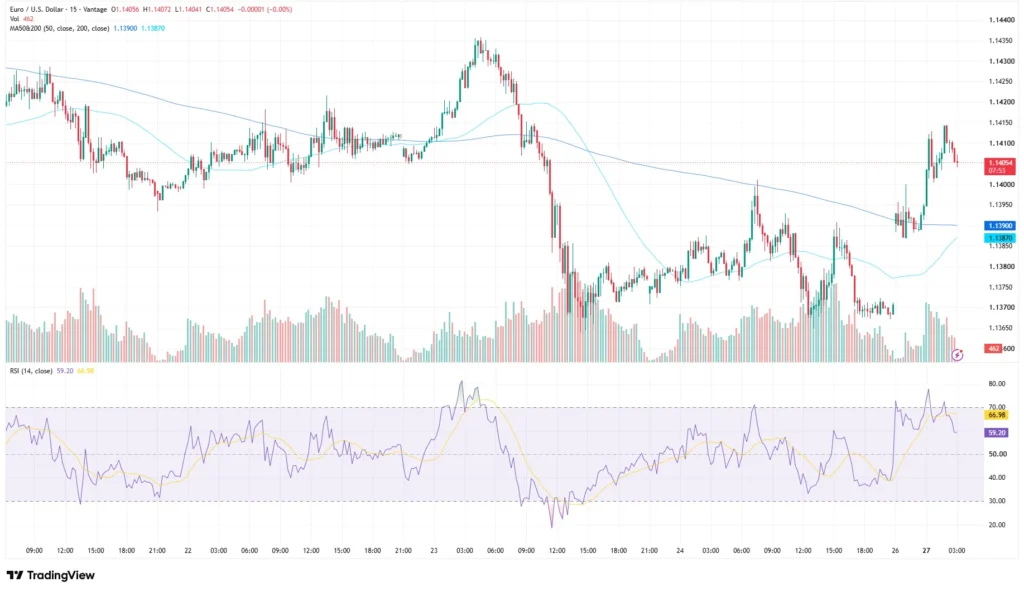
On the 15-minute chart, and in the kind of EUR/USD technical analysis this pair rewards this week, price opened near 1.1424 on 21 July 2026, drifted into a 1.1370 to 1.1400 band through Tuesday and Wednesday, then spiked hard into Thursday, 23 July 2026, touching 1.1430, only to hand almost all of it back the same day and slide to 1.1365. The move coincided with the ECB’s rate decision and subsequent press conference, with the euro’s initial rise reversing sharply later in the session.
From there, EUR/USD chopped inside 1.1365 to 1.1400 through Friday, then found its feet again from Sunday’s open, climbing toward 1.1415 before easing to the current 1.14054 print. The 50- and 200-period moving averages, at 1.13900 and 1.13870 respectively, now form a nearby support cluster beneath the current price.
RSI (14) reads 59.20, while its RSI-based moving average stands at 66.98. It dipped toward oversold during Thursday’s reversal and has since climbed back into the upper half of its range without reaching overbought, which is the chart’s way of saying: recovered, not roaring.
The real EURUSD news this week: Fed, ECB and a Middle East wildcard

Start with the ECB, since it moved first. It held all three of its key interest rates on 23 July 2026, following June’s hike in the deposit rate to 2.25% from 2.00%.[1] The statement flagged that energy prices, while volatile, remain well above pre-conflict levels, and that policymakers are watching how that shock filters through to inflation.[1] Eurozone inflation has cooled to 2.8% year-on-year in June from 3.2% in May, though growth for 2026 is tracking a modest 0.8%.[5]
Across the Atlantic, the Fed has held its target range at 3.50% to 3.75% for several meetings running. Under Chair Kevin Warsh, June’s meeting caught markets off guard: the dot plot showed nine of eighteen officials pencilling in at least one rate rise by year-end.[2,4] The data since has argued the other way, with June’s CPI cooling to 3.5% year-on-year from 4.2%, and core inflation easing to 2.6% from 2.9%.[4] Wednesday’s meeting has no updated Summary of Economic Projections, so the statement and Warsh’s press conference carry the full weight of the message.[2,3]
That tug-of-war between a hawkish dot plot and softer inflation prints shows up in the US Dollar Index, which has eased to around 101.3 as of 27 July, pulling back from a one-month high near 101.5 set on 23 July.[6] Add in oil-market volatility tied to the Middle East conflict, a factor both central banks keep circling back to, and it is easy to see why the euro to usd rate has settled into a holding pattern this week rather than picking a side.[5,7] Warsh took over as Fed Chair in May 2026.[8]
Levels to watch
The table below covers the support and resistance zones traders are monitoring on EURUSD. These are reference levels, not trade signals.
| Pair | Support | Resistance | What’s happening |
| EURUSD | 1.1365 / 1.1387–1.1390 (MA cluster) | 1.1415 / 1.1430 | Consolidating above its 50- and 200-period moving averages ahead of Wednesday’s Fed decision |
Table 1: Key levels as of 03:07 UTC (11:07 GMT+8), 27 July 2026. Source: Vantage EURUSD CFD, the TradingView setup used for this analysis. Indicative only.
What to watch this week
- FOMC Rate Decision, 29 July 2026: The Fed’s policy statement is due at 2:00pm ET (Wednesday), with Chair Kevin Warsh’s press conference to follow. This is a non-projection meeting, so no updated dot plot accompanies it.
- US Growth and Inflation Data, this week: The advance estimate of second-quarter GDP and June’s Personal Income and Outlays report, which includes the Fed’s preferred PCE inflation gauges, are due Thursday, 30 July 2026, the morning after Wednesday’s Fed decision.
- ECB Commentary: Having held rates on 23 July 2026, further remarks from Governing Council members may offer colour on the pace of any future tightening.
- Middle East Conflict and Oil Prices: Renewed energy-market volatility tied to the conflict has factored into both central banks’ recent statements and remains a variable for both currencies.
EUR/USD has traded across a range of roughly 70 pips over the displayed week, and Wednesday’s Fed decision has the ingredients to stretch that range further. A Stop Loss order can help define a predetermined exit point if the market moves against a position, although fast-moving or gapping markets can result in execution away from the specified stop level.
Leverage lets traders control a EUR/USD position bigger than their account balance alone would allow, and it is a genuinely double-edged tool, magnifying gains just as readily as losses. This makes reviewing position size relative to account equity particularly relevant ahead of scheduled event risk such as Wednesday’s decision. Read this guide to learn how margin, leverage, margin calls and stop-outs work.
RISK WARNING: CFDs are complex financial instruments and carry a high risk of losing money rapidly due to leverage. You should ensure you fully understand the risks involved and carefully consider whether you can afford to take the high risk of losing your money before trading.
Disclaimer: The information is provided for educational purposes only and doesn’t take into account your personal objectives, financial circumstances, or needs. It does not constitute investment advice. We encourage you to seek independent advice if necessary. The information has not been prepared in accordance with legal requirements designed to promote the independence of investment research. No representation or warranty is given as to the accuracy or completeness of any information contained within. This material may contain historical or past performance figures and should not be relied on. Furthermore estimates, forward-looking statements, and forecasts cannot be guaranteed. The information on this site and the products and services offered are not intended for distribution to any person in any country or jurisdiction where such distribution or use would be contrary to local law or regulation.
References
[1] “Monetary policy decisions – European Central Bank” https://www.ecb.europa.eu/press/pr/date/2026/html/ecb.mp260723~29f24d99bc.en.html Accessed on 27 July 2026.
[2] “Meeting calendars, statements, and minutes (2021–2027) – Federal Reserve” https://www.federalreserve.gov/monetarypolicy/fomccalendars.htm Accessed on 27 July 2026.
[3] “June 16-17, 2026 FOMC Meeting – Federal Reserve” https://www.federalreserve.gov/monetarypolicy/fomcpresconf20260617.htm Accessed on 27 July 2026.
[4] “Week Ahead: 27 July 2026 – IG Bank” https://www.ig.com/en-ch/news-and-trade-ideas/week-ahead–27-july-2026-260724 Accessed on 27 July 2026.
[5] “ECB Interest Rate Decision July 23, 2026: What to Expect From Lagarde and EUR/USD – FX Leaders” https://www.fxleaders.com/news/2026/07/23/ecb-interest-rate-decision-july-23-2026-what-to-expect-from-lagarde-and-eur-usd/ Accessed on 27 July 2026.
[6] “United States Dollar – Quote – Chart – Historical Data – News – Trading Economics” https://tradingeconomics.com/united-states/currency Accessed on 27 July 2026.
[7] “EUR/USD_W Chart – Capital.com” https://capital.com/en-int/markets/forex/euro-us-dollar-w-rate Accessed on 27 July 2026.
[8] “Fed Meeting Tracker 2026: How Interest Rate Shifts Shape Investor Strategy in July – Forbes” https://www.forbes.com/sites/investor-hub/article/fed-meeting-tracker-interest-rate-strategy/ Accessed on 27 July 2026.
