
 Updated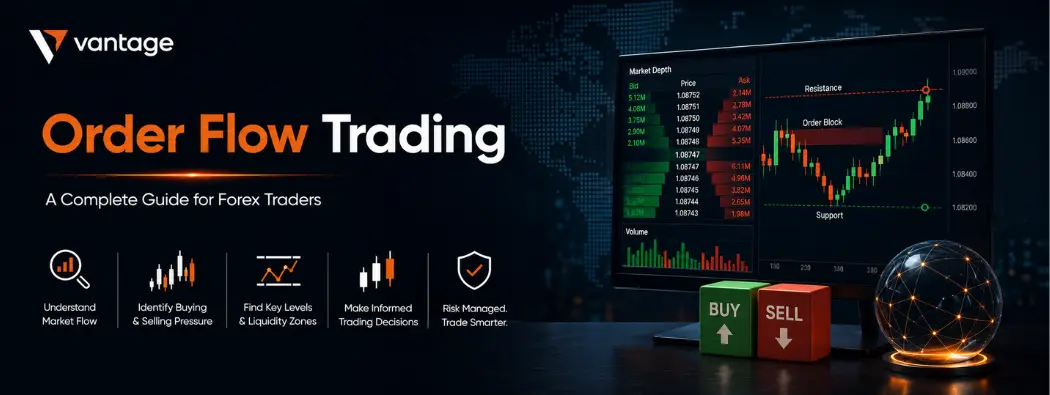
Order flow in forex trading involves analysing buying and selling activity to understand market pressure and broader market behaviour. Traders may also analyse factors such as volume, liquidity, and order activity to identify areas where buying or selling pressure may be concentrated.
For some traders, these observations are used alongside historical price patterns to provide additional market context.
In forex, traders often use tick volume (the number of price changes) and futures market data (actual trading volume and activity) as proxies, since there is no centralised source of volume data.
What Is Order Flow Trading?
Order flow trading involves analysing buying and selling activity in real time to assess market participation and shifts in market pressure, including whether buying or selling pressure appears to be increasing, decreasing, or being absorbed. Unlike traditional technical analysis, which focuses on chart patterns from the past, order flow seeks to reveal what is happening behind price movements.
Many traders view order flow as an additional confirmation tool rather than a standalone system. It is often combined with support and resistance(key areas where price has historically paused, reversed, or reacted), market structure (the overall pattern of price movement), trend analysis (understanding market movement, whether it is up, down, or sideways), and risk management (to limit potential losses).
Why Traders Use Order Flow
Order flow aims to help traders understand how the market moves because participants buy and sell:
- What price area are aggressive buyers entering the market
- Which price areas sellers may be defending or where selling activity appears more concentrated
- Whether buying or selling pressure appears to be strengthening or weakening
- Where liquidity or trading activity may be concentrated
- How large market participants may influence market activity
Because of these insights, many traders use order flow to gain additional context before making trading decisions.

The Forex Volume Challenge
Before learning how to trade forex using order flow, it is important to understand a limitation of the forex market. Unlike stock exchanges, the spot forex market is decentralised, i.e., it is not run through a single central exchange, so no single exchange records every transaction.
As a result, forex traders often rely on:
- Tick volume – how often the price changes
- Broker-provided volume data – trading activity your broker shows you
- Currency futures volume – trading activity from futures markets like CME
- Liquidity and price-action analysis – seeing and knowing what price does when it reaches important price areas, whether it stops, reverses, or breaks through.
Many traders use them to get useful information about market participation, but they do not provide a full picture of the market.
Risk Reality Check:
Forex volume data is estimated; therefore, you should use order flow analysis as one source of information rather than as a certainty.
How to Trade Order Flow: A Common Process
This is the process traders follow when applying order flow analysis.
1. Establish a Higher-Timeframe Bias
Many traders begin by analysing longer charts to see whether buyers or sellers have been in control.
They may examine:
- Market structure: the shape of price movements. So they know if the price makes higher moves, buyers are strong; if it makes lower moves, sellers are strong; if price moves sideways, buyers and sellers are balanced
- Trend direction – if prices are going up, down, or sideways
- Supply and demand zones – areas where prices may rise or fall
- Support and resistance levels – prices where the market often stops or turns
- Order blocks – areas where big trading activity happens
The purpose is not to predict future price movement with certainty but to create market context.
2. Mark Important Levels
After understanding the main trend, traders look for price areas where a lot of trading is likely to happen.
Common points of interest include:
- Previous highs and lows in prices
- Support(where price stops falling and may bounce up) and resistance levels(where prices rise and may fall)
- Supply and demand zones that show areas where strong buying or selling may happen
- Institutional order blocks, which some traders interpret as areas where larger market participants may previously have been active
- High-volume areas, which are price zones where a lot of trading happens
Many traders focus on order flow only when the price reaches one of these zones, blocks or areas.
3. Observe Market Activity at the Level
Traders monitor buying and selling activity, especially when the price approaches a certain area.
Questions they may ask include:
- Are buyers becoming more aggressive?
- Are sellers absorbing incoming orders?
- Is price movement getting stronger or weaker? Or is momentum increasing or weakening?
- Are more buy or sell orders coming into the market?
The goal is to understand how market participants are reacting and whether current activity aligns with a broader market view.
4. Look for Confirmation or Invalidation
Many traders wait for evidence that supports their market view.
Examples include:
- Increasing buying pressure at support(a price area where the market often stops falling and may bounce up)
- Selling pressure appears at resistance(a price area where the market often stops going up or goes back down)
- Strong momentum through a key level(when price moves quickly past an important price area without stopping)
- Rejection from a supply or demand zone(price hits a level and moves back the opposite way)
Some traders may treat a decisive move beyond a level as a sign that their original market view is no longer valid.
5. Consider Risk Before Acting
Forex risk management remains important regardless of the analysis method.
Many traders evaluate:
- Position size – how much money you put in a trade
- Potential reward relative to risk – how much you can gain compared to how much you can lose
- Market volatility – how fast and wildly the price is moving
- Trading costs – fees/spread you pay to enter and exit trades
- Alternative scenarios – other possible outcomes if the trade doesn’t go as planned
Order flow may improve market understanding of price movement, but it does not eliminate uncertainty.
What is an Order Flow Trading Strategy?
An order flow forex trading strategy focuses on analysing buying and selling activity as part of a broader decision-making process. But some traders go beyond that, often adapting order flow concepts to different market conditions.
Common order flow trading strategies include:
- Absorption setups – when the price is being held because of strong buying and selling activity
- Exhaustion setups – buying or selling pressure is running out
- Continuation setups – price keeps moving in the same direction
- False-breakout setups – price breaks a level, then quickly reverses
- Liquidity-driven setups – moves caused by stop losses or heavy buying and selling trading activity
Each focuses on how buyers and sellers interact around key levels.
Common Order Flow Trading Setups
Absorption
Absorption occurs when significant buying or selling activity is met by opposing orders, which may slow or temporarily limit price movement.
Exhaustion and Rejection
Exhaustion refers to a reduction in buying or selling pressure that may precede a slowdown in momentum or a change in market behaviour.
Imbalance and Continuation
An imbalance occurs when one side, buyers or sellers, becomes much stronger than the other.
For example:
- Strong buying may rapidly push the price higher.
- Strong selling may rapidly push the price lower.
Some traders view these conditions as signs of continuation.
False Breakouts and Stop Runs
Price moves past a level briefly, then quickly comes back. This happens because:
- Stop losses or automatic orders that close a trade get triggered, and traders close trades as a result of losses
- Traders enter the wrong direction because they place trades expecting the price to keep going one way, but it goes the opposite way instead.
- Stop and pending orders may be executed, contributing to increased market activity and liquidity shifts.
Trading Institutional Order Flow
Analysing institutional order flow is a commonly discussed concept in order flow trading. It is when institutions often execute large positions(very big trades) that can influence liquidity and market behaviour.
Retail traders cannot directly observe every institutional transaction, but some traders look for indications that large market participants may be active through:
- Volume spikes – a sudden jump in trading activity
- Liquidity shifts – where buy/sell orders are moving or building up changes
- Absorption patterns – one side is taking all the other side’s trades without the price moving much
- Footprint charts – charts that show buying vs selling at each price level
- Delta analysis – compares aggressive buying vs aggressive selling to see who is stronger
It is important to remember that these indicators are just signs, and no indicator can perfectly reveal institutional intentions.
Order Flow Trading Indicators
Several tools help traders analyse order flow using popular order flow trading indicators, which include:
Footprint Charts
Footprint charts explained mean displaying buying and selling activity at specific price levels.
Many traders use them to identify:
- Absorption(significant buying or selling activity is met by opposing orders, potentially slowing price movement)
- Imbalances(one side is much stronger than the other, so price moves fast)
- Aggressive market participation(lots of fast buying or selling using market orders)
Delta
Delta measures the difference between aggressive buying and aggressive selling, or, simply put, shows who is more aggressive: buyers or sellers.
- Positive delta suggests stronger buying activity.
- Negative delta suggests stronger selling activity.
Volume Profile
Volume profile highlights price levels where the most trading activity has occurred.
Many traders use it to identify:
- High-volume nodes – areas with lots of trading activity
- Low-volume nodes – areas with little trading activity
- Potential support and resistance zones – price areas where the market may pause or turn
Depth of Market (DOM)
DOM displays pending buy and sell orders or shows buy and sell orders waiting in the market. Some traders use it to assess liquidity (how many buy and sell orders there are) and order concentration (where orders are stacked).
Choosing an Order Flow Trading Platform
A quality order flow trading platform can provide access to advanced market data and visualisation tools.
Common features include:
- Footprint charts: show buying vs selling at each price level or area
- Volume profiles: show the price area where most trading happened
- DOM analysis: shows pending buy/sell orders waiting in the market
- Delta indicators: show whether buyers or sellers are stronger
- Custom market-depth tools: advanced tools to see liquidity and orders in detail
When traders compare platforms, they often evaluate things like:
- Data quality: the accuracy and reliability of market data
- Charting capabilities: how good and detailed the charts are
- Market coverage: how many markets/assets the platform supports
- Execution speed: how fast trades are placed and filled
- Educational resources: learning materials and guides provided by the platform
Best Order Flow Trading Software
There are many order flow trading software solutions on the market. Some of the popular options often include:
- Professional futures-trading platforms – platforms for trading futures contracts, which are agreements to buy or sell an asset at a fixed price on a future date.
- Advanced charting software – tools with detailed charts for analysis
- Institutional-grade analytics tools – powerful tools used by big firms for market analysis
- Multi-asset trading platforms – platforms that let you trade different types of markets (stocks, forex, crypto, etc.)
Different software packages vary significantly in cost, data availability, and complexity.
Traders should consider their experience level and trading objectives before selecting a solution.
Is There Free Order Flow Trading Software?
Yes, some free order flow trading software is available:
- Basic footprint-chart tools – these are tools that help you see buying and selling activity in a market
- Free volume-profile indicators – free tools that show you price labels or areas where most trading happens
- Trial versions of premium platforms – tools you can use all of their paid features for free, but for a limited time
- Community-developed analytical tools – tools built by traders and shared for free
However, when it comes to having data depth and advanced analytics, free solutions often have limitations compared to paid alternatives.
Should You Take an Order Flow Trading Course?
An order flow trading course may help traders understand:
- Market microstructure – how the market works at a detailed level (orders, trades, price movement)
- Order-flow concepts – how buying and selling orders move the market
- Footprint analysis – reading charts that show buy vs sell activity at each price
- Delta interpretation – understanding whether buyers or sellers are stronger
- Liquidity dynamics – how easily orders can be filled and how available buyers/sellers are in the market
However, course quality varies significantly.
Before purchasing a course, traders often evaluate:
- Instructor experience
- Educational content
- Transparency
- Independent reviews
- Practical examples
No course can guarantee trading success, and trading outcomes vary across individuals and market conditions.
Is There a Good Order Flow Trading Book?
A quality order flow trading book can provide a structured introduction to the subject.
Many traders use books to learn:
- Market mechanics
- Auction-market theory
- Volume analysis
- Institutional behaviour
- Order-flow concepts
Books can offer valuable foundational knowledge, although practical experience remains important for developing pattern recognition.
Common Mistakes in Order Flow Trading
| Mistake | Why It Can Be Problematic |
| Using it alone without doing other analyses like trend direction, support and resistance, market structure, etc. | You may not understand the market in general |
| Ignoring bigger trends or directions | Short-term signals can become misleading |
| Assuming the volume is perfect in forex; it is not fully accurate | No signal source shows all trading activity |
| Overtrading every signal or too many setups | Fees and spreads can reduce profit |
| Ignoring risk management | Losses can increase rapidly |
| Assuming institutions are always visible | Large activity can be difficult to identify accurately |
Is Order Flow Trading Profitable?
Profitability varies from trader to trader. Order flow can help you understand the market, but it doesn’t guarantee profit.
Trading success using order flow depends on:
- Managing risk
- Market conditions, whether they are favourable or not
- Experience
- Discipline
- How well you follow your strategy
Like all methods, it has both advantages and limits.
Frequently Asked Questions
How do you trade order flow?
Traders look at the market direction- if it is going up, down or sideways- mark important price levels, then watch buying and selling when the price reaches those levels
What is an order flow trading strategy?
An order flow trading strategy analyses buying and selling activity in a market to identify or evaluate potential market opportunities and risks.
Can you trade order flow in forex?
Yes, and since no single system tracks all forex data, traders often use tick volume and futures market data.
What are the best order flow trading indicators?
Popular tools include footprint charts (show buying vs selling at each price), delta indicators (show whether buyers or sellers are stronger), volume profiles (show where most trading happened), and depth-of-market displays (show pending buy and sell orders in the market).
Is trading institutional order flow possible?
Retail traders cannot observe every institutional order directly, but some traders use liquidity, volume, and order-flow analysis as potential indicators of larger market activity.
Is free order flow trading software worth using?
Free tools can help traders learn basic concepts, although they may have limitations compared with paid alternatives.
Do I need an order flow trading course?
Some traders use courses to learn fast, while others prefer books, practice with a demo account, and study independently. Different traders may prefer different learning approaches depending on their experience and objectives.
What is the best order flow trading platform?
The best platform depends on the trader’s:
Experience: beginners need simple platforms, experts need complex tools
Goals: some want quick trades, others want long-term analysis
Markets: forex, stocks, and crypto all need different tools
Data needs: some need basic charts, others need advanced order flow data
Risk Warning: CFDs are complex financial instruments and carry a high risk of rapid loss of money due to leverage. You should ensure you fully understand the risks involved and carefully consider whether you can afford to take the high risk of losing your money before trading.
Disclaimer: The information is provided for educational purposes only and doesn’t take into account your personal objectives, financial circumstances, or needs. It does not constitute investment advice. We encourage you to seek independent advice if necessary. No representation or warranty is given as to the accuracy or completeness of any information contained within.
This material may contain historical or past-performance figures and should not be relied upon. Furthermore, estimates, forward-looking statements, and forecasts cannot be guaranteed. The information on this site and the products and services offered are not intended for distribution to any person in any country or jurisdiction where such distribution or use would be contrary to local law or regulation.