
 Updated
Limit orders in forex are an order type to be executed at a specific price or better. You set the price, save your order, and wait for Priceweek to hit. It might not fill, and quick gaps could miss your level.
Price chasing is a common trading error. It often leads to late entries and poor pricing. Limit Orders in Forex address this by setting a price level in advance.
In this article, you will learn in minute detail what a limit order is in the financial market, how buy and sell limit orders work in forex, the benefits, risks, and a step-by-step process of how to place a limit order.
What is a limit order in forex?
A limit order is a pending order because it will be activated only when the price reaches your desired level. The concept is linked to the reality of how quotes operate in real time, as changes in liquidity and the spread can make or break whether an order gets filled and at what speed.
Therefore, limit orders are often mentioned alongside other types of orders, such as entry, stop-loss/take-profit, because these tools indicate where a trade begins and ends on the price chart.
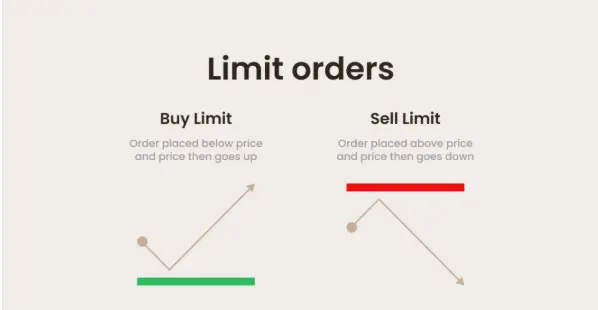
Buy Limit
If it’s a buy limit, it is below the current price. It activates when the market falls to the limit level, and it can be filled at that price or at a lower one. Buy limits are often illustrated in educational materials to show how an order could be placed when a price retraces to a support level or a technical retracement area.
Sell Limit
A sell limit is a pending order placed above the current price. It is triggered when the market reaches the limit level and trades at or above that price. They will punch up a sell limit around resistance or after price spikes into an area that used to be supply.
| Order | Placed where | Triggers when | Common use |
| Buy limit | below the current price | price trades down to the limit level | Buy a pullback at support |
| Sell limit | above the current price | price trades up to the limit level | sell a rally at resistance |
Buy limit order (meaning + how it works)
A buy limit is a type of pending order used in forex markets. A buy limit order in forex is placed at a price below the current market price.
It is designed to buy after a pullback reaches a set level. By contrast, a market order aims to fill at the best price available now.
In practice, buy limits are often linked to a support retest. A support area is a price zone where buying interest has appeared before. As a result, traders and analysts often discuss buy limits alongside entry, stop-loss, and take-profit levels. These terms describe where a trade begins, where risk is capped, and where exits may occur.
Example: pullback into a support retest
Assume EUR/USD trades at 1.1000 after a steady climb. A prior swing low formed near 1.0940, then the price bounced. Later, the price pulls back toward that same zone. For illustration, a buy limit could be shown at 1.0945 to demonstrate how a pending order works. If the market drops to that level, the order may fill. Hypothetical stop-loss and take-profit levels might be illustrated at 1.0915 and 1.1020, respectively.
Note: These numbers are purely illustrative and do not constitute trading advice.
Buy limit order (meaning + how it works)
A buy limit is a type of pending order used in forex markets. A buy limit order in forex is placed at a price below the current market price.
It is designed to buy after a pullback reaches a set level. By contrast, a market order aims to fill at the best price available now.
In practice, buy limits are often linked to a support retest. A support area is a price zone where buying interest has appeared before.
As a result, traders and analysts often discuss buy limits alongside entry, stop-loss, and take-profit levels. These terms describe where a trade begins, where risk is capped, and where exits may occur.
Example: pullback into a support retest
Assume EUR/USD trades at 1.1000 after a steady climb. A prior swing low formed near 1.0940, then the price bounced.
Later, the price pulls back toward that same zone. For illustration, a buy limit could be shown at 1.0945 to demonstrate how a pending order works. If the market drops to that level, the order may fill. Hypothetical stop-loss and take-profit levels might be illustrated at 1.0915 and 1.1020, respectively.
Note: These numbers are purely illustrative and do not constitute trading advice.
Sell Limit order
A sell limit is a type of pending order used in forex trading. A sell limit order in forex is placed above the current price.
It is designed to sell after the price rises to a chosen level. In that sense, it contrasts with a market order, which seeks an immediate fill.
Sell limits are often discussed in the context of a resistance retest. Resistance is a zone where selling interest has appeared before.
When price returns to that zone, some traders look for signs of rejection. A sell limit allows the entry to wait at the level, rather than chasing the price.
How it works (example with sample numbers)
Assume GBP/USD trades at 1.2500 after a recent drop. Earlier on the chart, the price bounced down from a resistance area near 1.2580.
Later, the price rallies back toward that same zone. For educational purposes, a sell limit could be illustrated at 1.2575 to show how a pending order works. If the price reaches that level, the order may fill. Hypothetical stop-loss and take-profit levels might be shown at 1.2610 and 1.2470, respectively.
Note: These examples are for illustrative purposes only and are not trading advice.
When to Use Buy Limit vs Sell Limit
In foreign exchange markets, buy limit and sell limit orders are common “pending” entries. They sit in the market until the price reaches a set level. A limit order is designed to fill at the stated price or better.
A buy limit is set at a price at or below the chosen level. A sell limit is set at a price at or above the chosen level. Because price may not return, a limit order may not fill.
Order terms can vary by platform and provider. With those basics in place, the next sections outline practical use cases and common risks.
When to use a Buy Limit
- Buy the dip in an uptrend: Price is making higher highs and higher lows. When you expect an asset to drop to a certain level before it rises again. Place a buy limit near prior support.
- Retest of a breakout: Price breaks above resistance, then pulls back. Set a buy limit at the old resistance zone.
- Fibonacci pullback entry: After a strong push higher, the price often retraces to a Fibonacci level. Place the buy limit at retrace levels between 38.2% and 61.8%.
- Mean-reversion to value: Price spikes above its short-term “fair” level. A buy limit at a moving average or Volume Weighted Average Price area can help.
When to use a Sell Limit
- Sell the rally in a downtrend: Price is making lower highs and lower lows. Place a sell limit near prior resistance.
- Retest of a breakdown: Price breaks below support, then rebounds. Set a sell limit at the old support zone.
- Fibonacci pullback entry: After a sharp drop, the price often retraces to a Fibonacci level. Place the sell limit around 38.2%–61.8% retrace levels.
- Fade an overbought push into supply: Price runs into a known selling zone. A sell limit lets you enter without chasing.
When to avoid limit orders
After chart analysis, order choice can shape execution quality. A Limit order is designed for price control, yet the fill is not guaranteed. In contrast, a Market order prioritizes execution at the best available price, which highlights the trade-off between speed and precision.
Limit orders are often less suitable when immediacy matters. This can occur around major economic releases, where prices can jump and skip levels. In that setting, the market may move away from the limit before it is reached, leaving the order unfilled.
They can also behave poorly during thin Liquidity periods, such as holidays, rollovers, or quiet sessions. Wider Bid–ask spread, and fewer resting orders can increase missed fills or partial fills.
Strong directional moves create another friction point. When price “runs,” a limit level can be left behind, especially if the goal is participation rather than price improvement.
Limit order vs Market order vs Stop order
A Limit Order is an order to buy or sell a security at a specific price or better.
A market order refers to an order to buy or sell a security immediately at the best available price.
A Stop Order in forex is an order to buy or sell a stock once its price reaches the specified called the stop price. Usually, when the stop price is reached, a stock order is automatically converted to a market order.
| Order Type | Main goal | Key Trade-off |
| Limit | Better price | May not fill |
| Market | above the current price | Price can fill |
| Stop | Trigger on move | Can trigger in spikes |
How to Place a Limit Order
- Open the trading screen: On most platforms, this is usually “Trade”, “New Order”, or order ticket.
- Choose the market or symbol: Choose the currency pair or instrument from the watch list.
- Pick the order side: Buy and Sell are typically what the ticket offers.
- Select “Limit” for the order type: Some platforms include this under “Pending order” or “Advanced.”
- Enter the limit price: This is the price at which the order will activate and attempt to fill.
- Enter the trade size: The size will be displayed in lots, units, or contracts, depending on the platform.
- Check estimated costs and spread: The spread and any fees are displayed on many tickets before an order is entered.
- Insert optional risk and stop levels: A few other tickets have both a stop loss and a take profit field available within the same form field.
- Select a timing option if you can: Typical choices are “Good till canceled” or an expiration date.
- Review the order summary: Typically, a platform will display the side, size, price, and any connected levels.
- Place the order and confirm: The order should say “Pending” until the price hits that interface level.
- Monitor, change, or cancel if you wish: On most platforms, changes can be made from the open orders or positions tab.
Limit orders are typically used for planned entries and for specific price points. If the price is never reached, these orders can go unexecuted.
Benefits of Using Limit Orders
- Price control at the order ticket: A limit order sets the highest buy price or the lowest sell price. This defines the worst price the order can accept. In fast markets, that control can reduce unwanted slippage.
- More structured trade planning: A fixed entry price makes distance-to-stop easier to measure. As a result, risk and reward can be estimated before entry. This also supports clearer record-keeping in a trading journal.
- Need to watch fewer ticks: Limit orders can wait at a chosen level for hours or days. This can suit planned setups around support and resistance zones. It can also reduce the urge to react to every price swing.
- Useful for exits, not just entries: Limit orders are also used to set take-profit targets. That keeps exits tied to pre-marked chart levels. Investor education pages often describe limit orders this way.
Major Risks of Using Limit Orders
- Failure-to-Execute Risk: The most significant risk is that the market may never reach your intended price, so the trade could either open or an order to take profit will never close.
- Partial Fills: In highly volatile or low-liquidity markets, your order could get filled only partially, resulting in a position that you didn’t plan on initially.
- Market Gapping: If the market gaps through your limit price (which tends to happen over weekends), you may not get your order executed, or, worse, it may be executed at a less favorable price than if the transaction had occurred when markets were open.4. Fake Reversals: Price may break through your limit level, but reverse almost instantly, causing them to fill your client orders just before the market pushes in the opposite direction.
Frequently Asked Questions
How does a buy limit order differ from a market order?
A buy limit sits below the current price and only fills at the limit price or better. A market order aims to fill right away at the best available price.
Which online broker in South Africa supports limit orders?
Some brokers available to South African residents, including Vantage Markets, support limit orders. Check your platform to see which order types it supports.
Limit order vs market order: which is better for beginners?
Market orders are often easier to understand because they focus on immediate execution. Limit orders focus on price control, although they can remain unfilled.
What are the risks of using limit orders in volatile markets?
Volatility can increase the risk of missed or partial fills, or of fast moves through levels. Wider bid–ask spreads can also affect when a level is “touched” on the quote.
What happens if my limit order price is never reached?
The order stays pending until it is cancelled or expires, depending on its time setting.
No position opens if the market never trades at the limit level.
What happens if my limit order price is never reached?
The order stays pending until it is cancelled or expires, depending on its time setting. No position opens if the market never trades at the limit level.
Which online trading platforms allow setting limit orders for JSE shares?
Examples include EasyEquities, FNB Share Investing, Standard Bank Online Share Trading, Absa Stockbroking, and Nedbank Online Share Trading. Each of these platforms describes using “market” and “limit/at limit” order types for share trades.
RISK WARNING: CFDs are complex financial instruments and carry a high risk of losing money rapidly due to leverage. You should ensure you fully understand the risks involved and carefully consider whether you can afford to take the high risk of losing your money before trading.
Disclaimer: The information is provided for educational purposes only and doesn’t take into account your personal objectives, financial circumstances, or needs. It does not constitute investment advice. We encourage you to seek independent advice if necessary. The information has not been prepared in accordance with legal requirements designed to promote the independence of investment research. No representation or warranty is given as to the accuracy or completeness of any information contained within.
This material may contain historical or past performance figures and should not be relied on. Furthermore, estimates, forward-looking statements, and forecasts cannot be guaranteed. The information on this site and the products and services offered are not intended for distribution to any person in any country or jurisdiction where such distribution or use would be contrary to local law or regulation.
References
- https://www.investopedia.com/terms/l/limitorder.asp What is a Limit Order in Forex and How Does It Work?
- https://www.investor.gov/introduction-investing/investing-basics/how-stock-markets-work/types-orders Types of orders
- https://www.expat.hsbc.com/international-banking/what-is-a-limit-order/ What is a Limit Order
- https://www.investopedia.com/terms/l/limitorder.asp What is Limit Order in Trading and How Does It Work?
- https://www.forexfactory.com/thread/263573-trading-with-limit-orders Trading with Limit Orders
- https://www.forexfactory.com/thread/1369375-mt5-script-for-placing-limit-orders MT5 Script for Placing Limit Order
- https://www.babypips.com/forexpedia/limit-order Limit Orders
- https://www.investing.com/academy/trading/stop-limit-order-definition/ Stop-Limit Order Definition: Unveiling the Power of Precision Trading
- https://www.investing.com/academy/stocks/limit-stop-market-order/ Limit Order, Stop Order, and Market Order in Stocks
- https://www.schwab.com/learn/story/3-order-types-market-limit-and-stop-orders 3 Order Types: Market, Limit, and Stop Orders