
 Updated
Order Blocks (OB) is part of what some traders call Smart Money Concepts, a framework for interpreting potential market behaviour, not a verified institutional strategy. They are one-way traders’ maps, where large players (such as financial institutions) may have acted, indicating price levels at which they enter the market.
In simple terms, an order block is a price zone left behind after a sharp move. That sharp move hints at strong buying or selling pressure.
This guide explains in minute detail what you need to know about order blocks in forex, where the idea comes from, its types, and valid order blocks. Also, this article is not a signal service and does not promise profits.
I must also add that it is strictly for educational purposes and does not constitute financial advice.
What are Order Blocks in Forex?
In simple terms, an Order Block in trading is a price zone that some traders associate with areas where large market participants may have been active. Some traders associate these zones with areas where central banks or large financial institutions may have been active, based on market observations, rather than verified data.
The idea is that if heavy buying once pushed the price higher, that same area may later act as support. If heavy selling once drove the price lower, that area may later act as resistance. When the price returns to that zone, some traders expect a reaction because orders may still be sitting there, or because they remember the level and respond quickly.
How traders study order blocks:
- Analyse historical price behaviour around key zones.
- To understand how price has reacted after strong directional moves.
- Compare different interpretations of market structure.
- To observe how price behaves when revisiting prior zones.
Warnings to keep in mind:
- Avoid zones that price had already revisited and filled; they lose reliability.
- Some traders expect stronger reactions from certain zones, although outcomes vary.
- Identify spikes in volume. Some traders interpret volume changes as part of their broader market analysis.
- Different traders draw them differently, so two charts may not match.
Where Does the Order Blocks Idea Come From?
Various online discussions and trading communities have debated the origins of Order blocks. Here are a few contributions.
When people say “order blocks,” they’re usually talking about a name that got popular online. The idea behind it is older. It’s the same thing many traders noticed for years: price pauses in a tight area, then shoots off hard, and later reacts when it comes back. Supply-and-demand traders have long called this the “base” before the big move.
According to InnerCircleTraders, the “order block” label emerged from a teaching style rooted in smart-money concepts. You’ll see terms like “ICT order blocks” and “Inner Circle Trader” in a lot of videos and communities. Those communities try to explain the pause as a period when larger traders may have built a position in pieces rather than placing a single large order. That story makes sense, but it’s still an interpretation, not a fact you can prove from a retail chart.
Here’s the big reality check that helps readers: in spot FX, Daniel Liberto posited that the market is over-the-counter, and trading is spread across many venues. So retail traders cannot see a full global order book. A lot of FX trading is also “invisible” to the wider market. That’s why order blocks are based on candles and structure, not secret bank data.
If you look at trader forums, you’ll see why the topic feels messy:
- On Reddit, many traders say order blocks are basically support/resistance or supply/demand with a new name.
- On the other side, some argue that the order block idea helps them mark the most important part of a zone and adds a clear “cause of the move” story.
- Checks on Nairaland reveal how traders often mix order blocks with market structure and liquidity talk, while still calling support/resistance the foundation.
So what’s the practical takeaway?
Order blocks are a structured way to box the “pause spot” before a strong move. They can help you clean up a chart. They can’t prove what banks did, and they don’t predict the future. This is an explanation for learning, not trading advice.
It’s important to stay grounded. No retail trader has direct access to a bank’s full order book in spot FX, and this article does not claim otherwise. The order block framework is not a “peek behind the curtain.” It’s a way many retail traders interpret price action.
They study where the market formed a tight base, where it appeared to absorb heavy trading, and where it then quickly rejected that area. From that, they mark a zone and watch how the price behaves if it returns.
Learning it from multiple sources at once is where the confusion starts. because different educators use different rules for defining an order block. Some focus on the last bearish or bullish candlestick preceding the impulse move. Others focus on using a wider range, such as wicks or a break in the structure, first. Some go so far as to use filters such as liquidity sweeps or session timing.
None of these indicators is wrong, because there is no single universal rule.
What Retail Traders Can and Cannot See About Order Blocks
Retail traders need to be clear about what they can and cannot see regarding order blocks.
Here is what retail traders can see;
- Traders can see specific candlestick patterns (bullish or bearish) and the associated volume for that period.
- They can clearly see subsequent sharp, impulsive moves away from the identified price area.
- They can see when the price revisits the order block area, often observing whether the price reacts in that area, based on how it behaved previously
- Retail platforms show general volume data
What Retail Traders Cannot See
- Retail traders do not have access to the actual data showing the specific volume of institutional buy and sell orders at different price levels, nor to their intent.
- Also, while some advanced retail platforms offer Level 2 data, it is often a filtered or limited view compared to what institutional brokers and exchanges see.
- Retail traders cannot access the execution algorithms used by big financial institutions to execute large orders over time without moving the market prematurely.
Types of Order Blocks: Bullish vs Bearish Order Blocks
There are other types of order blocks, but the main ones are Bullish and Bearish.
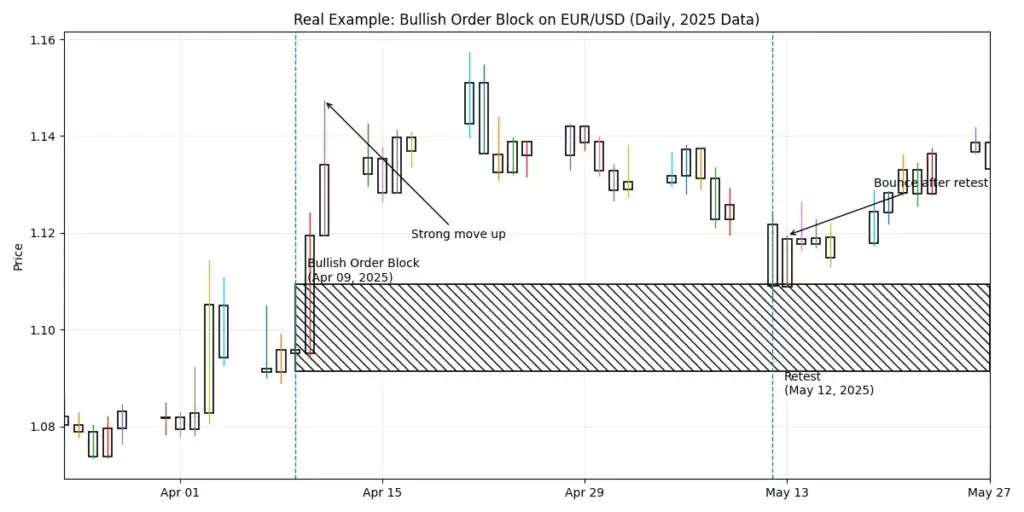
Bullish Order blocks
This is where significant buying activity occurs: when it appears in the market. These blocks usually form after a downward trend or the last down candle before a strong move up.
Traders treat it like a demand zone. The thinking is that buyers stepped in hard, absorbed selling, and then drove the price higher. If the price comes back, some traders watch for support and a fresh bounce.
Bearish Order blocks
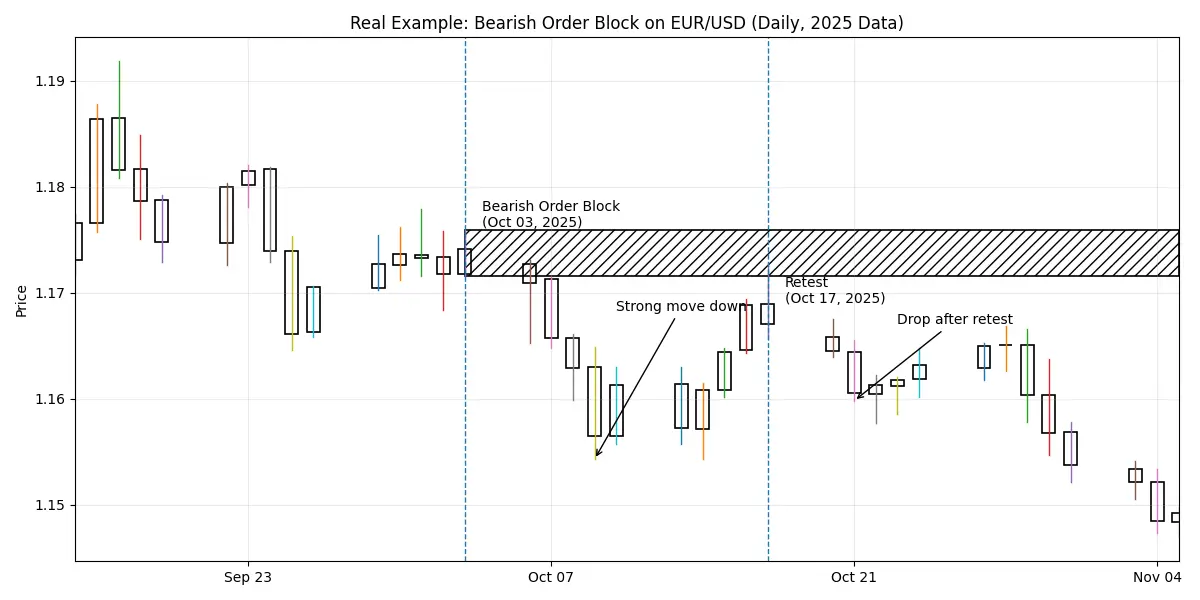
A bearish block is usually the last up candle or a tight upward range, right before a strong move down. It is characterised by strong selling pressure observed on the chart.
The Bearish Order block forms after an uptrend, where large sellers begin to offload their positions, creating a zone of resistance.
An Illustration
For example, let’s say the U.S. dollar (USD) strengthens sharply after a rise in U.S. interest rates. Higher rates attract investors seeking better returns, leading to more demand for the dollar. As a result, EUR/USD falls sharply because it takes fewer dollars to buy one euro.
On the chart, you might see a strong drop in EUR/USD as traders sell euros and buy dollars. Before that drop, the price may have paused in a small upward range, a few candles where buyers tried to push higher but failed. That area often becomes a bearish order block, showing where sellers stepped in hard.
Later, if EUR/USD starts to recover due to easing U.S. inflation or the European Central Bank (ECB) supporting growth, the price could climb back to that zone. When it does, many traders mark the last down candle before the next rally as a bullish block, the zone where euro buyers may have stepped in to absorb dollar strength.
This area, called a demand zone, reflects a shift in balance. Heavy dollar demand once drove prices lower, but when European traders or institutions begin buying euros at value levels, price bounces sharply from that zone. A bullish order block forms when demand exceeds supply, suggesting the market has found a base before a new rally.
In short, the USD’s strength or weakness often shapes how EUR/USD builds bullish order blocks, which mark where traders see opportunity to buy euros after dollar-driven declines.
What Makes a ‘Valid’ Order Block?
Every chart has a story to tell, and order blocks are the footprints left behind by institutions. It is also imperative to note that there is no single, universal rule for a “valid” order block.
Within Smart Money Concepts (SMC), traders use these ideas as one way to interpret market structure.
The following are what make the anatomy of a valid order block:
1. Clean impulsive move away from the block
Many traders look for order blocks that originate from an impulsive move. These moves are fast, aggressive, with little overlap, and volume expansion. Some traders prefer to see prices move away quickly rather than drift. A sharp push suggests strong participation and urgency. A slow crawl can mean the market was undecided.
2. Break of structure
Without BOS, there will be no Valid OB. That might be a clear new high in an up move, or a clear new low in a down move. The logic is simple: if the price broke a prior swing, the market may have shifted. Without that shift, the zone may be less meaningful.
- In bullish conditions, the move should break above a swing high or internal structure. While
- In bearish conditions, it should break below a swing low.
3. Imbalance
After displacement, there should be a visible Fair Value Gap (FVG) or imbalance- This candle is always 3 digits, with the largest in the middle. The void between consecutive candles shows inefficient pricing.
That is the “gap” in behavior where the price moved quickly and spent little time trading in the middle. The idea is that one side overwhelmed the other. It’s less about perfect candle patterns and more about the pace and shape of the move.
4. Freshness matters too
A zone that has been traded through many times can lose its impact. Each revisit can chew through resting orders. So traders often prefer order blocks that are still relatively fresh, with fewer clean retests.
NOTE: “valid” never means “will work.” These filters do not predict the future. They are just ways to pick zones that match a trader’s rules and avoid clutter on the chart. Price can still ignore a beautiful-looking block and keep going.
This section is descriptive only. It explains how traders often judge order blocks. It is not a signal or trading advice.
Support and Resistance Level vs Order Blocks vs Supply and Demand
Many traders get stuck because chart tools sound different but overlap extensively. Support and resistance levels, supply and demand, and order blocks often point to the same areas. The main difference is how each tool defines the zone.
Support and resistance level

These are often shaped by traders’ collective psychology. They are usually drawn as simple, horizontal levels. Support is where the price stopped falling before and bounced.
Resistance is the price level at which the price stops rising before resuming its decline. These levels can come from prior swing highs and lows, round numbers, or repeated stalls. They are easy to spot, but they can be drawn too tightly, as if the price were to turn at a single exact line.
Supply and demand zones
Large market participants significantly influence the formation of supply and demand zones.
A demand zone is where a strong rally starts after a base. A supply zone is where a strong drop starts after a base. Traders focus less on the exact turning point and more on the area where the price built up pressure, then moved away with speed.
Order blocks
are usually a more specific way to mark that same base. Instead of drawing a wide box around the whole structure, many traders mark the last tight range or final candle group before the impulsive move. In other words, if supply and demand say, “The move started from here,” an order block tries to say, “This part of the base matters most.” That is why order blocks often sit inside a broader supply or demand zone.
In real charts, you’ll notice the overlap fast. A bullish order block can align with a former support level. A bearish order block can sit just below a prior resistance level. Many “clean” order blocks are simply supply or demand zones drawn with stricter rules. So the concept is not new magic. It is a different lens on familiar price behavior: where the market paused, absorbed trading, and then moved away hard.
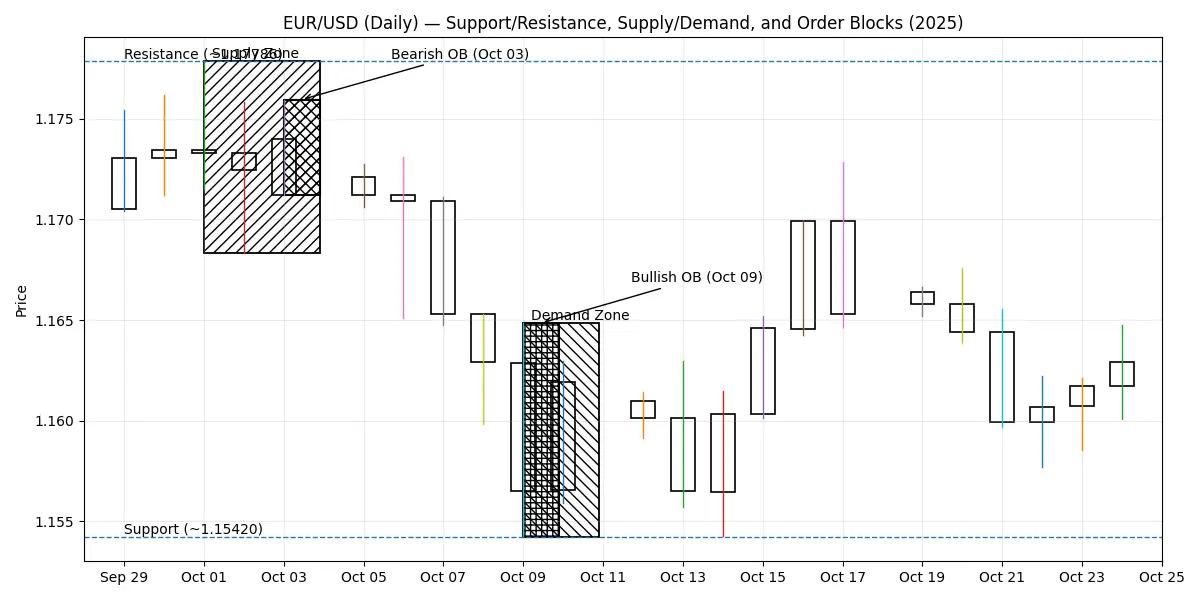
What matters most is not the label. It’s the plan. A level, a zone, or an order block only becomes useful when you pair it with context and risk control. That means trend, structure, timing, and clear rules for when you’re wrong. Risk management is commonly discussed alongside these tools, regardless of the approach used. If you don’t, changing the name of the zone won’t save the trade.
| Feature | Support & Resistance | Supply & Demand | Order Block |
| Origin | Historical price turning points and psychological barriers for retail traders. | Areas of significant market imbalance caused by large institutional orders. | The candle or price range that some traders interpret as reflecting strong market participation. |
| Precision | Typically represented as horizontal lines or broad ranges, often leading to “false breaks”. | Broader zones or rectangular areas. | Very precise, often a single or few candles wide, used for pinpoint entries. |
| Market View | Reactive: identifies where price has reacted in the past. | Analytical: focuses on zones that some traders monitor for potential future price behaviour. | Analytical: used by some traders to interpret market structure, often alongside additional confirmation. |
| Reliability | Can become weaker with multiple tests as orders are filled. | Focuses on “fresh,” unmitigated zones for higher probability moves. | Often considered relevant by some traders when analysing market structure, depending on context. |
Frequently Asked Questions
What is an order block in forex trading?
An order block is a price zone, not one exact price. Traders mark the last tight candle group before a strong move. They watch it as a possible reaction area on a return.
Are order blocks the same as supply and demand zones?
They overlap a lot, but they are not always the same. Supply and demand zones are wider “base than launch areas. Order blocks are often a tighter, more specific part of that base.
Do banks and institutions actually use order blocks this way?
Retail traders cannot see bank orders in spot FX. So no one can prove “banks used this exact block.” Order blocks are a price-action idea, not secret order data. Big firms do care about liquidity and key levels, though.
What is a valid order block?
There is no universal rule for “valid.” Many traders look for: a sharp move away, a clear structure break, and freshness. Valid never means it will work. It only means it fits your rules.
Are order blocks better than support and resistance?
Not better—just different labels for similar behavior. Support and resistance are often simple horizontal levels. Order blocks and supply/demand focus more on the “base” area. The edge comes from your plan and risk control, not the label.
Can I use order blocks on all timeframes and all forex pairs?
Order blocks can be studied on different instruments and timeframes for educational analysis.
Longer timeframes often yield cleaner zones and lower noise. Lower timeframes can work, but false breaks happen more often.
Can I trade using only order blocks?
Some traders choose to focus on order blocks alone, although this approach is widely debated. Order blocks work best with context, such as trends and structure. You also need clear entry, stop, and position-sizing rules. Without risk management, the best zone can still fail.
RISK WARNING: CFDs are complex financial instruments and carry a high risk of losing money rapidly due to leverage. You should fully understand the risks involved and carefully consider whether you can afford to take the high risk of losing your money before trading.
Disclaimer: The information is provided for educational purposes only and doesn’t take into account your personal objectives, financial circumstances, or needs. It does not constitute investment advice. We encourage you to seek independent advice if necessary. The information has not been prepared in accordance with legal requirements designed to promote the independence of investment research.
No representation or warranty is given as to the accuracy or completeness of any information contained within. This material may include historical or past performance figures and should not be relied on. Furthermore, estimates, forward-looking statements, and forecasts cannot be guaranteed. The information on this site and the products and services offered are not intended for distribution to any person in any country or jurisdiction where such distribution or use would be contrary to local law or regulation.
References
- https://www.investopedia.com/trading/support-and-resistance-basics/ Support and resistance in forex
- https://www.reddit.com/r/Daytrading/comments/1b8ysk6/ Where and when did order blocks originate from?
- https://www.investopedia.com/terms/o/order-imbalance.asp Order Imbalance in Trading: Definition, causes, and strategies
- https://www.investopedia.com/terms/l/liquidity.asp Understanding Liquidity and How to Measure It