
 Updated
You’ve probably come across the term “ICT Trading” on Forex websites, YouTube, or trader forums.
In ICT Trading, people share charts, live breakdowns, and short clips of “smart money” moves. ICT stands for Inner Circle Trader. Its purpose is to provide a framework that helps traders identify trading opportunities, market dynamics, and risks.
In this article, you’ll learn what “ICT” is. You’ll also learn what ICT trading suggests about price movements. We’ll cover the main ideas at a high level, with plain explanations.

Who Is ICT Trader (Inner Circle Trader)?
An ICT trader adheres to the Inner Circle Trading strategy. The ICT approach to trading is based on principles of market manipulation, institutional order flow, and smart money in financial markets. The ICT trading strategy was developed by Michael J. Huddleston, an online trading educator, to teach a specific approach to studying price charts.
What is an ICT Trading Strategy?
An ICT trading strategy is a trading approach based on the principles of market manipulation, institutional order flow, and smart money in financial markets.
This trading approach focuses on four main elements: market structure, liquidity pools, order flows, and time of day.
These elements are synthesized into a comprehensive market analysis.
Key Inner Circle Trading Concepts You Need To Know
Note: These concepts are discussed for educational purposes only and illustrate how some traders analyse market behaviour, not how to execute trades.
The ICT trading strategy is built on 7 important components:
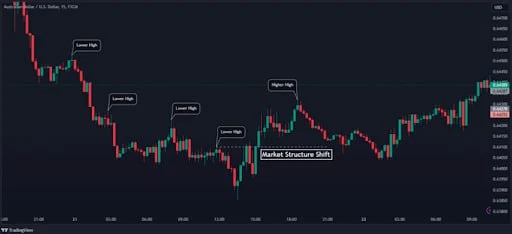
1. Market Structure Shift
A market structure shift is a level in the chat at which the prevailing trend is disrupted. The pattern of highs and lows defines trends. Traders observe whether the price is forming higher highs and higher lows, or lower lows and lower highs.
2. Liquidity
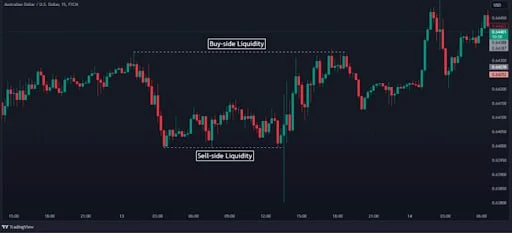
Liquidity in the ICT trading strategy comes in two forms: buy-side and sell-side. Buy-side liquidity refers to the area on a price chart where sellers’ stop-loss orders and waiting buyers’ buy-stop orders are placed. Sell-side liquidity refers to the area on the chart where buyers’ stop-loss orders and sellers’ sell-stop orders are placed.
Both zones are typically found at the extremes of price volatility, often near the tops and bottoms of price patterns.
3. Order Block
This zone is a central component of ICT trading because it is where prices move strongly, suggesting heavy buying or selling. ICT-style traders may treat these zones as possible support or resistance, but with extra rules tied to structure and liquidity.
These are zones that some traders mark as likely “institutional” activity. In the ICT trading strategy, order blocks are seen as reversal areas.
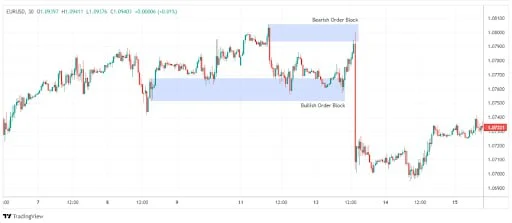
I. Bullish Vs Bearish Order Blocks
Both order blocks develop, each offering insights into potential price movements in different ways.
Bullish Order Block: This is formed when upward price movements follow bearish candles. In addition, this zone supports rising prices.
Bearish Order Blocks: Typically consist of two candles, with the first being bullish and the second being bearish. In addition, this zone serves as a support for falling prices.
ii. Breaker blocks
This is a failed Order Block where price breaks through and closes beyond its range, flipping from support to resistance (bullish OB becomes bearish breaker) or vice versa (bearish OB becomes bullish breaker).
Other Block types are the Mitigation block and the rejection block.
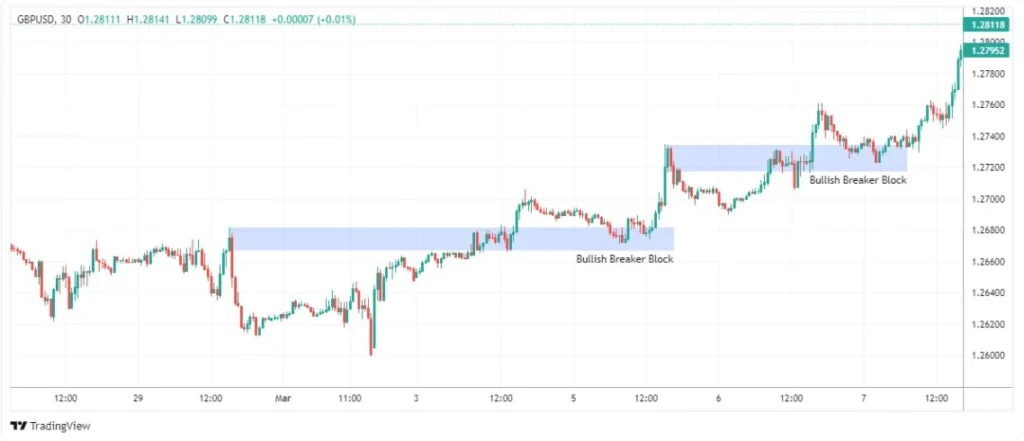
4. Imbalances (Fair Value Gap)
It is the basis of ICT concepts and refers to the disparity between buying and selling forces, which often occurs when there is a noticeable absence of trading within a price range.
Usually, before meeting an order block, Fair value gaps indicate chart areas where price may return to “fill” the gap, illustrating how markets can seek equilibrium.
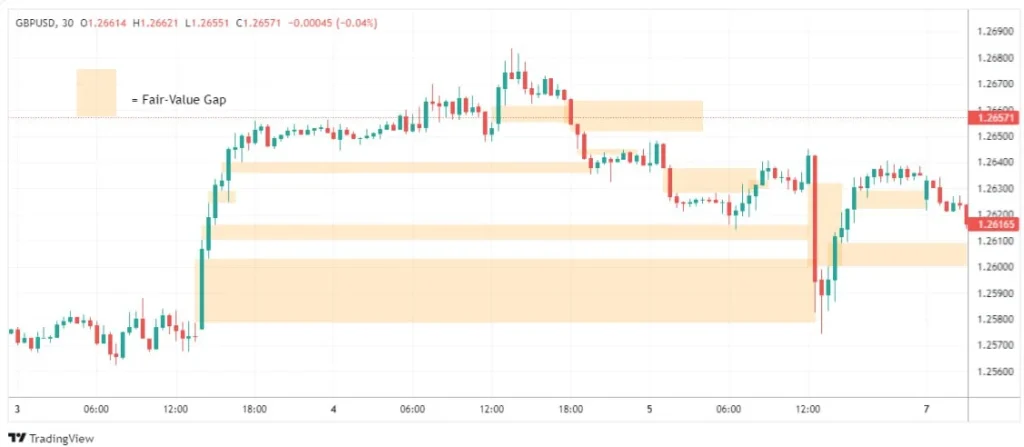
5. Displacements
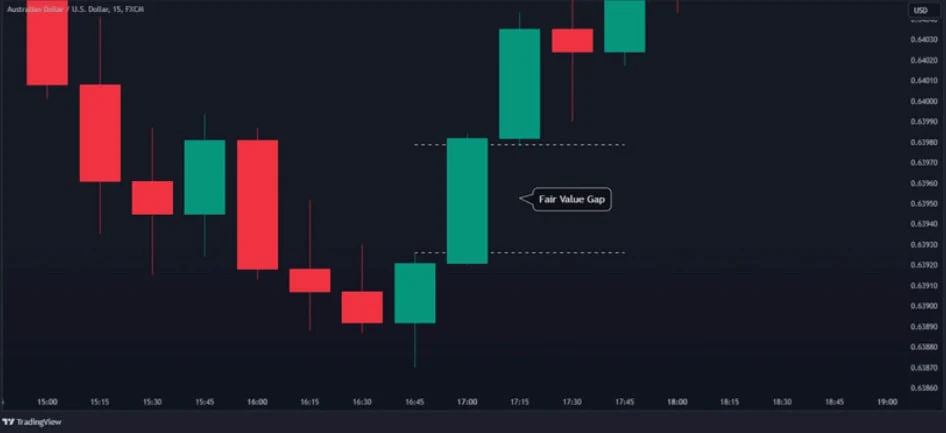
It is a sharp, aggressive price move with strong momentum, often indicated by large, full-bodied candles at the center with small wicks, signaling significant involvement by institutional traders, also known as Smart Money. This gap is often referred to as the Fair Value Gap.
It typically consists of 3 candles, with the largest in the middle.
6. Optimal Trade Entry (OTE)
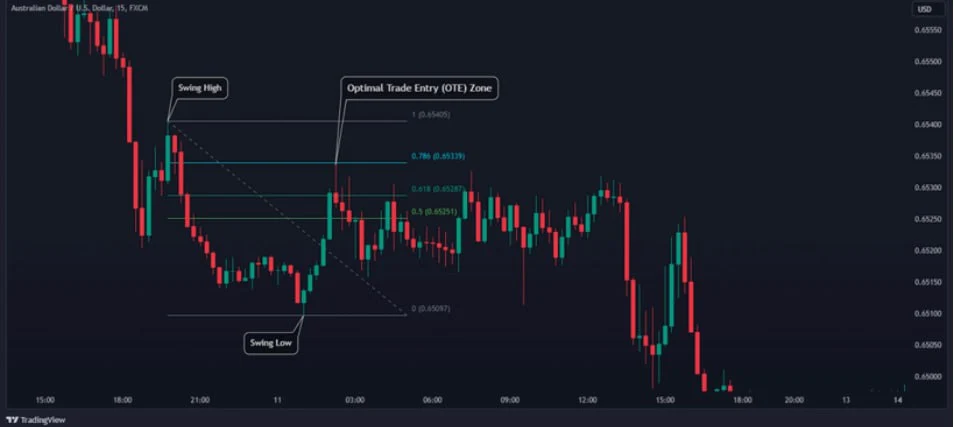
It is a concept in ICT strategy that references certain Fibonacci levels, which some traders study to understand market patterns. After an inducement that prompts a displacement (leaving behind an FVG), some ICT traders study Fibonacci retracement levels to analyze potential market reactions.
This zone is considered a potential area of interest according to ICT theory. Its effectiveness should be evaluated in a demo environment.
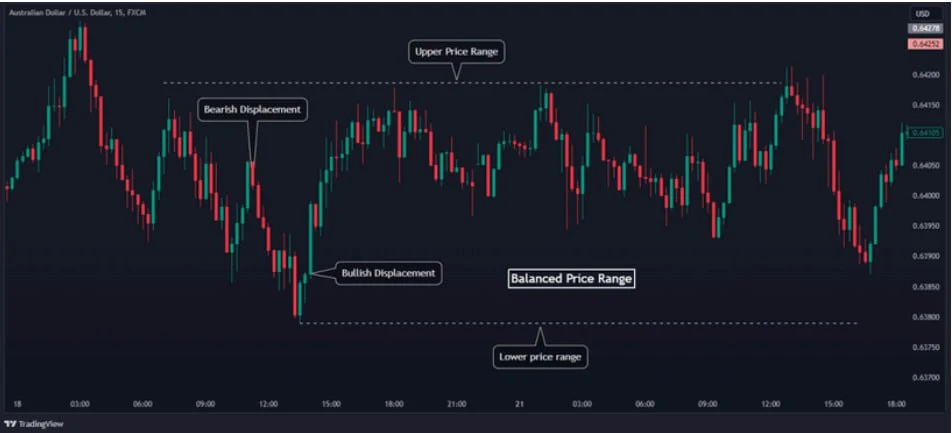
7. Balanced Price Range
This is another smart money concept that occurs when there is an overlap area between two opposite Fair Value Gaps in a short timeframe. Some traders study these areas when analysing market pullbacks.
Find a bullish FVG and a bearish FVG close together. Traders may observe bullish and bearish BPR zones to understand potential market behaviour, without implying specific trades.
Why ICT Trading Attracts Many Traders
The ICT trading strategy has gained significant momentum because it offers a more detailed framework for understanding institutional market dynamics and a unique perspective that differs from conventional retail trading. Here’s why ICT concepts have become popular among some traders:
- It provides structured labels for chart patterns, which may help in studying price action from a theoretical perspective.
- There is a huge amount of free content online. You can find videos, live breakdowns, clips, and notes almost everywhere. That makes it easy to start learning without paying for a course. It also creates big communities where people share setups, charts, and terms.
- It places significant emphasis on the time of day and trading sessions. Many learners prefer having set windows to watch, such as London or New York. It feels more planned than staring at charts all day.
- While ICT content often centres on the price story, it does not just focus on indicators. Instead of relying solely on moving averages or RSI, it asks: Where are stops likely to sit? Where might price run next? For many traders, that feels more “real” and easier to follow on a chart.
The Risks, Hype, and Common Mistakes
The risks
- ICT patterns can be subjective, such that traders may misinterpret the same market signals differently
- Poor execution of market signals may result in losses. Success lies in a trader’s ability to read and execute market signals precisely.
- Mastering a steep learning curve in ICT concepts requires significant time.
- ICT strategies can be difficult to backtest due to their conceptual nature. This is an important step to verify the effectiveness of a strategy.
Common Mistakes
- Misinterpreting market structure,
- Trading patterns, not liquidity, when you trade ICT, are like an upgraded version of price action. Asking the right questions can save you from such mistakes. Questions like “Is it the right time?” Do I have resting liquidity above or below the models?
- Trading low-resistant models in high-resistant markets. Let’s say you use the inversion model. But when candles overlapped, large wicks and a few value gaps appeared in the price action. Some setups only work in low-resistance conditions.
- Entering trades impulsively without clear entry or exit criteria and failing to journal trades prevent learning from past errors.
ICT PDFs Courses and Mentorships
Many traders seek resources such as the ICT trading strategy PDF, paid courses, and mentorship programs. While ICT terms spread fast online, what people want is a “one place” guide.
A PDF is just a file type. It can be excellent or low quality. The same applies to videos, courses, and mentorship calls. The value derives from the teacher’s clarity, the rules, and the testability of the material.
A clean PDF file with clear steps may be better than a long course with vague ideas. A good course may beat a PDF if it shows live examples and risk control.
Here are neutral safety checks that apply to any ICT resource:
- Watch out for guaranteed income claims. Any promise of fixed daily profits, “no loss” systems, or easy withdrawals is a red flag. Trading results vary, and losses can happen.
- Look for testable rules. A good resource explains the setup, entry trigger, stop, and exit plan. If you can’t write the rules down, you can’t test them.
- Test safely first. Use demo trading or a replay tool before risking real money. Track results over many trades, not a few screenshots.
- Understand costs and limits. Spreads, slippage, and fees can change outcomes. Tight-stop strategies can fail in real execution.
- Protect your money and mindset. Do not risk money you cannot afford to lose. Keep risk per trade small and fixed, and stop if you feel pressured.
How to Study ICT Trading Safely (Education Only)
If you’re a beginner with no prior knowledge of ICT concepts, start slow and keep it simple. You don’t need a paid program to begin learning. Bear in mind that you must prioritise risk management and practice with a Demo account.
Many basics are explained in free public videos, articles, and community posts. Start there, then decide what is worth further study.
Follow this stepwise study plan.
1) Start with free public content.
Free public content is available on YouTube, in blog articles, and in community posts. Pick one source at a time. Avoid switching between creators within a week. Jot down key terms like market structure, liquidity, order blocks, and fair value gaps.
2) Take notes in plain language.
Don’t copy buzzwords. Convert each concept into “if/then” rules. Example: “If price sweeps a prior low during London, then I look for a reversal setup.”
3) Backtest on old charts.
Scroll back and mark setups on historical data. Track what happens next. Count wins, losses, and average risk-to-reward. This helps you see if an idea holds up beyond a few screenshots.
4) Practise extensively on the demo first.
Use a demo account until you can follow your rules without breaking them. Demo trading offers risk-free environments.
5) Build your own plan
The essence of developing this plan is to be able to set strict rules covering entry criteria, risk-reward ratios, entry points, and daily losses
6) Journalling
Maintain a detailed journal of every trade, the emotional factors involved, and whether you followed your plan. The essence of journaling is to show what works for you and what doesn’t.
7) Transition slowly to live trading
Finally, once you have proven your worth with demo trading, you can now start with an extremely small amount of real capital to manage the psychological pressure of live trading.
Frequently Asked Questions
What is ICT trading in forex?
ICT is short for Inner Circle Trading. It is a chart-based style that focuses on market structure, liquidity areas, and timing. Traders look for where stops may sit above highs and below lows. They then watch how the price reacts around those areas during key sessions.
Is ICT trading a good strategy?
It can be useful for some traders, but it depends on how you test and apply it. An ict trading strategy works only if you can follow clear rules and manage risk. Demo test first and track results in a journal.
Do I need to pay for an ICT mentorship to learn?
No. Many ideas are available in free public content and community notes. Paid help may offer structure, but you should judge quality carefully and avoid “guaranteed results” claims.
Can beginners use ICT trading?
Beginners can study ict trading, but they should keep it simple. Start with basic market structure and one or two concepts, not everything at once. Practice on a demo and journal each trade to build your skills.
Is there a free PDF on ICT trading strategies?
You may find free files online, but an ict trading strategy PDF is just a format, not proof of quality. Use it as a study note.
Does ICT trading guarantee profits?
No. No method can guarantee profits in forex or any market. Losing trades are normal, so risk control and consistency matter more than any single setup.
RISK WARNING: CFDs are complex financial instruments and carry a high risk of rapid loss of money due to leverage. You should fully understand the risks involved and carefully consider whether you can afford to take the high risk of losing your money before trading.
Disclaimer: The information is provided for educational purposes only and doesn’t take into account your personal objectives, financial circumstances, or needs. It does not constitute investment advice. We encourage you to seek independent advice if necessary. The information has not been prepared in accordance with legal requirements designed to promote the independence of investment research. No representation or warranty is given as to the accuracy or completeness of any information contained within.
This material may include historical or past performance figures and should not be relied on. Furthermore, estimates, forward-looking statements, and forecasts cannot be guaranteed. The information on this site and the products and services offered are not intended for distribution to any person in any country or jurisdiction where such distribution or use would be contrary to local law or regulation.
References
- https://medium.com/@wernerotto/optimal-trade-entry-ote-precision-entry-after-a-smart-money-move-a6f0cbb061d7. Optimal Trade Entry (OTE): Precision Entry After a Smart Money Move
- https://forextester.com/blog/ict-trading/. ICT Trading in 2026: What Is Inner Circle Trading Strategy?
- https://www.youtube.com/watch?v=BfgYDds3YMA. 5 Common ICT Trading Mistakes