
 Updated
Changes in rand and USD are key economic factors that affect the cost of imported goods and services in South Africa. The economy is import-reliant because key goods such as machinery, electronics, chemicals, and fuel are priced in dollars. Also, services, flights, hotels, and overseas spending often settle in USD or track it.
Even “small” things add up: online subscriptions, phone upgrades, and cross-border shopping can feel more expensive when the dollar strengthens. In the forex world, USD/ZAR is an exotic, emerging-market pair. It is one of the most traded pairs in the global African currency market.
In addition, it swings more than major pairs like EUR/USD. Liquidity can be thinner, reactions can be sharper, and headlines can move prices in minutes. You often see larger daily ranges, wider spreads, and sudden gaps around risk-off events.
Think of this as an educational overview of USD/ZAR for South African traders, starting with the factors that typically move the pair. The big drivers include the US dollar cycle, global risk mood, commodity links, local data, and SA policy headlines. Also, watch event risk. CPI, jobs data, and central bank signals can trigger fast repricing. This article is strictly for educational purposes only.
What is USD/ZAR, and how does the Quote Work?
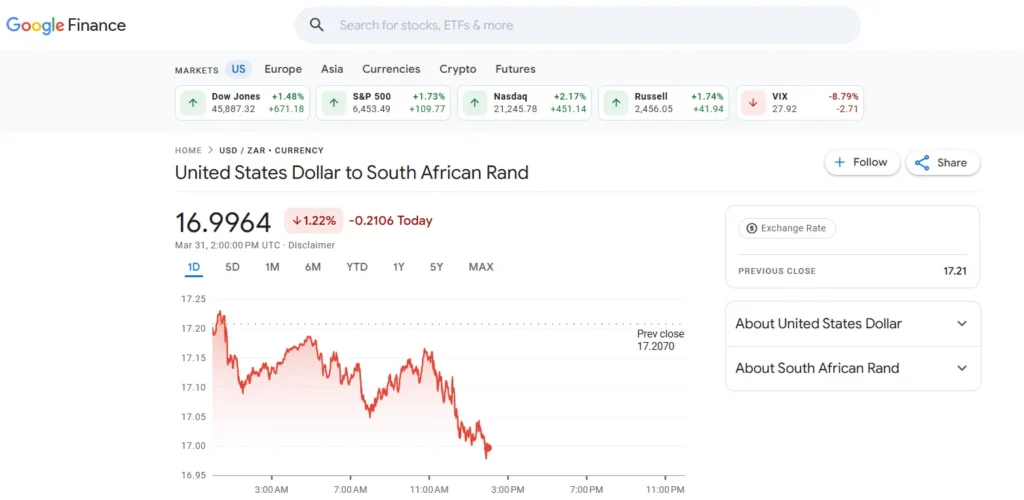
In simple terms, USD/ZAR is the exchange rate between the US dollar and the South African rand. In FX terms, USD is the base currency, and ZAR is the quote or counter currency. That means the price tells you one simple thing: how many rand 1 US dollar can buy.
So if USD/ZAR = 16.99, it reads as:
1 USD = 16.99ZAR
If the rate rises, the dollar is likely to strengthen against the rand. If it goes down, the rand is getting stronger versus the dollar. That’s the core of how this USD/ZAR forex pair works, and why traders often call it the “dollar rand pair.”
Here’s a quick way to think about the math using a sample rate (example numbers only, not live):
| USD Amount | ZAR at 16.99 |
| 1 USD | 16.99 ZAR |
| 10 USD | 169.9ZAR |
| 100 USD | 1,699.00 ZAR |
| 1,000 USD | 16,990.00 ZAR |
Sometimes naming can get messy, so let’s clean it up:
- Market format: “USD/ZAR” (standard quote)
- How people search: “USD to ZAR” or “ZAR to USD.”
- The inverse you may see: “ZAR/USD” (not the same quote; it’s flipped)
If you see ZAR/USD, that rate tells you how many dollars 1 rand can buy. It will look like a small number because the rand is worth a fraction of a dollar. Traders sometimes mix these up, so always check which side is base and which is quote.
Now, a quick word on pips. For most FX pairs, a pip is the fourth decimal. With USD/ZAR, brokers often quote to four or five decimal places. A “small” move can still matter, since USD/ZAR can travel far in a single day. When you size up a position, even a 20–50-pip move can quickly change your P&L, especially during news or thin liquidity.
That’s the quote mechanics. Once you get the base/quote logic, the dollar rand pair becomes much easier to track.
Is USD/ZAR a Major, Minor, or Exotic Pair – and Why It Matters
Forex pairs fall into three broad categories.
Major currency pairs are the most traded, usually against the USD, with deep liquidity and tight spreads. Examples are GBP/USD, EUR/USD, and USD/CHF.
Minors are liquid pairs that don’t include USD, such as EUR/GBP or AUD/NZD.
Exotics pair a major currency with an emerging-market currency, and they trade with less depth.
USD/ZAR sits firmly in the exotic currency pairs category. It’s an emerging-market currency pair, which is why many traders call it the USD/ZAR exotic pair. That label isn’t just a category. It changes how the trade behaves.
Consequences
1. Spreads are wider than what you’d see on majors. Even in calm markets, the costs of entering and exiting can be higher. Around news or illiquid hours, spreads can widen quickly.
2. The pair can make sharper moves on local headlines. South African data surprises, policy signals, credit or ratings talk, and political headlines can all reprice the rand fast.
When global risk sentiment turns, the rand can also react hard, because emerging-market currencies tend to be sensitive to risk-on/risk-off flows. This is where USD/ZAR volatility becomes the headline feature, not a footnote.
3. Liquidity can be thinner at certain times, increasing the risk of slippage. If you trade during quiet periods or around major releases, your fill may not match your click.
For South African-based traders, USD/ZAR is commonly treated as an exotic pair. This classification is associated with higher volatility, wider spreads, and increased sensitivity to news. Know which sessions carry the most activity, and don’t treat stops as optional. USD/ZAR can reward patience, but it punishes risk-taking quickly.
What Moves USD/ZAR? Key Drivers of the Rand vs Dollar
Let us take a closer look at the key factors driving USD/ZAR.
1. US Factors – Federal Reserve Policy & Dollar Strength
The big global currencies tend to dance to the tune of massive central banks like the US Federal Reserve. A blend of factors often creates significant volatility.
USD/ZAR starts with the dollar side of the equation. When the Federal Reserve signals tighter policy, higher rates, or a “higher for longer” stance, global demand for USD can rise.
The dollar is the world’s reserve currency and a go-to haven in times of stress. That means shifts in Fed messaging can ripple through all FX pairs, including the dollar-rand pair.
Key US data feeds into that pricing. Inflation prints shape how traders think about future rates. Jobs data and wage trends influence growth expectations and the stickiness of inflation. Fed meetings and speeches can change the tone fast, even without a rate move. None of this predicts direction. It explains why USD can reprice sharply when the market’s rate path changes.
2. South African Factors – SARB, Economy & Politics
On the rand side, the South African Reserve Bank is responsible for adjusting the rand’s interest rates. When SARB is seen as credible on inflation, it can support the rand. When inflation surprises or growth looks fragile, expectations can shift.
Traders watch SARB rate decisions, the language of the statement, and inflation forecasts because they affect how attractive ZAR assets are relative to USD assets.
Local data also drives sentiment. Inflation, GDP, unemployment, retail sales, trade, and current account numbers can all move the rand, especially when the surprise is big. South Africa is a commodity-linked economy too, so export dynamics and terms of trade often show up in the currency.
Then there’s the headline layer: fiscal concerns, debt trajectory, and ratings risk. When investors worry about fiscal discipline or financing costs, they demand a higher premium to hold rand exposure. Additionally, governance issues and policy instability can cause USD/ZAR to react quickly.
Energy is a recurring theme. Eskom and power supply constraints can weigh on growth expectations and business confidence. When the market prices slower growth or higher risk, the rand can weaken, and USD/ZAR trades higher.
3. Global Risk Sentiment & Emerging-Market Flows
To understand USD/ZAR, you also need the global mood.
Risk-on is when investors feel comfortable taking risks. Money flows into higher-yielding assets and emerging markets.
Risk-off is when investors get defensive. They cut risk, raise cash, and lean toward safe-haven currencies.
ZAR often trades like a high-beta emerging-market currency. In times of global stress, sharp equity sell-offs, geopolitical shocks, or volatility spikes can weaken EM currencies. Investors reduce exposure, and the USD can catch a bid. In more optimistic scenarios, stable markets, strong risk appetite, and healthy carry demand could support ZAR as flows return.
This is why the USD/ZAR volatility profile can look different from that of the majors. It’s not just about local data. It’s also about global positioning and risk appetite.
3. Local Events & News Calendar
USD/ZAR is also a “calendar pair.” Scheduled events can create predictable pockets of risk. On the South African side, watch:
- SA Budget Speech
- SARB MPC meetings
- Key releases like CPI, GDP, unemployment, retail sales, PMI, trade/current account
On the US side, the big market movers include:
- FOMC meetings
- US CPI
- Non-Farm Payrolls
- Retail sales and major Fed speakers
The practical point is to use an economic calendar. Being aware of upcoming events is an important part of market analysis. If a high-impact release is near, make sure to create a trading plan. Some traders stand aside. Others reduce size, widen timing buffers, or trade only after the initial reaction has settled. With a USD/ZA exotic pair, the market can gap, spreads can widen, and slippage can occur at the worst time. Planning is part of the edge.
When Is USD/ZAR Most Active? Sessions & Volatility Overview.
USD/ZAR trades 24 hours a day, 5 days a week. While there are different trading sessions, activity usually builds as Europe comes online. London is a major FX hub, and the rand often sees more two-way flow during those hours. Usually open from 8 AM – 5 PM.
You’ll also see faster reactions to headlines, especially when the global risk mood shifts. If you watch the chart in South African time (SAST), the pair often “wakes up” in the late morning and stays livelier into the afternoon.
The busiest window is often the London–New York overlap. That’s when two deep liquidity centres trade at the same time. More volume can mean cleaner moves, but it can also mean sharper bursts when a high level breaks. US releases can hit during this overlap, which matters because USD/ZAR is highly sensitive to US data surprises and broader dollar strength.
How USD/ZAR Is Commonly Traded via Regulated Brokers
Most traders don’t “buy dollars and sell rand” in the physical sense. They trade USD/ZAR via spot FX or CFDs, which are electronically priced. You’re trading the price movement, not walking away with cash in hand.
Start with the basics: open an account with a regulated broker, like Vantage Markets. Regulation matters because it sets rules on how client money is handled, what disclosures must be made, and how complaints are managed. A regulated broker will also give you clear risk warnings. Read them. Then read the broker’s Terms & Conditions, especially the margin policy.
Once the account is set, you’ll trade on a platform (often MT4/MT5 or a web platform). Learn the core order types before you place a real trade:
The following order types are platform features, not trade recommendations.
- Market order: enter now at the best available price.
- Limit order: enter only at a better price you choose.
- Stop order: enter if the price breaks a level (momentum entry).
- Stop-loss: exit if you’re wrong.
- Take profit (TP): exit if the price hits your target.
USD/ZAR is often traded on margin, which means you can control a larger position with a smaller deposit. Leverage is the multiplier. It can boost gains, but it can also magnify losses fast. If the price moves against you and your margin falls too low, the broker may issue a margin call or close positions automatically. Know exactly where that line is before you trade.
Costs matter more than people think, especially on an exotic pair. Your main costs are:
- Spread: the gap between the buy and sell prices.
- Swaps/overnight financing: a fee or credit if you hold past the daily cutoff.
Because USD/ZAR can be volatile and less liquid at times, spreads can widen, and slippage can occur. That’s normal market structure, not a glitch. Many traders choose to start with a demo account to familiarise themselves with platform features and order execution.
Practice placing orders, setting stops, and using risk tools. Keep position sizes small when you go live. Journal every trade: entry reason, exit reason, news context, and what you’d do differently. That’s how you turn a chart into a process, and a process into consistency.
Common USD/ZAR Trading Approaches Discussed in Market Analysis
The approaches below are for educational purposes only. They are not trading signals or recommendations.
1. Trend-Following on Higher Timeframes
USD/ZAR can trend hard, so many traders start by defining direction on D1 or H4. The goal is simple: trade in the same direction as the bigger move. Instead of chasing a fast candle, you wait for the price to pull back into a prior level or structure zone. Then you look for an entry trigger on the H1 or M30 timeframe.
Keep the toolkit basic. Mark clean support and resistance, recent swing highs/lows, and obvious trend structure. Some traders add a simple moving average to stay on the right side of momentum, but the real edge is patience.
You’re waiting for confluence: level, structure, and a clear rejection. If you can’t explain the setup in two sentences, it’s usually noise.
Journal the trades. Take a screenshot of the entry, note the reason, and track the results. Demo test the rules before sizing up. Trends reward process. They punish impulse.
2. Range & Mean-Reversion in Quieter Conditions
There are periods when USD/ZAR goes sideways and respects a range. You’ll see price bounce between clear support and resistance with repeated failures to break out. In those conditions, some traders use mean-reversion logic: buy near support, sell near resistance, and keep stops tight.
The warning is important: ranges can break hard, especially near events. USD/ZAR doesn’t always “leak” out slowly. It can jump. That’s why stops must be respected, and why you avoid “just one more try” when the price is pressing the edge of the range.
If the range is messy, skip it. Clean ranges trade cleaner. Choppy ranges chew accounts.
3. News & Event-Driven Trading (Advanced Only)
Some experienced traders focus on events such as SARB decisions, Fed meetings, CPI reports, and major jobs data. They trade the reaction, not the headline. If done well, it can work. But if done poorly, it’s a fast way to learn about slippage.
News trading carries high risk: spikes, gapping, spread widening, and poor fills. Beginners should avoid aggressive event trading. The smarter plan is often to reduce size, wait for the first move to settle, or avoid trading altogether. Sometimes the best trade is no trade.
USD/ZAR Trade Walkthrough
The USD/ZAR walkthrough is for educational purposes only. It is not a trading signal or a recommendation.
A trader in South Africa starts with the H4 chart. They notice the price has been making higher highs and higher lows, so their bias stays with the uptrend. Instead of buying into a fast move, they mark a pullback zone near a prior structure area that fits their plan. The key is patience. They wait for the price to come to the level, not the other way around.
Before placing any trade, they calculate the position size using a fixed-percentage risk rule. They decide how much they can lose on the idea, then size the trade so the stop-loss matches that risk. No guesswork. No, “I’ll just make it back later.”
For the setup, entry is placed only after the price shows a clear reaction in the pullback zone. The stop-loss goes where the trade idea is wrong, not where it “feels” safe. The take-profit is set at a logical area ahead, based on prior swing structure, so the exit is planned, not improvised.
They execute the trade exactly as written in their rules. Then they log it in a journal: why the trend was valid, why the zone mattered, how the risk was set, and how they felt during the trade.
After the trade closes, they review one thing first: did they follow the rules? Not just the P/L. Emotional traps show up fast in USD/ZAR, moving stops, revenge trading after a loss, or overtrading around news. Discipline is what keeps a good plan from turning into noise.
Common Mistakes South African Traders Make
USD/ZAR feels familiar to South Africans, which is exactly why it trips people up. Here are the mistakes I see most, and what to do instead.
1) Overleveraging because it feels “normal.”
TradeA knows the rand. He thinks he knows the pair. On a SARB day, he sizes up “just this once.” One spike, a widened spread, and the account is forced out on margin. Later, he improves by cutting size, using wider risk buffers, and standing aside during big events.
Better approach: Treat USD/ZAR like an exotic. Start smaller than you think.
2) Chasing every rand-headline spike.
A headline hits, price jumps, and traders hit market orders late. They buy the top or sell the bottom, then get snapped back.
Better approach: Wait for the first move to settle—trade levels, not adrenaline.
3) Ignoring SA and US macro events.
People watch local news but forget that the US CPI, FOMC, and NFP can move the dollar hard. Or they focus on the Fed and ignore SA budget risks and SARB guidance.
Better approach: Use an economic calendar. Know what’s coming on both sides.
4) Trading random hours in thin liquidity.
Quiet hours can mean wider spreads and worse fills. Stops can slip. Price can gap.
Better approach: Trade when London and the overlap are active. Avoid rollover chop.
5) Strategy-hopping without journaling.
Trader B flips from trend to scalping to “news trades” in one week. Nothing sticks because nothing is tested.
Better approach: Pick one method. Track 30–50 trades. Review, then tweak.6) Moving or removing stops.
This is the emotional trap: “It’ll come back.” Sometimes it doesn’t.
Better approach: Place the stop where your idea is wrong. Then leave it alone.
Hedging Concepts (High-Level Only)
Some South African traders view USD/ZAR as part of a broader “rand hedge” idea. The logic is that a move higher in USD/ZAR can offset certain rand-based risks. But hedging with leverage is complex and risky. It can increase exposure rather than reduce it.
Treat this as concept-level only. For real hedging decisions, get independent advice and make sure you understand the product, the costs, and the downside.
Conclusion
USD/ZAR may look like a straightforward exchange rate, but it can behave like a fast-moving market. Two forces shape it at once: shifts in the US dollar’s strength and changes in South African confidence. On top of that, global “risk-on/risk-off” swings can amplify moves, which is why this pair often feels more reactive than major currencies.
If you choose to trade it, discipline is the priority. Keep your approach simple, trade during liquid hours when possible, and size positions with extra caution. Always check the South African and US event calendar before entering. Around major releases or rollovers, spreads can widen, and fills can be less precise, so your plan needs to account for that.
Consistency in USD/ZAR doesn’t come from guessing direction. It comes from managing exposure, waiting for higher-quality setups, and learning from your own history. Journal your trades, review them regularly, and use a demo environment until your rules perform in different conditions. With a clear process and controlled risk, USD/ZAR becomes less about stress and more about structure.
RISK WARNING: CFDs are complex financial instruments and carry a high risk of losing money rapidly due to leverage. You should ensure you fully understand the risks involved and carefully consider whether you can afford to take the high risk of losing your money before trading.
Disclaimer: The information is provided for educational purposes only and doesn’t take into account your personal objectives, financial circumstances, or needs. It does not constitute investment advice. We encourage you to seek independent advice if necessary. The information has not been prepared in accordance with legal requirements designed to promote the independence of investment research.
No representation or warranty is given as to the accuracy or completeness of any information contained within. This material may contain historical or past performance figures and should not be relied on. Furthermore, estimates, forward-looking statements, and forecasts cannot be guaranteed. The information on this site and the products and services offered are not intended for distribution to any person in any country or jurisdiction where such distribution or use would be contrary to local law or regulation.
References
- https://www.investopedia.com/terms/c/currencypair.asp Understanding Currency Pairs: Major, Minor, and Exotic Examples
- https://www.usezaro.com/blog/major-pairs-in-forex A Trader’s Guide to Major Pairs in Forex
- https://www.imf.org/-/media/websites/imf/imported-full-text-pdf/external/pubs/ft/wp/2016/_wp16205.pdf IMF Working Paper: What Drives the Rand /US Dollar Exchange Rate?
- https://www.linkedin.com/pulse/how-trade-usd-zar-south-african-rand-trading-ifc-markets-pnbje/ How to Trade USD ZAR, South African Rand Trading