


[DAILY TRADING] EURUSD Analysis 8 July 2026 – EURUSD Forecast Today as Euro Holds Near 1.1420 Ahead of CPI

Vantage Editorial Team >
Vantage Editorial Team >
Vantage is a global, multi-asset broker with a team of in-house writers and market analysts who produce educational and insightful trading content for traders of all levels.
 Updated Wed, 2026 July 8 08:07
![[DAILY TRADING] EURUSD Analysis 8 July 2026 – EURUSD Forecast Today as Euro Holds Near 1.1420 Ahead of CPI](https://www.vantagemarkets.com/wp-content/uploads/2026/06/EURUSD_hero_8Jun2026-1.webp)
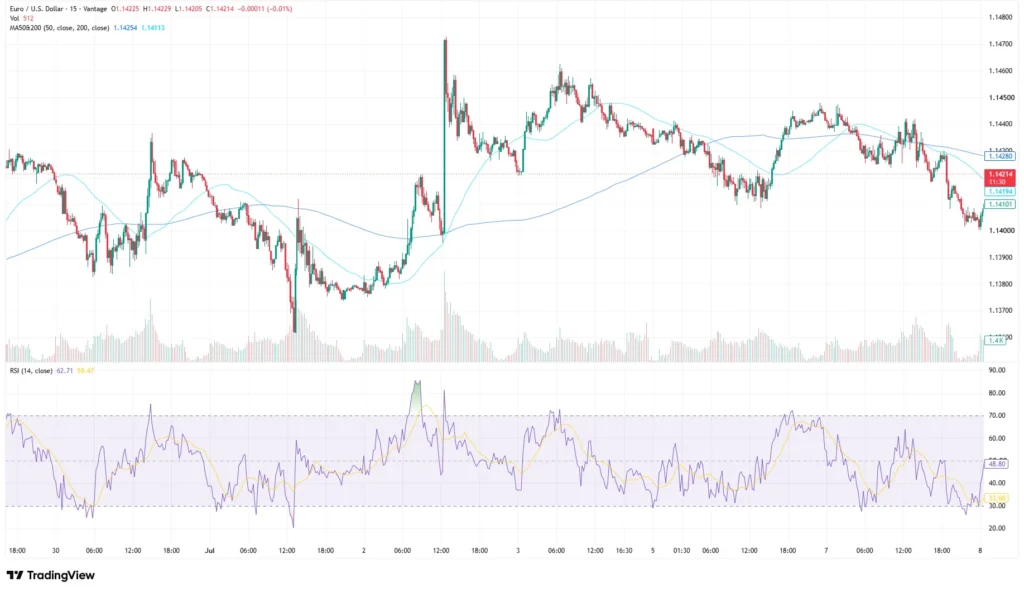
This EURUSD forecast today looks at where EUR to USD stands after a choppy week in FX markets. EURUSD traded at 1.14214 as of 07:03 UTC (15:03 GMT+8) on 8 July 2026, down 0.01% on the session after opening at 1.14225 and ranging between 1.14205 and 1.14229 on the 15-minute chart. The pair is consolidating rather than extending last week’s recovery, as traders weigh a weaker-than-expected US jobs report against the European Central Bank’s first rate hike since 2023.
Key points: EURUSD forecast today
- EURUSD traded at 1.14214 as of the cut-off, sitting between its 50-period moving average at 1.14254 and its 200-period moving average at 1.14113 on the 15-minute chart, a setup pointing to consolidation rather than a clear trend.
- The pair has pulled back from a weekly high close to 1.1480 reached after the 2 July US jobs report showed payrolls rising by just 57,000, well below the 115,000 consensus.[1]
- Traders are watching 14 July, when the US June CPI report is due, and 28-29 July, the date of the next Fed meeting, as the next directional catalysts.[4,5]
EURUSD technical analysis: what the chart is showing
On the 15-minute chart, EURUSD has traded in a tightening range through the Asian session, last changing hands at 1.14214, little changed from the 1.14225 open. This EURUSD technical analysis shows price sitting almost exactly between its 50-period moving average at 1.14254 and its 200-period moving average at 1.14113, a compression reflecting the broader sideways drift since the pair’s spike toward 1.1480 in early July. See the latest EURUSD news here.
The RSI (14, close), read from the TradingView setup used for this analysis, sits at 48.80, roughly mid-range and well off the overbought zone above 70 touched during the early-July rally. Momentum has cooled since then, with the 200-period moving average sitting only a few pips below spot.
With price trading between the 50- and 200-period moving averages and RSI near neutral, the chart currently favours continued consolidation until a catalyst produces a breakout. Tick volume on the latest 15-minute candle remained relatively subdued, suggesting no unusually strong participation behind the latest move.
EURUSD news today: what’s driving the euro and the dollar
The dollar’s broader move lower traces back to 2 July 2026, when the US Bureau of Labor Statistics reported that nonfarm payrolls rose by just 57,000 in June, well short of the 115,000 consensus, while unemployment slipped to 4.2% as labour force participation fell to 61.5%.[1] April and May 2026 payrolls were also revised down by a combined 74,000.[1] The soft print left markets pricing in less near-term tightening from the Federal Reserve under new Chair Kevin Warsh, who took the oath of office in May and held the federal funds rate at 3.50%–3.75% at his first meeting as chair in June.[2]
On the other side of the pair, the European Central Bank raised its three key interest rates by 25 basis points on 11 June, its first hike since 2023, lifting the deposit facility rate to 2.25%.[3] The Governing Council pointed to inflation pressure tied to the Middle East conflict and higher energy costs, and revised its 2026 headline inflation projection up to 3.0%.[3]
That policy divergence, a softer US dollar driven by weaker economic data alongside a relatively hawkish ECB, helps explain EURUSD’s advance from below 1.1400 toward 1.1480, and is the backdrop for this euro to dollar forecast.

EURUSD chart levels traders are watching
The table below covers the EURUSD chart zones traders are monitoring today. These are reference levels, not trade signals.
| Pair | Support | Resistance | What’s happening |
| EURUSD | 1.1411 (200-period MA) / 1.1362 | 1.1440 / 1.1480 | Consolidating between the 50- and 200-period moving averages after last week’s rally |
Table 1: Key levels as of 8 July 2026, 07:03 UTC. Sources: Vantage EURUSD CFD, TradingView. Indicative only.
Price has struggled to clear resistance in the 1.1440-1.1480 band since early July, while the 200-period average near 1.1411 has offered nearby support. A sustained break above 1.1440 or below the 200-period moving average near 1.1411 would suggest the current consolidation phase is ending; holding inside these boundaries keeps EURUSD in the same sideways pattern.
What to watch next for EURUSD trading
- US CPI, 14 July 2026: The June inflation report is scheduled for release at 08:30 ET (20:30 GMT+8). A hotter-than-expected print would reinforce the case for the Fed holding rates steady for longer.[4]
- FOMC meeting, 28-29 July 2026: The next Federal Reserve policy decision lands on 29 July. This meeting does not include a fresh Summary of Economic Projections.[5]
- ECB commentary: Further remarks from Governing Council members on the pace of any additional 2026 rate moves remain a swing factor for the euro leg of the pair.[3]
On risk management: EURUSD has moved inside a roughly 120-pip range over the past week, and the 1.1419 and 1.1480 zones outlined above are levels market participants are using as technical reference points rather than fixed markers. Stop Loss placement relative to these zones is worth revisiting ahead of Tuesday’s CPI print, which has the potential to move the pair sharply in either direction.
Leverage works both ways when EURUSD trading is consolidating ahead of a high-impact data release, and EURUSD CFDs on the Vantage platform can be traded up to 1:1000. Position sizing relative to account equity is worth reviewing before the CPI and FOMC dates above, given the risk of a sharp move once the range resolves.

RISK WARNING: CFDs are complex financial instruments and carry a high risk of losing money rapidly due to leverage. You should ensure you fully understand the risks involved and carefully consider whether you can afford to take the high risk of losing your money before trading.
Disclaimer: The information is provided for educational purposes only and doesn’t take into account your personal objectives, financial circumstances, or needs. It does not constitute investment advice. We encourage you to seek independent advice if necessary. The information has not been prepared in accordance with legal requirements designed to promote the independence of investment research. No representation or warranty is given as to the accuracy or completeness of any information contained within. This material may contain historical or past performance figures and should not be relied on. Furthermore estimates, forward-looking statements, and forecasts cannot be guaranteed. The information on this site and the products and services offered are not intended for distribution to any person in any country or jurisdiction where such distribution or use would be contrary to local law or regulation.
References
[1] “The Employment Situation – June 2026 – U.S. Bureau of Labor Statistics” https://www.bls.gov/news.release/archives/empsit_07022026.htm Accessed on 8 July 2026.
[2] “Kevin Warsh takes oath of office as Chairman of the Federal Reserve – Federal Reserve Board” https://www.federalreserve.gov/newsevents/pressreleases/other20260522a.htm Accessed on 8 July 2026.
[3] “Monetary policy decisions, June 2026 – European Central Bank” https://www.ecb.europa.eu/press/pr/date/2026/html/ecb.mp260611~4d41bd5e83.en.html Accessed on 8 July 2026.
[4] “Consumer Price Index – U.S. Bureau of Labor Statistics” https://www.bls.gov/cpi/ Accessed on 8 July 2026.
[5] “FOMC Meeting Calendars and Information – Federal Reserve Board” https://www.federalreserve.gov/monetarypolicy/fomccalendars.htm Accessed on 8 July 2026.
