
 Updated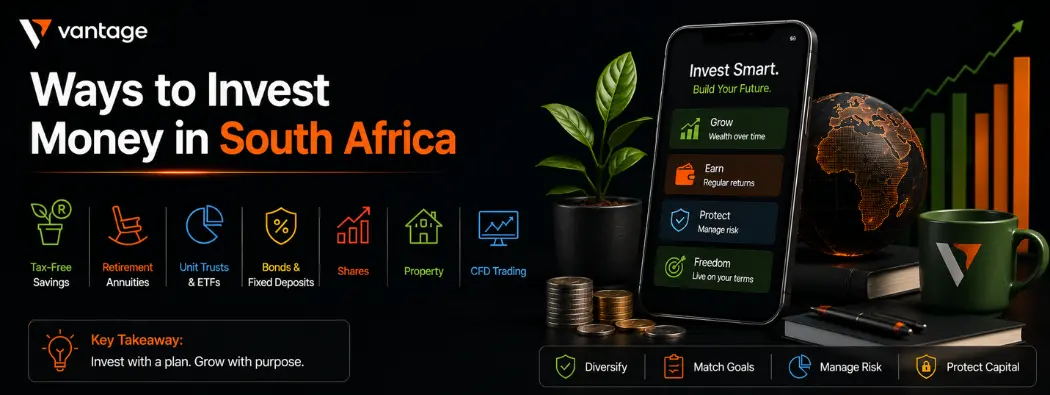
As living costs rise, many South Africans look beyond bank savings to protect their money from inflation. The right choice depends on their goals, time frame, and risk tolerance.
There are two main approaches: investing and CFD trading.
Investing involves buying assets such as shares, ETFs, bonds, or property. These assets may grow in value or produce income through dividends, interest, or rent. However, prices can also fall, causing losses.
CFD trading involves speculating on price movements without owning the asset. Traders can trade rising or falling markets and may use leverage. Leverage can increase gains, but it can also lead to rapid and significant losses.
Common investment options in South Africa include tax-free savings accounts, retirement annuities, unit trusts, ETFs, bonds, shares, and property.
Each option has different costs, risks, tax rules, and possible returns. Investors should choose based on their financial goals and ability to manage risk.
Key Takeaways
- Investing can help savings grow faster than inflation over time, because investments may generate returns while inflation reduces the buying power of cash.
- Your goal and investment time frame should guide your decisions, because money needed in the near future is often invested differently from money set aside for decades.
- Different investment options have different risk levels, because some assets experience larger price swings than others.
- Owning an asset is different from trading a CFD, because investors own the underlying asset, while CFD traders gain or lose based on its price movements without ownership.
- Diversification can reduce concentration risk because if one investment performs poorly, the others might perform well. So the better investments offset the bad ones.
- Capital is always at risk, and losses are possible, because investment values can fall due to market, economic, or company-specific factors.
What to Decide Before You Invest
Before choosing between different investment options, decide what you want your money to achieve. For instance, achieving a short-term goal of buying a car in two years may require a different approach from saving for retirement over several decades. Investments that fluctuate in value can be difficult to rely on when you need access to your money soon.
Risk tolerance(how well you can manage investment losses and market fluctuations) matters as well. Some people are comfortable seeing investment values rise and fall. Others prefer stability, even if potential returns are lower. Being realistic about your comfort with risk can help you avoid emotional decisions during market volatility.
An emergency fund should generally come before investing. Having cash available for unexpected expenses can prevent the need to sell investments at an inconvenient time.
High-interest debt should also be managed carefully. If your debt charges 20% interest per year but your investment returns are lower than the interest you pay on the debt, the debt can grow faster than your investments, potentially leaving you worse off overall.
The investment should fit the goal. Many beginners start by searching for a suitable way to invest money in South Africa, but a more useful question is which investment matches your specific circumstances.

Ways to Invest Money in South Africa
South Africans can choose from several investment routes. Some focus on capital preservation and income, while others aim for long-term growth. Understanding how each option works, who it may suit, and the risks involved can help you make a more informed decision.
Tax-Free Savings Accounts (TFSA)
Tax-Free Savings Accounts offer tax benefits: any growth and withdrawals are tax-free, though there are limits on how much you can invest.
A TFSA can hold cash (money you save), ETFs (funds that hold a collection of investments), unit trusts (professionally managed investment funds from different investors), and other approved investments. Many investors use a TFSA for long-term investing. But more importantly for investors, it is also tax-free, and growth and returns can compound over time.
This option may suit beginners and long-term investors who want a simple structure with tax advantages.
The main risk is that contribution limits are strict and penalties can apply if they are exceeded. The investments held inside the TFSA can also rise or fall in value depending on market conditions. You own the underlying investments within the account.
Retirement Annuities (RA)
A Retirement Annuity (RA) is a long-term investment designed to help you save for retirement. Contributions may qualify for tax benefits.
The account invests your money in underlying funds (investment portfolios that hold different assets) that you or the provider selects. Your investment grows or falls based on how those funds perform over time.
Retirement annuities may suit investors with long-term retirement goals who want tax benefits.
An RA is an account that holds investments rather than being an investment itself. The underlying funds can lose value, fees can affect long-term performance, and access to the money is generally restricted until retirement age. You have exposure to the underlying investments through the RA structure.
Unit Trusts
With a unit trust, your money is pooled with other investors’ money and invested by a professional fund manager. When you invest, you buy units in the fund—the value of those units changes according to the performance of the assets held by the fund manager.
Unit trusts may appeal to investors who prefer a hands-off approach and broad diversification.
Fund management fees reduce returns over time, and the value of the investment can fall during market downturns. Investors own units in the fund itself. Those looking for a lower-cost alternative often compare unit trusts with ETFs.
Exchange-Traded Funds (ETFs)
ETFs (Exchange-Traded Funds) are investment funds holding a collection of assets, such as shares. ETFs are bought and sold like shares on a stock exchange.
Investors can buy ETFs through a broker or hold them in a TFSA. Many ETFs provide exposure to multiple companies through a single investment, helping spread risk. ETFs may suit investors seeking diversification and those who want a relatively low-cost investment.
Market declines can reduce ETF values, and offshore ETFs introduce currency risk. Investors own ETF units rather than individual shares. ETFs are often considered when researching how to invest money in South Africa with a long-term perspective.
Government and Retail Bonds
Government and retail bonds involve lending money to the government in exchange for interest payments over a fixed period. RSA Retail Savings Bonds are available through South Africa’s National Treasury and offer different term lengths.
These investments may suit people seeking capital preservation and predictable income.
Returns may grow more slowly than inflation, which can reduce your purchasing power over time. Your money may also be locked in for a set period. Investors earn interest and receive their original investment back when the bond matures.
Fixed Deposits and Money Market Accounts
Fixed deposits and money market products are designed for capital preservation and short-term savings.
They usually require funds to remain invested for a specific term. Money market accounts usually allow easier access to your money than fixed deposits.
These products may suit investors prioritising stability over growth.
The main drawback is that your money may grow more slowly than inflation, reducing its buying power. Fixed deposits can also restrict access to your money until the agreed term ends. Your funds remain as cash with the bank rather than being invested in assets that may offer higher growth potential.
Shares: Local and Offshore
Shares represent ownership in a company. Investors can buy South African shares listed on the Johannesburg Stock Exchange or invest in companies based outside South Africa through an investment platform.
Shares may suit investors willing to accept market volatility(how much and how quickly investment prices rise and fall) in pursuit of long-term growth.
Individual company shares can fall sharply in value, and overseas investments can be affected by exchange rate fluctuations. Investors own the shares directly. This differs from share CFDs, where traders speculate on price movements without owning the underlying company shares.
Property and REITs
Property investing can involve purchasing physical real estate or investing in Real Estate Investment Trusts (REITs).
Owning a property requires a substantial capital investment and can incur ongoing maintenance costs. REITs offer exposure to listed property through exchange-traded securities (investments bought and sold on a stock exchange).
REITs may appeal to investors seeking exposure to real estate markets.
Direct property can be difficult to sell quickly and may involve ongoing costs such as maintenance and management. REIT values can rise or fall with market conditions. Investors either own the property directly or own units in a real estate investment trust (REIT).
CFDs and Active Trading
Contracts for Difference, also called CFDs, are a form of trading in which traders speculate on price movements without owning the underlying asset. CFDs can be used to trade forex (currencies), commodities (raw materials such as gold or oil), indices, and shares (company stocks).
CFDs use margin (the deposit required to open a trade) and leverage (borrowing exposure to control a larger position with less money). Traders can also profit from long positions (buying in anticipation of a price increase) and short positions (selling in anticipation of a price decrease).
Experienced and active traders usually trade CFDs. They monitor positions regularly and manage risk effectively.
The risks are substantial; leverage magnifies both losses and gains. Rapid market movements can result in significant losses, and traders can lose money quickly when markets move against their positions.
Unlike shares, ETFs, bonds, or property, CFDs do not provide ownership of the underlying asset. They are trading instruments rather than traditional investments.
Vantage Markets offers CFD trading across a range of markets. CFDs should be considered carefully and understood fully before trading.
Owning an Asset vs Trading a CFD
One of the most important distinctions when considering ways to invest money in South Africa is the difference between owning an asset and trading a CFD.
When you invest in shares, ETFs, bonds, unit trusts, or property, you own the asset or units in a fund. Your returns depend on how the investment performs over time.
CFDs work differently. CFDs allow you to speculate on price movements without owning the underlying asset. Traders can take positions on rising markets (when they expect prices to increase) or falling markets (when they expect prices to decrease) and often use leverage (controlling a larger position with a smaller deposit), which can increase both profits and losses.
| Feature | Owning the Asset | Trading a CFD |
| Ownership | You own the asset or fund units. | You do not own the underlying asset. |
| leverage | Usually none. | Often uses leverage. |
| Time horizon | Typically months or years. | Often short-term. |
| Income | May receive dividends or interest. | No ownership income. |
| Main risk | Asset values can fall. | Leverage can magnify gains and losses. |
| Example providers | Banks, stockbrokers, fund managers. | CFD brokers such as Vantage Markets (Pty) Ltd, FSP 51268, FSCA. |
How to Start Investing in South Africa
If you are wondering how to start investing in South Africa, a simple process can help you avoid common mistakes.
- Set a goal and time frame. If you need money for a house deposit in three years, you may choose lower-risk investments than someone saving up for retirement in 25 years, who might need a long-term investment option.
- Choose an investment route. Someone seeking to profit from long-term investment growth may consider shares or ETFs, while someone prioritising capital preservation may prefer a fixed deposit or a bond.
- Choose a regulated provider. For example, use a bank, broker, or investment platform that is authorised to offer financial services in South Africa.
- Verify the provider. Before investing, check the provider on the FSCA register to confirm it is properly licensed.
- Start small. Instead of waiting until you have R10,000, you could begin by investing a few hundred rand each month and build from there.
- Review periodically. For example, review your investments every six or twelve months to check whether they still align with your goals and risk tolerance.
Many beginners searching for the best way to invest their money in South Africa focus on returns first. In practice, choosing an investment that fits your goals and risk tolerance is usually more important than chasing the highest potential return.
Costs, Tax, and Regulation to Keep in Mind
Every investment comes with costs and fees. And you have to pay from your returns. The most common are: management and platform fees, brokerage commissions, and transaction costs.
So, to ensure you know how much return you can have when comparing investment options, focus on the total cost rather than a single advertised fee.
Tax is another consideration. Capital gains tax may apply when certain investments are sold at a profit. Interest and dividend income may also have tax implications depending on the investment.
Tax-Free Savings Accounts provide tax advantages because qualifying growth and withdrawals are tax-free, subject to SARS contribution limits. Investors should always check the latest limits and rules directly with SARS.
Regulation matters as well. The FSCA oversees South Africa’s financial services industry. Before investing, verify that the provider is properly authorised and regulated.
Understanding costs, taxes, and regulations can help you make more informed investment decisions to avoid unnecessary surprises. This information is educational and should not be considered financial advice.
Common Mistakes New Investors Make
Many beginner investors make avoidable mistakes.
- Investing without an emergency fund. If unexpected expenses come up and you need cash urgently, you may be forced to sell your investments, even at a loss. Consider building an emergency fund before investing.
- Chasing past performance. An investment that performed well last year may not perform well next year. Focus on your goals rather than recent returns.
- Ignoring fees. Small fees you pay can increase over time, and when subtracted from returns, reduce profits. Always compare the total cost before investing.
- Using too much leverage, as with leverage, where you control large positions (trade) with a small deposit. If the market moves in your favour, you make higher profits; if it doesn’t, you incur significant losses. It is important to understand the risks of leverage before using it, as it can magnify both gains and losses.
- Putting everything into one investment. If that investment performs poorly, your portfolio could suffer significantly. Spreading money across different investments can reduce risk.
- Investing without a plan. Making decisions based on emotions or market headlines can lead to mistakes. Set a goal, choose a time frame, and follow a consistent strategy.
Conclusion
There are many ways to invest money in South Africa, ranging from tax-free savings accounts and bonds to shares, ETFs, property, and CFDs.
The most suitable investment depends on your goals, how long you plan to invest, and how much risk you are comfortable taking. Lower-risk options generally experience lower price volatility, although losses remain possible. Higher-risk investments may offer greater growth potential but can also result in larger losses.
It is also important to understand the difference between owning an asset and trading a CFD. Investors own the underlying asset, while CFD traders speculate on its price movements without owning it.
Before committing funds, it is important to understand the investment, review the risks, and choose a regulated provider. If you are interested in trading, then practice with a demo account before risking real money.
Frequently Asked Questions
What is the best way to invest money in South Africa?
There is no single option that suits everyone. The right investment depends on your goals, how long you plan to invest, and how much risk you are comfortable taking. For instance, someone saving for retirement in 25 years may choose ETFs, while someone saving for a house deposit in three years may prefer lower-risk options. Many investors use a mix of investments to spread risk.
How can I start investing with a small amount?
You can start investing in TFSAs and ETFs with as little as a few hundred rand. Many investors choose regulated providers, set clear investment goals, and invest regularly.
What is the difference between investing and trading?
Investing involves buying and owning assets such as shares, ETFs, bonds, or property, often for the long term, to profit from increases in their value. Trading focuses on shorter-term price movements. CFD traders speculate on price movement rather than owning the underlying asset and may use leverage, which increases risk.
How much money do I need to start investing?
The amount depends on the investment and provider. Some products allow you to start with a few hundred rand. Starting early and investing consistently is often more important than the amount you begin with.
Is investing money in South Africa safe?
No investment is completely risk-free. Some investments carry less risk than others, but losses are always possible. Understanding the risks and using regulated providers can help you make more informed decisions.
Can I lose money in a TFSA?
Yes. A TFSA provides tax benefits, but the investments held inside the account can still rise or fall in value. Your risk depends on the investments you choose
Do I pay tax on investment profits in South Africa?
Some investment profits may be taxed, depending on the type of investment and how the profit is earned. TFSAs offer tax benefits, but contributions are subject to limits. If you are unsure, consider seeking professional tax advice.
Risk Warning: CFDs are complex financial instruments and carry a high risk of rapid loss of money due to leverage. You should ensure you fully understand the risks involved and carefully consider whether you can afford to take the high risk of losing your money before trading.
Disclaimer: The information is provided for educational purposes only and doesn’t take into account your personal objectives, financial circumstances, or needs. It does not constitute investment advice. We encourage you to seek independent advice if necessary. No representation or warranty is given as to the accuracy or completeness of any information contained within.
This material may contain historical or past-performance figures and should not be relied upon. Furthermore, estimates, forward-looking statements, and forecasts cannot be guaranteed. The information on this site and the products and services offered are not intended for distribution to any person in any country or jurisdiction where such distribution or use would be contrary to local law or regulation.