
 Updated
We all know (and love) gold as the shiny yellow metal that is worth a whole lot of money. But why is it worth so much, and what makes it so valuable? For those wondering how to start investing in gold, understanding why gold has value is the perfect first step.
Well, gold is a rare metal available in limited quantities, which makes it scarce and increases its value when demand rises. Moreover, gold is one of the most useful metals, with numerous commercial applications in electronics, healthcare, dentistry, and aerospace. If you’re considering gold investment for beginners, these scarcity and utility are core reasons investors value it.
Of course, gold is also highly popular as jewellery – its lustrous, malleable nature lends itself well to creating attractive designs for a variety of pieces, from necklaces to bangles and rings.
Key Points
- Beginners have multiple ways to invest in gold, including physical gold, Gold IRAs, gold CFDs, and gold ETFs, each offering different benefits and considerations.
- Gold is highly valued for its scarcity, usefulness across various industries, and historical role as a financial asset, making it a sought-after commodity in times of economic uncertainty.
- Gold provides a hedge against market volatility and has shown substantial long-term appreciation, making it a viable option for diversifying investment portfolios, especially if you’re learning how to start investing in gold.
Why is Gold Valuable?
Clearly, gold has intrinsic value due to its industrial importance and status as a valuable natural resource. This foundational understanding matters if you’re evaluating how much money you need to invest in gold and why it holds up during uncertainty.
But gold’s most important role is its place in our financial system. Because of its scarcity and high value, gold was used as a medium of exchange, with gold coins used as money over 6,000 years ago. When society adopted paper currency, gold served as backing, guaranteeing the value of banknotes.[1]
After shifting to a fiat currency system – where the value of bank notes is backed by the government that issues them – gold remains a highly desired commodity and investment asset. This is best demonstrated by central banks, which maintain gold holdings as part of their reserves to ensure liquidity.
Amidst the current global uncertainty, gold is once again proving its worth. Central banks have been buying record levels of gold since 2021, making the shiny metal one of the best-performing asset classes at the start of 2024 [2]. From 2019 through 12 April 2024, gold outperformed the S&P 500, rising an impressive 81.65% compared to the S&P 500’s 76.22% increase [3]. For those researching investing in gold for beginners, these data points show why interest has surged.
Is Gold a Good Investment? [4]
While demand for gold has surged in recent years, investors should understand that gold has a rather inconsistent track record as an investment asset. The following chart shows the price of gold vs the stock market (represented by the Dow Jones Industrial Average, DJIA) over the past 30 years —useful context for how to start investing in gold with realistic expectations.
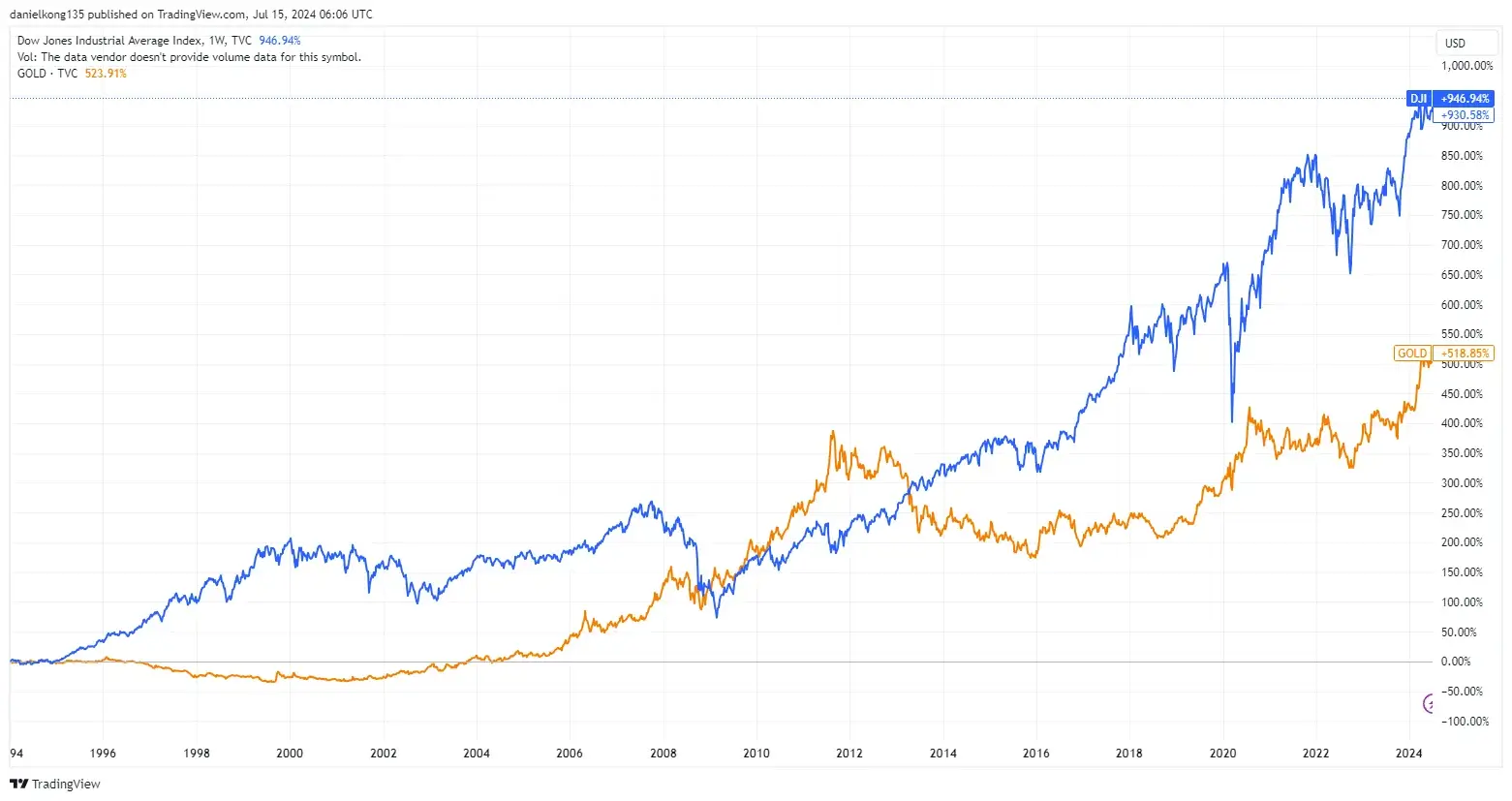
The orange line plots the price of gold, and the blue line shows the DJIA. The grey bars represent periods of recession.
In terms of total returns, you can see that the stock market provides much higher returns, with the DJIA growing by over 900% over the past 30 years. Meanwhile, gold has appreciated by around 500%.
Thus, this shows that a 30-year portfolio tracking the DJIA would have significantly higher returns compared to one purely made up of gold.
But that doesn’t mean gold isn’t a good investment. Notice the period between 2008 and 2013, when gold price clearly outperformed the DJIA. This (and other similar historical instances) mark gold as an asset class all its own, and may have low or even negative correlation with equities—one reason investing in gold for beginners often focuses on diversification.
Discover the dynamics of gold prices and their trends with our comprehensive article, ‘Gold Price Over 10 Years and Gold Trend Analysis’.
As such, given its inherent value, gold may be helpful for portfolio diversification, allowing investors to hedge against a degree of market risk. Indeed, given its continued strong demand from central banks and institutional investors, gold remains one of the safest investment assets of all time—key takeaways for gold investment for beginners.

Why do Investors like Gold?
Liquidity
In investing, liquidity refers to the ease and speed with which an asset can be bought or sold in a secondary market. An example of a highly liquid asset is stocks, which can be sold quickly if needed. In contrast, real estate is an illiquid asset class – it typically takes weeks or months to complete a sale.
The gold market is one of the largest and most liquid global markets available. Physical gold holdings worldwide are estimated at around US$5.1 trillion, with an additional US$1 trillion in open interest via derivatives. For investing in gold for beginners, this liquidity makes entry and exit straightforward.
Gold has even higher liquidity than some financial markets (EUR/JPY, DJIA), and the market sees trading volume similar to that of U.S. Treasury Bills.
The high liquidity of the gold market means retail investors can freely execute their trades without undue delay. This facilitates efficient trading at fair prices. High liquidity also enables traders to enter and exit positions quickly, facilitating risk management.
Diversification [5]
Diversification is a popular risk-hedging strategy. By spreading your investments across assets with low correlations, you may reduce the effects of market volatility and severe downturns.
As discussed earlier, gold’s low correlation with the stock market makes it an effective portfolio diversifier.
During the Great Financial Crisis of 2008, equities, hedge funds, real estate, and most commodities fell. Gold stood out as the exception, not only holding its value but also rising 21% over the period, as shown in the chart below. This attribute is frequently highlighted in guides on how to start investing in gold.

Store of Value
Because of its unique role in our society, gold is globally acknowledged as a store of value. It enjoys high demand and is influenced by the dynamics of supply and demand as a scarce natural resource.
Furthermore, gold has maintained its status as a trusted store of value throughout history, reflecting its enduring appeal and limited availability—insight that’s vital for readers exploring investing in gold for beginners.
All these factors are why gold remains one of the few asset classes that have held its value throughout history. Compare this to stocks, which become worthless if the company issuing them collapses.
Thus, by investing in gold, investors can preserve a portion of their funds against risks in a way that other asset types cannot.
Returns
Another reason investors like gold is that it tends to appreciate over time.
Refer to chart 1, which compares gold prices to the DJIA. In that chart, we see that gold has appreciated by around 500% over the past 30 years, proving its long-term value.
This remarkable growth demonstrates gold’s resilience and reliability as an investment, even during periods of economic uncertainty.
How to Invest in Gold for Beginners
1. Gold IRA
You can transfer part of your contributions to your Individual Retirement Account (IRA) into a gold-investing IRA.
Doing so allows you to diversify your retirement savings into gold, potentially benefiting from the asset class. Be sure to check your local regulations to choose the best type of gold IRA for your needs.
2. Physical Gold (Bullion and Jewellery) [6]
Physical gold is widely available for sale in the forms of bars and coins. You can purchase gold bullion from a variety of sources, such as dealers and pawn shops. While some may like the physical look and feel of gold, owning physical gold also requires proper, secure storage – whether at home or with a custodian. For investing in gold for beginners, storage and premiums are key considerations.
Note that buying gold jewellery is not the same as investing in physical gold, as the gold used in each case has different purities. Investment-grade physical gold must have a purity of at least 99.5%.
However, such high-purity gold is unsuitable for jewellery, as it can be easily deformed through everyday use. Instead, gold jewellery often uses a mix of gold and other metals to enhance strength, resulting in lower purity.
Thus, investors wishing to buy gold jewellery as an investment should take care to choose only 99.5% pure gold, and recognise that lower-purity gold jewellery can dilute the value of their gold holdings—a practical nuance for how to start investing in gold the right way.
3. Gold CFDs
Some people may wonder how to invest in gold for beginners with little money. Gold CFDs (Contract for Difference) are often one of the most accessible ways to start, as they typically require a lower minimum threshold compared to buying physical gold. However, this method is also more risky because CFDs use leverage, which can magnify both gains and losses.
Gold CFDs (Contract for Difference) allow investors to speculate on gold prices without owning the physical metal, providing flexibility in investment strategies. This approach allows investors to earn returns from both rising and falling gold prices.
Traders can engage with products such as Gold vs Australian Dollar (XAU/AUD), Gold vs Euro (XAU/EUR), and Gold vs US Dollar (XAU/USD), each reflecting different currency influences on gold prices.
4. Gold Futures [7]
Gold futures contracts are agreements between buyers and sellers to purchase a certain amount of gold at a specific price on a specific date, regardless of market conditions.
Traders use futures to hedge against unexpected market movements, but investors can also use gold futures to speculate on gold’s price movements.
Be advised that this is a highly advanced investing strategy, and is better left to experienced investors—an important caution for gold investment for beginners.
5. Gold ETFs and Gold Mining Stocks
Another way to invest in gold is via gold ETFs and gold mining stocks.
Gold ETFs invest in a basket of gold-related assets, ranging from gold stocks to gold futures contracts to the physical metal itself.
As such, there is a wide variety of gold ETFs available with different compositions and areas of focus, offering investors a rich selection. If you’re unsure which one to go with, look for a gold ETF with a strong track record of keeping pace with gold’s historical returns.
Meanwhile, gold mining stocks are issued by companies engaged in prospecting, mining, and distributing physical gold. You can choose to invest in gold mining stocks as an alternative to gold ETFs, but beware of overly concentrating your positions.
For more detailed insights, check out our article titled ‘Sprott Gold Miners ETF (SGDM): What You Need To Know,’ which provides an in-depth look at gold miners ETFs.
Conclusion: Gold, a Frontier Worth Exploring
Perhaps the best testament to gold is how it remains relevant and in demand even throughout all this time. Where currencies and other asset classes have come and gone, gold has stood the test of time as a store of value, medium of exchange, and safe-haven asset. This enduring role is a compelling reason for investing in gold for beginners.
Investors shouldn’t ignore this asset class in the pursuit of high returns. By incorporating gold’s unique strengths, investors can build resilience in their portfolios to better ride out economic uncertainty.
Ready to start trading gold? Sign up for a live account with Vantage today and trade gold (XAUUSD) CFDs to seize trading opportunities whether prices increase or fall, without the need to own the physical metal.
Frequently Asked Questions
How do I start investing in gold?
You can start investing in gold by choosing a method that suits your budget and goals. Popular options include physical gold, gold ETFs, gold mining stocks, gold CFDs, and gold-backed retirement accounts. Beginners typically start by opening a trading account with a regulated broker and selecting the gold products they want to trade or invest in.
Which gold investment options are safest for beginners?
Gold ETFs and physical gold (such as bullion or coins) are generally considered the safest options for beginners. They offer direct exposure to gold prices without the complexities of leverage or futures trading. Gold ETFs, in particular, provide an easy, low-cost, and diversified way to invest.
How much gold is a good first-time investment?
There is no fixed amount, but beginners can start small depending on the product. It’s best to invest only what fits your risk tolerance and financial goals.
How much money do you need to invest in gold?
You don’t need a large amount to start investing in gold. The minimum depends on the method you choose. Gold ETFs and gold CFDs allow you to begin with a lower initial capital, while buying physical gold typically requires a larger upfront payment. The key is to choose an amount that aligns with your budget and risk tolerance.
Is it worth investing in gold for beginners?
Yes, gold can be worthwhile for beginners because it helps diversify a portfolio and acts as a hedge during inflation or market volatility. While gold isn’t designed for fast growth, its stability makes it a useful long‑term store of value.
How do I open an account to buy gold stocks?
To buy gold stocks, open an account with a regulated brokerage or trading platform like Vantage. After verifying your identity and funding your account, you can search for gold mining companies or gold-related ETFs and place your first trade directly through the platform.
References:
- “The Many Uses of Gold – Geology.com”. https://geology.com/minerals/gold/uses-of-gold.shtml. Accessed 15 July 2024.
- “Gold Shines So Far in 2024 as Central Banks Invest Heavily – Investopedia”. https://www.investopedia.com/gold-shines-so-far-in-2024-as-central-banks-invest-heavily-8672711. Accessed 15 July 2024.
- “Gold vs. S&P 500: Which Has Grown More Over Five Years? – Visual Capitalist”. https://www.visualcapitalist.com/gold-vs-sp-500-which-has-grown-more-over-five-years/. Accessed 15 July 2024.
- “Gold Price vs Stock Market – 100 Year Chart – Macrotrends”. https://www.macrotrends.net/2608/gold-price-vs-stock-market-100-year-chart. Accessed 15 July 2024.
- “Gold’s key attributes – 2. Diversification – World Gold Council”. https://www.gold.org/goldhub/research/relevance-of-gold-as-a-strategic-asset/golds-key-attributes-2-diversification. Accessed 15 July 2024.
- “How to start investing in gold: A beginner’s guide – Standard Chartered”. https://www.sc.com/sg/wealth/insights/how-to-invest-in-gold/. Accessed 15 July 2024.
- “How To Invest In Gold For Beginners – CBS News”. https://www.cbsnews.com/news/how-to-invest-in-gold-for-beginners/. Accessed 15 July 2024.