
 Updated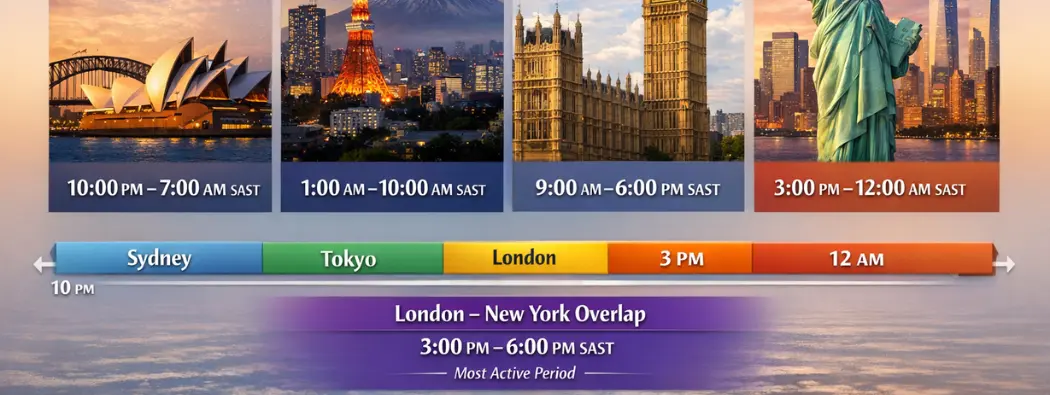
The timing of your US30 trading hours in South Africa can make or break your deals. Spreads change, volatility comes in waves, and US news hits at odd hours in South Africa. By ignoring the time difference between South Africa and New York, you are often paying more and getting fewer moves.
This article explains how South African traders can adjust U.S. market trading hours to fit their work, sleep, and family schedules.
In this guide, you’ll learn…
- US30 session times in South African Standard Time (SAST)
- How New York, London, and Asian sessions overlap in SAST
- The best times and days to trade US30 from South Africa
- Why is US30 sometimes unavailable or more expensive to trade
- How to build trading routines that respect sleep, work, and family time
Risk warning: US30 and CFD trading involve high risk and leverage. Timing can help you avoid bad conditions, but it cannot guarantee profits. This guide is for educational purposes only and does not constitute financial advice.
Why US30 Trading Hours Matter for South African Traders
Most traders focus on signals and systems but pay little attention to time. But with US30, time is a significant factor. Time is one factor traders often consider when planning their sessions, along with strategy and risk management.
US30 is based on the US stock market, the Dow Jones index. The DJIA follows New York trading hours, not South African hours.
South Africa is several hours ahead of New York. That means the most active US30 moves often happen late in your day.
So while Wall Street is starting its workday, you may be driving home from work or putting kids to bed. If you ignore the time zone gap, you run into problems. You:
- trade when the market is half asleep
- fight with wide spreads and slow moves
- end up tired, forcing trades late at night.
Your job is not to match New York. Your job is to map New York hours onto an existing life.
Liquidity, volatility, and spreads change all day long.
The US30 chart may look “24 hours.” However, the quality of those hours varies significantly.
When liquidity is high
Liquidity is higher when:
- New York is open
- London and New York sessions overlap
- Major news hits (US jobs data, CPI, Fed, etc.)
During these times:
- Spreads often tighten
- Orders fill faster and cleaner
- Your stop loss is less likely to get hit by “random” noise
- Breakouts and trends have more follow-through
Liquidity and price movements tend to be more structured during these periods, but outcomes vary by individual trades.
When liquidity is low
Liquidity tends to drop:
- Late at night in South Africa, after the US cash close
- During quiet Asian hours
- Around daily rollover or platform maintenance
In these low-liquidity pockets:
- Spreads can blow out without warning
- Slippage on entries and exits becomes more common
- Price can “jump” between levels with no real flow
- Your tight stops can get hunted with one random spike
The pattern is simple: Good liquidity → better fills, cleaner moves.
Poor liquidity → more noise, stress, and surprises.
South African life: work, family, then charts
Many South African traders have full-time jobs. Many also have kids, partners, parents, and community duties.
You cannot just say, “I will trade all New York hours.” You would destroy your health and your relationships.
So you must choose realistic windows:
- Before work (early morning check and maybe London open)
- After work (short session around the New York Open)
- Short evening session, then screens off at a set time.
You may want to ask yourself;
- What time do I leave for work?
- What time do I get home?
- When do I need to be present for my family?
- How much energy do I still have in the evening?
These questions will help you choose one or two blocks to focus on.

Core US30 Trading Sessions in South African Time
In forex and index trading, the New York session is key. If you trade from South Africa, you must understand how time zones and daylight savings time change that session on your chart.
New York time basics
New York uses Eastern Time (ET). It has two modes during the year:
- Eastern Standard Time (EST) → UTC-5
- Eastern Daylight Time (EDT) → UTC-4
In simple terms:
- During the US winter, New York is on standard time (EST)
- During the US summer, New York is on daylight time (EDT)
Twice a year, the US changes its clocks:
- In spring, clocks move one hour forward (EST → EDT)
- In autumn, clocks move one hour backwards (EDT → EST)
This looks small.
But for a trader in South Africa, it shifts your active New York window by one full hour.
Time difference: South Africa vs New York
Let’s compare SAST (UTC+2) with Eastern Time:
| When New York is on EST (UTC-5) | SAST (UTC+2) is 7 hours ahead |
| When New York is on EDT (UTC-4) | SAST (UTC+2) is 6 hours ahead |
The time gap is either 7 or 6 hours, depending on the time of year.
That is the core idea:
- Winter in New York → South Africa is +7 hours
- Summer in New York → South Africa is +6 hours
New York session in South African time
The US stock market “cash session” in New York runs typically:
09:30 – 16:00 New York time
This is the key window for many US30 (Dow Jones) traders.
- Liquidity is high
- Spreads often tighten
- News can hit
- Big intraday moves often begin here
During New York Standard Time (EST, UTC-5)
In the US winter, New York is on EST (UTC-5). South Africa is still SAST (UTC+2).
The difference is 7 hours. To convert the New York cash session to South African time, add 7 hours:
- New York open: 09:30 + 7 hours = 16:30 SAST
- New York close: 16:00 + 7 hours = 23:00 SAST
During New York Standard Time, the main US cash market session for SA traders is 16:30 – 23:00 SAST. For many traders in South Africa, this answers the question “What time does US30 open in South Africa during the New York winter?”:
US30 cash market activity starts around 16:30 SAST and runs through the evening to 23:00 SAST.
During New York Daylight Time (EDT, UTC-4)
In the US, during the summer, New York is on EDT (UTC-4). South Africa is still SAST (UTC+2). Now the difference is 6 hours.
Add 6 hours to convert:
- New York open: 09:30 + 6 hours = 15:30 SAST
- New York close: 16:00 + 6 hours = 22:00 SAST
So, during New York daylight time, the US cash session for SA traders is: 15:30 – 22:00 SAST
In this period, when traders ask “What time does US30 open in South Africa during the New York daylight time?, the simple answer is: The main US30 cash session starts around 15:30 SAST and closes around 22:00 SAST, as long as New York is on daylight time.
London and Asia sessions in South African time
Trading the US30 from South Africa and watching New York alone is impossible because market flows depend on both the London and Asian sessions.
| Session | Local | Approx. Time in South Africa (Standard) | Approx. Time in South Africa (Daylight) | Notes |
| Asia session | Roughly 00:00–09:00 UTC | 02:00–11:00 SAST | 02:00–11:00 SAST (no-change) | Quieter US30 most of the time; can move on global risk events |
| London session | About 08:00–16:00 | ≈ 10:00–18:00 SAST (UK on GMT) | ≈ 09:00–17:00 SAST (UK on BST) | High forex liquidity helps set trend before and into US pre-market. |
| Newyork cash session | 09:30–16:00 ET | 16:30–23:00 SAST | 15:30–22:00 SAST | Main US30 window |
| US pre-market/ after-hours | Pre-market: 04:00–09:30 ET After-hours: roughly 16:00–20:00 ET | Pre-market: 11:00–16:30 SAST After-hours: 23:00–03:00 SAST (next day) | Pre-market: 10:00–15:30 SAST After-hours: 22:00–02:00 SAST (next day) | Thinner liquidity; can still see sharp US30 spikes around news or earnings |
US30 Broker Trading Hours vs Underlying Market Hours
The underlying Dow Jones cash market trades on the New York Stock Exchange, with a regular session from 09:30–16:00 New York time. This is when the “real” stocks in the index change hands. Liquidity is deepest here, and price moves can be more meaningful.
However, US30 CFDs are broker products. They usually follow index futures hours, not just the cash session. This can mean:
- Longer trading windows
- Short overnight breaks
- Daily maintenance or reset periods
Because of this, you might be able to trade US30 CFDs outside the 09:30–16:00 cash window, but with different spreads and volume.
The exact US30 CFD trading hours vary by broker. They can change based on liquidity providers and platform settings. You should always check:
- The product specification
- The Market Watch details on your platform
For example, Vantage offers CFDs on indices that track futures and cash trading sessions. Traders can see the exact schedule for US30 in MT4/MT5 by right-clicking the symbol, choosing “Specification”, and reading the trading hours listed there.
Why is US30 sometimes “closed” or spreads are wider?
You may notice US30 is “closed” or shows vast spreads at times. Common reasons include:
- Daily maintenance or rollover: Trading is paused briefly to allow servers and pricing to reset.
- Weekends and global public holidays: When the underlying market is closed, CFD trading may also stop or thin out.
- Around major news releases, Liquidity providers widen spreads to manage risk before and after big data.
- Tranquil sessions (like late Asia): Fewer active participants mean thinner liquidity and wider spreads.
What can you do as a trader?
- Check the instrument specification for US30 in your platform.
- Watch the Market Watch status and current spread.
- View your broker’s trading hours page on their website.
- Avoid forcing trades during periods of low liquidity or extreme spreads, even if the market is technically open.
Best Times to Trade US30 from South Africa
When people ask for the best times to trade US30, they really want balance. Good movement, but not chaos. Time to focus without burning out.
Volatility sweet spots in SAST
1. US cash market open
The US cash session opens at 09:30 New York time. From South Africa, this is:
- Around 16:30–23:00 SAST when New York is on standard time
- Around 15:30–22:00 SAST when New York is on daylight time
The first 1–2 hours after the cash open are often wild.
Spreads can jump.
Moves can be fast and sharp.
Breakouts and fakeouts both happen a lot.
Many traders observe increased activity during this period, but trading decisions should depend on individual circumstances.
2. Major US news releases
Big US news like NFP, CPI, and Fed decisions often hit in the SA afternoon or evening.
Standard times in South Africa:
- Key data (like NFP, CPI): early afternoon SAST
- Fed rate decisions and press events: evening SAST
3. London – New York overlap
When London is still open, and New York is waking up, you get a potent flow mix.
For many SA traders, this is roughly mid-afternoon, around 15:00–17:00 SAST, depending on daylight changes.
Character: more structured intraday moves. You still get volatility, but often cleaner trends than pure news spikes.
Many swing and day traders see this overlap as one of the best times to trade the US30 with more control.
Matching trading windows to your lifestyle
Full-time worker (9–5 job)
You get home, eat, then sit at the charts.
Practical windows:
- 18:00–21:00 SAST
- Or a shorter burst like 19:00–20:30 SAST
| PROS | CONS |
| You catch the heart of New York’s cash hours | You trade when you’re tired from work |
| Plenty of movement on US30 | Less time with family or friends |
Flexible or remote worker
You can shape your day around intense sessions.
Practical windows:
- 14:00–17:00 SAST (London–US overlap build-up)
- 15:30–18:00 SAST (early New York push)
| PROS | CONS |
| You can trade when both London and New York are active. | You must protect focus and avoid trading all day |
| Ability for you choose times when your mind feels sharpest |
Early-morning or quieter-session trader
Some traders prefer less noise.
Practical windows:
- 02:00–05:00 SAST (late US / early Asia)
- 07:00–09:00 SAST (Asia winding down, pre-London prep)
| PROS | CONS |
| The charts are calmer, fewer huge spikes | US30 can be slow |
| More leisurely if you like routine and quiet mornings | Wider spreads are typical in thin liquidity |
Volatility vs control – timing is not your edge by itself.
Knowing the best times to trade the US30 is helpful. But time alone is not an edge.
Your real edge comes from:
- A tested strategy
- Strict risk management
- Strong execution and discipline
Track your own data. Journal which sessions you trade, how volatile they feel, and how you perform. Over time, you will see which SAST windows fit your style, your mind, and your life.
Related reading: Learn more about Forex Sessions and Timing in SAST
Risk Management Around High-Volatility Trading Hours
High-volatility periods on the US30, such as the US cash open and major news releases, can be both exciting and dangerous.
You might see big moves and fast profits, but losses can grow just as quickly.
During these windows, your risk rules must be tighter, not looser.
- Use smaller position sizes than usual.
- Plan your stop-loss distance and accept that slippage may occur when the price moves quickly.
- Avoid moving stops just because candles look crazy in the moment.
- Fast markets also tempt traders to overtrade.
You see movement and feel pressure to “catch every move.”
This often leads to revenge trading, chasing entries, and breaking your own rules.
Set clear, written limits such as:
- A daily loss limit (for example, stop trading after a set % or amount lost).
- A maximum number of trades per session.
- A rule to take a break after a big win or significant loss, so your emotions can cool down.
Risk management is not only about money. Your health and sleep matter too. If you repeatedly trade very late at night, your focus and decision-making will decline. Try to avoid long-term schedules that force you to trade while exhausted, even if those hours line up with “perfect” volatility. Use the timing rules in this article alongside sound risk principles.
Pair your chosen session windows with position sizing, stop-loss, and psychology rules from the main US30 trading guide so your overall plan works as a single system, not just a hunt for busy hours.
Tools and Resources to Stay on Top of US30 Trading Hours
To manage US30 trading hours from South Africa, you need the right tools. Start with an up-to-date economic calendar to track NFP, CPI, Fed events, and earnings. Combine this with a reliable world clock/time zone tool so you always know when sessions overlap and daylight saving time changes apply for New York and London.
On MT4/MT5 or your chosen platform, set price and time alerts. For example, trigger an alert 30 minutes before the US cash open, before major news, or at your personal “no-trade” cutoff time. This keeps you organised and prevents you from staring at charts all day.
For quick reference, bookmark this “US30 Trading Hours in South Africa” page, your main “How to Trade US30” guide, and Vantage’s market analysis pages so you can align timing with fresh insights. If you are still testing your schedule, consider opening a Vantage demo account. Use it to try different time windows and routines on US30 before risking real capital.
FAQs About US30 Trading Hours in South Africa
What are the US30 trading hours in South Africa?
US30 is a CFD on the Dow, so hours are set by your broker, not by the exchange.
As a guide, the main US cash market session is:
- About 16:30–23:00 SAST when New York is on standard time (EST)
- About 15:30–22:00 SAST when New York is on daylight time (EDT)
Your broker may offer longer CFD hours around this window.
What time does US30 open and close in South African time?
For the main cash session:
- Open: 09:30 ET → 16:30 SAST (EST) or 15:30 SAST (EDT)
- Close: 16:00 ET → 23:00 SAST (EST) or 22:00 SAST (EDT)
Check the instrument specification or Market Watch for your broker’s exact CFD hours.
How do daylight saving changes in the US affect US30 trading times in South Africa?
South Africa stays on SAST (UTC+2) all year. New York switches between EST (UTC-5) and EDT (UTC-4). That means the time gap changes:
- 7 hours during US standard time
- 6 hours during US daylight time
So the US30 cash open shifts by one hour on your SAST clock.
Can I trade US30 outside regular US stock market hours?
Yes, most brokers offer extended CFD hours based on index futures. But spreads can be wider, and moves may be slower outside the main cash session. Always check your broker’s trading hours for US30.
Is it safe to trade US30 late at night from South Africa?
The platform might be open, but that does not mean it is wise. Late sessions can have thin liquidity and wide spreads. Also, trading while tired hurts your decisions. Try to avoid schedules that often cut into sleep and health.
Do all brokers have the same US30 trading hours, and can other African traders use these times?
No. US30 CFD hours vary by broker, server time, and liquidity provider. Always confirm in the product specification or Market Watch. Traders in other African countries can still use these times by adjusting for their local time zone relative to SAST and New York.
RISK WARNING: CFDs are complex financial instruments and carry a high risk of losing money rapidly due to leverage. You should ensure you fully understand the risks involved and carefully consider whether you can afford to take the high risk of losing your money before trading.
Disclaimer: The information is provided for educational purposes only and doesn’t take into account your personal objectives, financial circumstances, or needs. It does not constitute investment advice. We encourage you to seek independent advice if necessary. The information has not been prepared in accordance with legal requirements designed to promote the independence of investment research.
No representation or warranty is given as to the accuracy or completeness of any information contained within. This material may include historical or past performance figures and should not be relied on. Furthermore, estimates, forward-looking statements, and forecasts cannot be guaranteed. The information on this site and the products and services offered are not intended for distribution to any person in any country or jurisdiction where such distribution or use would be contrary to local law or regulation.
- https://ww2.24timezones.com/difference/us-ny/south_africa. Time in New York vs South Africa
- https://support.easyequities.co.za/support/solutions/articles/5000622232-are-there-specific-market-hours-to-invest-in Are there specific market hours to invest in?
- https://ng.investing.com/tools/market-hours Market Hours
- https://www.youtube.com/watch?v=lHvLDsgWs7M US30 Strategy to Grow Small Accounts
- https://www.vantagemarkets.com/en-za/academy/best-time-to-trade-forex-in-south-africa Best Time to Trade Forex in South Africa