
 Updated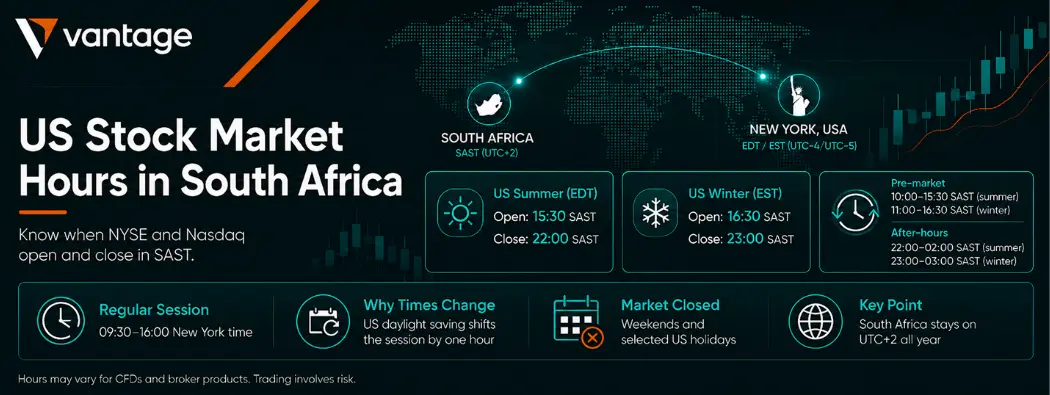
For South African traders, the US stock market is usually most active in the late afternoon.
That timing makes it possible to follow US shares after most of the local workday has passed. Companies such as Apple, Nvidia, Tesla, Amazon, Microsoft, and Meta all trade during this period.
The main question is often simple: What time does the US stock market open in South Africa? The regular session opens at either 3:30 p.m. or 4:30 p.m. SAST.
The time changes because the United States uses daylight saving time. South Africa keeps the same clock throughout the year.
The US stock market may open at either of these times during the year. The one-hour change may seem small, but it can easily confuse.
A trader expecting a 3:30 p.m. opening may find the market unusually quiet. In many cases, the opening bell has simply moved to 4:30 p.m.
The NYSE and Nasdaq open at 15:30 SAST during US daylight saving time and 16:30 SAST during US standard time. They close at 22:00 and 23:00 SAST, respectively.
Key takeaways
- Regular trading lasts from 09:30 to 16:00 New York time.
- SAST hours are 15:30–22:00 or 16:30–23:00.
- US daylight saving time causes the one-hour change.
- Holidays and broker product hours may affect access.
US Stock Market Opening and Closing Times in South Africa
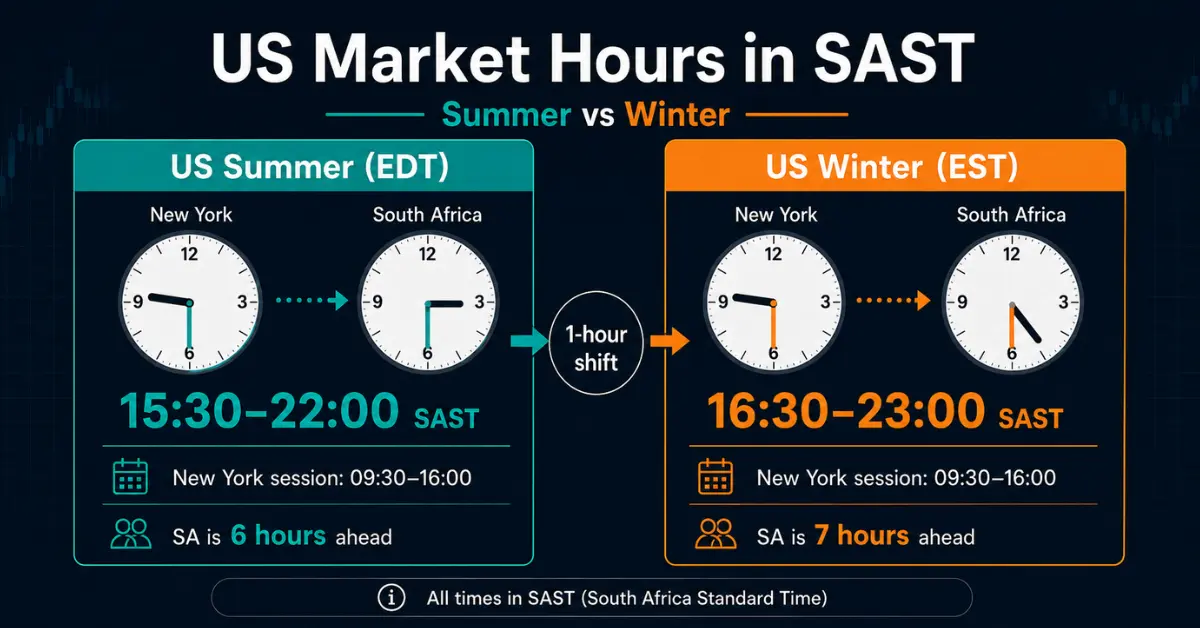
South African traders usually access the US stock market from the afternoon into the evening. The main period is the regular cash session, when shares listed on the New York Stock Exchange and Nasdaq trade.
In New York, the regular cash session runs from 09:30 to 16:00, Monday to Friday. The market does not open on weekends and may close on US public holidays.
The South African trading hours change during the year. The United States changes its clocks for daylight saving time, while South Africa remains on SAST.
During the US winter, New York is seven hours behind South Africa. The regular session runs from 16:30 SAST to 23:00 SAST.
During the US summer, New York is six hours behind South Africa. The opening time moves to 15:30 SAST, while the closing time moves to 22:00 SAST.

US Stock Market Hours in SAST
| US period | New York hours | South African hours |
| US winter | 09:30–16:00 | 16:30–23:00 SAST |
| US summer | 09:30–16:00 | 15:30–22:00 SAST |
For beginner and intermediate traders, the main point is that the market has two opening times in South Africa. The change usually becomes noticeable around March and November.
Trading volume often increases around the cash market open, as more market participants become active. US index futures and CFDs may trade outside these hours, but the cash session marks the start of regular share trading.
The final hour may also see more orders as market participants close or adjust positions. Trading hours for CFDs, shares, and extended-hours products may vary between brokers.
Why do the US stock market times change in South Africa
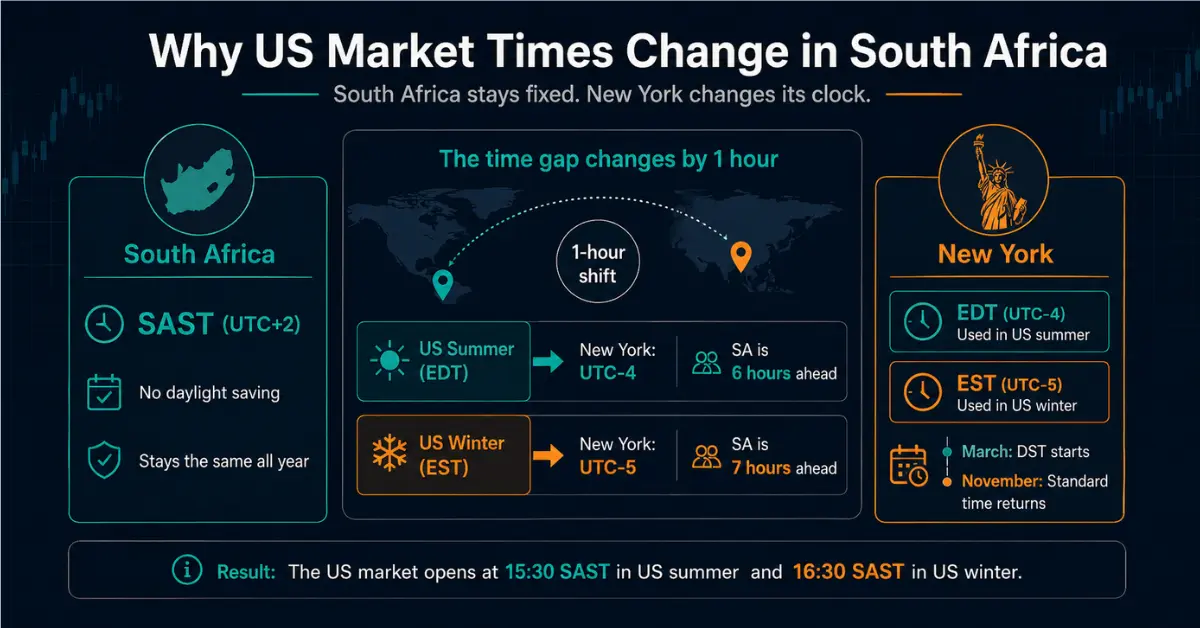
The US stock market opens at two different SAST times during the year because New York changes its clocks.
New York uses Eastern Standard Time (EST) for part of the year. It then moves to Eastern Daylight Time, known as EDT. South Africa does not make this change and remains on UTC+2 throughout the year.
When New York is on EST (UTC−5), South Africa is seven hours ahead. A 09:30 market opening in New York falls at 16:30 SAST. The regular session closes at 23:00 SAST.
When New York moves to EDT at UTC−4, the time gap becomes six hours. The same 09:30 opening then falls at 15:30 SAST, with the close at 22:00 SAST.
In 2026, daylight saving time starts in the US on Sunday, 8 March. The new trading hours apply from Monday, 9 March. Standard time returns on Sunday, 1 November, with SAST hours resuming on Monday, 2 November.
Most broker platforms automatically adjust the market schedule. The time shown on a chart may still reflect the broker’s server time rather than SAST.
The trading session remains six and a half hours. Only the SAST opening and closing times change.
US Pre-Market and After-Hours Trading in SAST
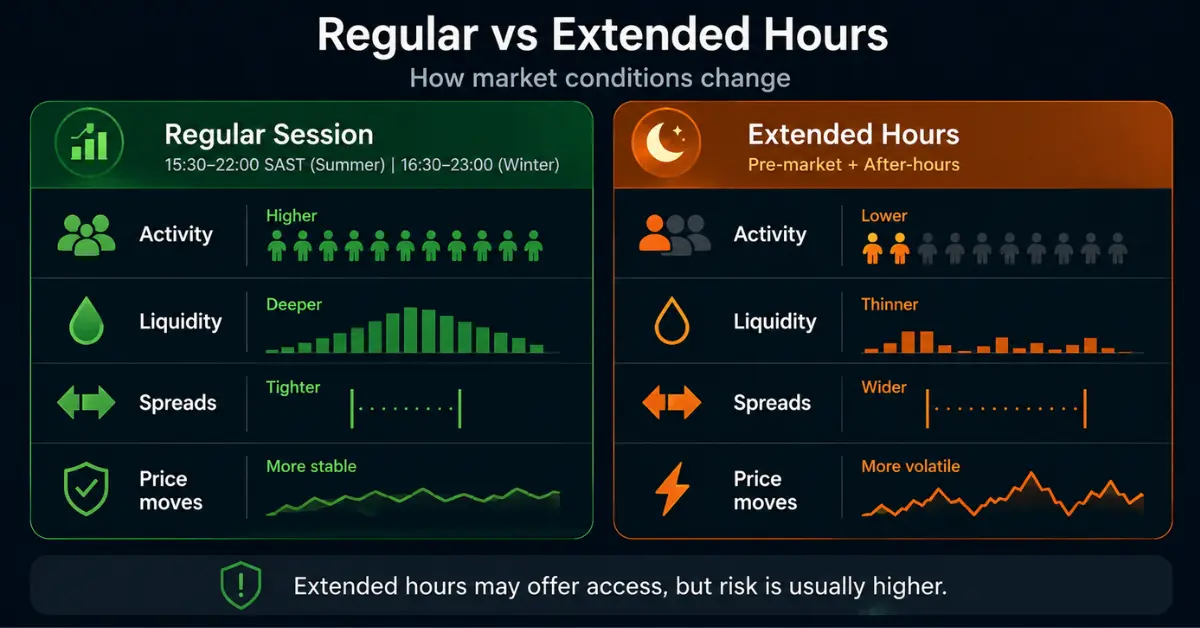
US shares also trade before and after the regular market session.
The pre-market session runs from 04:00 to 09:30 Eastern Time. In South Africa, that means 10:00–15:30 SAST during US daylight saving time. During US standard time, it becomes 11:00–16:30 SAST.
After-hours trading runs from 16:00 to 20:00 Eastern Time. The South African hours are 22:00–02:00 SAST during US daylight saving time and 23:00–03:00 SAST during US standard time. Since the session continues after midnight, it ends on the next day in South Africa.
These extended sessions may provide market access during periods when earnings reports, company announcements, analyst changes, and economic news are released outside the regular session.
Trading activity is usually lower during these periods. With fewer orders available, spreads may widen, and prices may change more quickly. An order may also be filled at a different price from the one shown moments earlier.
When Is the US Stock Market Closed?
The NYSE and Nasdaq do not open on Saturdays or Sundays. They also close on selected US public holidays.
These dates follow the US calendar, not the South African calendar. A public holiday in South Africa may still be a normal trading day in the United States.
The main US market holidays in 2026 are:
| Holiday | Date |
| New Year’s Day | 1 January |
| Martin Luther King Jr. Day | 19 January |
| Presidents’ Day | 16 February |
| Good Friday | 3 April |
| Memorial Day | 25 May |
| Juneteenth | 19 June |
| Independence Day observed | 3 July |
| Labor Day | 7 September |
| Thanksgiving Day | 26 November |
| Christmas Day | 25 December |
Some trading days end early instead of closing for the full day. These sessions often finish at 13:00 Eastern Time.
In 2026, the early-close dates include 27 November and 24 December. Since New York is on standard time, the market closes at 20:00 SAST.
Share trading, stock CFDs, and extended-hours products may follow different broker schedules. The exchange calendar covers the official market session, while a broker may set separate times for its products.
Trading US Shares Outside the Cash Session: 24-Hour CFDs
Some brokers may offer selected US share CFDs with extended weekday trading hours. These may include Tesla, Nvidia, Netflix, Meta, Broadcom, and Palantir, although product availability may vary between brokers and jurisdictions.
A share CFD follows the price of the underlying stock. However, buying a CFD does not mean owning the company’s shares. There are no shareholder voting rights, and the trade takes place through an agreement with the broker.
CFDs may also involve leverage. As a result, profits and losses are based on the full trade value rather than only the margin required to open the position. Leverage can magnify both profits and losses.
The regular US cash session takes place while the NYSE and Nasdaq are open. Trading volume is usually higher during this period. Spreads may also be smaller because more buyers and sellers are active.
Outside the cash session, a 24-hour CFD may remain available overnight, depending on the broker and product offered. These hours may provide market access during periods when earnings reports, company news, and other events are released after the market closes.
Trading activity can be lower outside regular hours. This may lead to wider spreads, fewer available orders, and larger price changes.
Is the US Stock Market Open Right Now in South Africa?
To know whether the US stock market is open from South Africa, three details matter: the day, the current SAST time, and the US market calendar.
The NYSE and Nasdaq regular sessions run from Monday to Friday. They remain closed on weekends and selected US market holidays.
During US daylight saving time, regular trading runs from 15:30 to 22:00 SAST. During US standard time, the session runs from 16:30 to 23:00 SAST.
The market is open when:
- The day is from Monday to Friday.
- The current time falls within the correct SAST session.
- The date is not a US market holiday or early-close session.
For example, the regular cash market is closed on a Sunday, even when a broker displays changing prices.
Conclusion
For South African traders, the US stock market opens at either 15:30 or 16:30 SAST, depending on the time of year. The regular session closes at 22:00 or 23:00 SAST.
The change is due to US daylight saving time. South Africa remains on UTC+2 throughout the year, while New York moves between EDT and EST.
Regular trading takes place from Monday to Friday, excluding US exchange holidays. Pre-market, after-hours, futures, and share CFDs may follow different schedules. Some broker platforms may offer selected US share CFDs outside the main cash session, although product availability and trading hours may vary.
Knowing the correct SAST hours helps explain changes in market activity, spreads, and trading volume. It also reduces confusion when the opening bell moves by one hour in March and November.
The official exchange calendar and the broker’s product schedule remain useful reference points, especially around holidays, half-days, and extended trading sessions.
Frequently Asked Questions
What time does the US stock market open in South Africa?
The regular session opens at 15:30 SAST during US daylight saving time and 16:30 SAST during US standard time.
What time does it close in SAST?
The market closes at 22:00 SAST during US daylight saving time and 23:00 SAST during US standard time.
Why does the SA time change twice a year?
New York changes between EDT and EST, while South Africa remains on UTC+2 throughout the year.
Is the US market open right now in South Africa?
The regular market is open on weekdays when the current SAST time falls within that day’s session, and the date is not a full exchange holiday.
Can I trade US stocks after hours from South Africa?
Yes, when the broker offers extended-hours access, although available shares and session times may vary.
Is the US market open on weekends?
No, the regular NYSE and Nasdaq sessions run from Monday to Friday.
What are the US market holidays?
Main exchange holidays include New Year’s Day, Good Friday, Memorial Day, Independence Day, Thanksgiving, and Christmas.
Is the US market open on South African public holidays?
It may remain open because US exchanges follow the American market calendar rather than South African holidays.
Do US shares CFDs follow the same hours as the share market?
Not always, since some CFDs follow cash-market hours while others offer extended or near-24-hour weekday trading.
How many hours behind SAST is New York?
New York is six hours behind SAST during EDT and seven hours behind during EST.
Risk Warning: CFDs are complex financial instruments and carry a high risk of rapid loss of money due to leverage. You should ensure you fully understand the risks involved and carefully consider whether you can afford to take the high risk of losing your money before trading.
Disclaimer: The information is provided for educational purposes only and doesn’t take into account your personal objectives, financial circumstances, or needs. It does not constitute investment advice. We encourage you to seek independent advice if necessary. No representation or warranty is given as to the accuracy or completeness of any information contained within.
This material may contain historical or past performance figures and should not be relied on. Furthermore, estimates, forward-looking statements, and forecasts cannot be guaranteed. The information on this site and the products and services offered are not intended for distribution to any person in any country or jurisdiction where such distribution or use would be contrary to local law or regulation.
References
- US Stock Exchange Market and Trading Hours – https://www.nyse.com/trade/hours-calendars
- Daylight Saving Time Rules – https://www.nist.gov/pml/time-and-frequency-division/popular-links/daylight-saving-time-dst
- Pre-market and after-hours trading – https://www.investopedia.com/ask/answers/06/preaftermarket.asp