
 Updated
This article(NAS100 trading hours in South Africa) was written by the Vantage Markets content team, with insights from trading specialists familiar with NAS100 volatility, earnings reactions, and market timing in South African time zones. All content is provided for educational purposes only.
“This guide on NAS100 trading hours in South Africa is part of a broader educational series published by Vantage Markets, aimed at helping South African traders understand global market structures.”
Introduction
This article outlines NAS100 trading hours in South Africa, including key periods such as the opening auction, power hour, and after-hours sessions. For comparisons with continuously traded markets, see our articles on the best time to trade Forex in South Africa and the best time to trade Gold in South Africa.
In South Africa, this index follows the trading schedule of U.S. markets, so local traders must convert activity to South African Standard Time (SAST). Understanding this timing helps identify when market activity and price movement tend to increase.
What Time Does NAS100 Trade in South Africa?
The NAS100, as an index tracking major U.S. technology and growth companies, follows the operating hours of the NASDAQ exchange in New York. For traders in South Africa, this schedule must be adjusted to reflect South African Standard Time (SAST), which is typically seven hours ahead of Eastern Standard Time (EST) and six hours ahead during U.S. daylight saving time.
Under normal conditions, NAS100 trading begins at 15:30 SAST and ends at 22:00 SAST. This window reflects the official U.S. market session from 09:30 to 16:00 EST. Outside this core session, limited pre-market and after-hours trading is also available through some brokers, though liquidity during these periods may differ.
The table below outlines the typical NAS100 trading hours as they align with South African time:
| Session | U.S. Time (EST) | South African Time (SAST) |
| Pre-Market | 04:00 – 09:30 | 11:00 – 15:30 |
| Core Trading Session | 09:30 – 16:00 | 15:30 – 22:00 |
| After-Hours Session | 16:00 – 20:00 | 22:00 – 02:00 (next day) |
These hours may shift slightly due to U.S. daylight saving time changes, which occur between March and November each year. South Africa does not observe daylight saving time, so traders should periodically verify session overlaps to remain in sync.
While these windows indicate when the market is open, not all hours offer the same level of price movement or participation. The timing of economic reports, earnings announcements, and institutional trading flows can significantly influence activity, as discussed in later sections of this article.
NAS100 Intraday Structure for South African Traders
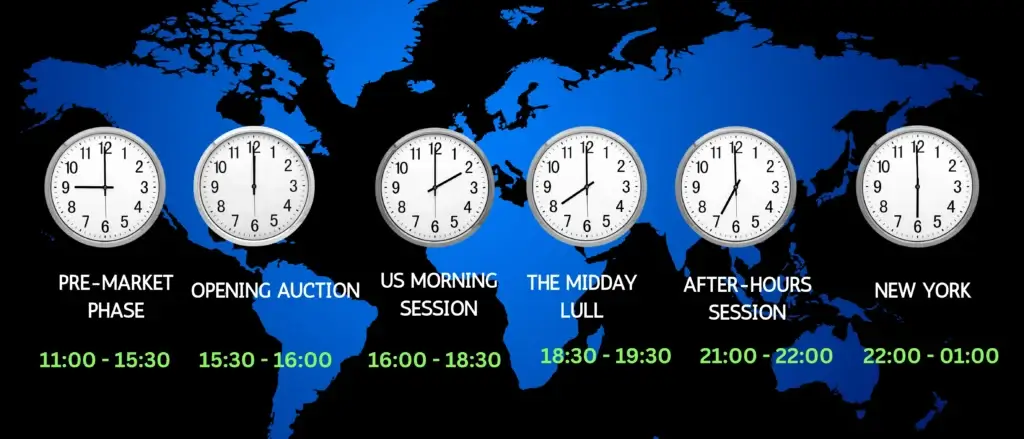
The NAS100 trading day follows the U.S. stock market schedule. For traders in South Africa, this means activity begins in the late afternoon and continues into the night. Each phase of the trading day brings different levels of price movement and liquidity. Below is a breakdown of how the NAS100 behaves at other times, using South African Standard Time (SAST).
Pre-Market (11:00–15:30 SAST)
Before the U.S. market officially opens, some brokers offer access to NAS100 through pre-market trading. During this time, price changes are mainly influenced by overnight news, early earnings reports, and economic data from Europe and Asia.
Liquidity is generally lower than during regular trading hours, which can lead to much wider spreads and more sudden price changes. While not all South African traders participate in this early session, many follow it to gauge how the market might open.
This pre-market window is handy when monitoring reactions to overnight developments or preparing for the opening auction later in the afternoon.
Opening Auction (15:30–16:00 SAST)
This 30-minute period marks the start of the official NAS100 trading day. Activity usually increases quickly as traders respond to overnight news, early corporate earnings, or U.S. economic data. Volatility is often high during this session.
A large portion of daily volume often enters the market here as major participants position themselves for the day ahead. This makes it one of the busiest parts of the trading day.
Unlike continuously traded markets such as Forex, where volume is spread across multiple global sessions, the NAS100 opening auction is tightly focused, with most movement concentrated in a short window.

U.S. Morning Session (16:00–18:30 SAST)
After the market settles from the opening auction, trading continues through the early afternoon in the United States. During this time, scheduled reports such as inflation updates, job numbers, or consumer confidence figures are often released.
The market typically follows through on earlier trends during this session. Depending on the day’s news, it may continue in one direction or begin to slow down.
The trading will remain active, with many traders treating it as the main phase for executing strategies based on the day’s headlines.
Midday Lull (18:30–19:30 SAST)
Trading volume often drops during this hour, as many U.S.-based market participants step away for lunch. Price movements may become slower, and spreads can widen slightly.
While the index is still open, fewer significant moves typically occur. Some traders may reduce their activity or take a break during this quieter phase. For those comparing NAS100 with gold trading patterns, this midday slowdown can resemble periods of reduced movement seen in metals markets during non-overlapping sessions.
Power Hour (21:00–22:00 SAST)
As the U.S. session approaches its close, trading activity often picks up again. This period, known as the “power hour,” is shaped by institutional traders adjusting positions before the end of the day.
Market-on-close (MOC) orders, executed at or near the closing price, can lead to sharp price movements, especially when large volumes are involved. This hour tends to see stronger momentum and larger swings compared to earlier in the session.
Price changes during this time may reflect final reactions to the day’s news or a setup for overnight sentiment.
After-Hours Session (22:00–01:00 SAST)
Even after the official close, some brokers continue to offer access to NAS100 through after-hours trading. This session is heavily influenced by corporate earnings, which are often released shortly after the market closes.
Tech companies like Apple, Microsoft, and Alphabet frequently report earnings during this window. Reactions to these announcements can create price gaps or trigger strong moves, affecting how the index opens the following day. To follow earnings releases and their timing, many traders refer to official sources, such as the NASDAQ earnings calendar, for schedule updates.
Interested in how to trade NAS100 and strategies to use? Read our comprehensive NASDAQ 100 CFD trading guide.
Earnings Season and NAS100 Volatility Patterns
The NAS100 includes many large technology and growth-focused companies listed on the NASDAQ exchange. These businesses release their financial results at regular intervals throughout the year, during earnings seasons.
Earnings seasons usually occur four times a year, in January, April, July, and October. During these months, most companies in the index report their quarterly results, which can affect the index’s price, especially when expectations are missed or exceeded.
In South African Standard Time (SAST), many of these reports are released after the U.S. market closes, typically between 22:00 and 01:00 SAST. Because these announcements occur outside the core trading session, their impact often shows up in futures pricing and in the opening auction the next day.
Quick Summary:
- NAS100 earnings seasons: Jan, Apr, Jul, Oct
- Most earnings reports are released after 22:00 SAST
- Price reactions may appear as overnight gaps or sharp moves during the following opening session
Not all earnings have the same impact. Companies with a larger weight in the index, such as Apple, Microsoft, or Alphabet, tend to move the NAS100 more than smaller components. For example, in July 2023, the index opened nearly 2% higher after strong results from both Microsoft and Alphabet.
During earnings season, price activity in the after-hours session (22:00–01:00 SAST) often increases. Many traders follow these announcements using sources such as the Investing.com earnings calendar, which tracks reporting dates for major global stocks.
These earnings-related movements also contribute to the patterns observed in the next day’s opening auction and, later, during the power hour, two sessions where volatility tends to rise. You can learn more about how these sessions behave in the intraday NAS100 structure section of this article.
Compared to continuously traded assets like Forex pairs, the NAS100 responds more directly to company-specific results. These sharp, time-bound movements during earnings season are part of what makes the index unique.
NAS100 vs Forex vs Gold: Timing Comparison
While NAS100 is widely traded in South Africa, its trading hours and structure differ from those of other popular markets, such as Forex and gold. Understanding these differences can help clarify why each market behaves differently at certain times of the day. Each instrument follows a unique rhythm. NAS100 is tied to the operating hours of the U.S. stock exchange, while Forex and gold trade nearly 24 hours a day, five days a week. As a result, volatility and trading opportunities emerge at different times, depending on the asset and its market structure.
What is the main difference between NAS100 and Forex trading times in South Africa?
NAS100 operates on fixed U.S. exchange hours, while Forex is available around the clock. NAS100 pauses between sessions, leading to gaps, while Forex adjusts to news in real time.
The table below outlines key timing features of each market, with all times shown in South African Standard Time (SAST):
| Market | Type | Trading Hours (SAST) | Volatility Peaks | Key Influences |
| NAS100 | U.S. equity index (exchange-based) | 15:30–22:00 (core) Pre: 11:00–15:30 After-hours: 22:00–01:00 | 15:30–16:00 (opening auction) 21:00–22:00 (power hour) | Earnings season, U.S. data, global tech sentiment |
| Forex | Currency market (24/5 OTC) | 00:00 Monday – 23:59 Friday | 10:00–12:00 (London) 15:00–18:00 (London–New York overlap) | Central bank decisions, interest rates, inflation |
| Gold (XAU/USD) | Precious metal (24/5 OTC) | 00:00 Monday – 23:59 Friday | 15:00–18:00 (U.S. session open) 17:30–20:00 (Fed-related events) | USD strength, inflation data, global risk sentiment |
📌 Quick Summary:
- NAS100 trades during set U.S. hours and shows more gaps
- Forex and gold trade continuously and react to global events in real time.
- Timing strategies must adapt to each market’s structure.
In practice, traders often notice that Forex pairs like USD/ZAR or EUR/USD move sharply during the London–New York overlap, while NAS100 tends to see its most significant moves during the U.S. opening auction or closing hour.
These timing differences are explored further in the forex trading sessions guide, which explains how session overlaps influence currency markets. Similarly, the day-trading-gold article provides more context on gold’s daily rhythm and its connection to U.S. macro releases.
To gain a broader understanding of how trading sessions influence global markets, this Investopedia guide outlines the structure and overlap of key trading windows.
The next section provides a detailed summary of the NAS100’s most active time blocks, mapped in SAST, to help clarify when the index tends to move the most.
NAS100 Trading Windows in SAST
Unlike markets that operate 24 hours a day, the NAS100 follows the daily opening and closing cycle of the U.S. stock market. For South African traders, this means index activity unfolds within a fixed window during local afternoon and evening hours.
While the NAS100 is technically available in extended hours, most of the significant movement occurs during the core U.S. session, especially when institutional orders, earnings announcements, and economic releases enter the market. The table below outlines how activity typically shifts throughout the day, using South African Standard Time (SAST) as a reference.
| Time (SAST) | Session | Market Behaviour | |
| 11:00 –15:30 | Pre-Market | Futures adjust to overnight news; low liquidity | Asia/Europe news, earnings previews |
| 15:30 –16:00 | Opening Auction | High volume and fast price moves | After-hours earnings, macro data |
| 16:00 –18:30 | US morning session | Trend continuation or reversal | Economic reports, early U.S. trading |
| 18:30 –19:30 | Midday pause | Slower movement, reduced participation | U.S. lunch hour |
| 21:00 – 22:00 | Power hour | Final surge in activity before close | Market-on-close orders, daily rebalancing |
| 2:00 – 01:00 | After-hours session | Light volume, futures price shifts | Post-close earnings, late news |
Chart 4: Typical shifts in NAS100 hours, using South African Standard Time (SAST) as a reference.
When does NAS100 show the most volatility in South Africa?
The most active periods are usually 15:30–16:00 SAST (opening auction) and 21:00–22:00 SAST (power hour), when volume and momentum typically rise.
These windows reflect common institutional behaviour. For example, tech-sector earnings from companies like Apple, Meta, or Alphabet often lead to noticeable movement during the after-hours session, which then shapes the opening price the next day.
Unlike Forex, which operates 24/5 and reacts to global events around the clock, the NAS100 compresses its activity into a narrower timeframe. If you’re interested in how that compares, see our complete forex trading sessions overview, which breaks down the global overlaps that drive currency pair movements. Similarly, day trading gold often involves watching for Fed-related announcements or inflation reports, but those events can also affect the NAS100 depending on timing.
📈 Ready to explore NAS100 in a live environment?
Practise and familiarise yourself with market timings on a Vantage demo or live trading account. Opening an account only takes a few minutes.
Key Takeaways for South African NAS100 Traders
Understanding when the NAS100 is most active can help traders better interpret market behaviour, especially since the index is tied to specific U.S. trading hours, unlike 24-hour markets such as Forex.
Below is a summary of core points from this guide, with a focus on South African Standard Time (SAST).
Timing Framework:
- Core trading session: 15:30–22:00 SAST
- Pre-market activity: 11:00–15:30 SAST (futures + sentiment shifts)
- After-hours session: 22:00–01:00 SAST (earnings reaction window)
- Most active periods:
- 15:30–16:00 – Opening Auction (volatility surge)
- 21:00–22:00 – Power Hour (institutional flows before close)
Related Resources
- Compare timing differences with gold trading sessions
- Learn how day trading gold works around macro events and sentiment swings.
Frequently Asked Questions (NAS100 Trading Hours in South Africa)
What time does the NAS100 open and close in South Africa?
The NAS100 follows U.S. exchange hours. In South African Standard Time (SAST), it opens at 15:30 and closes at 22:00 during the regular trading session. Some brokers also offer access to pre-market (11:00–15:30) and after-hours (22:00–01:00) trading.
Why does NAS100 sometimes open with a price gap?
Price gaps can occur when new information, such as earnings results or global news, is released after the market closes. These developments are often priced in during the opening auction at 15:30 SAST, leading to a jump or a drop from the previous day’s close. More on this can be found in the section on price gaps and discovery.
What is the most active time to trade NAS100 in SAST?
NAS100 tends to show the highest activity and volume during two key windows:
- Opening Auction (15:30–16:00)
- Power Hour (21:00–22:00).
These periods reflect institutional order flow and daily rebalancing. You can also refer to our forex trading sessions for comparison.
What is the most active time to trade NAS100 in SAST?
NAS100 tends to show the highest activity and volume during two key windows:
- Opening Auction (15:30–16:00)
- Power Hour (21:00–22:00).
These periods reflect institutional order flow and daily rebalancing. You can also refer to our forex trading sessions for comparison.
Is NAS100 open during South African public holidays?
Yes, NAS100 trading hours are based on U.S. market schedules. It remains open on South African public holidays unless the U.S. exchange itself is closed. Major brokers or exchanges typically publish a list of U.S. market holidays.
How does NAS100 differ from gold or Forex in terms of timing?
NAS100 follows a fixed session schedule, while gold and Forex trade continuously from Monday 00:00 to Friday 23:59 SAST. This means NAS100 is more likely to gap at the open, while Forex and gold respond to news in real time.
See our day trading gold article for a breakdown of gold’s timing behaviour.
RISK WARNING: CFDs are complex financial instruments and carry a high risk of rapid loss of money due to leverage. You should ensure you fully understand the risks involved and carefully consider whether you can afford to take the high risk of losing your money before trading.
Disclaimer: The information is provided for educational purposes only and doesn’t take into account your personal objectives, financial circumstances, or needs. It does not constitute investment advice. We encourage you to seek independent advice if necessary. The information has not been prepared in accordance with legal requirements designed to promote the independence of investment research. No representation or warranty is given as to the accuracy or completeness of any information contained within. This material may contain historical or past performance figures and should not be relied on.
Furthermore, estimates, forward-looking statements, and forecasts cannot be guaranteed. The information on this site and the products and services offered are not intended for distribution to any person in any country or jurisdiction where such distribution or use would be contrary to local law or regulation.