
 Updated
How we built this guide: We used a UTC baseline for the major forex trading sessions and converted the session windows to SAST (UTC+2). Because some regions change clocks for daylight saving time, we show both standard-time and daylight-time conversions where needed. We review this page around DST change periods and update the tables if the offsets change
If you trade from South Africa, timing matters. This guide helps you convert major time zones into SAST so that you can plan session windows, news alerts, and overlap periods with confidence.
South Africa Standard Time (SAST) is UTC+2 all year, because South Africa does not use daylight saving time (DST). That makes SAST a stable base for schedules. Many other regions change clocks during the year, though.
When places like the UK, the US, or Australia move into or out of Daylight Saving Time(DST), the same “local time” can land on a different time in SAST. That is why any useful converter must factor in the date, not only the time.
What is Coordinated Universal Time(UTC)?
To start with, it is important to understand the concept of Coordinated Universal Time(UTC) and why it is important.
UTC is the world’s base or reference clock. It is the time used to line up clocks across countries. UTC is kept with atomic clocks, so it stays steady.
Most time zones are written as a UTC offset. An offset tells you how many hours a place is ahead of, or behind, UTC.
Example: SAST is UTC+2. That means South Africa is two hours ahead of UTC, all year.
UTC is also the simplest “middle step” for conversions. If you ever feel stuck, convert it using these two moves:
- Local time → UTC
- UTC → SAST (add 2 hours)
Why dates matter (DST):
UTC does not change. Some countries change their offset during DST. That is why the same local clock time can map to a different SAST time.
Quick examples:
- 12:00 UTC = 14:00 SAST
- 08:00 London time = 10:00 SAST in GMT weeks, and 09:00 SAST in BST weeks
- 09:30 New York time = 16:30 SAST in EST weeks, and 15:30 SAST in EDT weeks
Forex Trading Sessions in SAST
Forex trading sessions represent the active periods during the day when trading activity is heightened as a result of the operations of financial centres around the world.
SAST stays fixed at UTC+2 all year. Session times shift because other hubs use DST. These hours are typical session windows. Your broker or calendar may define them a bit differently.
| Trading session (hub) | Typical hours in SAST when the hub is on standard time | Typical hours in SAST when the hub is on daylight time |
| Sydney | 00:00–09:00 SAST | 23:00–08:00 SAST |
| Tokyo | 02:00–11:00 SAST | 02:00–11:00 SAST |
| London | 10:00–19:00 SAST | 09:00–18:00 SAST |
| New York | 15:00–00:00 SAST | 14:00–23:00 SAST |
Session Overlaps in SAST
Session overlaps are the periods when two major sessions run at once. Liquidity may increase during these periods, and spreads can sometimes narrow as market activity rises.
Because SAST never changes, overlap times move mainly due to DST elsewhere.
These overlap windows are typical, not strict rules.
| Overlap | SAST when major hubs are on standard time | SAST when major hubs are on daylight time |
| Sydney + Tokyo | 02:00–09:00 | 02:00–08:00 |
| Tokyo + London | 10:00–11:00 | 09:00–11:00 |
| London + New York | 15:00–19:00 | 14:00–18:00 |
What traders usually notice most
- London + New York is often considered one of the more active overlap periods.
- The overlap can shift by one hour across the year.
- News releases during overlaps can raise volatility fast.
ET, EST, and EDT to SAST
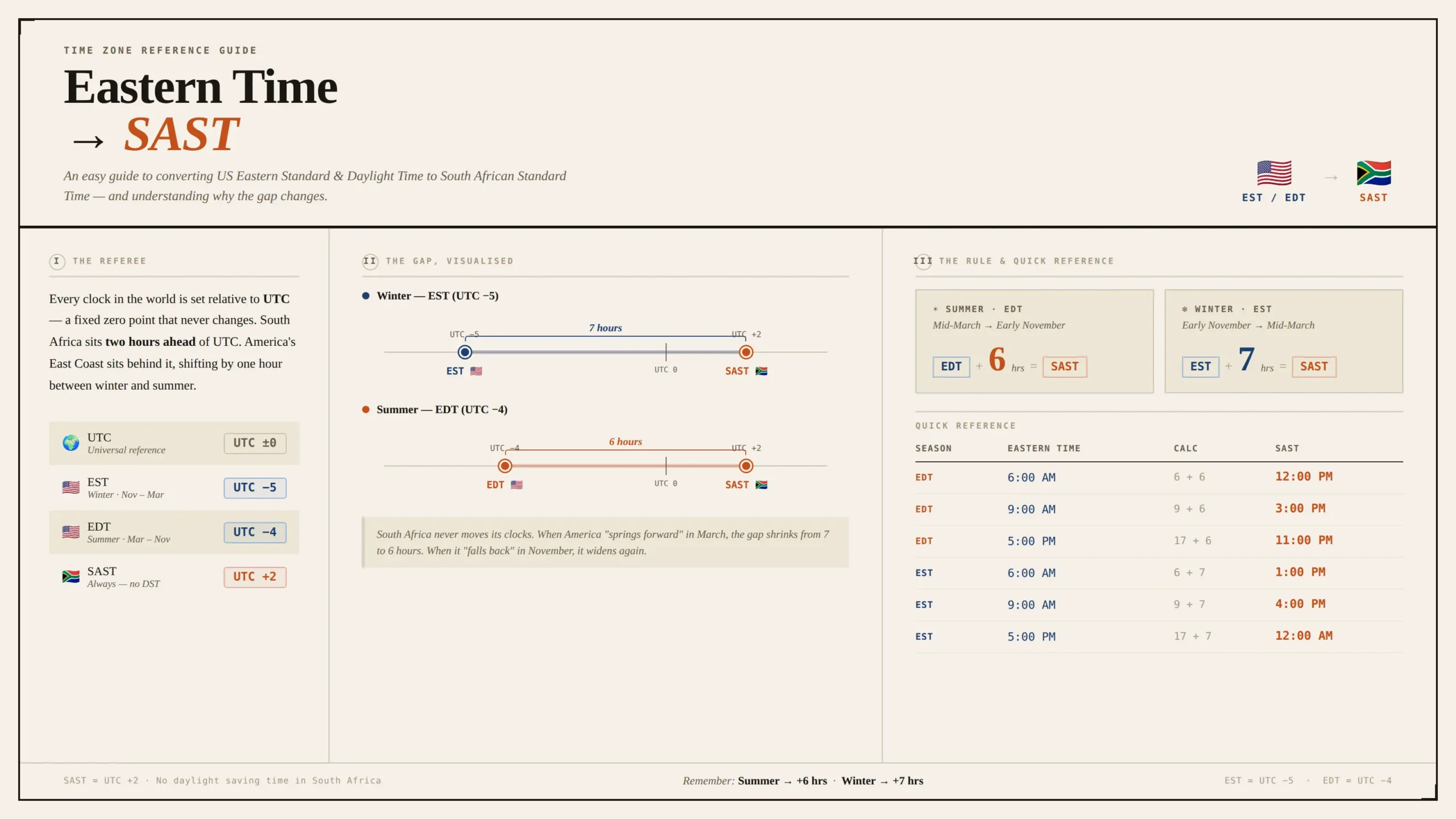
ET means US Eastern Time. It is the general term for the entire time zone; EST or EDT. It changes its name and offset during the year.
- EST, Eastern Standard Time, is observed during the winter months when daylight saving time is not in effect
- EDT, on the other hand, is Eastern Daylight Time. It is the time observed during the summer months when DST is in effect.
So ET can map to SAST in two different ways. Here is a quick table guide.
| Time label | UTC offset | SAST difference | Simple rule |
| SAST | UTC+2 | — | Base time in South Africa |
| EST | UTC-5 | SAST is +7 hours | Add 7 hours to EST |
| EDT | UTC-4 | SAST is +6 hours | Add 6 hours to EDT |
| ET | EST or EDT | +7 or +6 | Depends on the date |
ET to SAST Conversion Table
This table shows the same ET clock time in both cases; EST or EDT.
| ET time | SAST if ET = EST (add 7h) | SAST if ET = EDT (add 6h) |
| 00:00 | 07:00 SAST | 06:00 SAST |
| 06:00 | 13:00 SAST | 12:00 SAST |
| 08:00 | 15:00 SAST | 14:00 SAST |
| 09:30 | 16:30 SAST | 15:30 SAST |
| 12:00 | 19:00 SAST | 18:00 SAST |
| 15:00 | 22:00 SAST | 21:00 SAST |
| 17:00 | 00:00 SAST (next day) | 23:00 SAST |
| 20:00 | 03:00 SAST (next day) | 02:00 SAST (next day) |
| 23:00 | 06:00 SAST (next day) | 05:00 SAST (next day) |

Worked examples:
Let’s see how to convert 7pm Eastern Time in South Africa. Below is a simple step-by-step method you can reuse every time.
Step-by-step: Convert 7:00 PM Eastern to South Africa (SAST)
Step 1) Confirm the time zones
- South Africa is SAST = UTC+2 (all year).
- Eastern time is either:
- EST = UTC−5 (winter)
- EDT = UTC−4 (summer)
- EST = UTC−5 (winter)
Step 2) Decide if Eastern is EST or EDT
Use the date of the meeting. Common rule (US/Canada):
- EDT runs from the second Sunday in March to the first Sunday in November.
- Outside that range, it’s EST.
Step 3) Convert Eastern time to UTC
Use this rule:
- If EST (UTC−5): add 5 hours to get UTC.
- If EDT (UTC−4): add 4 hours to get UTC.
Step 4) Convert UTC to South Africa (SAST)
SAST is UTC+2, so:
- Add 2 hours to your UTC time.
Step 5) Handle day change
If you pass 12:00 AM, the date becomes the next day.
PT, PST, and PDT to SAST

PT means US Pacific Time. It is the third most populous time zone in the US. And it spans from Canada to Mexico. It switches between PST and PDT during the year.
- PST = Pacific Standard Time
- PDT = Pacific Daylight Time
- SAST = South Africa Standard Time (always UTC+2)
So the same PT clock time can convert two ways, based on the date. Below is a table showing the conversion of PT, PST, and PDT to SAST.
| Time label | UTC offset | SAST difference | Simple rule |
| SAST | UTC +2 | — | South Africa base time |
| PST | UTC-8 | SAST is +10 hours | Add 10 hours to PST |
| DST | UTC-7 | SAST is +9 hours | Add 9 hours to PDT |
| PT | PST or PDT | +10 or +9 | Depends on the date |
PT to SAST conversion table
| PT time | SAST if PT = PST (add 10h) | SAST if PT = PDT (add 9h) |
| 00:00 | 10:00 SAST | 06:00 SAST |
| 03:00 | 13:00 SAST | 12:00 SAST |
| 06:00 | 16:00 SAST | 14:00 SAST |
| 08:00 | 18:00 SAST | 15:30 SAST |
| 09:30 | 19:30 SAST | 18:30 SAST |
| 12:00 | 22:00 SAST | 21:00 SAST |
| 14:00 | 00:00 SAST (next day) | 23:00 SAST |
| 16:00 | 02:00 SAST (next day) | 01:00 SAST (next day) |
| 20:00 | 06:00 SAST (next day) | 05:00 SAST (next day) |
| 23:00 | 09:00 SAST (next day) | 08:00 SAST (next day) |
CT, CST, and CDT to SAST
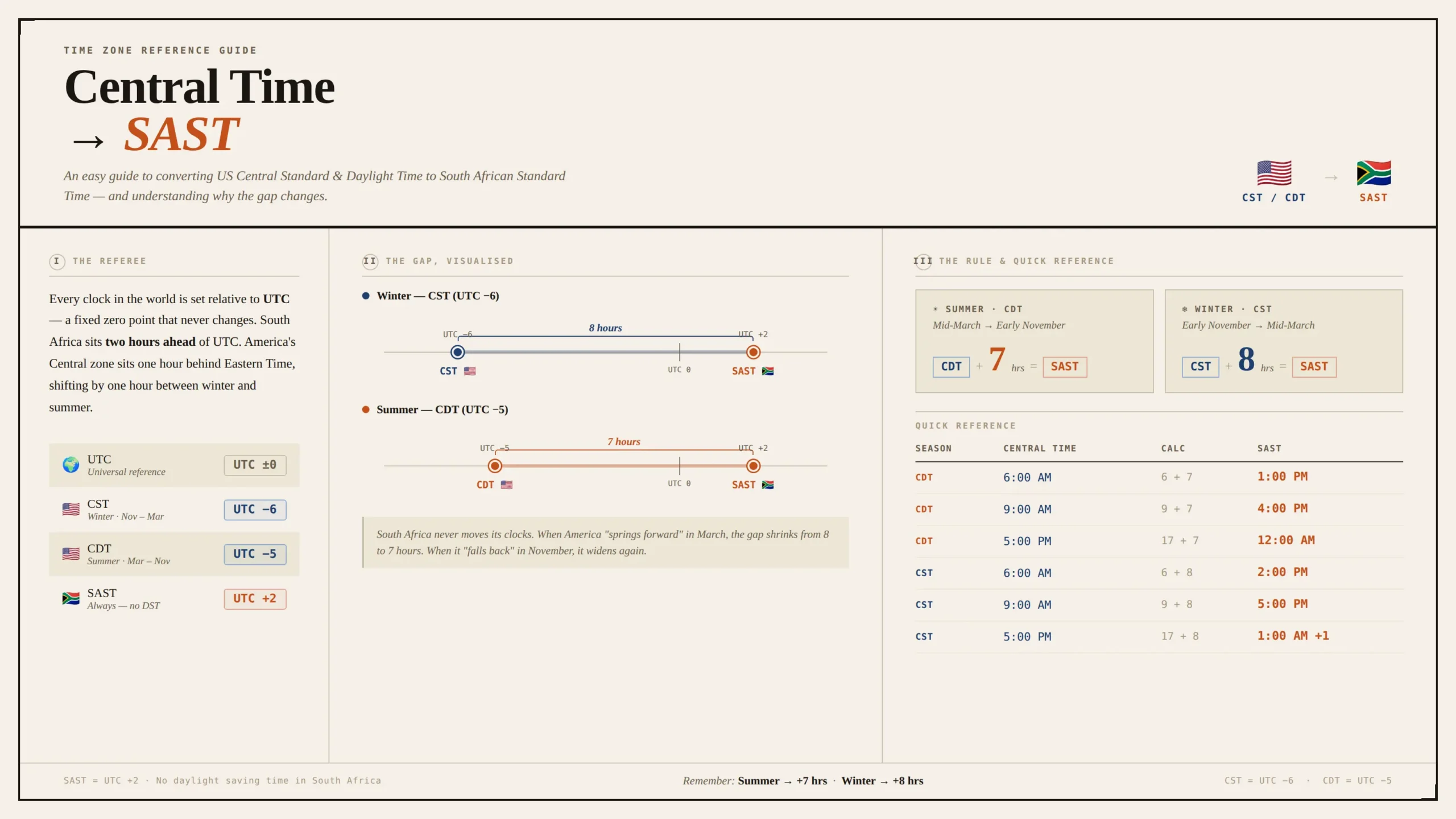
CT means US Central Time, or Central Standard Time, or Central Daylight Time. It switches between CST and CDT during the year. I must also add that it is the second easternmost time zone in the US.
Below is a table showing the conversion of CST and CDT to SAST
| Time label | UTC offset | SAST difference | Simple rule |
| SAST | UTC +2 | — | South Africa base time |
| CST | UTC-6 | SAST is +8 hours | Add 8 hours to CST |
| CDT | UTC-5 | SAST is +7 hours | Add 7 hours to CDT |
| CT | CST or CDT | +8 or +7 | Depends on the date |
CT to SAST conversion table
| CT time | SAST if CT = CST (add 8h) | SAST if CT = CDT (add 7h) |
| 00:00 | 08:00 SAST | 07:00 SAST |
| 06:00 | 14:00 SAST | 13:00 SAST |
| 08:00 | 16:00 SAST | 15:00 SAST |
| 09:30 | 17:30 SAST | 16:30 SAST |
| 12:00 | 20:00 SAST | 19:00 SAST |
| 15:00 | 23:00 SAST | 22:00 SAST |
| 17:00 | 01:00 SAST (next day) | 00:00 SAST (next day) |
| 20:00 | 04:00 SAST (next day) | 03:00 SAST (next day) |
| 23:00 | 07:00 SAST (next day) | 06:00 SAST (next day) |
Worked examples
Example 1: Event at 08:30 CT
- 08:30 CST → 08:30 + 8 = 16:30 SAST
- 08:30 CDT → 08:30 + 7 = 15:30 SAST
Example 2: Event at 15:00 CT
- 15:00 CST → 23:00 SAST
- 15:00 CDT → 22:00 SAST
Example 3: Event at 17:00 CT (date change risk)
- 17:00 CST → 01:00 SAST (next day)
- 17:00 CDT → 00:00 SAST (next day)
Simple way to convert CT to SAST
- Confirm if the date uses CST or CDT.
- Add 8 hours for CST, or 7 hours for CDT.
- If the result passes midnight, shift to the next SAST date.
UK time to SAST: GMT, BST, and the key difference
UK time uses two labels across the year, GMT and BST. Greenwich Meridian Time is used in winter. It is used during the standard time zone in Europe, Africa, North America, and Antarctica.
British Standard Time (BST) uses daylight saving time and is used in the summer in the UK.
SAST stays fixed at UTC+2 all year. So the UK-to-SAST gap changes with the season.
Here is a quick table showing the UK time conversion to SAST:
| Time label | UTC offset | SAST difference | Simple rule |
| SAST | UTC +0 | — | South Africa base time |
| GMT | UTC+0 | SAST is +2 hours | Add 2 hours to GMT |
| BST | UTC+1 | SAST is +1 hours | Add 1 hour to BST |
| UK Time | GMT or BST | +2 or +1 | Depends on the date |
UK time to SAST conversion table
| UK time | SAST if UK = GMT (add 2h) | SAST if UK = BST (add 1h) |
| 00:00 | 02:00 SAST | 01:00 SAST |
| 06:00 | 08:00 SAST | 07:00 SAST |
| 08:00 | 10:00 SAST | 09:00 SAST |
| 09:30 | 11:30 SAST | 10:30 SAST |
| 12:00 | 14:00 SAST | 13:00 SAST |
| 15:00 | 17:00 SAST | 16:00 SAST |
| 17:00 | 19:00 SAST | 18:00 SAST |
| 20:00 | 22:00 SAST | 21:00 SAST |
| 23:00 | 01:00 SAST (next day) | 00:00 SAST (next day) |
Worked examples
Example 1: The London session starts at 08:00 UK time
- 08:00 GMT → 10:00 SAST
- 08:00 BST → 09:00 SAST
Example 2: Event at 14:00 UK time
- 14:00 GMT → 16:00 SAST
- 14:00 BST → 15:00 SAST
Example 3: Event at 23:30 UK time (day change)
- 23:30 GMT → 01:30 SAST (next day)
- 23:30 BST → 00:30 SAST (next day)
London session hours in SAST (common benchmark)
| London session | For UK time | In SAST during GMT | In SAST during BST |
| Open → Close | 08:00–17:00 | 10:00–19:00 | 09:00–18:00 |
Australia time to SAST: AEST, AEDT, Brisbane, and Sydney
Australia uses more than one time zone. For trading schedules, Brisbane and Sydney matter most.
- Brisbane (Queensland) uses AEST all year.
- Sydney (New South Wales) uses AEST in winter and AEDT in summer.
- SAST stays fixed at UTC+2, with no DST.
So, Sydney-to-SAST can change by one hour, depending on the date.
Quick offset table
| Location/label | UTC offset | Difference vs SAST (UTC+2) | Simple rule (to SAST) |
| SAST | UTC +2 | — | Base time |
| AEST (Brisbane) | UTC+10 | AEST is +8 hours ahead | Subtract 8 hours |
| AEST (Sydney, winter) | UTC+10 | AEST is +8 hours ahead | Subtract 8 hours |
| AEDT (Sydney, summer) | UTC+11 | AEDT is +9 hours ahead | Subtract 9 hours |
Australia time to SAST conversion table
| Australia time | SAST if AEST (subtract 8h) | SAST if AEDT (subtract 9h) |
| 00:00 | 16:00 SAST (prev day) | 15:00 SAST (prev day) |
| 06:00 | 22:00 SAST (prev day) | 21:00 SAST (prev day) |
| 08:00 | 00:00 SAST | 23:00 SAST (prev day) |
| 09:30 | 01:00 SAST | 10:00 SAST |
| 12:00 | 04:00 SAST | 03:00 SAST |
| 15:00 | 07:00 SAST | 06:00 SAST |
| 18:00 | 10:00 SAST | 09:00 SAST |
| 21:00 | 13:00 SAST | 12:00 SAST |
| 23:00 | 15:00 SAST | 14:00 SAST |
Worked examples
Example 1: Brisbane webinar at 10:30 (AEST)
Brisbane uses AEST year-round.
10:30 AEST → 02:30 SAST (subtract 8 hours).
Example 2: Sydney event at 09:00 (date matters)
- If Sydney is on AEST: 09:00 → 01:00 SAST
- If Sydney is on AEDT: 09:00 → 00:00 SAST
Same Sydney clock time. Different SAST result.
Example 3: Sydney event at 08:00 (day change risk)
- 08:00 AEST → 00:00 SAST (same day)
- 08:00 AEDT → 23:00 SAST (previous day)
Simple way to convert Australia time to SAST
- Pick the city: Brisbane or Sydney.
- Check if Sydney is on AEST or AEDT for that date.
- Subtract 8 hours for AEST, or 9 hours for AEDT.
- If you cross midnight, adjust the date in SAST.
Frequently Asked Questions
What time is 7 pm Eastern time in South Africa?
7 pm ET is 02:00 SAST the next day if ET means EST. It is 01:00 SAST the next day if ET means EDT.
What time is 9 pm ET in South Africa?
9 pm ET is 04:00 SAST the next day if ET means EST. It is 03:00 SAST the next day if ET means EDT.
What time is 10 am EST in South Africa?
10:00 EST is 17:00 SAST the same day. EST is 7 hours behind SAST.
What time is 10 am EST in South Africa?
10:00 EST is 17:00 SAST the same day. EST is 7 hours behind SAST.
What time is 4 pm UK time in South Africa?
16:00 UK time is 18:00 SAST if the UK is on GMT. It is 17:00 SAST if the UK is on BST.
Does South Africa have daylight saving time?
No, South Africa does not use DST. SAST stays UTC+2 all year.
Why does ET to SAST change during the year?
ET switches between EST (UTC-5) and EDT (UTC-4). That shifts the SAST conversion by one hour.
What are the forex trading sessions in SAST?
Typical session blocks are Sydney 00:00–09:00, Tokyo 02:00–11:00, London 09:00–19:00, and New York 14:00–00:00 in SAST. London and New York shift by one hour when DST applies.
When is the London–New York overlap in SAST?
It is usually 15:00–19:00 SAST when the US/UK are on standard time. It is usually 14:00–18:00 SAST when DST is in effect.
RISK WARNING: CFDs are complex financial instruments and carry a high risk of losing money rapidly due to leverage. You should ensure you fully understand the risks involved and carefully consider whether you can afford to take the high risk of losing your money before trading.
Disclaimer: The information is provided for educational purposes only and doesn’t take into account your personal objectives, financial circumstances, or needs. It does not constitute investment advice. We encourage you to seek independent advice if necessary. The information has not been prepared in accordance with legal requirements designed to promote the independence of investment research.
No representation or warranty is given as to the accuracy or completeness of any information contained within. This material may contain historical or past performance figures and should not be relied on. Furthermore, estimates, forward-looking statements, and forecasts cannot be guaranteed. The information on this site and the products and services offered are not intended for distribution to any person in any country or jurisdiction where such distribution or use would be contrary to local law or regulation.
References
- https://en.wikipedia.org/wiki/Eastern_Time_Zone What is the Eastern Time zone
- https://www.timeanddate.com/time/zones/ct/ Central Time
- https://www.timeanddate.com/time/zones/pt/ Pacific Time
- https://en.wikipedia.org/wiki/South_Africa_Standard_Time/ South Africa Standard Time
- https://en.wikipedia.org/wiki/British_Summer_Time British Summer Time
- https://www.timeanddate.com/time/zones/aest/ Austr