
 Updated
South Africa’s bond yields make headlines in the financial market; they are either going up or down. They can influence the rand, local rates, and investor flows. Yields matter if you are trading USD/ZAR or watching SARB decisions.
A quick refresher on Bonds: When a government needs a large amount of money for a public project, they issue bonds to investors. The issuer (government) promises to pay an annual interest rate (Coupon rate) on the loan to investors, usually in a 6-month period. The government also promises to pay back the principal value of the bond (face value) on a specific maturity date.
A bond yield is the yearly return a buyer earns at today’s bond price. It moves up and down as bond prices change. In South Africa, people often mean RSA government bond yields, with the 10-year yield as the main headline number.
This guide explains in detail what the South African government’s yield means. It also shows why the 10-year yield gets so much attention when compared with the 5-year yield, what moves the South African government yield, trusted places to track yield, and a step-by-step guide to tracking yield.
What is a Government Bond Yield?
A government bond yield is the return investors expect each year on a government-issued debt security, expressed as a percentage of its price. It is based on the bond’s market price today, not only its coupon.
A bond yield is calculated by dividing the bond’s annual coupon payment (the interest the bond pays) by its current market price.
Why Traders Care About Yields
Yields are not just a bond topic. They are a money and risk signal for the whole market.
Bond yields can tell you:
- How markets see future inflation. Let’s say there is a 10-year rising treasury yield, which can indicate expectations for stronger economic growth and higher inflation.
- How markets price SARB rate risks. Higher yields can reflect higher perceived risk.
- How much risk premium do investors demand for SA debt?
- How strong the foreign demand may be for rand assets.
When yields jump fast, the rand often feels it. Higher yields can attract carry flows, but risk can offset that.
10-year vs 5-year yields in South Africa
A “10-year yield” means the bond matures in about a decade. In other words, it is the interest rate that the South African government pays to borrow money for a decade.
A “5-year yield” means the interest rate that the South African government pays to borrow money for five years. The bond matures in about five years.
Time to maturity matters because it changes the risk buyers face. Longer bonds carry more inflation and policy uncertainty. Shorter bonds react more to near-term rate changes.

What the 10-year yield is
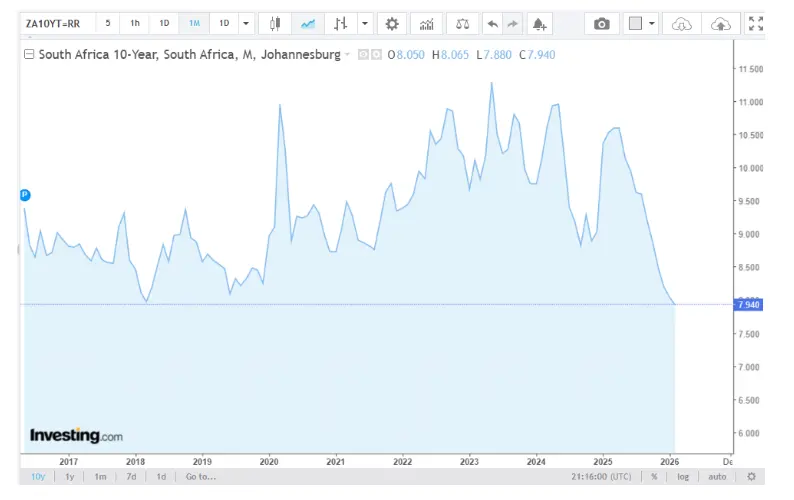
The 10-year yield indicates the cost of long-term government borrowing. It also influences long-term borrowing for banks and companies. The 10-year yield tends to go along with the risk climate in markets.
When global risk appetite wanes, investors demand higher yields. They demand higher compensation to hold riskier local securities.
Extra yield can also reflect local worries, such as in South Africa. Variables involved include inflation, growth, debt, and trust in policy. The risks are such that long yields can leap in a hurry.
What traders watch in the 10-year
Over a 10-year period, traders watch whether a yield is rising or falling.
A rising 10-year yield can signal higher long-term risk premiums. It can also mean inflation fears are creeping up. Sometimes it signals heavy bond selling by global funds.
A falling 10-year yield can signal a calmer risk mood. It can also mean inflation is expected to cool. It may also reflect safe-haven flows into bonds.
What is the 5-year yield?
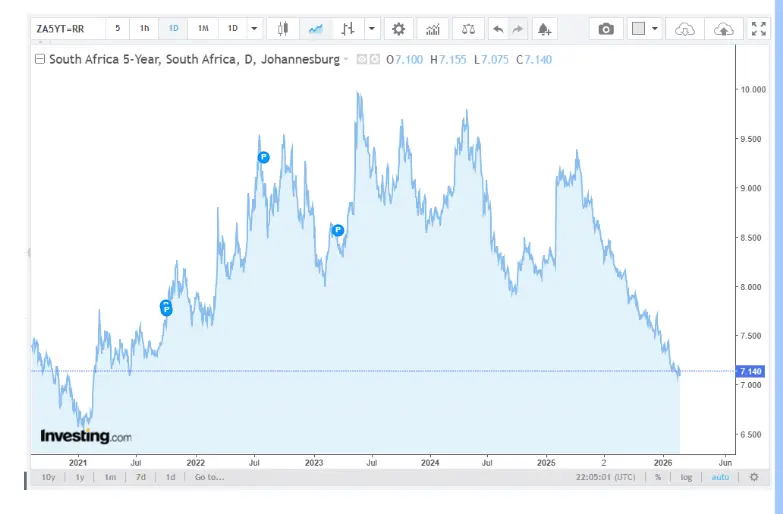
Comparison Between a 10-year vs 5-year yield in South Africa
| Item | 10-year yield | 5-year yield |
| Signals | Long-term risk and inflation fears | Mid-term policy path and rate outlook |
| Common uses | Benchmarks long borrowing and risk mood | Tracks expected SARB moves over the years |
| Key risks | Inflation, debt worries, global risk-off shocks | Surprise policy shifts, inflation surprises, growth swings |
What moves the South African Government Yield?
1) SARB policy and rate expectations
Shorter yields react most to SARB signals. If the market expects hikes, front-end yields rise. If cuts look likely, front-end yields usually fall.
Longer yields also react, but in a different way. They embed future inflation and term risk for many years.
2) Inflation
Inflation is the silent driver of long yields. Higher expected inflation pushes yields higher over time. Lower expected inflation can pull yields lower.
3) Fiscal news and debt supply
Budgets and debt plans matter for long bonds. More borrowing can raise yields through extra supply. Fiscal worry raises risk premiums and pushes yields higher.
Auction results also matter on the margin. Weak demand can lift yields in that maturity bucket. Strong demand can pull yields down after auctions. National Treasury publishes bond auction calendars and guidance.
4) Global rates and risk mood
US Treasury yields can drag SA yields with them. Global risk-off can cause outflows from Emerging Market bonds. That can lift yields and weaken the rand together.
5) Credit and liquidity risk
If investors doubt long-term stability, yields rise. If liquidity dries up, yields can gap higher. This is common during shocks and thin trading days.
How to track South African Government Bond Yields
- Pick the yield you will follow: Start with the South Africa 10-year government bond yield. Add one shorter point, like a 2-year or 5-year, for context.
- Use SARB as your daily reference: Check the South African Reserve Bank’s current market rates data.
- Confirm which bond is being quoted: The 10-year yield can refer to a specific RSA bond near 10 years. It can also be a curve-based 10-year point. Write down the bond code or the curve label when you can.
- Watch the auction calendar: Auctions can shift demand and move yields. Check the National Treasury’s fixed-rate bond auction schedule. Note the auction day and the bond maturity on offer.
- Use JSE data when you want more detail: The JSE is useful for broader bond market data. It helps when you want pricing across several maturities. It also helps when you want curve-level data.
- Use a charting site for quick trend checks: Use a finance chart site to spot the daily direction fast. Set a habit by checking the 1-day, 5-day, and 1-month views.
- Cross-check before you act: Compare your official read (SARB) with one chart source. Small gaps happen due to timing or bond selection. Record the date, time, and source with your number.
Trusted places to check yields and bond data
- South African Reserve Bank (SARB): best for official market rate references.
- National Treasury (Investor / Debt Operations): best for auctions, supply, and debt updates.
- Johannesburg Stock Exchange (JSE): strong for local bond market data and curve info.
- Trading Economics: quick charts and recent yield moves.
- Investing.com: easy yield charts and short-term performance views.
How Yields are Used in Investing and Trading
People watch yields because they shape rates, risk appetite, and flows. This is just for educational purposes, not personal financial advice.
From the Investing lens
For long-term investors, yields work like a comparison tool. They help you judge what return you may earn for taking a risk.
1. Compare income options: Investors often compare yields across choices, such as:
- Government bonds vs bank deposits
- Different bond maturities (2-year vs 10-year)
- Different countries’ bond markets
A higher yield can reflect higher income potential, but it may also signal higher inflation expectations or increased risk.
2. Time horizon matters: Time changes the risk you carry. Short-term bonds usually react more to policy changes sooner. Long-term bonds carry more inflation and long-run uncertainty.
3. Risk pricing: When investors worry about debt or stability, yields can rise. That rise is the market asking for more reward to lend.
From the Trading lens
Traders track yields because they influence capital flows. Still, a yield move is not a clean buy or sell signal.
1. Forex Impact: Forex often reacts to yield differences between countries. Wider spreads can support carry interest. But if yields rise due to fear, a currency can weaken anyway.
So traders ask why yields moved, not just how much.
2. Equity Impact: Higher yields can pressure stocks over time. Lower yields can ease financial conditions and support risk-taking. But earnings, growth, and news still matter a lot.
3. Why don’t yields give a signal by themselves? The same yield jump can mean different things, like:
- Higher inflation worries
- A change in rate forecasts
- Budget or debt concerns
- Global risk-off selling
Context decides the message.
Common mistakes when reading South African government bond yields
South African government bond yields are widely used as market indicators. But a lot of the readers misunderstand what the numbers really say. Below are five common mistakes people make and how to avoid them.
1. Treating yield as a guaranteed return
Even if a bond is held to maturity, actual returns can still be affected by inflation, taxation, and credit risk. A quoted yield is not a guarantee. It is a market estimate at today’s price. If yields increase after you buy a bond, the bond price can decrease. That drop in price can diminish your total return. That is even more relevant if you might sell before maturity.
Also, inflation, interest rates, and country risk are factors that contribute to a yield not being guaranteed.
2. Mixing up yield and coupon rate
The coupon rate is the fixed interest rate set at issue. It does not change over the bond’s life.
The yield changes every day because the bond price changes. Two bonds can have the same coupon but different yields today. Always check which number you are looking at.
3. Ignoring inflation when comparing yields
A high yield can still mean weak buying-power returns. What matters is the return after inflation.
If inflation is close to the yield, the real return is small. If inflation is higher than the yield, the real return can be negative. This is why real yield and inflation trends matter in South Africa.
4. Assuming government bond means are risk-free.
Government bonds are often seen as safer than company bonds. At the same time a safer investment. However, they are not completely risk-free because:
- Inflation is staying high for longer
- Fiscal strain and rising debt costs
- Currency risk for foreign investors
- Market liquidity risk in stressed periods
Yields rise when investors want more pay for these risks.
5. Reading one day’s move as a trend
Bond yields can move on a single headline. That does not mean the market has changed direction.
A better approach is to check:
- 5-day and 1-month charts
- Major data releases (inflation, SARB decisions, budget news)
- Global moves, like US Treasury yields and risk mood
Look for repeated moves with clear drivers. That is more reliable than one-day noise.
Frequently Asked Question
What is the South Africa 10-year government bond yield?
It’s the market return on an SA government bond with a 10-year term. The 10-year yield refers to the market return on a South African government bond with a maturity of around 10 years.
Why do SA government bond yields change every day?
Because bonds trade daily, their prices move with buying and selling. As prices change, yields adjust to match the new market price.
What is the difference between yield and interest rate?
An interest rate is often a set rate, like a policy or bank lending rate. A bond yield is a market rate that moves as the bond price moves.
What is the difference between yield and coupon rate?
The coupon rate is fixed when the bond is issued. The yield changes because the bond’s trading price changes.
When yields rise, do bond prices always fall?
For the same bond, a higher yield usually comes with a lower price. Across different bonds or data feeds, timing and methods can blur it.
What moves the 10-year yield the most?
Inflation outlook, SARB rate expectations, and budget or debt news matter most.
Global yields and risk-off days can also shift it quickly.
Where can I track SA government bond yields?
Use SARB Current Market Rates, plus JSE bonds data for market detail.
For supply context, check National Treasury auction calendars, and use Trading Economics or Investing.com for quick charts.
Is the 10-year yield a forecast?
No, it’s not a promise of where yields will go next.
It’s today’s market pricing of long-term rates, inflation, and risk.
References
- https://www.investopedia.com/terms/b/bond-yield.asp Bond Yield: What it is and How it works
- https://www6.royalbank.com/en/di/hubs/investing-academy/article/why-should-investors-care-about-bond-yields/kkr40f2o Why Investors Should Care About Bond Yields
- https://www.investopedia.com/terms/y/yieldcurve.asp? Yield Curve: How It Works and Types
- https://www.investopedia.com/terms/b/bondquote.asp#:~:text=Yield%20Quotes,8 Bond Quote: Definition, How to read for trading, and an example
- https://www.reuters.com/world/africa/south-african-rand-firms-ahead-national-budget-2026-02-25/? South African Rand Firms Ahead of National Budget
- https://www.vantagemarkets.com/en-za/academy/types-of-bonds/ What are the Types of Bonds