
 Updated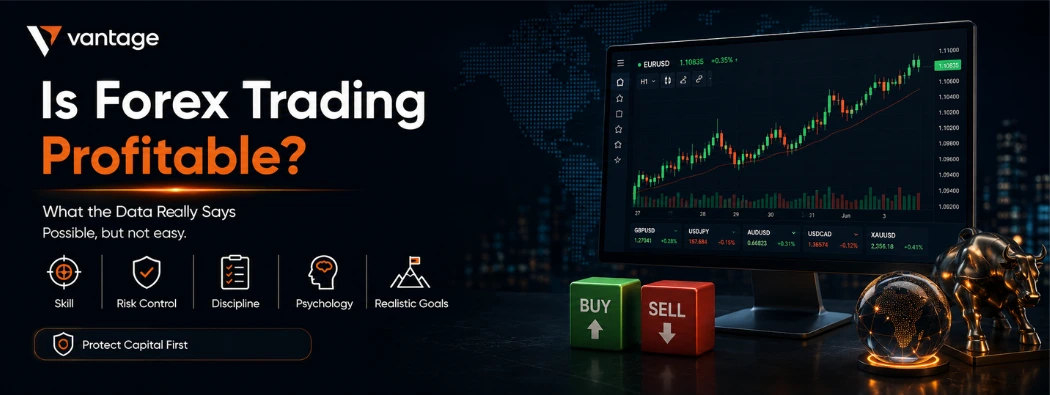
Trading forex through CFDs can be profitable, but most retail clients lose money. Regulators such as the FCA, ESMA, FSCA and CFTC note that a majority of retail traders using leveraged forex and CFDs incur losses, emphasising the importance of understanding the risks involved.
However, a small group of disciplined traders achieves consistent results. Profitability is far more difficult than social media often suggests.
Key Takeaways
- Trading forex through CFDs can be profitable, but most retail clients lose money.
- Profitability requires skill, discipline, and effective risk management.
- High leverage can magnify potential profits and losses, depending on whether the price moves in your favour.
- Most successful traders focus on preserving capital.
- There is no guaranteed or average forex income.
- The same risks apply to traders in South Africa.
- Anyone promising guaranteed returns should be treated as a red flag.

So, is forex trading profitable?
Being honest about this helps build trust and sets realistic expectations for your audience, encouraging patience and understanding of the journey involved.
- Skill: The ability to analyse markets, identify trading opportunities, and execute trades using a tested strategy rather than guesswork.
- Risk management: Limiting losses through proper position sizing, stop-loss orders, and avoiding excessive leverage.
- Trading psychology: Controlling emotions such as fear, greed, impatience, and overconfidence that can lead to poor trading decisions.
- Capital preservation: Protecting your trading account from large losses through discipline and risk management can help you feel more in control and confident about your long-term success.
- Realistic expectations: Understanding that consistent profitability takes time and that forex trading is a long-term journey can encourage patience and perseverance among your audience.
Most beginners focus on potential profits, while experienced traders focus on controlling losses. This article focuses primarily on retail forex trading through CFDs.
In this guide, you’ll learn how profitable forex trading really is, why most traders lose money, what separates profitable traders from unsuccessful ones, and whether it’s profitable in South Africa.
Is Forex Trading Profitable?
Yes, trading forex through CFDs can be profitable, although achieving consistent profitability is neither easy nor guaranteed.
Many forex ads push the narrative of success and luxury lifestyles. However, when you analyse regulatory data, most retail traders eventually lose money. Recognising that consistent profitability requires knowledge, discipline, risk management, and a tested trading strategy can motivate your audience to develop these qualities.
The reality is simple:
- A minority of traders make consistent profits.
- Most traders either break even or lose money.
- Profitability is possible but uncommon.
- Success usually takes years, not weeks.
Anyone claiming that forex trading is an easy path to wealth should be approached with caution.
How Profitable Is Forex Trading?
The profitability of forex trading varies dramatically between traders. Some traders profit while others lose; understanding that outcomes depend on experience, risk management, leverage, market conditions, and trading psychology helps set honest expectations.
- Trading experience: Experienced traders are often better at recognising market patterns, managing risk, and avoiding common beginner mistakes.
- Risk management: This helps you limit losses and protect trading capital during periods of losses. (The process of limiting potential losses by controlling how much money you risk on each trade)
- Leverage, which allows traders to open larger trades with less capital, can boost profits but also magnifies losses. Excessive leverage can quickly deplete a trading account when trades go against you.
- Market conditions, such as volatility, trending, or uncertainty, can greatly affect trading performance and opportunities. For example, traders profit when prices rise slowly, but rapid price swings can cause trades to fail and lead to losses.
- Trading psychology: traders should have plans and stick to them, not changing their minds when a trade goes wrong. For instance, A trader plans to wait for a clear signal before buying. However, when the price suddenly drops, out of fear of losing, they panic and sell early rather than following their plan.
- Transaction costs: trading fees you pay, such as spreads, commissions, and overnight fees, that, when deducted from your profits, can significantly impact long-term profitability.
A trader who protects capital and manages risk effectively often outperforms a trader who constantly seeks large gains.
Instead of asking how much money forex traders make, a better question is whether they can consistently generate positive returns while controlling risk.
Why Most Forex Traders Lose Money
Several factors contribute to the high failure rate among retail traders.
Excessive Leverage
Leverage allows traders to control larger positions(trade bigger) with smaller deposits. In simple terms, you’re using a large amount of borrowed leverage compared to your own money to trade. While leverage can increase profits, it also magnifies losses.
A small market or price move against a highly leveraged position (a borrowed trade) can quickly wipe out a trading account. Many traders use position sizing and stop-loss orders as part of their broader risk management approach to limit potential losses, although no single approach is suitable for every trader.
Poor Risk Management
Many beginners risk too much on a single trade. Profitable traders typically focus on preserving capital by reducing the probability of large, avoidable losses. They understand that survival in the market is more important than chasing quick gains.
Emotional Trading
Fear, greed, revenge trading, and impatience often lead to poor decisions. Many traders abandon their plans after a few losses and begin making impulsive trades. For example, a trader loses a few trades, gets angry, then puts more money on the next trade to “win it back,” only to lose even more.
Unrealistic Expectations
Social media often promotes unrealistic income claims. Many beginners expect to double their money quickly. When those expectations are not met, they take excessive risks and lose capital.
You can watch a video of a trader claiming to have turned $100 into $10,000 in a week. When people see that, they want to trade with their savings, expecting quick results or profits.
Most of the time, cases end up badly, especially for beginners. Because after a few small losses, rather than quick profits, they start betting larger amounts to “catch up” and end up losing most of their money.
Trading Costs
Trading fees such as spreads, commissions, and overnight holding fees erode profitability over time when you pay them from your profits. This is why traders aim to make enough profit to cover their fees.
Does Your Broker Affect Profitability?
The broker you choose can influence your trading experience and overall costs. When choosing a broker, factors to consider include:
- Regulation: A regulated broker must follow rules designed to protect clients. This helps clients avoid fraudulent and unfair practices.
- Trading fees: Charges for trading, such as commissions or other account costs. Higher fees reduce your overall profit.
- Execution quality: How quickly and accurately your trades are processed. Poor execution can result in getting a worse price than expected.
- Spreads: The spread is the difference between the bid and ask prices for a currency pair. If spreads are wide, you pay more to trade, increasing trading costs.
- Available leverage: Allows you to trade larger positions with less money. Higher leverage can increase profits but also increase losses.
- Platform reliability: A reliable trading platform works smoothly and stays online during market hours. Technical problems can prevent you from entering or exiting trades when needed.
Lower trading costs may reduce overall trading expenses, although profitability ultimately depends on many factors, including market conditions and individual trading decisions. A transparent and well-regulated broker also provides a safer trading environment than an unregulated offshore provider.
What Makes Profitable Forex Traders Different?
Many traders who achieve consistent results often share several common characteristics:
They Focus on Risk First
Successful traders often prioritise limiting losses rather than maximising profits. For example, before placing a trade, a trader decides to risk only $10 on a $1,000 account. If the trade goes wrong, the loss stays small.
They Follow a Tested Strategy
Profitable traders rely on proven methods instead of random decisions. For example, a trader enters trades only when specific conditions in their strategy are met, rather than buying or selling on a gut feeling.
They Keep Detailed Records
When you record and account for all the trades you have made, you can analyse them to identify mistakes and improve decision-making over time. After every trade, a trader writes down why they entered, why they exited, and the result. Later, they notice they lose money when trading during major news events and adjust accordingly.
They Remain Disciplined
Consistency often matters more than finding the perfect strategy. For instance, a trader’s plan calls for stopping trading after three losses in a day. Even though they want to keep trading, they follow the rule and stop.
They Continue Learning
Financial markets evolve constantly. Successful traders adapt to changing conditions and continue improving their skills. For instance, a trader notices that market conditions have changed and takes time to learn new techniques and improve their strategy rather than using the same approach forever.
Do the Math: What Profitability Actually Looks Like
Profitability depends on expectancy.
A simple expectancy formula is:
Expected Profit = (Win Rate × Average Win) − (Loss Rate × Average Loss) − Trading Costs
For example:
- Win rate: 40%
- Average win: R3,000
- Loss rate: 60%
- Average loss: R1,000
Expected outcome:
(0.40 × 3,000) − (0.60 × 1,000)
= R1,200 − R600
= R600 before trading costs
This example shows why traders do not need a high win rate to be profitable. Risk-to-reward ratios often matter more than being right on every trade.
Is Forex Trading Profitable in South Africa?
Forex trading is a legal financial activity in South Africa and has become increasingly popular among retail traders. However, legality does not guarantee profitability.
South African traders face many of the same challenges as traders elsewhere, including:
- Over-leverage
- Poor risk management
- Social media misinformation
- Trading scams
- Unrealistic profit expectations
Many South Africans are attracted to forex trading because of its accessibility and relatively low entry requirements. However, high leverage offered by some brokers can significantly increase risk.
Forex profits may also have tax implications. Traders should consult a qualified tax professional regarding their specific circumstances.
Anyone considering forex trading in South Africa should focus on education, risk management, and realistic expectations rather than promises of quick wealth.
Is Online Forex Trading Profitable?
Online forex trading can be profitable, but online access alone does not create an advantage.
Modern trading platforms provide powerful tools, real-time pricing, educational resources, and advanced charting. However, profitability still depends on the trader, not the platform.
The same risks that apply to traditional forex trading also apply to online trading.
What Is the Average Profit in Forex Trading?
There is no reliable average profit in forex trading. Some traders make a profit while others lose. A small group of traders can achieve exceptionally high profits.
Because outcomes vary so widely, focusing on average profits can be misleading.
A better approach is to evaluate:
- Percentage returns: How much your account grows or shrinks relative to its value. For example, turning $1,000 into $1,100 is a 10% return.
- Risk-adjusted performance: How much profit you make relative to the risk you take. Making steady profits with low risk is generally better than making the same profit with high risk.
- Drawdown levels: How much your account falls from its highest point before recovering. For example, if your account drops from $1,000 to $800, that’s a 20% drawdown.
- Capital preservation: Protecting your trading money from large losses so you can continue trading and take future opportunities.
- Consistency over large gains: Professional traders usually prefer making smaller, regular profits over time rather than chasing occasional big wins that come with higher risk.
Professional traders often prioritise consistency over large gains.
Can You Make a Living From Forex Trading?
A small number of traders generate enough income to trade full-time. However, making a living from forex trading requires:
- Significant skill
- Adequate capital
- Strong risk management
- Emotional discipline
- Long-term consistency
Most traders do not reach that stage. For many people, forex trading does not generate sufficient or consistent income to replace full-time employment, and outcomes vary significantly depending on individual circumstances.
Conclusion
So, is forex trading really profitable?
Yes, trading forex through CFDs can be profitable, although consistent profitability is neither easy nor guaranteed. However, profitability is far more challenging than many advertisements and social media influencers suggest. Most retail traders lose money because they use excessive leverage, ignore risk management, and approach trading with unrealistic expectations.
The traders who succeed tend to focus on education, discipline, consistency, and capital preservation. Rather than seeking shortcuts, they build skills over time and treat trading as a long-term endeavour.
Trading forex through CFDs offers opportunities, but it also carries significant risk. Understanding both sides of that reality is the first step toward becoming a more informed trader.
Risk Warning: CFDs are complex financial instruments and carry a high risk of rapid loss of money due to leverage. You should ensure you fully understand the risks involved and carefully consider whether you can afford to take the high risk of losing your money before trading.
Disclaimer: The information is provided for educational purposes only and doesn’t take into account your personal objectives, financial circumstances, or needs. It does not constitute investment advice. We encourage you to seek independent advice if necessary. No representation or warranty is given as to the accuracy or completeness of any information contained within.
This material may contain historical or past-performance figures and should not be relied upon. Furthermore, estimates, forward-looking statements, and forecasts cannot be guaranteed. The information on this site and the products and services offered are not intended for distribution to any person in any country or jurisdiction where such distribution or use would be contrary to local law or regulation.