
 Updated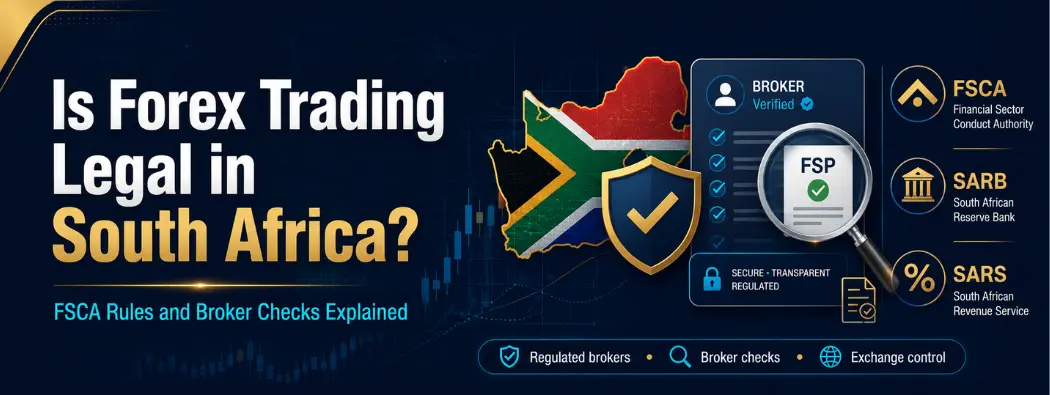
Forex trading is entirely legal in South Africa, but it is heavily misunderstood due to market risks and prevalent scams. Safe trading requires understanding two distinct regulatory bodies:
- The FSCA authorizes brokers to offer derivatives such as CFDs (speculating on price movements without owning the underlying currency).
- The SARB enforces strict exchange-control regulations on direct foreign currency transactions.
Regulators do not protect traders from financial or market losses; their role is strictly to ensure that brokers operate transparently and legally. Ultimately, success and safety for a beginner depend on choosing an authorized, suitable platform and understanding the rules that apply to their specific trading activities.
Is Forex Trading Legal In South Africa?
Forex trading is legal in South Africa when conducted through regulated financial service providers, especially for derivatives such as CFDs. But when it comes to trading foreign currency, it is subject to exchange-control rules by the South African Reserve Bank (SARB), and then banks handle the transactions – not all platforms or brokers operate under South African regulation.
Legality, in simple terms, depends on the product type. FSCA-authorised financial service providers offer CFDs. Then, real currency trading is subject to the SARB’s exchange rules. SARS oversees tax rules. When you understand that well enough, you can learn more about regulated, higher-risk, or unverified platforms.
Key takeaways
- Forex access exists in South Africa, but they follow different rules and is handled by different systems.
- FSCA only regulates authorised financial service providers in SA.
- CFDs allow you to trade currency price movements, but you do not own the actual currency.
- Exchange-control rules apply when real foreign currency is moved or held.
- Verifying the broker’s regulatory status is an important consideration.

Understanding Forex Regulation in South Africa
Forex activity in South Africa isn’t just legal; it isn’t about legality, but more so, which regulator controls which type of activity.
When it comes to CFDs, individuals trade price movements in different currencies without owning the currencies themselves, through financial service providers regulated by the Financial Sector Conduct Authority (FSCA).
When it involves the direct buying, selling, or holding of foreign currency, South Africa’s financial system allows it by setting exchange-control rules (e.g., how foreign currency moves in and out of the country, how much you can send abroad, whether you can buy dollars, etc.). Banks and approved dealers process all transactions, especially those involving foreign currency crossing borders.
Some beginners might think that forex trading is one activity, but in reality, it is
- Trading currency price movements through CFDs
- Directly buying and holding foreign currency
- Trading or investing through a company that is not regulated in South Africa
Before a broker can offer services such as CFDs, they must obtain approval from the FSCA, which regulates forex brokers in South Africa. Even though trading is regulated, it does not mean it is safe or profitable. The brokers are just bound to follow certain rules.
The South African Revenue Service (SARS) oversees tax rules. The South African Reserve Bank (SARB) sets exchange-control rules, including limits on how much you can deposit and withdraw. Tax and exchange rules are handled separately and depend on your situation.
What Counts As Forex Trading In South Africa?
The term “forex trading” can refer to different activities, especially in regulatory and practical contexts.
Here is a clearer breakdown that helps reduce confusion:
| Activity | Meaning | Why it matters |
| Direct currency exchange | Buying or selling physical foreign currency | Typically handled through banks or authorised dealers under exchange-control rules |
| Forex CFDs | Trading based on changes in the price of currency, but you do not own the currency itself | No ownership of currency; exposure comes from price differences |
| Broker platform trading | Using trading platforms MT4, MT5, or similar platforms | No ownership of currency; exposure comes from price differences |
| Broker platform trading | Using trading platforms MT4, MT5, TradingView or similar platforms | The platform is only a tool; what matters is if the provider is regulated |
| Offshore account funding | Sending money to foreign-based trading accounts | It may involve additional exchange control rules if your money or broker is outside South Africa—for example, payment limits. |
So it’s not right to assume that “online forex trading” always refers to one uniform activity. In practice, it can involve different types of trading (Forex CFD trading, Direct currency trading, Forward or futures contracts, etc.), sending money abroad, or using overseas accounts, each with different rules that may apply.
Who Regulates Forex Brokers In South Africa?
Different institutions regulate forex brokers in SA. Each has its responsibilities in the financial system.
The FSCA (Financial Sector Conduct Authority) regulates financial service providers. Their main focus is to ensure authorised financial providers adhere to certain legal standards when serving their customers. A broker operating in South Africa authorised by the FSCA usually has a valid FSP number. That number is a reference to verify that they are a legal entity authorised to conduct financial activities. Rules can include:
- Telling brokers that trading carries risk.
- Be honest about trading activities, like not guaranteeing you profits.
- Your money should be safe, etc.
The South African Reserve Bank focuses on and is responsible for setting rules on exchange control that govern how foreign currency moves in and out of the country. These rules can mean asking for approval, limits, or proof of where the money is going.
SARS (South African Revenue Service) handles taxation. When you trade, there may be tax implications, depending on whether the gains are treated as income or capital.
| Body/role | Function | Practical relevance |
| FSCA | Regulates financial service providers | Confirms whether a broker entity is authorised |
| FSP Number | Licence identifier | Used to verify the legal status of a provider |
| SARB | Exchange control oversight | Influences cross-border currency movement |
| SARS | Tax authority | Determines reporting and tax obligations |
How to check if a Forex Broker is Authorised
When checking whether a broker is authorised to offer forex-related products and services, the assessment goes beyond whether the website or marketing materials are professional.
A practical verification process includes:
- One starting point is identifying the legal entity name shown in the broker’s footer or legal documentation
- The FSCA FSP register may be used to search for the FSP number associated with that entity
- The register can be searched using the entity name or FSP number
- Confirming whether registered details match the website information may be useful
- Reviewing risk disclosures and product descriptions carefully
The FSCA search tool provides a public register of authorised financial service providers:
Some brokers might use a brand name that is different from their officially registered company name in the FSCA database. The footer or Legal/Terms section may contain the registered company name on the website.
It may be helpful to verify the payment account details provided by the provider. Also confirming the name they give you for deposits, contracts, and risk documents, and ensuring it matches the authorised company name in the FSCA register. If it doesn’t match, there is an issue.
Skipping these checks may increase exposure to potential scams or unverified providers.
Legal, Regulated, and Safe Are Not The Same Thing
It may be worth noting that being regulated does not mean you won’t lose money, or that the provider follows the rules set by the Financial Sector Conduct Authority (FSCA).
| Statement | Better understanding | Practical implication |
| If it is legal, it is safe | Regulation governs conduct, such as being honest with you, not outcomes | Losses may still occur due to volatility and leverage |
| If it is regulated, it means it is risk-free | Regulation governs conduct, such as being honest with you, not outcomes | Risk management remains essential |
| A recognised brand means it is legitimate | Legal entity matters more than marketing brand | Verification should focus on FSP details |
| Profits are guaranteed if rules are followed. | Trading outcomes are uncertain; sometimes you profit, other times you do not | No performance guarantees exist |
Regulation primarily focuses on being honest and clear in communication with customers. Market risk, including potential losses, is normal with trading instruments such as CFDs. Sometimes you gain, other times you do not, as the market is volatile.
Understanding these distinctions may help set more realistic expectations for trading outcomes, not guaranteed fake promises.
FSCA-Regulated Broker Vs Offshore Broker Considerations
Traders in South Africa trade on both local and offshore platforms, each of which operates under different regulatory frameworks.
- An FSCA-authorised entity adheres to South African regulatory oversight, including conduct standards and local compliance expectations.
- Offshore entities may be regulated in other jurisdictions, so enforcement mechanisms, complaint handling, and consumer protections are different from those set by the FSCA.
| Check | FSCA-authorised entity | Offshore entity |
| Regulation | FSCA oversight | Foreign regulator |
| Verification | FSCA register | External regulator checks |
| Complaint process | Local regulatory pathways | Maybe outside the SA jurisdiction |
| Funding | Typically, local banking channels | May involve cross-border processes |
| Risk context | Regulated conduct standards | Varies by jurisdiction |
During dispute resolution with an offshore entity, the process may differ from the FSCA’s rules and may not align with local expectations of bodies and customers. As resolution processes may depend on foreign regulatory systems
Exchange Control And Funding Considerations
Put simply, exchange control refers to the rules that apply when one moves foreign currency in and out of the country, especially electronically through banks. These rules are overseen by the South African Reserve Bank’s framework and implemented by authorised financial institutions.
Sending actual foreign currency abroad follows different rules:
- Banks may ask you why you need to send money overseas. And also for proof that it is for trading account funding.
- There might be a limit to how much you can send, and they might also review your profile.
- Approved banking channels are typically required (not informal or personal payment routes).
- You might be asked to explain why you need to send foreign currency and what it is for.
- Banks may request the source of funds (where the money came from).
- Certain transactions need bank approval before processing under South African Reserve Bank rules.
Do Forex Traders Pay Tax In South Africa?
Forex trading activity in South Africa may have tax implications. Traders are encouraged to consult a qualified tax professional or visit www.sars.gov.za for guidance specific to their situation.
Legal Does Not Mean Low Risk: Key Trading Risks
The fact that trading is legal does not mean you won’t experience risks. The truth is, trading comes with risks.
When trading forex CFDs, leverage can amplify exposure to price movements. This means that gains and losses may be larger relative to your invested capital. At the same time, prices can be unstable when you buy low and sell lower, or buy higher and sell lower. Prices can change very quickly, especially during major news or unstable market conditions.
Key risk factors include:
- Leverage amplifying exposure, which means you can lose cash after trading for an extended period of time
- Margin requirements affect positions, meaning you may need extra money to keep trading when you lose
- Rapid market fluctuations mean prices change very quickly as they go up and down rapidly
- Execution differences under volatile conditions, meaning trades may not go as planned. When you try a trading strategy, it may not lead to profits.
- Emotional decision-making under pressure means that people sometimes make emotional rather than logical decisions.
Common Red Flags In Forex-Related Offers
With unregulated trading offers, you see certain signs and know this is trouble.
Common warning signs of a provider offering unregulated trading products and services include:
- Promises of guaranteed returns – meaning you will always make your money back, no matter what. Trading doesn’t work that way.
- Pressure to deposit money quickly for no reason
- Communication only via messaging apps
- Requests for personal account transfers
- Unverifiable license or entity information
- Use of copied or misleading regulatory details
When these signals are present, it may be useful to consider whether the company is legitimate and regulated. Traders may find it useful to consult the FSCA search tool.
Traders may find a deeper breakdown of scam patterns and verification methods useful, available here.
General Considerations for New Traders
In forex trading, Many traders find it useful to start by learning before live trading.
A typical sequence includes:
- Understanding how forex CFDs and leverage function – Traders may consider learning how forex CFDs and leverage function
- Verifying the legal entity and regulatory status of a provider – Check whether the broker is regulated
- Reviewing risk disclosures and trading conditions – Review the risks associated with trading
- Testing platform functionality through a demo environment – Use a demo account to practice without real money
- Developing a personal risk framework and record-keeping system – Consider how much you can afford to risk before trading
Conclusion
Forex trading in South Africa is legal. Trading products like CFDs, when you do not own the trading money, and buying or moving real foreign currency for trading follow different bank rules.
What matters most is:
- The type of product you’re trading
- Whether the broker is properly regulated
- The real company behind the platform
- Basic tax and money-transfer rules
You can check this using FSCA records.
Trading with a demo account can also help you practice to understand the process before using real money.
Frequently Asked Questions
Is Forex Trading Legal In South Africa?
Yes, trading is legal, but it must be done through properly regulated financial service providers.
Do I Need a License to Trade Forex In South Africa?
No, not when you need to trade as an individual. But a business that offers financial services to others requires approval from authorities such as the FSCA.
Who Regulates Forex Brokers In South Africa?
The FSCA regulates brokers. SARB manages currency movement rules, and SARS handles tax.
How To Check If A Broker Is FSCA-Regulated?
Search the broker’s name or their FSP number on the FSCA register.
Are Forex CFDs Legal In South Africa?
Yes, forex CFDs are legal as long as you trade with an authorised broker found in the FSCA register.
Can South Africans Trade With Offshore Forex Brokers?
Yes, but they may follow different rules and carry additional risks.
Do Forex Traders Pay Tax In South Africa?
Forex trading activity may have tax implications in South Africa. For guidance specific to your situation, consulting a qualified tax professional or visiting www.sars.gov.za is recommended..
Can Bank Cards Be Used For Forex Deposits?
Watch out for guaranteed profits, pressure to deposit, and unverified licenses.
Is Forex Trading The Same As Gambling?
Forex CFD trading is a regulated financial activity, but it carries significant risk. Losses can occur rapidly, and outcomes are not guaranteed regardless of the approach taken.
Risk Warning: CFDs are complex financial instruments and carry a high risk of rapid loss of money due to leverage. You should ensure you fully understand the risks involved and carefully consider whether you can afford to take the high risk of losing your money before trading.
Disclaimer: The information is provided for educational purposes only and doesn’t take into account your personal objectives, financial circumstances, or needs. It does not constitute investment advice. We encourage you to seek independent advice if necessary. No representation or warranty is given as to the accuracy or completeness of any information contained within. This material may contain historical or past performance figures and should not be relied on.
Furthermore, estimates, forward-looking statements, and forecasts cannot be guaranteed. The information on this site and the products and services offered are not intended for distribution to any person in any country or jurisdiction where such distribution or use would be contrary to local law or regulation.