
 Updated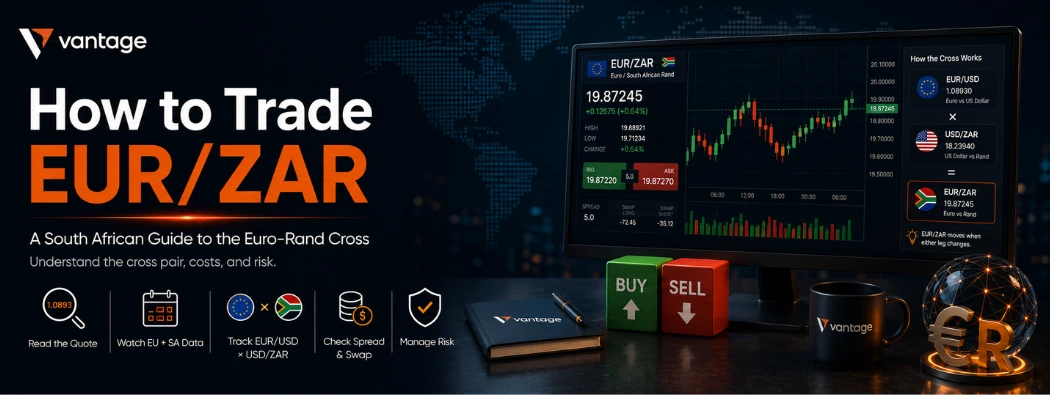
The European Central Bank made a decision in Frankfurt about interest rates in Europe, while South Africa’s economic calendar was quiet, but it still led to EUR/ZAR moving sharply. The euro was the main reason for that, and that is the first thing to understand about this currency pair. This is a simple but clear example showing how interest rates can affect price movement and might not be related to the South African economy.
- Higher interest rates mean more people want that currency, so the price often goes up.
- Lower interest rates mean less demand for that currency, so the price often goes down.
Changes influence EUR/ZAR in both the euro and the South African rand. For South African traders using CFDs, it offers a way to speculate on exchange rate price movements without owning either currency.
This guide focuses on how to trade EUR/ZAR, not converting euros into rand for travel or business payments.
In simple terms, EUR/ZAR is a cross-currency pair in which changes in either currency can affect the exchange rate. Those who wish to explore how EUR/ZAR behaves may use a demo account to practice under simulated market conditions before deciding whether live trading is appropriate for their circumstances.
Key Takeaways
- EUR/ZAR measures euro strength against the rand. A rising rate means the euro is gaining or the rand is weakening.
- The pair is shaped by two linked markets. Its simplified formula is EUR/USD × USD/ZAR, so both currency relationships matter.
- EUR/ZAR can be costly and volatile. Lower liquidity often means wider spreads, more slippage, and larger price swings.
- Key drivers come from Europe and South Africa. Traders watch ECB and SARB decisions, inflation, growth, jobs, commodities, and global risk mood. Risk control is vital. Traders should size positions carefully, limit leverage, check swap costs, avoid duplicate rand exposure, and consider demo practice first

What Is EUR/ZAR and How Does the Quote Work?
In this pair, EUR/ZAR, the euro comes first and the Rand second, and shows how many South African rand are required to buy one euro.
- EUR is the base currency.
- ZAR is the quote currency.
If EUR/ZAR trades at 20.00, it means one euro is worth 20 rand.
As explained above, and as you understand how the exchange rate works, it is only one part of understanding how to trade EUR/ZAR. What you need to understand next is what drives that value up or down.
A rising EUR/ZAR rate means the euro is gaining value relative to the rand. A falling EUR/ZAR rate means the rand is gaining value relative to the euro.
Understanding the Cross-Rate Mechanism
EUR/ZAR is not one of the most heavily traded currency pairs in the world. It is rather a trade between two major markets that are widely traded:
- EUR/USD
- USD/ZAR
In practice, EUR/ZAR is derived from:
EUR/USD × USD/ZAR = EUR/ZAR
That structure means EUR/ZAR is influenced by:
- EUR/USD (euro vs US dollar market)
- USD/ZAR (US dollar vs South African rand market)
As EUR/ZAR is affected by both the euro and the South African rand, here is how each currency’s price movement affects the other:
Start:
- EUR/USD = 1.10
- USD/ZAR = 18.00
New EUR/ZAR = 1.10 × 18.00 = 19.80
Now both move, but in opposite directions:
- EUR/USD rises to 1.12 (euro stronger and pushes EUR/ZAR up)
- USD/ZAR falls to 17.65 (rand stronger and pushes EUR/ZAR down)
New EUR/ZAR = 1.12 × 17.65 = 19.77
A Worked Cross-Rate Example
The cross-rate formula is simply explained like this:
- EUR/USD = 1.10
- USD/ZAR = 18.00
The implied EUR/ZAR rate would be:
1.10 × 18.00 = 19.80
Now assume EUR/USD rises by roughly 0.4%, and USD/ZAR rises by roughly 0.4% as well. Because both pairs moved higher, EUR/ZAR could rise by about 0.8%.
For instance:
- EUR/USD rises by 0.4% from 1.10 to about 1.1044
- USD/ZAR rises by 0.4% from 18.00 to about 18.07
The new EUR/ZAR rate becomes:
1.1044 × 18.07 = 19.96
EUR/ZAR has risen from 19.80 to 19.96, which is an increase of about 0.8%.
The reverse can happen too.
Suppose EUR/USD rises while USD/ZAR falls by a similar amount. One move pushes EUR/ZAR higher while the other pushes it lower. EUR/ZAR may not move much even when both EUR/USD and USD/ZAR are moving up or down.
A quiet EUR/ZAR chart does not always mean the market is inactive. Sometimes opposing forces simply offset one another.
Why EUR/ZAR Behaves Differently From USD/ZAR
EUR/ZAR and USD/ZAR both trade the rand, but the US dollar drives USD/ZAR, while the euro drives EUR/ZAR, so they react to different global forces.
Liquidity
EUR/USD is among the world’s most liquid currency pairs (it is traded a alot). EUR/ZAR trades less frequently, which can lead to larger price gaps during active market periods. This is because no one is willing to trade at every price level.
EUR/ZAR behaves differently from major currency pairs because it has lower liquidity, higher trading costs, and more volatile price movements. Here is how:
Spread Costs
Cross pairs (e.g., EUR/ZAR) are more expensive to trade than major pairs (e.g., EUR/USD) because fewer people trade them. For CFD traders, short-term trades are more affected by costs because spreads take up a larger share of small price moves. For example:
- You trade EUR/ZAR using a CFD
- Spread (cost to enter/exit) = 0.10 ZAR
Scenario A: small short-term move
- Price moves in your favour by 0.15 ZAR
- You close the trade
Result:
- Gain = 0.15 ZAR
- Cost = 0.10 ZAR
- Net profit = 0.05 ZAR
This simplified example is provided for illustrative purposes only and does not reflect actual trading outcomes.
Readers looking for a detailed explanation can explore Vantage’s guide to forex spreads.
Volatility
Because two currency relationships influence the pair, EUR/ZAR can produce larger percentage swings(the price moves up or down by a bigger %) than some major pairs. EUR/ZAR depends on EUR/USD (euro strength) and USD/ZAR (rand strength or weakness)
Larger moves can increase opportunity, but they also increase risk. Position size (trade size) becomes more important when price fluctuations widen. Because the bigger your trade, the more each price move affects your money.
For instance:
1. Small position
- Trade size: 1,000 units
- Price move: +0.10 ZAR
- Result: 1,000 x 0.10 = +10 ZAR profit
2. Large position
- Trade size: 10,000 units
- Same price move: +0.10 ZAR
- Result: 10,000 x 0.10 = +100 ZAR profit
Pip Value and Position Sizing on EUR/ZAR
A pip is generally the fourth decimal place in a forex quote. Because EUR/ZAR trades at a much higher level than EUR/USD, traders often notice that pip values and position (trade size) calculations feel different.
EUR/ZAR = 20.0000 (what this means is that 1 euro = 20 rand)
Position size = 10,000 EUR
1 pip = 0.0001 move in the EUR/ZAR price
So:
Small trade (10,000 EUR)
Step 1: starting value
- 10,000 × 20.0000 = 200,000 ZAR
Step 2: price moves 1 pip
- New rate = 20.0001
- 10,000 × 20.0001 = 200,001 ZAR
Result:
- Change = +1 ZAR
Larger trade (100,000 EUR)
Step 1: starting value
- 100,000 × 20.0000 = 2,000,000 ZAR
Step 2: price moves up by 1 pip
- New rate = 20.0001
- 100,000 × 20.0001 = 2,000,010 ZAR
Result: +10 ZAR
A 100,000-unit position or active trade means you are trading roughly ten times.
These figures are examples only. Actual values depend on position size (trade size), contract specifications (the rulebook of how a trade works), and current market pricing.
For that reason, traders often calculate position size before entering a trade rather than after it has been opened.
The broader concept of pips applies across the forex market, but EUR/ZAR’s higher exchange rate means traders should pay attention to how pip values and their movements translate into rand-based profit and loss.
What Moves EUR/ZAR?
EUR/ZAR price movement responds to developments affecting both the euro and the rand.
Factors on the Euro Side
The euro side of the pair often reacts to activities including but not limited to:
- European Central Bank policy decisions: The ECB raises rates to slow inflation by reducing spending, which can strengthen the euro as higher returns attract investors. It lowers rates to support growth by encouraging spending, which can weaken the euro as demand for the currency falls.
- Eurozone inflation data: Shows how fast prices are rising in Europe. High inflation can push the ECB to adjust interest rates, which in turn affects the euro.
- Eurozone growth figures: Measure whether the economy is growing fast or slow. Strong growth supports the euro’s price; weak growth can pressure it lower.
- Employment reports: Measure whether employment is increasing or decreasing. When there are more jobs, it indicates a strong economy, which can strengthen the euro.
- Manufacturing and services surveys: Measure business activity in factories and services. Above 50 usually means the economy is growing, and below 50 means it is bad.
Germany has the largest economy in the euro area, so traders often monitor the German economic releases. Economic data from France, Italy, and Spain can also influence expectations for Eurozone growth.
Global risk sentiment can also affect the euro. During periods of market uncertainty, investors sometimes shift capital between currencies, creating additional volatility.
Factors the Rand Responds To
The rand responds to a different set of influences. For the South African rand, it is:
- Interest rates: The South African Reserve Bank (SARB)’s monetary policy and interest rate decisions can influence the value of the South African rand.
- Economic releases: Reports on inflation, economic growth, employment, and business activity.
- Commodity markets: Price movements in commodities such as gold, platinum, coal, and other resources linked to South Africa’s economy.
- Broader risk sentiment: Events that make investors feel more confident or more cautious. For example, a major war, recession fears, or financial market stress can affect demand for the rand and euro.
All of which can affect ZAR.
For a more detailed look at what moves the rand, see the USD/ZAR trading guide.
The practical point is simple: EUR/ZAR can move due to developments in Europe, in South Africa, or both simultaneously.
Trading EUR/ZAR Through a Regulated Broker
When trading EUR/ZAR through CFDs, traders speculate on price movements rather than exchanging physical currencies. A CFD follows the price movement of the underlying market. Profit or loss depends on whether the price moves up or down after the trade is opened.
Spread Costs
EUR/ZAR spreads are often wider than those found on heavily traded major pairs.
For short-term traders, spread costs account for a large percentage of total trading costs because they open and close positions more often and aim for smaller price moves. Here is an example to show how spread costs can be high for short-term traders:
Trader A
- Target: 20 pips
- Spread: 2 pips
- Spread cost = 2 ÷ 20 = 10% of the move
Trader B
- Target: 200 pips
- Spread: 2 pips
- Spread cost = 2 ÷ 200 = 1% of the move
Key point: Trader A is more affected by the spread because their profit target is small, so the cost takes up a bigger share of the move.
Swap Charges
Swap charges may apply when positions remain open overnight (or are incurred for keeping a trade open past the daily market close). The size (how big your trade is) and direction(whether you buy or sell) of swap charges depend on factors such as:
- Interest-rate differences: Higher relative interest rates attract capital into that currency and can push up its price.
- Market conditions: News and volatility determine how strongly and how fast the price moves.
- Position direction: Buying or selling determines whether you profit when the price goes up or down.
- Broker pricing: Spreads and fees reduce profit but do not affect market direction.
Because euro and rand interest rates can differ materially, overnight holding costs may vary depending on whether a trader is long or short EUR/ZAR.
Swap charges should be viewed as a trading cost and a source of risk rather than a potential income stream.
Leverage Considerations
Leverage allows traders to control greater market exposure with a smaller initial outlay (meaning you trade a larger amount of money than you actually put in). So leverage can increase both losses and gains.
Example
- You deposit: R100
- Leverage lets you control: R1,000 worth of trading
If the market goes in your favour
- Price moves up
- Your R1,000 trade makes +10%
- Profit = R100
Your position would increase in value by R100 before applicable costs, assuming a 10% favourable price movement.
If the market goes against you
- Price moves down
- Your R1,000 trade loses -10%
- Loss = R100
Your position would decrease in value by R100 before applicable costs, assuming a 10% adverse price movement.
Readers who want a detailed explanation can review Vantage’s educational material on forex leverage.
Correlation With USD/ZAR and GBP/ZAR
EUR/ZAR belongs to a broader group of rand crosses. It is part of a group of currency pairs that include USD/ZAR and GBP/ZAR.
The difference lies in the other currency:
- USD/ZAR reflects the US dollar versus the rand.
- EUR/ZAR reflects the exchange rate between the euro and the rand.
- GBP/ZAR reflects the exchange rate between the British pound and the rand.
This matters for exposure(how much you are affected by a price move).
If a trader opens EUR/ZAR and USD/ZAR in the same direction, they effectively increase their exposure to rand movements, as both positions may be affected if the rand strengthens or weakens. This can make both profits and losses larger than expected.
For that reason, traders check whether rand pairs usually move together before opening more than one trade at the same time.
Why South African Traders Watch the Euro
The euro matters to South Africa beyond the forex market, and here is why:
The European Union remains one of South Africa’s largest trading partners. Goods, services, tourism activity, and investment flows create ongoing economic links between South Africa and Europe.
When economic conditions change across the Eurozone, South African businesses involved in imports, exports, tourism, or international transactions may feel the effects. For example:
If the Eurozone economy slows down, Europeans may travel less and spend less on imports. This can reduce demand for South African exports such as minerals and fruit, and reduce tourism income for South Africa.
That is why EUR/ZAR traders also watch global economic news, not just South Africa.
EUR/ZAR is driven by both European and South African factors, making it different from USD/ZAR.
Risks and Common Pitfalls
EUR/ZAR presents risks that traders often monitor carefully.
Overleveraging
Large price swings (or price movements) not in your favour can lead to significant losses when position sizes (how large your trade is) become too large relative to your account size.
Ignoring Spread Costs
A trading strategy that appears profitable on paper can look very different once trading costs are factored in. For example, spread fees can reduce or remove the profit.
Thin Liquidity Periods
Market activity is lower when European and South African trading hours are closed. Reduced liquidity (fewer buyers and sellers in the market) may increase slippage (when you click buy at 20.00, the trade executes at 20.05 instead). Less activity = fewer people to match your trade = worse or higher execution price.
Trading Without a Defined Plan
Watching exchange-rate conversions is different from trading a CFD market.
- Entry points: when you decide to open a trade
- Exit conditions: when you decide to close a trade
- Position sizing: how big the trade is
- Risk controls: Rules to limit losses (like stop-loss)
All of which affect outcomes.
Many of these issues also appear in other rand pairs, including USD/ZAR.
Conclusion
EUR/ZAR is a cross-currency pair that combines euro risk and rand risk in a single market – meaning anything affecting the euro or the rand can move the price.
Its price is derived from EUR/USD and USD/ZAR, which means developments in Europe, South Africa, or both can influence the exchange rate. So it doesn’t move like major pairs like EUR/USD (euro vs US dollar), GBP/USD (British pound vs US dollar), etc.
For South African traders, understanding the cross-rate relationship is often the starting point. The next step is usually to observe how the pair behaves under changing market conditions and to become familiar with costs (money you lose to trading, e.g., spreads/fees), volatility (how quickly and how much the price moves), and position sizing (how large your trade is).
Those who want practical experience often start in a demo environment before deciding whether live market trading is appropriate for their circumstances.
CFDs are complex instruments, and when traded with leverage, they can carry a high risk of rapid loss of capital. Think carefully before trading CFDs because you could lose money, and make sure you can afford the risk. Vantage Markets (Pty) Ltd is an authorised Financial Services Provider, FSP No. 51268.
Frequently Asked Questions
What is EUR/ZAR?
EUR/ZAR is the exchange rate between the euro and the South African rand. It shows how many rand are required to buy one euro.
Why is EUR/ZAR considered volatile?
The pair combines euro-related and rand-related market drivers. Movements in either currency can affect the exchange rate.
Is EUR/ZAR a cross pair or an exotic pair?
It is generally described as a cross-currency pair that combines a major currency with an emerging-market currency.
What moves EUR/ZAR the most?
ECB decisions (such as interest rate changes), Eurozone data (like inflation and GDP reports), South African economic news (such as jobs and inflation figures), and global risk sentiment (for example, war news or financial market stress) can all move EUR/ZAR.
How is EUR/ZAR different from USD/ZAR?
USD/ZAR measures the US dollar against the rand. EUR/ZAR measures the euro against the rand and is influenced by developments in the euro area.
How do you read an EUR/ZAR quote?
If EUR/ZAR is trading at 20.00, one euro is worth 20 South African rand.
Does the pip value work differently on EUR/ZAR?
The pip concept is the same, but the pair’s exchange-rate level and contract size can affect how pip movements translate into rand values.
Can EUR/ZAR be traded through CFDs on Vantage?
Yes, Vantage offers access to EUR/ZAR CFD trading, allowing you to gain exposure to price movements without owning the underlying currencies.
Risk Warning: CFDs are complex financial instruments and carry a high risk of rapid loss of money due to leverage. You should ensure you fully understand the risks involved and carefully consider whether you can afford to take the high risk of losing your money before trading.
Disclaimer: The information is provided for educational purposes only and doesn’t take into account your personal objectives, financial circumstances, or needs. It does not constitute investment advice. We encourage you to seek independent advice if necessary. No representation or warranty is given as to the accuracy or completeness of any information contained within.
This material may contain historical or past-performance figures and should not be relied upon. Furthermore, estimates, forward-looking statements, and forecasts cannot be guaranteed. The information on this site and the products and services offered are not intended for distribution to any person in any country or jurisdiction where such distribution or use would be contrary to local law or regulation.