
 Updated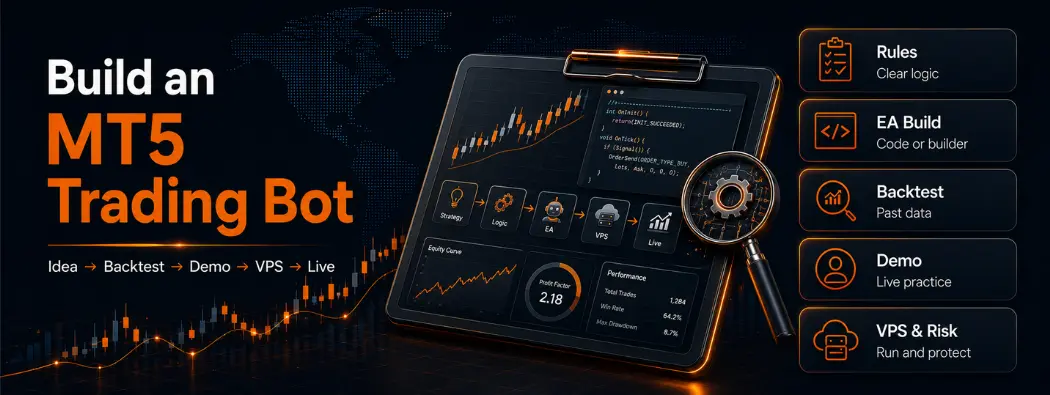
Many traders reach a point where they no longer want to watch charts all day. They already have a strategy and want it executed consistently, even when they are away from the screen.
That is where an Expert Advisor MT5 setup comes in.
To build an automated strategy on MT5, start with a rules-based trading system, turn those rules into an Expert Advisor, backtest it, forward-test it on a demo account, run it on a VPS, and only then consider going live. Automation executes discipline; it does not create an edge.
This guide explains how to test strategies effectively and implement risk controls, so traders can feel confident managing their investments before risking real money.
A demo account allows traders to test an automated strategy before considering live trading.
Key Takeaways
- An EA automates a plan you already have. It amplifies whatever strategy sits underneath, good or bad, and never creates an edge on its own.
- You need explicit, rules-based logic first (entries, exits, SL/TP, sizing, filters); anything discretionary can’t be automated reliably.
- Three build routes: no-code builder (fast, limited), MQL5 (full control, steep curve), or hire a developer (professional, variable cost and quality).
- MT4 EAs don’t run on MT5. They run on different languages (MQL4 vs MQL5); you rewrite, convert, or rebuild, then re-test.
- Testing is non-negotiable and sequential: backtest (watch for curve-fitting) → demo forward-test → go live small with monitoring.
- A VPS is about reliability, not speed; it keeps the EA running through outages and disconnects.
- Mandatory risk controls: max-drawdown limit, kill switch, coded position sizing, active monitoring; extra caution with martingale and grid.
- No-code alternatives (copy trading, signals) shift the reliance onto external providers.
What an Expert Advisor Actually Is – and Isn’t
An Expert Advisor (EA) is a program that automatically follows trading rules on MT5.
Once attached to a chart, it can monitor prices, place trades, manage positions, and close trades according to the rules it has been given. In simple terms, it automates actions that would otherwise be performed manually.
This is the basis for using an Expert Advisor in MT5. The platform executes the rules, while the trader creates and tests them.
What an EA does not do is predict the market.
It cannot identify opportunities not already built into its logic, nor can it guarantee profitable results. If the underlying strategy is weak, automation will simply execute that strategy more consistently.
An EA can help remove hesitation and emotional decision-making. It can also quickly repeat mistakes if its rules are poorly designed or if market conditions change.
The key point is simple: an Expert Advisor automates a trading plan you already have. It does not create an edge on its own. To manage risks effectively, incorporate proper risk controls and discipline, especially since automation can quickly amplify both gains and losses if rules are poorly designed or market conditions shift.
Before you automate, develop a strategy with clear, explicit rules to reassure traders that their decisions are well-defined and trustworthy.

Define your Strategy First
Before you build an EA, you need a strategy that can be defined precisely.
An automated system can only follow rules that are stated clearly. If a trading decision depends on intuition, discretion, or a visual judgement that cannot be explained, it cannot be automated reliably.
At a minimum, a strategy should define:
- Entry conditions
- Exit conditions
- Stop-loss levels
- Take-profit levels
- Position sizing rules
- Any filters or market conditions
For example, “buy when the market looks strong” cannot be programmed. “Buy when price closes above a moving average” can.
This is one of the most important stages of the automation process.
Automation amplifies whatever strategy sits underneath it. A disciplined strategy may benefit from consistent execution. A weak strategy can produce poor results more quickly when automated, because every rule is applied without hesitation.
That is why automation begins with rules, not code.
Before writing a line of MQL5 or using an EA builder, make sure your strategy is specific enough for a computer to follow exactly as intended. If the rules are unclear, the automation will be too.
Three Ways to Build an EA on MT5
Once you have a rules-based strategy, there are three main ways to turn it into an Expert Advisor.
Each approach has advantages and trade-offs. The best choice depends on your technical skills, budget, and the level of control you want over the final system.
| Method | Advantages | Limitations |
| No-Code Builder | Fast to use, little technical knowledge required | Limited flexibility and customisation |
| MQL5 Coding | Full control over strategy logic and features | Steeper learning curve and development time |
| Commission a Developer | Professional implementation without coding yourself | Quality varies, and costs can add up |
An MT5 EA builder is often the fastest way to get started. These tools allow traders to create simple automated systems using menus and templates rather than code. The trade-off is that complex logic can be difficult to implement.
The second option is expert advisor programming in MQL5. This requires more time and technical skill, but it offers the greatest flexibility and control.
The third option is to hire a developer. This can work well for traders with a clearly defined strategy who do not want to learn programming. Even then, the trader still needs to specify the rules accurately and test the finished product thoroughly.
No matter which route you choose, thorough testing remains crucial to help traders feel confident and in control before deploying the EA live.
Porting an Existing MT4 EA to MT5
Many traders assume an MT4 Expert Advisor will run on MT5 without changes. In practice, it does not.
The reason is that MT4 and MT5 use different programming languages. MT4 EAs are written in MQL4, while MT5 EAs are written in MQL5. Although the languages are related, they are not directly compatible.
If you want to convert an MT4 EA to MT5, there are three realistic options.
The first is to rewrite the EA in MQL5. This is usually the most reliable approach, especially for complex systems.
The second is to use a conversion service or developer. This can save time, but the finished EA still needs thorough testing because translation errors can occur.
The third option is to rebuild the strategy using an EA builder. This may work for simpler systems that rely on clearly defined rules.
Some traders search for ways to convert an MT4 EA to MT5 online. Conversion tools do exist, but they are rarely perfect. Automated conversions often struggle with custom indicators, trade-management logic, and platform-specific functions.
For that reason, any converted EA should be treated as new software.
Whether you rewrite, convert, or rebuild an EA, thorough backtesting and forward-testing are essential before live deployment. Remember, successful conversion is just the start; ongoing testing and optimisation ensure your strategy remains effective in changing market conditions.
Backtesting Your EA in the MT5 Strategy Tester
Backtesting is the process of running an EA against historical market data to see how it would have behaved in the past.
The MT5 Strategy Tester makes this possible and is an important step before any live deployment. A backtest can help identify coding errors, weaknesses in the strategy, and conditions where the EA performs poorly.
What a backtest cannot do is predict future results.
Markets change over time, and a strategy that worked well on historical data may behave very differently in future conditions. This is why a strong backtest should be viewed as evidence that a strategy deserves further testing, not proof that it will be profitable.
One common mistake is over-optimisation, sometimes called curve-fitting. This happens when a trader repeatedly adjusts settings until the strategy fits past data extremely well. The result can look impressive historically while performing poorly in live markets.
Other factors matter too.
Backtest results depend on assumptions about spreads, slippage, execution quality, and historical data accuracy. Small differences in these variables can produce very different outcomes.
The purpose of a backtest is not to predict the future. It is to evaluate whether a strategy is robust enough to justify the next step: forward testing in a live market environment.
For a detailed walkthrough of the platform itself, see the MT5 Strategy Tester guide.
Forward-Testing on a Demo Before Real Money
After backtesting, the next step is forward-testing the EA on a demo account.
This means running the strategy in a live market environment using virtual funds. Prices continue to move in real time, but no real capital is at risk.
Many traders treat this step as optional. It is not.
A backtest evaluates how a strategy behaved in historical conditions. A demo test shows how the EA behaves in current market conditions, with live data flowing through the platform.
Demo results will not exactly match a backtest. Market conditions change, spreads vary, and execution assumptions can differ from those used during historical testing.
At the same time, demo results will not perfectly match live trading either. Real-money trading introduces additional factors, including liquidity changes, execution differences, and psychological pressure.
Despite these limitations, forward-testing remains one of the most valuable stages of the process.
It helps confirm that the EA functions correctly, follows its rules as intended, and behaves reasonably in a live market environment.
Before risking real capital, allow the strategy to run on a demo account long enough to observe its strengths, weaknesses, and operational reliability.
Running Your EA 24/7: A VPS and Going Live
An Expert Advisor can only trade while MT5 is running.
If your computer is switched off, loses power, disconnects from the internet, or closes the platform unexpectedly, the EA stops operating. For a strategy that needs continuous market access, this can become a problem.
This is where a Virtual Private Server (VPS) becomes useful.
A VPS is a remote computer that runs continuously in a professional data centre. Instead of relying on a home computer, traders can run MT5 and their EA on a server designed for stable, uninterrupted operation.
The goal is not faster profits. The goal is reliability.
A VPS can reduce the risk of missed trades caused by power outages, internet interruptions, software updates, or accidental shutdowns. For strategies that monitor markets around the clock, this can be an important operational advantage.
Once an EA has passed both backtesting and forward-testing, the next step is live deployment.
Start small.
Even after extensive testing, live markets can behave differently from historical and demo environments. Execution conditions, slippage, and changing market dynamics may affect performance.
Going live should be treated as another stage of testing rather than the finish line.
Monitor the EA closely during its early operation. Confirm that trades are being executed correctly, risk controls are functioning as intended, and performance remains consistent with expectations.
For a detailed guide to hosting and setup, see the Forex VPS South Africa article.
Remember that automation does not remove risk. When leveraged CFD positions are involved, an automated strategy can lose money quickly if its logic or risk controls fail.
Risk Controls Every Automated Strategy Needs
Automation can improve consistency, but it also introduces risks that manual traders may notice and stop more quickly.
An EA follows its rules without hesitation. If those rules are flawed, or if market conditions change significantly, losses can accumulate before the problem is identified.
This is why every automated strategy should include risk controls.
One of the most important is a maximum drawdown limit. If losses reach a predefined level, the EA should stop opening new positions until the strategy is reviewed.
A kill switch is another useful safeguard. This allows trading activity to be automatically paused when unusual conditions arise or when performance falls outside acceptable limits.
Position sizing matters as well.
Risk per trade should be built into the code rather than left to chance. An EA that increases exposure too aggressively can lead to large losses in difficult market conditions.
Monitoring remains essential.
Automation does not mean “set and forget.” Technical failures, broker connection issues, data problems, and unexpected market events can affect performance. An EA can fail silently if no one is monitoring its activity.
High-risk approaches such as martingale and grid systems deserve particular caution. These strategies can increase exposure rapidly and may produce large drawdowns if market conditions move against them.
Automation should reduce manual workload, not remove risk management. Strong controls remain necessary whether trades are placed by a person or by code.
No-Code Alternatives: Copy Trading and Signals
Not every trader wants to build, code, or maintain an Expert Advisor.
For those traders, copy trading and trading signals offer alternative ways to participate in the markets without having to develop an automated system from scratch.
Copy trading allows a trader to mirror another trader’s positions automatically. When the selected trader opens or closes a position, the same action is replicated on the follower’s account according to the chosen settings.
Trading signals work slightly differently. Instead of automatically copying trades, they provide trade ideas that the trader can review and choose whether to follow.
Both approaches can reduce the amount of analysis and development work required.
They also come with trade-offs.
The trader remains dependent on another person’s decisions, risk management, and consistency. Past performance does not guarantee future results, and periods of strong performance can be followed by periods of poor performance.
Unlike an EA that follows rules you designed yourself, copy trading and signals place greater reliance on external providers.
For traders who are not ready to build an automated strategy, these options can be useful alternatives. They should still be evaluated carefully, tested where possible, and managed with realistic expectations.
Conclusion
Building an automated trading strategy on MT5 is a process, not a shortcut.
The journey starts with a rules-based strategy, continues through development and testing, and ends with careful live deployment. Along the way, each stage serves a different purpose: building, backtesting, forward-testing, hosting, and risk management.
The most important lesson is that an Expert Advisor executes a trading plan. It does not create one.
A well-designed EA can help apply rules consistently. A poorly designed strategy can still lose money, regardless of how advanced the automation appears.
That is why testing matters at every stage. A backtest is not a prediction, a demo account is not a live account, and going live should begin with conservative position sizes and active monitoring.
If you are ready to start automating a strategy, begin with a demo account first. Once the EA has been thoroughly tested and you understand its risks and limitations, you can consider moving it to a live trading environment.
Frequently Asked Questions
What is an Expert Advisor on MT5?
An Expert Advisor (EA) is a program that automatically executes trading rules on MT5, including entries, exits, and trade management.
Do you need to code to build an EA?
No. Traders can use no-code builders, hire a developer, or learn MQL5 and build the EA themselves.
Can you build an EA without coding?
Yes. Many MT5 EA builder tools allow traders to create automated strategies using templates and visual interfaces.
How do you install an EA on MT5?
The EA file is added to MT5, attached to a chart, and configured with the required settings before automated trading is enabled.
Can you convert an MT4 EA to MT5?
Yes, but it will not run directly on MT5. The EA must usually be rewritten, converted, or rebuilt and then tested again.
Is automated trading profitable?
Automation can improve consistency, but it does not create an edge. Results depend on the quality of the underlying strategy and market conditions.
Do you need a VPS to run an EA?
Not always, but a VPS can help keep MT5 running continuously without relying on a home computer or internet connection.
Does MT5 trade automatically?
MT5 can execute trades automatically when an Expert Advisor is installed, configured correctly, and allowed to run.
What’s the difference between an EA and a robot?
In practice, the terms are often used interchangeably. An EA is the MT5 term for an automated trading program.
Risk Warning: CFDs are complex financial instruments and carry a high risk of rapid loss of money due to leverage. You should ensure you fully understand the risks involved and carefully consider whether you can afford to take the high risk of losing your money before trading.
Disclaimer: The information is provided for educational purposes only and doesn’t take into account your personal objectives, financial circumstances, or needs. It does not constitute investment advice. We encourage you to seek independent advice if necessary. No representation or warranty is given as to the accuracy or completeness of any information contained within.
This material may contain historical or past-performance figures and should not be relied upon. Furthermore, estimates, forward-looking statements, and forecasts cannot be guaranteed. The information on this site and the products and services offered are not intended for distribution to any person in any country or jurisdiction where such distribution or use would be contrary to local law or regulation.