
 Updated
At first, the idea of using the best automated forex trading robot sounds appealing.
You find a tool that can scan the market, spot trade setups, and place trades based on set rules. Unlike human traders, it works without emotion and sticks to its logic. It does not hesitate or second-guess decisions. For many traders, this offers a more structured and disciplined way to approach the market.
Automated forex trading systems have become increasingly common among retail traders.
They may reduce the need for constant screen monitoring in some cases and can apply rules more consistently than manual execution. Some traders are drawn to automation because they prefer a rule-based approach or have limited screen time. However, automated systems do not remove market risk or guarantee improved outcomes.
Still, this is where many people get it wrong.
They focus on what the robot promises. They do not spend enough time thinking about what the robot needs to work well, what can go wrong, and what role they still have to play after the system is switched on.
Before considering an automated trading system, it is important to understand how they work, what risks are involved, and what ongoing oversight is required.
In this guide, we will delve into the details.
- What is a forex trading robot all about
- How it works
- Benefits and limitations
- Comparison between manual and automated trading
- How to choose one
- Who should choose to use a forex trading robot
What is a Forex Trading Robot?
A forex trading robot is software that can open and close trades based on set rules without needing constant manual action. It often works on platforms like MetaTrader 4 or MetaTrader 5 using the MQL scripting language. The goal is to automate trading tasks. While some robots are free, others are sold as paid tools or part of a service.
It can:
- scan the forex market
- spot trade setups
- open trades
- close trades
- manage stop-loss and take-profit levels.

For example
A robot might be told:
- Buy EUR/USD when a short moving average crosses above a long moving average
- risk 1% per trade
- Close the trade at 50 pips profit
- Stop the trade at 25 pips loss
Once those rules are set, the robot can act on them automatically, though ongoing monitoring by the trader remains important.
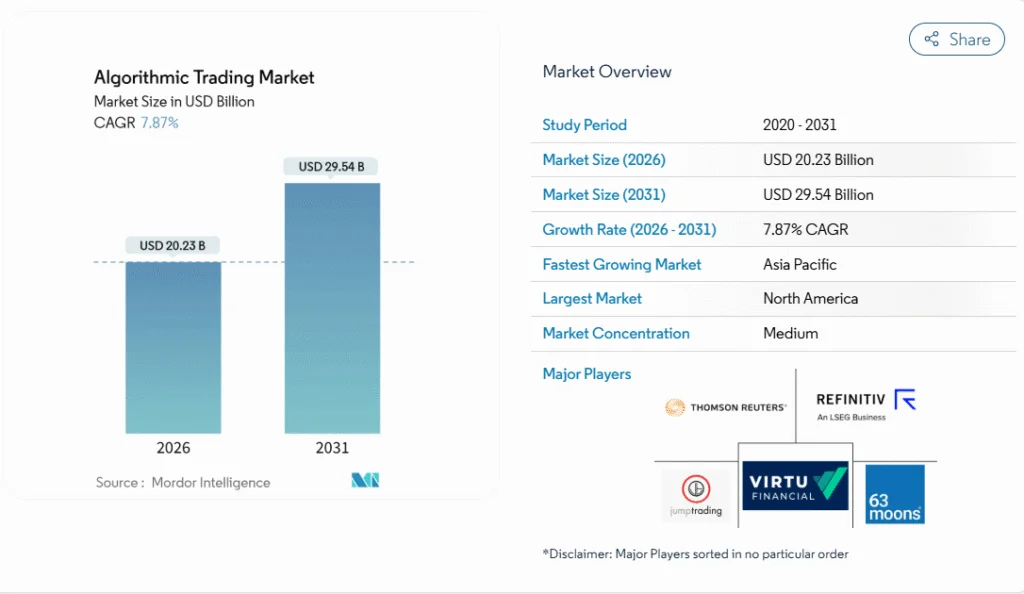
Note: These figures are projections only and are not guaranteed. Actual market developments may differ.
Driver Impact: Growth is propelled by demand for sub-millisecond execution on United States and Japanese equity venues, cloud-native backtesting that lowers capital outlays for small desks, and a widening pool of retail application programming interface users across India and Southeast Asia.
Source: Mordorintelligence
How Does a Forex Trading Robot Work?
Forex trading robots are software programs that follow coded rules to analyse the market and act on those rules automatically. On MetaTrader platforms, they are often referred to as Expert Advisors (EAs). MetaTrader explains that EAs can automate trading tasks, analyse price data, and execute strategies once they are attached to a chart and auto trading is enabled.
In practice, a robot works like this: it receives live market data, checks that data against its trading rules, and then opens, manages, or closes trades when those rules are met. Those rules may be based on indicators, price breakouts, trend signals, or risk settings such as stop-loss and take-profit levels. This means a robot does not think like a human trader. It simply follows instructions with speed and consistency.
That consistency is one reason some traders use robots. They may apply rules more consistently, which some traders find reduces emotionally driven decisions. MetaTrader provides a strategy tester that allows traders to review how a robot would have performed on historical data. However, past performance is not indicative of future results, and live trading conditions may differ significantly. Still, testing alone is not enough. A system may perform well on historical data but struggle in live markets where spreads, slippage, and market conditions change.
This is why traders should treat forex robots as tools, not shortcuts to easy profit.
Benefits
- Speed: Automated trading improves the speed at which traders can execute trades. Advances in trading technology help market participants process data and execute trades more effectively. In simple terms, automated systems can respond faster to indicators that meet their algorithms.
- Consistency: Because the system follows coded rules, it can reduce impulsive decisions and execute the same logic across trades. That makes trading more disciplined, even though it does not guarantee good results. This is a practical inference from how regulators describe algorithmic trading and control frameworks.
- Lack of emotion: The absence of emotion in the trading process helps remove emotional decision-making from trade execution. The Algorithm executes trades based on logic and preset parameters.
- Ability to backtest: Before you risk your real capital, traders can run their algorithm against years of historical data to see how it performed. Backtesting may help traders assess how specific parameters performed under historical conditions. However, these results do not reflect live market conditions and should not be relied upon as a guarantee of future performance.
Limitations
Using automated trading systems comes with drawbacks as well. These drawbacks include;
- Technical Failures: Automated systems can fail due to coding errors, poor design, poor data quality, or changing market conditions. Firms use algorithmic trading to maintain resilient systems, limits, and controls precisely because those risks are real.
- Market Risks: One final limit matters most. Automation does not remove market risk. Forex is volatile, carries substantial risk, and can lead to rapid losses of most or all capital. Automation does not make trading safe. Forex carries substantial risk and can lead to rapid loss of capital.
- Cost: Building a robust automated system is hardly free. Professional-grade automation often requires a subscription.
Manual Trading Vs Automated Trading
Here is a concise comparison table that compares manual and automated trading:
| Aspect | Manual Trading | Automated Trading |
| Who makes the trading decision? | The trader decides when to enter, exit, and adjust trades. | A computer algorithm determines order timing, price, size, and order management, with limited or no human intervention. |
| Execution speed | Human-paced execution. | Very fast execution; modern trading systems can operate at microsecond or nanosecond timescales. |
| Consistency | Can vary based on the trader’s judgment, focus, and discipline. | Follows preset rules more consistently once deployed. |
| Monitoring needs | Requires active screen time and direct trade handling. | Reduces manual order handling, but still needs human monitoring, controls, and risk oversight. |
| Main advantage | Greater direct control and real-time discretion. | Better speed, scale, and rule-based execution |
| Main Limitation | More exposed to manual entry mistakes, including fat-finger errors. | More exposed to algorithm failures, deployment errors, and bad data inputs. |
Types of Automated Forex Trading Robots
Automated Forex trading robots come in different forms. Each type follows a clear trading logic. The main difference is how it reads the market and manages risk.
1. Trend-Following Robots
A bot trading system is designed to identify and capitalise on market trends in the forex market. Their goal is to enter after a trend begins and stay in the move for as long as momentum lasts.
These robots often rely on technical tools such as moving averages, the Relative Strength Index, and the Bollinger bands. When the market shows a steady upward or downward path, the robot may open a trade in that direction. It usually exists when the trend weakens or starts to turn.
This type of robot tends to perform best in strong, clear trends. It may lose its edge when the market moves in a narrow range.
2. Grid Trading Robots
Grid trading robots place trades at fixed intervals across the market. They create a structure of buy and sell levels around the current price.
As the market rises or falls through those levels, the robot adds positions based on its setup. This approach is often used to capture repeated swings rather than one large move.
Grid robots are sometimes used in range-bound markets, though they carry significant risk if prices move persistently in one direction without reversing, potentially resulting in substantial losses.
3. Martingale Robots
Martingale robots increase trade size after a loss. The idea is to recover losses when the next trade wins.
This method carries a significant risk. A sustained losing streak can lead to rapid and substantial losses, including loss of most or all capital. Traders should approach this strategy with extreme caution.
Still, the risk is very high. A long losing streak can lead to large drawdowns and fast account damage.
4. News Trading Robots
News trading robots are built to react to major economic events. These may include central bank updates, inflation releases, or labour data.
Their purpose is to capture fast price moves that often follow major announcements. Some try to trade the first breakout. Others wait for direction to become clearer before entering.
This style can offer sharp opportunities, but it also comes with added risk. Slippage, spread expansion, and sudden reversals can affect results.
5. AI-Based Trading Robots
AI-based trading robots use advanced models to read patterns in market data. They are designed to adjust as conditions change.
These robots may study price action, volatility, volume, and other signals. Some systems also review broader data inputs to refine trade decisions. Unlike fixed-rule robots, they are built to adapt rather than follow one strict formula.
Results depend on the quality of the underlying data, the robustness of testing, and careful risk management. Flexibility in design does not reduce the inherent risks of forex trading.
How To Choose the Best Automated Trading Robot
When choosing the best automated forex trading robot, several considerations come into play: strategy design, risk controls, software compatibility, and performance testing. There is no one trading robot that’s universally regarded as best, since its suitability depends on a trader’s goals, skills, and risk appetite.
Some of the main considerations are;
1. Underlying trading strategy: an automated trading robot is working based on some programming. As a result, the logic behind entering and exiting trades with appropriate risk management largely determines the robot’s quality. A system with low or overly narrow trading conditions can fail to perform well when market conditions change.
2. Risk control is another important factor. The trading robot must integrate clear parameters for position size, stop-loss, maximum number of trades, and total capital exposure. These controls work to limit the potential for catastrophic losses and allow the trader to influence the system within well-defined risk limits.
3. Backtesting results: These are usually used to evaluate a robot’s historical performance, but be careful interpreting them. While historical testing can yield helpful insights into how a strategy would have fared under prior market conditions, nothing guarantees that the same will happen in live trading. Real-time environments may have very different market conditions, execution quality, spreads, and slippage.
4. Live support and updates: Over time, automated trading systems may need maintenance, adjustments, or software upgrades. If the robot is essentially a product of regular development and has clear documentation, it may be better maintained over time, though this does not guarantee performance or reduce trading risk..
Who Should Use an Automated Forex Trading Robot?
An automated forex trading robot is not for everyone. It works best for traders who need structure, want to save time, and understand that automation does not remove risk.
- Busy Traders: Some traders do not have enough time to watch charts throughout the day. They may have full-time jobs, business duties, or other daily demands. For them, an automated trading robot may help execute a preset strategy without constant screen time, though monitoring and risk oversight remain necessary. It allows them to stay involved in the market while reducing the need to place every trade by hand.
- Rule-based traders: Automated trading robots are also a good fit for traders who prefer a clear system. These traders like defined entry and exit rules, fixed trade setups, and a more disciplined approach. Since the robot follows programmed instructions, it suits people who want consistency and do not want emotions to affect every decision.
- Beginners who want support: They may also use an automated forex trading robot, but should do so with caution. A robot can help with execution and provide some structure, but it should not replace learning. New traders still need to understand how the forex market works, how risk is managed, and why a strategy performs well or poorly.
Can Automated Forex Trading Produce Results?
Automated forex trading robots do not guarantee profits. Results vary significantly depending on market conditions, strategy settings, and risk management applied. Results depend on the strength of the trading strategy, the settings applied, the market environment, and how carefully the system is managed.
Returns can vary widely, even when two traders use the same robot, because execution, risk levels, and market conditions are not always identical. It is also important to note that no robot wins on every trade. Forex trading carries substantial risk, and performance shown in tests or simulations may differ from real trading outcomes because hypothetical results are created with hindsight and do not fully reflect live financial risk.
Frequently Asked Questions
What is an automated Forex trading robot?
An automated Forex trading robot is software that analyses price data and executes trades based on a preset algorithm. In MetaTrader, these robots are commonly referred to as trading robots or Expert Advisors.
What is an Expert Advisor in forex trading?
An Expert Advisor, or EA, is a program used in MetaTrader to automate trading analysis and order handling. It follows coded rules and can generate signals or place and manage trades directly from a chart.
Are Forex trading robots legal?
Forex trading robots can be legal, but the rules depend on the country, the broker, and whether the provider is offering regulated trading or advisory services. In the U.S., retail forex counterparties must be registered, and giving paid advice on retail off-exchange forex can trigger CTA registration requirements.
Can beginners use automated Forex trading robots?
Yes, beginners can use them, and traders can download, rent, or buy robots even without programming knowledge. Still, beginners should learn the basics first, because forex is volatile and losses can happen very quickly.
Do Forex robots work all the time?
No. The CFTC flags claims of 100% win rates as a warning sign, and the hypothetical results often differ from live trading because they are created with hindsight and do not reflect real financial risk.
What is the best automated Forex trading robot?
There is no single best robot for every trader. The right choice depends on the strategy, risk controls, platform fit, and the robot’s performance in testing, not on bold profit claims.
Can I use a Forex robot on MT4 or MT5?
Yes. Both MT4 and MT5 support Expert Advisors, and MetaTrader provides built-in tools to attach, run, and test them on charts.
Is automated Forex trading safe?
Automated forex trading is not automatically safe. Forex itself carries substantial risk, and automated systems add extra risks such as faulty algorithms, bad data, and system failures, so they still need close oversight.
Risk Warning: CFDs are complex financial instruments and carry a high risk of rapid loss of money due to leverage. You should ensure you fully understand the risks involved and carefully consider whether you can afford to take the high risk of losing your money before trading.
Disclaimer: The information is provided for educational purposes only and doesn’t take into account your personal objectives, financial circumstances, or needs. It does not constitute investment advice. We encourage you to seek independent advice if necessary. No representation or warranty is given as to the accuracy or completeness of any information contained within.
This material may contain historical or past performance figures and should not be relied on. Furthermore, estimates, forward-looking statements, and forecasts cannot be guaranteed. The information on this site and the products and services offered are not intended for distribution to any person in any country or jurisdiction where such distribution or use would be contrary to local law or regulation.
References
- https://corporatefinanceinstitute.com/resources/career-map/sell-side/capital-markets/automated-trading-systems/ – Automated Trading Systems
- https://www.dailyforex.com/forex-brokers/best-forex-brokers/automated-trading – Best Auto Trading Platforms
- https://www.investopedia.com/terms/forex/f/forex-trading-robot.asp – Forex Trading Robots: Definition, functionality, and Cost
- https://forex92.com/blog/what-is-a-trend-following-forex-robot/ – What is a Trend Following Forex Robot
- https://discuss.ilw.com/forum/immigration-discussion/522302-who-should-try-forex-trading-robots – Who Should Try Forex Trading Robots
- https://www.litefinance.org/blog/for-beginners/forex-robots/ – Best Forex Robots
- https://www.vantagemarkets.com/en-za/academy/ai-forex-trading/ – Role of AI in forex Trading