
 Updated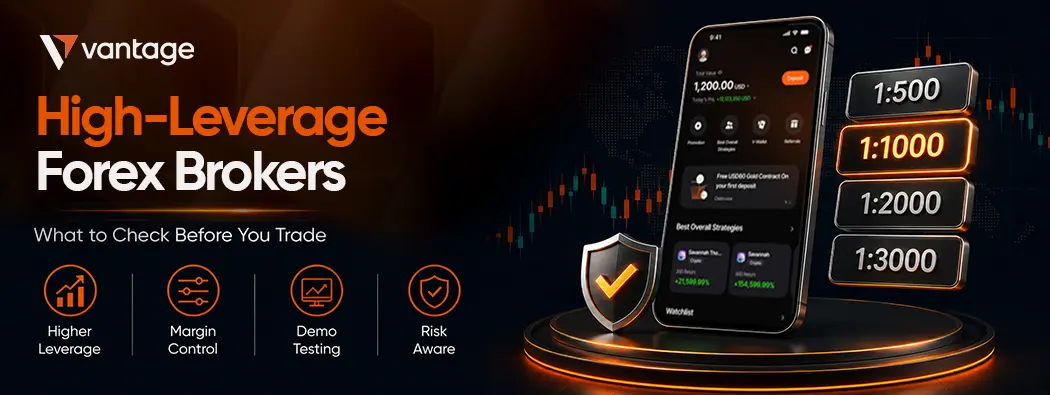
High-leverage forex brokers are popular for one simple reason: they allow traders to open larger positions with less money in their trading accounts.
For many traders, that sounds attractive. A small account can control a much bigger position. A $500 account, for example, may be able to trade far larger market exposure when leverage is available.
But leverage is a double-edged tool. It can increase potential gains, but it can also increase losses just as fast.
Key Takeaways
- High leverage lowers margin requirements but does not lower trade risk.
- Maximum leverage should not be the only point of comparison when comparing brokers.
- Regulation and account entity affect leverage, protections, and complaint routes.
- Spreads, commissions, swaps, and execution also affect trading costs.
- Demo testing can help traders review platform quality before funding.
What are High-Leverage Forex Brokers?
High-leverage forex brokers are brokerage firms that allow traders to open larger forex positions with a smaller margin deposit. In simple terms, they give traders access to more market exposure than their account balance alone would normally allow.
Leverage in forex is usually shown as a ratio, such as 1:500, 1:1000, or 1:2000. A broker offering 1:500 leverage allows every $1 of margin to control up to $500 in market exposure. With 1:1000 leverage, the same $1 of margin can control up to $1,000 in exposure.
High leverage can make a smaller account feel more flexible. A trader with limited capital may be able to open positions that would otherwise require a much larger deposit. The broker is not adding cash to the account; it is reducing the margin needed to hold a position.
Higher leverage also changes the risk profile of a trade. Larger exposure can increase potential profit when the market moves in the trader’s favour. The same exposure can also increase losses when the price moves against the position.
High leverage forex brokers are often discussed for combining flexibility with higher risk, making margin control and position size central to the trading process.
Why Traders Look for High-Leverage Forex Brokers
In forex trading, leverage is often used to increase market exposure without needing the full trade value upfront.
A major reason traders look for high leverage is the lower margin requirement. Higher leverage reduces the amount of capital needed to open a position. For example, a 1:500 leverage ratio requires less margin than a 1:30 ratio.
The risk is that losses can also grow quickly when the market moves against the position.
High leverage is also common among traders with small accounts. It can give smaller account holders access to larger trade sizes. At the same time, small accounts are more exposed to sharp drawdowns when position sizes are too large.
Many short-term traders, such as day traders, may also prefer high leverage. Their strategies often focus on small price movements, so leverage can make those moves more meaningful in account terms. However, short-term trading can be affected by spreads, slippage, news events, and sudden price swings.
Another reason is flexible position sizing. High leverage can align with traders’ strategies, regulate margin use, stimulate market activity, and support the opening of positions of varying sizes.
However, if misused, it will drive up risk exposure. It is merely a trading tool, never a substitute for risk control, and must be used in conjunction with compliant risk control measures such as position management and loss forecasting.

How to Compare High-Leverage Forex Brokers
High leverage can look attractive at first glance. A broker offering 1:500 or 1:1000 leverage may seem more flexible than one offering 1:30 or 1:50. But experienced traders usually look beyond the headline number.
A strong broker comparison should include regulation, trading costs, execution, margin rules, platform quality, and risk tools. Maximum leverage matters, but it should be one part of the review, not the full reason for choosing a broker.
| Factor | What to Check | Why It Matters |
| Regulation | The broker’s license and regulator | Strong regulation may offer better client protection, but it often comes with lower leverage limits. |
| Account entity | Local entity vs offshore entity | The same broker may offer different leverage, rules, and protections under different entities. |
| Maximum leverage | The highest leverage offered, such as 1:100, 1:500, or 1:1000 | Higher leverage lowers margin needs, but it can also increase the speed of losses. |
| Instrument-level leverage | Leverage for forex pairs, gold, indices, stocks, crypto, and commodities | Leverage is often not the same across all markets. Major forex pairs may have higher leverage than more volatile assets. |
| Margin call | The equity level at which the broker sends a warning | Margin call rules indicate when an account is under risk pressure. |
| Stop-out | The level at which the broker starts closing open trades | A low stop-out level may give trades more room, but losses can also become larger. |
| Spreads | Average spreads, not only “from 0.0 pips” claims | Tight spreads can reduce trading costs, especially for active traders. |
| Commission | Per-lot fees or round-trip charges | A low-spread account may still be costly when commission is added. |
| Swaps | Overnight fees for long and short positions | Swap charges can affect traders who hold positions for more than one day. |
| Execution | Slippage, requotes, order speed, and fill quality | Fast and fair execution becomes more important when using high leverage. |
| Platform | MT4, MT5, TradingView, web, or mobile app | A good platform helps with charting, order control, and trade tracking. |
| Risk tools | Stop-loss, take-profit, alerts, negative balance protection, and guaranteed stops were offered. | These tools help traders understand and manage exposure. |
| Demo access | Demo account length, pricing, and platform features | A demo account allows traders to test conditions before using real funds. |
A broker with very high leverage is not always the better choice. For example, a 1:1000 leverage account with wide spreads, weak regulation, unclear stop-out rules, and poor execution may be less useful than a lower-leverage account with cleaner pricing and stronger protection.
High leverage enables flexible position adjustment and reduces margin usage, but it amplifies losses. It must never be used to cover up poor risk planning, weak trading setups, or over-allocated positions.
Before depositing funds into a trading account, you must first verify the latest terms and conditions published on the broker’s official website and inspect key pages, such as the margin table, account types, legal documents, spread and commission schedule, swap rates, execution policy, and risk disclosure.
Check Regulation and Account Entity Before Comparing Leverage
Many foreign exchange brokers adopt an operating model that relies on multiple legal entities, each registered in South Africa, Europe, Asia, or offshore regions.
These entities differ from one another in applicable rules, leverage limits, trading terms, client protection rules, and complaint processes, meaning traders that use the same brand may face inconsistent trading conditions.
For South African traders, it is useful to check the broker’s regulatory details before considering leverage. The account should be reviewed based on the legal entity named in the client agreement, not only the logo on the website. This helps traders understand which rules may apply to their account.
Client protections also deserve close attention. These may include how client money is handled, whether negative balance protection applies, how margin close-outs work, and what happens if there is a dispute.
Support quality also matters, especially when dealing with deposits, withdrawals, trade execution, or account verification.
Another key point is the dispute handling process. Traders must be equipped with information about complaint-receiving enterprises and regulatory agencies.
High leverage can be useful, but it should come after these checks. A large leverage offer means little if the account entity, protections, support, and complaint route are unclear. This is not legal advice; it is a practical way to compare brokers with more care.
Highest Leverage vs Suitable Leverage
In forex trading, the highest leverage is the maximum leverage a broker makes available. The suitable leverage is the level that fits a trader’s account size, trade setup, risk tolerance, and position size.
A broker with the highest leverage is not always the best fit. Very high leverage can make it easier to open large positions with a small amount of margin. That may look attractive, but the market risk does not become smaller. Losses are still based on the full position size, not only the margin used to open the trade.
Here is a simple example using a $100,000 trade size:
| Leverage | Margin Needed |
| 1:100 | $1,000 |
| 1:500 | $200 |
| 1:1000 | $100 |
| 1:2000 | $50 |
| 1:3000 | About $33 |
From the table, 1:3000 needs much less margin than 1:100, but the trade exposure is still $100,000. So, if the position moves against the trader, the loss is linked to the $100,000 exposure.
A useful way to look at leverage is through the lens of real leverage. Real leverage compares the open trade size with the account balance. For example, a trader with a $1,000 account and a $10,000 open position is using 10:1 real leverage, even if the broker allows 1:1000.
Position size is also important. A bigger position makes each pip worth more, while a smaller position makes each pip worth less.
Traders can also use less than the maximum leverage available. A broker may offer 1:1000 or higher, but the actual risk depends on the chosen trade size.
Low Spread and High Leverage: What to Compare Together
Low spreads and high leverage can sound like a great deal. The spread affects the cost of opening and closing a trade, while leverage affects the margin required to control a larger position. But these two points alone do not show the full trading cost.
A broker may promote “spreads from 0.0 pips,” yet the account may still charge commission on each trade. In that case, the real cost is not just the spread. It is the spread plus commission.
Swaps are another part of the cost. It is a transaction cost item incurred when a trading position is held overnight. Low-spread accounts, which are marketed as having low explicit costs, may still increase the actual trading costs for swing traders if their swap rates are excessively high.
Slippage risk in trading requires focused attention. Even with tight spreads, unfavourable trade execution during major news events, market gaps, or periods of low liquidity will still erode this advantage. Order execution speed is also critical; excessively slow execution can disrupt opening and closing positions.
Platform stability is just as important, especially when using high leverage. A frozen chart, delayed price feed, or failed login can create real problems during active market hours.
Here is a simple checklist to use when comparing accounts:
| What to Compare | Why It Matters |
| Average spreads | Shows normal trading cost |
| Commission | Adds to the total trade cost |
| Swap rates | Affects overnight positions |
| Slippage | Shows possible price differences |
| Execution speed | Affects entries and exits |
| Platform stability | Reduces trade control issues |
| Leverage | Shows margin flexibility |
Low spread and high leverage can be useful, but they should be evaluated alongside total cost, execution quality, and account conditions.
Understanding 1:500, 1:1000, 1:2000, and 1:3000 Leverage
The higher the leverage, the less margin is needed to open the same trade size.
1:500 leverage means $1 in margin can control $500 in market value. So, a $100,000 position would need $200 in margin.
1:1000 leverage means $1 in margin can control $1,000. For a $100,000 position, the margin needed would be $100.
1:2000 leverage means $1 in margin can control $2,000. In this case, a $100,000 position would need $50 in margin.
1:3000 leverage means $1 in margin can control $3,000. A $100,000 position would need about $33.33 in margin.
| Leverage | Margin Needed for a $100,000 Position |
| 1:500 | $200 |
| 1:1000 | $100 |
| 1:2000 | $50 |
| 1:3000 | About $33.33 |
These figures can look attractive because less money is tied up as margin. But the market exposure stays the same. A $100,000 trade still carries $100,000 worth of exposure, whether the margin is $200 or $33.33.
Extreme leverage can make small market moves more harmful. A quick price spike, a wider spread, or a news-driven move can quickly reduce account equity. It may also lead to a margin call or stop-out if the account cannot support the open trade.
High-leverage offers may also come with conditions. Some brokers may link 1:1000, 1:2000, or 1:3000 leverage to certain account types, account balances, instruments, or legal entities. So, the advertised leverage may not apply to every trader, market, or account.
Margin Calls, Stop-Out Levels, and Negative Balance Protection
A margin call is a warning that an account is approaching its required margin limit. It usually happens when open trades move against the account, and equity falls. In simple terms, the account may no longer have sufficient free margin to comfortably support the open positions.
A stop-out level is more serious. This is the point at which the broker may begin closing open trades. The goal is to stop the account from falling further below the required margin level. Stop-out rules can differ from one broker to another, and they may also vary by account type or legal entity.
Negative balance protection means the account should not fall below zero where this feature applies. For example, if a sharp market move causes heavy losses, this protection may limit the loss to the amount held in the trading account.
High leverage can make margin pressure build faster. It allows larger positions with lower margin requirements, but the market exposure is still real. Even a small price move can affect equity when the position size is too large for the account.
Before funding any account, traders should check the broker’s margin call level, stop-out level, negative balance policy, account entity, and product terms. These details help explain how the account may behave during volatile market conditions.
How to Test a High-Leverage Broker Before Funding
A demo account is a useful place to start. It does not copy live market conditions perfectly, but it can show how the broker’s platform, margin system, and trading tools work.
A simple demo test can begin with small practice trades on the same platform and account type that will be used for live trading. The first thing to watch is the use of margin. Check how the used margin, free margin, and margin level change when a position is opened, moves into profit, or moves into loss.
The next area is stop-loss placement. Some brokers have minimum stop distances on certain instruments. Testing stop-loss, take-profit, and pending orders can show how flexible the order system feels.
The trading platform speed also matters. During normal market hours, trades may open and close smoothly. During active periods, such as session overlaps or news-heavy moments, the platform may behave differently. Delays, frozen charts, rejected orders, or slow updates can become more noticeable.
Spread behaviour is another key detail. A broker may show tight spreads during calm periods, but spreads can widen when the market becomes active or liquidity drops.
Mobile stability is worth checking, too. Many traders manage positions from a phone, so login speed, chart loading, alerts, and order changes matter.
Trade history reporting should also be reviewed. A clear report should show the entry price, exit price, timestamps, commission, swap, profit, and loss.
When moving from demo to live, many traders begin with small trade sizes. Live trading can involve slippage, wider spreads, and faster price movement, so smaller exposure makes the transition easier to study.
Where Vantage Fits for Eligible Traders
Vantage may fit traders who want to compare account types, platform access, trading tools, and risk features before choosing a live setup. It is not just about finding the highest leverage. The better question is whether the account terms match the trader’s needs, location, and level of experience.
For eligible traders, Vantage offers various account paths, including demo and live accounts.
Traders can compare account types such as Standard STP, RAW ECN, and Premium-related options, depending on what is available under their region and account entity. MT4 and MT5 access also makes it familiar for traders who already use charting tools, expert advisors, and common order types.
Demo access is useful for testing the platform first. It gives traders room to test spreads, order placement, margin use, alerts, and overall platform flow without risking real funds.
Risk tools also matter. Traders should review stop-loss options, margin rules, stop-out levels, negative balance terms, and account conditions before funding.
If Premium Account leverage is mentioned, users should first check the current Vantage account page and legal terms, as leverage may depend on eligibility, balance, instrument, and entity.
A balanced next step is to start with a demo or compare account types before opening a live account.
Conclusion
High-leverage forex brokers like Vantage give traders more room to manage margin and open larger trading positions with a small upfront capital requirement. However, leverage should not be viewed in isolation. A high-leverage offer may look attractive, yet the actual trading experience also depends on regulation, account type, spreads, commissions, swaps, execution speed, platform stability, and risk controls.
Frequently Asked Questions
What are high-leverage forex brokers?
High-leverage forex brokers allow traders to control larger positions with a smaller margin deposit.
Which broker has the highest leverage?
There is no fixed answer because leverage offers change by broker, account type, instrument, balance, region, and legal entity.
Are high-leverage forex brokers safe?
They can be used in regulated settings, but high leverage raises risk because losses can grow faster when position sizes are large.
What does 1:500 leverage mean in forex?
1:500 leverage means $1 of margin can control $500 in market exposure.
What does 1:1000 leverage mean in forex?
1:1000 leverage means $1 of margin can control $1,000 in market exposure.
Is unlimited leverage safe for forex trading?
Using unlimited leverage is highly risky because a very small price movement can place heavy pressure on account equity.
Should beginners use high leverage for trading?
Beginners should understand margin, position size, stop-out rules, and risk exposure before using high leverage.
Can a broker offer high leverage and low spreads?
Yes, but traders should still compare commissions, swaps, slippage, execution speed, and platform stability.
What should I check before opening a high-leverage forex account?
Check regulation, account type, maximum leverage, instrument-level leverage, margin call, stop-out, spreads, commission, swaps, and broker risk terms.
How can I test a high-leverage broker before funding?
Use a demo account to test margin use, spreads, stop-loss placement, alerts, mobile stability, platform speed, and trade reports.