
 Updated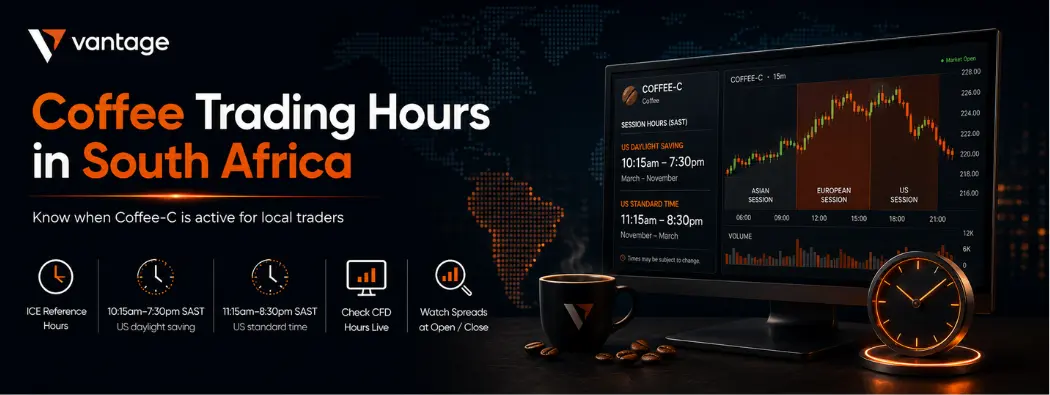
Coffee-C trading hours in South Africa depend on the ICE reference markets’ trading times. Coffee C futures typically trade from 4:15 a.m. to 1:30 p.m. New York time, which is 10:15 a.m.–7:30 p.m. in SAST (South African time); during US daylight saving time, the time is 11:15 a.m.–8:30 p.m. SAST (South African time); during US standard time.
The time of day can influence market activity. During active market hours, trading activity may increase, resulting in more frequent price movements. Many traders monitor these periods as part of their market analysis.
This guide focuses strictly on timing: when coffee markets are active on the Intercontinental Exchange, how to convert hours to South African time, what changes during daylight saving, and what to check on the platform before trading Coffee-C.
Key Takeaways
Coffee-C CFD hours on trading platforms such as Vantage may differ and should always be confirmed live before trading. Times can differ because brokers have to adjust for things the exchange doesn’t control, such as:
- liquidity (if trading is too thin, they may pause or widen spreads, which means it is more expensive to trade)
- technical maintenance or server updates
- different internal trading session structures
- holidays and regional operating rules
- risk management during unstable market periods
What are coffee trading hours?
Coffee trading hours are the time windows during which coffee prices are actively traded or quoted. There is no single universal schedule for coffee trading hours, and it can vary or mean different things:
- Exchange futures trading hours (ICE)
- CFD trading hours (broker platforms)
- Price quotation windows during overlapping global sessions, or simply, when different global markets are open at the same time, and prices are actively moving.
The most widely used benchmark to measure coffee trading hours is ICE futures, which defines when Arabica and Robusta coffee contracts can be traded. CFD brokers use these reference prices from the underlying exchanges listed above. But availability for trading coffee depends on:
- Liquidity: how many people are buying and selling at that time
- Internal systems: the broker’s own platform rules and technical setup
- Market conditions: how stable or volatile the market is at that moment
Coffee is not a 24/7 market. It trades within defined sessions and becomes inactive outside those windows, especially over weekends and holidays.

Coffee C trading hours in South Africa
Coffee C represents the Arabica coffee benchmark traded on ICE Futures U.S. It is traded in New York time and must be converted into South African time for practical use.
ICE Coffee C reference hours
| Market | Exchange | Base Hours (New York) | SAST (US Daylight Saving) | SAST (US Standard Time) |
| Coffee C (Arabica) | ICE Futures U.S. | 4:15 a.m.–1:30 p.m. | 10:15 a.m.–7:30 p.m. | 11:15 a.m.–8:30 p.m. |
These are exchange reference hours. They do not guarantee availability on CFD platforms.
On broker platforms such as Vantage, Coffee-C CFDs track the real market price, but trading hours may vary due to liquidity (when it is low), server schedules(when it is down for maintenance), or internal trading rules:
- When the market is allowed to open or close on their system
- Minimum trading conditions they enforce, like margin requirements or the amount of money you need in your account to open and keep a trade
- Temporary pauses during low-liquidity periods or when trading activity is low
- When there is no trading activity during holidays or server rollover times
Before interacting with Coffee-C on platforms such as MT4 or MT5, traders should confirm the instrument’s availability and session status.
Robusta coffee trading hours in South Africa
Robusta coffee (a type of coffee bean traded on global markets) is traded on ICE Futures Europe and follows London-based hours. It is a separate benchmark from Arabica, but it is useful for comparing the global coffee timing structure.
| Market | Exchange | Base Hours (London) | SAST (UK Summer Time) | SAST (UK Standard Time) |
| Robusta | ICE Futures Europe | 9:00 a.m.–5:30 p.m. | 10:00 a.m.–6:30 p.m. | 11:00 a.m.–7:30 p.m. |
Robusta timing is slightly different due to the London session structure. However, for most retail CFD traders, Coffee-C (Arabica) is the primary reference instrument.
Why do coffee trading hours change
Coffee trading hours are not fixed and can change because global financial markets adjust their clocks and schedules throughout the year – the main reason is daylight saving time.
South Africa does not change its clocks, but the United States and the United Kingdom do. Clocks are moved forward in spring and back in autumn so people get more daylight in the evening and less wasted daylight in the morning. When those markets shift forward or backward by one hour, the local South African viewing time for coffee markets also shifts accordingly.
Other factors that affect trading hours include:
- Public holidays in the US or UK
- Exchange maintenance windows
- Liquidity reductions during off-peak periods(fewer people are trading at that time, so there is less buying and selling activity)
- Broker-specific platform adjustments like hours, pricing, or availability
Key point on daylight saving
When New York or London exchange trading hours change, it is reflected in South African time later. This is not a change in the market itself, but a change in the clock alignment.
Are Coffee-C CFD hours the same as ICE futures hours?
Coffee-C CFD hours are not always identical to ICE futures hours. ICE provides the reference trading schedule and market pricing, but CFD platforms replicate it, and tradable hours depend on broker configuration.
On Vantage platforms using MT4 or MT5, Coffee-C availability may vary depending on:
- Market session settings: the trading times on the platform
- Liquidity conditions: market activity levels, whether it is active or less active
- Server time alignment: platform time settings
- Holiday schedules: holiday trading hours
- Temporary trading restrictions like trading pauses, limits on opening or closing trades, etc.
This means ICE hours are a guide, not a guarantee of CFD availability.
What to check before trading Coffee-C
Before placing any trade or even using a demo account, the platform conditions matter more than theoretical exchange hours.
| Check | Why it matters |
| Market status | You can know whether Coffee-C is open or closed |
| Spread | Trading costs can widen during low liquidity, or when one session is opening, and another is closing |
| Swap | Overnight costs for holding trades may apply |
| Margin | It determines how much capital is required to open positions |
| Lot size | Controls exposure and risk scale |
| Stop-loss distance | Coffee prices can move sharply in short bursts |
| Holiday notices | Trading hours may change without standard patterns |
These checks are especially important during market open and close periods, when price movement and spreads can become less stable.
When traders often watch the coffee markets
Coffee markets tend to show more activity during certain global sessions in New York and London. These periods are commonly associated with higher liquidity, but market activity can vary and does not guarantee trading opportunities or execution conditions.
Common observation periods include:
- Early US trading hours when ICE Coffee C opens – when the US coffee market first opens
- Overlaps between European and US sessions – when European and US markets are open at the same time
- Periods of major weather updates affecting crop expectations – times when important weather news may affect coffee supply
- Inventory and supply report releases – times when reports about coffee stock levels and supply are released
During these times, price movement may increase, but so may spreads (your trading cost, or the difference between the buy and sell prices) and short-term volatility (how quickly and how much prices move up and down).
Common timing mistakes to avoid
| Mistake | Why it matters |
| Assuming CFD hours match ICE hours | Broker platforms may differ from exchange schedules |
| Ignoring daylight saving changes | In New York and London, trading times shift by one hour seasonally |
| Trading without checking spreads | Costs can increase during volatile sessions |
| Holding positions into market close | Gaps and execution differences may occur |
| Ignoring holidays | Liquidity and access may be reduced |
| Using outdated timing tables | Exchange schedules can be updated periodically |
Conclusion
When trading coffee, trade time depends on ICE trading hours, the time zone conversion, and your broker’s live trading hours. Before trading, always confirm live conditions, check spreads and margin requirements (to know how much it costs to trade), and verify whether the market is currently open.
To learn more and better understand coffee trading, traders can explore the coffee CFD trading guide, the Coffee-C MT4/MT5 workflow page, and trade on a demo account to avoid risking money before moving to live markets.
Frequently Asked Questions
What are coffee trading hours in South Africa?
Coffee C futures reference hours convert to 10:15 a.m.–7:30 p.m. SAST when the US observes daylight saving time and to 11:15 a.m.–8:30 p.m. during standard time. But the time you spend with your brokers may vary.
What time does Coffee-C open?
It generally follows ICE trading timing, opening around 10:15 a.m. SAST during daylight saving time (1 hour ahead) and 11:15 a.m. during standard time.
Are CFD hours the same as ICE futures hours?
No. ICE is just the reference time in hours for trading and CFD platforms to set actual availability.
Why do coffee trading hours change?
It can change due to daylight saving time adjustments, holidays, and broker platform schedules.
Can I trade coffee on weekends?
No, coffee markets are typically closed over weekends. Trading happens from Monday to Friday.
What should I check before trading Coffee-C?
You should check market status, spread, margin, swap, lot size, stop-loss distance, and holiday notices to understand if the market is open, what it costs to trade, how much you’re risking, and whether conditions are stable.
Do spreads change during trading hours?
Yes, especially when the market opens and closes, or during low-liquidity periods.
Should beginners use a demo account first?
Yes, trading with a demo account is important because it lets you trade price movements without risking actual funds.
Risk Warning: CFDs are complex financial instruments and carry a high risk of rapid loss of money due to leverage. You should ensure you fully understand the risks involved and carefully consider whether you can afford to take the high risk of losing your money before trading.
Disclaimer: The information is provided for educational purposes only and doesn’t take into account your personal objectives, financial circumstances, or needs. It does not constitute investment advice. We encourage you to seek independent advice if necessary. No representation or warranty is given as to the accuracy or completeness of any information contained within.
This material may contain historical or past-performance figures and should not be relied upon. Furthermore, estimates, forward-looking statements, and forecasts cannot be guaranteed. The information on this site and the products and services offered are not intended for distribution to any person in any country or jurisdiction where such distribution or use would be contrary to local law or regulation.
References
- ICE Futures Trading Hours htps://www.ice.com/trading-hours/
- Coffee Futures Overview http://Investing.com