Updated
Blue chip stocks are shares in large, financially sound companies with a long record of stable earnings — the household names that tend to lead their industries and hold up better than smaller, newer firms when the economy turns.
Investing in them means buying those shares, either individually or through funds that hold a basket of them, and typically holding for the long term to seek capital growth and dividend income.
Blue chips are not a guaranteed win, though.
They can be expensive to buy, grow more slowly than younger companies, and still fall sharply in a downturn — so understanding what actually qualifies a stock as blue chip, how to evaluate one, which names lead across major markets, and how to gain exposure through shares, funds or Contracts for Difference (CFDs) matters before committing capital.
Key Points
- Blue chip stocks are shares in large, established companies valued for steady earnings and resilience, but they often trade at a premium and can still lose value in a downturn.
- Investors typically gain exposure by buying individual shares, holding blue-chip funds or exchange-traded funds (ETFs) for instant diversification, or speculating on price movements through share CFDs without owning the underlying stock.
- Evaluating a blue chip means checking its market capitalisation, dividend record, profitability and debt — not just recognising the brand.
- The large-cap leaders of the Nifty 50 and BSE Sensex — such as Reliance Industries, TCS and HDFC Bank — are widely regarded as blue chips, while global examples include names like Apple and Microsoft.
What Is a Blue-Chip Stock?
A blue-chip stock is a share in a large, well-established company with a strong reputation, reliable earnings and the financial strength to withstand economic downturns. The term comes from poker, where blue chips traditionally carry the highest value at the table.
Most blue chips share a set of common traits.
They are usually large-cap companies — a market capitalisation above roughly $10 billion is a common threshold — and many feature in major indices such as the S&P 500, the Dow Jones Industrial Average or the Nasdaq-100 [2]. The equivalent leaders in other markets anchor benchmarks such as the Nifty 50 and the BSE Sensex.
- Scale and market position: They are nationally or internationally recognised and tend to lead their industries.
- Financial strength: They have consistently demonstrated profitability and carry balance sheets robust enough to survive multiple economic cycles.
- Dividend record: Many, though not all, pay regular dividends, and some have raised them for decades.
- Brand durability: They own well-known brands that hold up through competition and changing consumer habits.
Because of these traits, blue chips are often used as foundational holdings, in contrast to higher-risk plays such as penny stocks or micro-cap firms. That resilience comes at a cost, though — a point the next sections return to.
How to Invest in Blue-Chip Stocks
Investing in blue-chip companies follows the same broad process as investing in any share, with a focus on quality and the long term. The steps below describe what many investors work through; none is financial advice, and the right approach depends on individual circumstances.
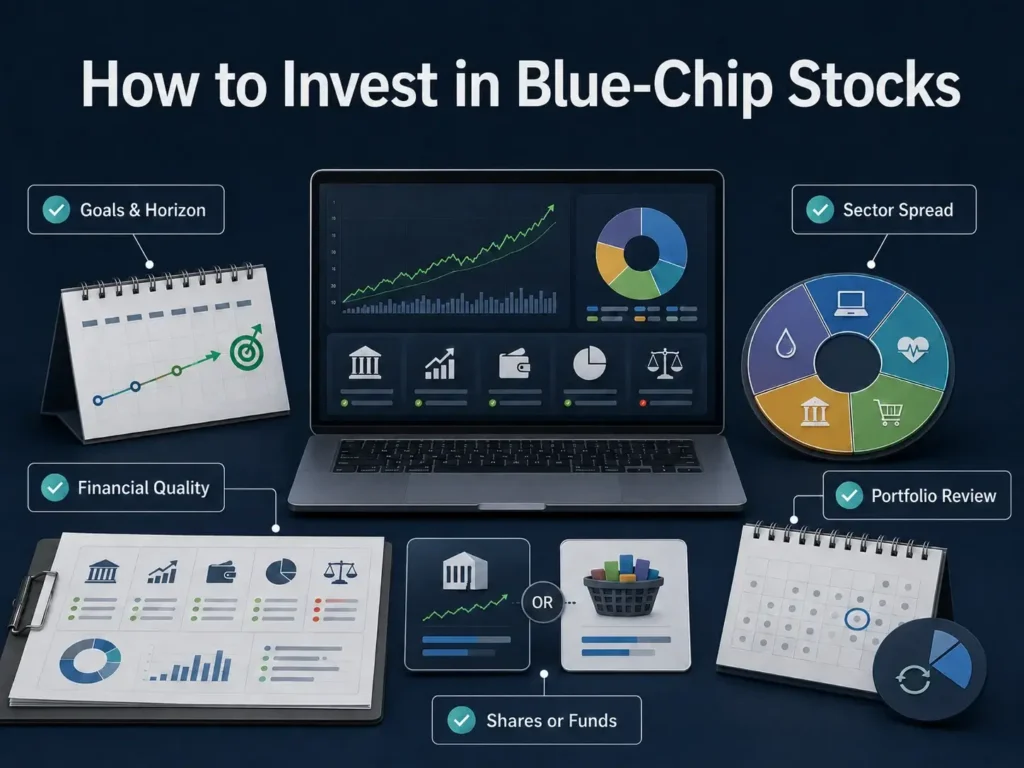
- Set clear goals and a time horizon: Decide whether you are investing mainly for long-term capital growth, dividend income, or a mix of both, as this shapes which companies and which route may suit you. A longer time horizon generally gives an investor more room to ride out short-term market volatility.
- Research and evaluate the financials: Look beyond the brand at metrics such as market capitalisation, revenue and earnings growth, dividend yield and history, return on equity, and debt levels. Consistent profitability and a manageable debt load are often more telling than a familiar name.
- Decide between individual shares and funds: You can buy shares in individual blue-chip companies, or gain diversified exposure through blue-chip index funds and ETFs that hold a basket of them. Funds spread risk across many companies; individual shares give more control over what you hold.
- Diversify across sectors: Even stable companies face industry-specific risks, so spreading holdings across sectors — technology, healthcare, consumer goods, financials and energy, for example — can help manage exposure.
- Monitor and review your portfolio: Company fundamentals and market conditions change, so many investors review their holdings periodically and rebalance where their allocation has drifted.
The practical route often depends on the market. Many investors gain diversified blue-chip exposure through a Nifty 50 index fund or a systematic investment plan (SIP), while others buy individual shares through a Demat account. Those seeking global blue chips can access them through international brokers, or trade their price movements as share CFDs.
Whichever route you choose, the aim of blue-chip investing is usually steady, compounding growth over years rather than rapid gains over weeks.
Blue Chip Stocks Examples: Global and Nifty 50 Leaders
No single authority publishes a definitive blue-chip list, but certain names appear consistently because of their size, track record and market leadership. The examples below show how blue chips look across different markets — they are illustrative, not recommendations.
| Market | Example blue-chip stocks | Typical sector strength |
| Global (US) | Apple, Microsoft, Johnson & Johnson, Procter & Gamble | Technology, healthcare, consumer goods |
| Nifty 50 / BSE Sensex | Reliance Industries, TCS, HDFC Bank, Infosys, ITC | Energy & retail, IT services, banking, FMCG |
| Europe | Nestlé, LVMH, SAP | Consumer goods, luxury, enterprise software |
The above examples are for illustrative purposes only and do not constitute a recommendation to buy, sell, or hold any financial instrument. Past performance is not a reliable indicator of future results.
Investors can hold established blue chips such as TCS or HDFC Bank directly, and — subject to their broker and jurisdiction — gain exposure to global names like Apple or Microsoft, including as share CFDs. With CFDs, leverage magnifies both gains and losses, so they suit shorter-term positions rather than long-term holding.
Shares, Funds and CFDs: Ways to Access Blue-Chip Stocks
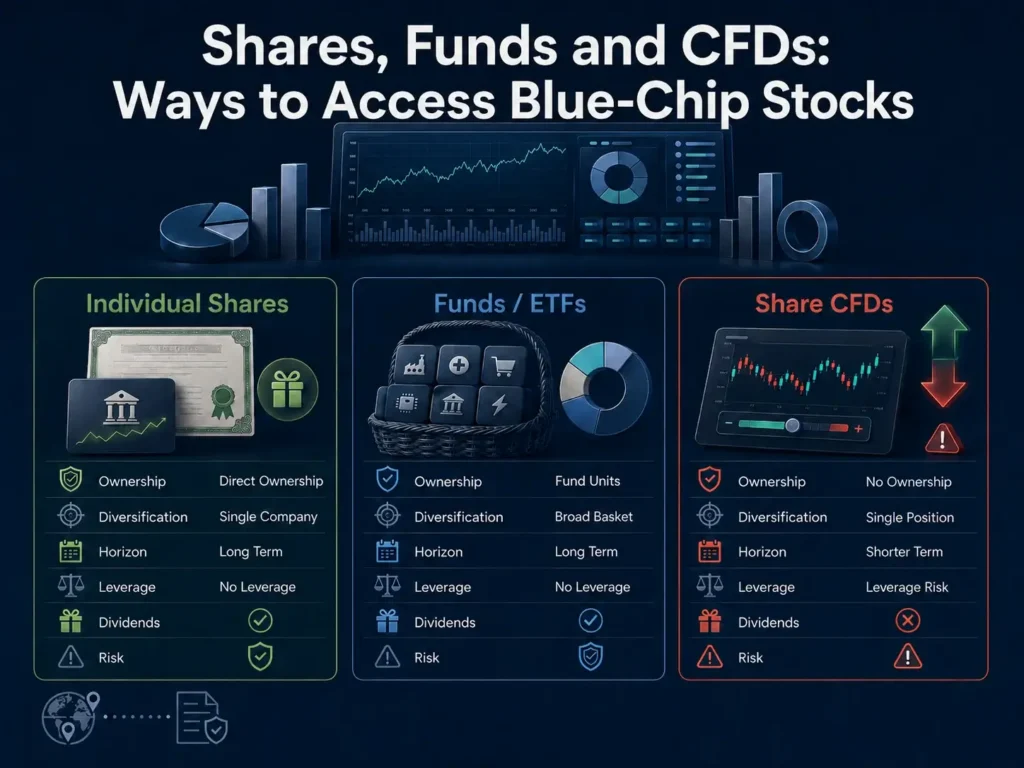
There are three common ways to gain exposure to blue-chip companies, and they differ in ownership, cost and risk.
Buying shares directly makes you a part-owner of the company, with any dividends and voting rights that come with the stock, and suits investors with a long horizon. Blue-chip funds and ETFs bundle many companies into a single holding, offering instant diversification and a more hands-off approach.
A third route is trading Contracts for Difference (CFDs). A CFD is an agreement to exchange the difference in an instrument’s price between opening and closing a position, letting a trader speculate on a blue-chip company’s price movement without owning the underlying share. CFDs can be traded long or short, and they use leverage — which can magnify both gains and losses.
They do not confer ownership or dividend entitlement in the way holding the share does, and the high risk of leverage means they are generally used for shorter-term positions rather than long-term investing.
The availability of shares, ETFs, funds and share CFDs depends on the jurisdiction, the broker providing the service, and applicable local regulations. Investors and traders should confirm which products are available and whether their chosen provider is authorised to offer them in their country.
| Feature | Individual Shares | Blue-Chip Funds / ETFs | Share CFDs |
| Ownership | Direct ownership of the share | Ownership of fund units | No ownership of the underlying |
| Diversification | Single company per holding | Broad, across many companies | Single instrument per position |
| Typical horizon | Long term | Long term | Often shorter term |
| Leverage | Not typically used | Not typically used | Yes — magnifies gains and losses |
| Dividends | Paid to the shareholder | Distributed or reinvested by the fund | Not owned; may involve CFD adjustments |
| Main risk | Company-specific price falls | Market-wide declines | Amplified losses from leverage |
Benefits and Risks of Blue-Chip Stocks
| Benefits | Risks |
| Relative stability and a long track record | Often trade at a premium, so entry can be costly |
| Potential for consistent dividend income (if dividend-paying) | Not immune to sharp falls in a downturn |
| Available across many sectors for diversification | Lower growth potential than younger growth stocks |
| High liquidity from strong, steady demand | Exposure to geopolitical and cross-border risks |
The main appeal of blue chips is stability. Their long track records mean they are often better positioned to recover after market downturns, and dividend-paying blue chips can provide a stream of income that some investors reinvest to compound returns over time. Because they span many industries, a selection of them can also form the core of a diversified portfolio, and their popularity means positions are usually easy to enter and exit.
The trade-offs are real. Blue-chip shares are often highly priced, so building a position can require significant capital. Many are mature businesses, which can mean slower growth than growth stocks — investors chasing rapid appreciation may find blue chips lag.
Most importantly, blue chip does not mean bulletproof. American International Group (AIG) was a component of the Dow Jones Industrial Average and one of the world’s largest insurers before its exposure to the US housing market forced an $85 billion Federal Reserve rescue during the 2008 financial crisis [3].
The lesson from 2008 is not to avoid blue chips, but to treat their stability as relative, not absolute.
Blue-Chip Stock Example: Apple Inc (AAPL)
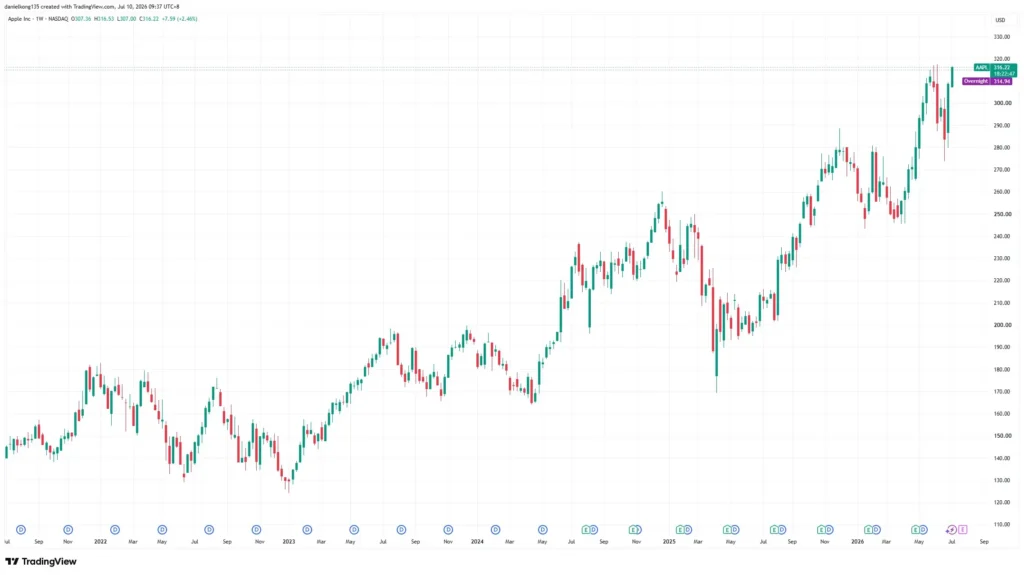
Apple Inc is one of the most widely cited blue-chip stocks. As of early July 2026, its market capitalisation stood at around $4.4 trillion, making it one of the most valuable listed companies in the world, with trailing twelve-month revenue of roughly $451 billion and a return on equity above 140%, according to CNBC [4].
Apple illustrates why investors treat blue chips as quality holdings — and why quality is not the same as cheap. The company has continued to lean on its Services business and its push into artificial intelligence to support growth, and it has kept returning cash through buybacks and a modest dividend.
At the same time, its shares have traded on a price-to-earnings ratio of around 34, well above the broader market, and it faces competition and regulatory pressure over its App Store in the EU and UK. A high-quality company can still be a high-priced one, and a premium valuation leaves less room for error if growth disappoints.
The above example is for illustrative purposes only and does not constitute a recommendation to buy, sell, or hold any financial instrument. Past performance is not a reliable indicator of future results.
Traders who want exposure to Apple’s price movements without owning the stock can do so through share CFDs, though the use of leverage means both potential gains and potential losses are magnified.
Long-Term Strategies for Blue-Chip Investors
Blue-chip investing tends to reward patience. A few approaches are common among long-term investors.
Reinvesting dividends is one. Blue chips with a record of rising dividends can be used to build passive income, and reinvesting those payouts in the early years can help an income stream compound faster — though dividends are never guaranteed and can be cut.
Buy-and-hold is another.
While blue chips rarely deliver explosive gains, the S&P 500 — dominated by large, established companies — has returned an average of about 10% a year since 1957, according to Fidelity, illustrating how steady compounding can add up over decades. Past performance is not a reliable indicator of future results [1].
Some investors also favour blue chips positioned at the front of structural trends. Companies such as Nvidia, which sit at the centre of the AI build-out, combine established scale with exposure to a fast-growing theme — though concentration in a single trend carries its own risk.
The through-line across these strategies is time: blue chips are generally chosen to be held, not traded in and out of.
The Bottom Line
Blue-chip stocks offer a way to participate in the growth of large, resilient businesses with lower typical volatility than smaller stocks — but not without cost or risk.
How you access them matters: owning shares or funds suits long-term investing, while share CFDs offer short-term, leveraged exposure to price movements without ownership, and with amplified risk. Whichever route fits your goals, the same discipline applies — understand what you are buying, diversify, and size positions to the risk you can afford to take.
Frequently Asked Questions
What are blue-chip stocks?
Blue-chip stocks are shares in large, well-established companies with a long record of stable earnings, strong finances and, often, regular dividends. They are typically large-cap businesses that lead their industries and feature in major indices such as the S&P 500 or the Nifty 50. The name reflects their perceived high value, borrowed from the blue chips used in poker.
How do you buy blue-chip stocks?
Blue-chip stocks can be bought as individual shares through a brokerage or Demat account, or accessed through blue-chip funds and ETFs that hold a diversified basket of them. The general process involves setting your goals, researching the companies or funds, and reviewing your holdings over time. Traders can also gain exposure to blue-chip price movements through CFDs, without owning the underlying shares.
Are blue-chip stocks a safe investment?
No investment is risk-free. Blue-chip stocks are generally less volatile than smaller or newer companies because of their financial strength and market position, which is why they are often held as core, longer-term positions. Even so, their share prices can fall in a downturn, as the 2008 collapse of some large financial firms showed, so they should not be treated as guaranteed.
Is Apple a blue-chip stock?
Apple is widely regarded as a blue-chip stock. It is one of the world’s largest companies by market capitalisation, with a long record of profitability, strong cash generation and a globally recognised brand — the classic hallmarks of a blue chip. As with any blue chip, that status reflects scale and resilience, not a guarantee against price falls.
What is the opposite of a blue-chip stock?
The rough opposite of a blue-chip stock is a penny stock or micro-cap share — small, often young companies with low market values, limited track records and higher volatility. They can offer faster growth but carry materially higher risk, including the risk of steep or total loss, which is why they sit at the opposite end of the risk spectrum from established blue chips.
What is the difference between investing in blue-chip shares and trading blue-chip CFDs?
Buying shares makes you a part-owner of the company, with any dividends and voting rights, and suits a long-term horizon. Trading a Contract for Difference (CFD) lets you speculate on a company’s price movement, long or short, without owning the share, using leverage that magnifies both gains and losses. CFDs are generally used for shorter-term positions and carry a high risk of rapid loss.
Do blue-chip companies pay dividends?
Many blue-chip companies pay regular dividends, and some have increased them for decades, which is part of their appeal to income-focused investors. However, not all blue chips pay dividends, and even long-standing dividends can be reduced or suspended if a company’s circumstances change.
References
- “What Is the S&P 500 and Stock Market Average Return? — Fidelity” https://www.fidelity.com/learning-center/trading-investing/sp-500-average-return Accessed 1 July 2026
- “Blue Chip: Definition and Examples — Investopedia” https://www.investopedia.com/terms/b/bluechip.asp Accessed 1 July 2026
- “AIG: 1 Year After its Bailout — CNBC” https://www.cnbc.com/id/32865451 Accessed 1 July 2026
- “Apple Inc. (AAPL) Quote — CNBC” https://www.cnbc.com/quotes/AAPL Accessed 3 July 2026