


WTI (USOIL) Outlook This Week: May 11–15

John Ikechukwu >
John Ikechukwu >
Vantage is a global, multi-asset broker with a team of in-house writers and market analysts who produce educational and insightful trading content for traders of all levels.
 Updated Tue, 2026 May 12 05:29

The USOIL market remained volatile during the previous trading week, as crude oil prices continued to react to geopolitical developments, supply concerns, inflation expectations, and broader global economic conditions.
Although oil prices remain relatively elevated compared to earlier periods, market sentiment has become increasingly volatile as traders assess whether slowing global growth and demand concerns could begin to outweigh ongoing supply-side risks.
As the new trading week begins, market participants are likely to remain focused on global demand expectations, OPEC+ policy developments, geopolitical tensions, and macroeconomic data from major economies.
Crude Oil Price Outlook for May 2026
The outlook for USOIL remains mixed, with crude oil trading between strong supply-side support and growing concerns about global demand.
On the one hand, geopolitical instability and ongoing supply risks continue to support oil prices.
On the other hand, slowing economic activity across several major economies and concerns surrounding future consumption continue to limit bullish momentum.
This creates a market environment where oil prices remain highly sensitive to both macroeconomic conditions and geopolitical developments.
Global Supply Concerns Continue to Support Oil Prices
Supply-side conditions remain one of the most important factors supporting crude oil prices.
Several ongoing developments continue to contribute to uncertainty surrounding global oil supply:
- Geopolitical tensions in key oil-producing regions remain elevated
- Risks surrounding major shipping routes continue to create market uncertainty
- OPEC+ production management policies continue to influence supply conditions
- Limited spare production capacity in some regions continues to support prices
These factors continue to maintain a supply-driven risk premium in the oil market.
Investors remain concerned that any further disruptions to global supply chains or transportation routes could quickly tighten market conditions and push prices higher.
At the same time, OPEC+ continues to play a major role in shaping market sentiment through production targets and output adjustments.
As long as supply-side risks remain elevated, crude oil prices are likely to remain supported.
OPEC+ Production Policy Remains a Major Market Driver
OPEC+ policy expectations continue to significantly influence the outlook for USOIL.
Markets continue to closely monitor production targets and comments from major oil-producing nations.
Several factors continue to shape expectations surrounding OPEC+ policy:
- Production discipline remains important for price stability
- Oil-producing nations continue to monitor global demand conditions
- Supply management strategies remain focused on preventing excessive price weakness
At the same time, concerns around slowing global demand may influence future production decisions.
If economic conditions weaken further, OPEC+ may face increasing pressure to adjust production levels in order to stabilise prices.
This creates a market environment in which traders remain highly sensitive to policy-related headlines or production updates.
Global Economic Growth Concerns Continue to Pressure Demand
Although supply conditions remain supportive, growing concerns surrounding global economic growth continue to create pressure on oil demand expectations.
Several major economies continue to show signs of slowing momentum:
- Manufacturing activity remains soft in several regions
- Consumer demand has weakened in parts of Europe and Asia
- Higher borrowing costs continue to pressure economic activity
- Concerns surrounding slower global trade remain present
These conditions continue to raise concerns that future growth in oil consumption may slow.
At the same time, restrictive monetary policy from major central banks continues to create additional uncertainty around economic activity and energy demand.
As a result, traders remain increasingly focused on economic data releases and growth forecasts when assessing the broader outlook for oil prices.
Inflation and Interest Rates Continue to Influence Oil Markets
Inflation and monetary policy remain closely linked to the outlook for crude oil.
Higher oil prices continue to contribute to inflationary pressure globally, particularly through transportation and energy-related costs.
However, elevated inflation has also forced central banks to maintain relatively restrictive monetary policies.
This creates a complicated relationship between oil prices and broader macroeconomic conditions:
- A Higher oil prices contribute to inflation
- Higher inflation supports restrictive central bank policies
- Higher interest rates may reduce economic growth and energy demand
As a result, oil markets continue to react not only to supply and demand conditions, but also to broader monetary policy expectations.
Investors remain highly sensitive to inflation data and central bank commentary, particularly from the Federal Reserve and other major institutions.
US Dollar Strength and Its Impact on USOIL
The US dollar continues to play an important role in shaping crude oil price movements.
Since oil is priced globally in US dollars, movements in the dollar often influence global demand conditions and investor sentiment.
- Several factors continue to support the dollar:
- Elevated US Treasury yields remain supportive
- The US economy continues to show relative resilience
- Federal Reserve policy expectations continue to favour the greenback
- Safe-haven demand remains present during periods of uncertainty
A stronger dollar can create pressure on oil prices by making crude more expensive for buyers using other currencies.
At the same time, any signs of weakening in dollar momentum could support USOIL by improving affordability and investor sentiment.
This reinforces the importance of monitoring both energy market developments and broader currency movements.
Geopolitical Tensions Continue to Create Volatility
Geopolitical developments remain one of the biggest sources of volatility in the crude oil market.
Several ongoing global issues continue to influence sentiment:
- Tensions in key oil-producing regions remain elevated
- Concerns surrounding supply disruptions continue to affect market positioning
- Energy infrastructure risks remain an important factor
Periods of heightened geopolitical uncertainty typically increase fears surrounding potential supply interruptions, which can quickly push prices higher.
However, recent market behaviour suggests that while geopolitical developments continue to influence short-term volatility, broader macroeconomic conditions are increasingly becoming the dominant driver of longer-term direction.
Key Economic Events to Watch for USOIL This Week
Several important developments are likely to influence crude oil prices during the week of 11th – 15th May 2026.
Key areas of focus include:
- OPEC+ commentary and production updates
- Global economic data releases
- US inflation and employment figures
- Federal Reserve policy commentary
- US Dollar Index performance
- Developments in geopolitical tensions and energy markets
These factors are likely to shape expectations surrounding both oil demand and broader market sentiment throughout the week ahead.
USOIL Weekly Forecast and Market Outlook
The overall outlook for USOIL remains relatively balanced, although market conditions continue to favour elevated volatility.
On one hand:
- Supply-side risks continue to support prices
- OPEC+ production discipline remains supportive
- Geopolitical uncertainty continues to maintain a risk premium
On the other hand:
- Slowing global growth continues to pressure demand expectations
- Restrictive monetary policy remains a concern for future consumption
- US dollar strength continues to limit upside momentum
As a result, crude oil prices are likely to remain highly reactive to economic data, geopolitical headlines, and monetary policy expectations throughout the week ahead.
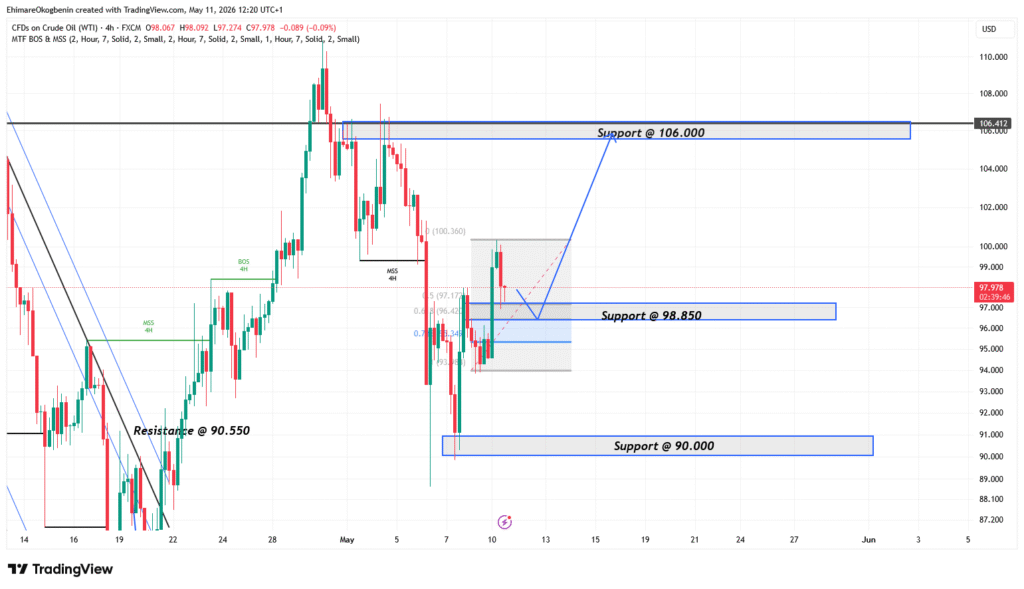
USOIL Technical Analysis: 11th – 15th May 2026
From a technical perspective, USOIL (WTI Crude Oil) continues to trade within a bullish yet highly volatile structure, with current prices fluctuating around the $103–$105 range.
Recent price action suggests that oil remains supported by geopolitical risk premiums and ongoing supply concerns, although momentum continues to face resistance near recent highs.
Key Resistance Levels
- Immediate Resistance: $105.00 – $107.00
- Secondary Resistance: $110.00
- Major Resistance: $115.00
A sustained break above the $107.00 region could strengthen bullish momentum and open the path toward the $110.00 level.
Key Support Levels
- Immediate Support: $100.00
- Secondary Support: $95.00
- Major Support: $90.00
The $100.00 region remains a key short-term support zone. A sustained break below this area could expose oil to deeper downside pressure toward the $95.00 level.
Overall, USOIL remains in a consolidation phase within a broader bullish structure, as traders continue to monitor geopolitical developments, supply disruptions, and broader macroeconomic conditions.
USOIL Technical Analysis: 11th – 15th
From a technical perspective, USOIL (WTI Crude Oil) continues to trade within a bullish yet highly volatile structure, with current prices fluctuating around the $103–$105 range.
Recent price action suggests that oil remains supported by geopolitical risk premiums and ongoing supply concerns, although momentum continues to face resistance near recent highs.
Key Resistance Levels
- Immediate Resistance: $105.00 – $107.00
- Secondary Resistance: $110.00
- Major Resistance: $115.00
A sustained break above the $107.00 region could strengthen bullish momentum and open the path toward the $110.00 level.
Key Support Levels
- Immediate Support: $100.00
- Secondary Support: $95.00
- Major Support: $90.00
The $100.00 region remains a key short-term support zone. A sustained break below this area could expose oil to deeper downside pressure toward the $95.00 level.
Overall, USOIL remains in a consolidation phase within a broader bullish structure, as traders continue to monitor geopolitical developments, supply disruptions, and broader macroeconomic conditions.
Final Thoughts on the USOIL Forecast for May 2026
USOIL remains in a complex macroeconomic environment shaped by competing supply and demand forces.
While ongoing geopolitical tensions and supply-side concerns continue to provide underlying support for prices, broader economic uncertainty and slowing global growth remain important downside risks.
- Current market conditions may involve
- Volatile and reaction-driven price action
- Increased sensitivity to macroeconomic data
- Frequent shifts in short-term market sentiment
At this stage, the crude oil market remains in a “macro-driven consolidation phase”, where neither bullish nor bearish momentum has fully established long-term dominance.
Risk Warning & Disclaimer
RISK WARNING:
CFDs are complex financial instruments and carry a high risk of rapid loss of capital due to leverage. You should ensure you fully understand the risks involved and carefully consider whether you can afford to take the high risk of losing your money before trading.
DISCLAIMER:
This material is provided for informational and educational purposes only and does not constitute investment advice or a recommendation to buy or sell any financial instrument. The views expressed represent a general market perspective and do not take into account individual investment objectives, financial situations, or risk tolerance. Market conditions can change rapidly, and past performance is not a reliable indicator of future results. You should seek independent financial advice where appropriate.
