


Brent & WTI Outlook, IEA Surplus Risk, and Trading Ideas

John Ikechukwu >
John Ikechukwu >
Vantage is a global, multi-asset broker with a team of in-house writers and market analysts who produce educational and insightful trading content for traders of all levels.
 Updated Tue, 2026 February 24 05:58

Key Takeaways
The crude oil market in February 2026 is in a transition phase: supply is rising faster than demand, the IEA is flagging a sizeable 2026 surplus, yet geopolitical risks are preventing a deeper price collapse. Brent recently traded around 67.75 USD/bbl and WTI around 62.89 USD/bbl, leaving prices below their 2025 highs but off recent lows.
Key points for readers:
- The IEA now expects global oil demand to grow by about 850,000 bpd in 2026, while supply is set to rise by about 2.4 mb/d, implying a surplus close to 3.7– 4.0 mb/d (almost 4% of demand).
- According to oilprice.com, this imbalance is structurally bearish, but OPEC+ decisions and Iran‑related tensions still inject upside risk into prices.
- For traders, the current environment favors a cautious bearish bias and “sell‑on‑rallies” setups, with breakout scenarios reserved for strong geopolitical shocks.
Current Market Outlook
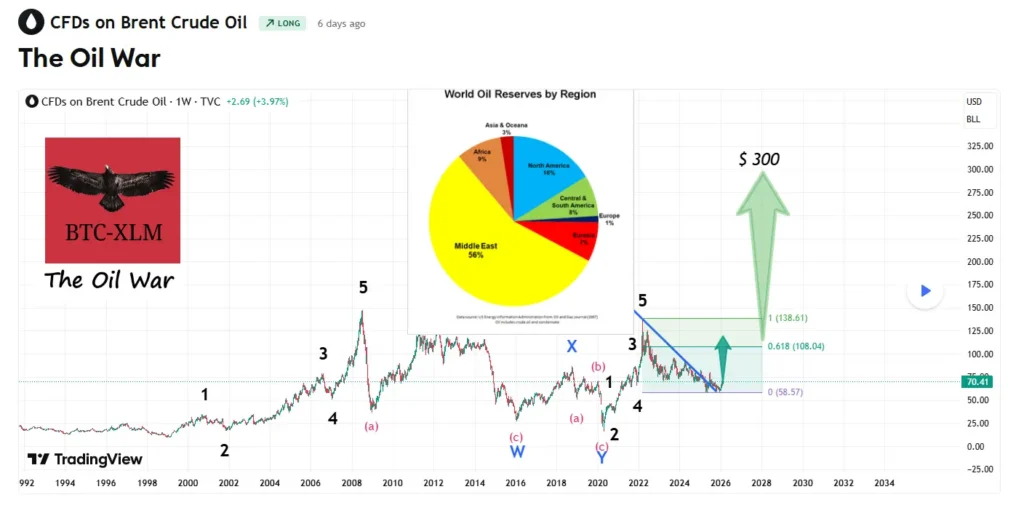
Price levels and recent performance
- Brent crude: about 67.75 USD/bbl on 13 February 2026.
- WTI (CFD proxy for front‑month crude): about 62.89 USD/bbl on 13 February 2026.
- Over the past month, both benchmarks have recovered modestly but remain materially below year‑ago levels, signaling a consolidation phase rather than a strong uptrend.
In simple terms, prices are caught between bearish oversupply and bullish risk premiums from geopolitics.
Data Outlook(as of mid‑February 2026)
| Metric | Latest value/comment | Source |
| Brent spot | 67.75 USD/bbl on 13 Feb 2026 | TradingEconomics |
| WTI spot | 62.89 USD/bbl on 13 Feb 2026 | TradingEconomics |
| 1‑month Brent move | Up about 1.8%, still ~9% below a year ago | TradingEconomics |
Fundamentals: Supply vs Demand
Supply outlook: Why the IEA sees a surplus
The main structural driver in 2026 is strong supply growth. The IEA’s February Oil Market Report estimates global oil production will rise by about 2.4 mb/d in 2026 to roughly 108.6 mb/d, assuming OPEC+ keeps its current plan. A large share of this growth comes from the US, Brazil, and Guyana, alongside OPEC+ output increases that resumed after years of cuts.
The IEA now projects global supply to exceed demand by about 3.73 mb/d in 2026, equivalent to almost 4% of world demand, a surplus larger than many other forecasts. This is why many institutional outlooks describe the 2026 market as “oversupplied” or “glutted” unless OPEC+ cuts again.
Demand outlook: Growth, but slower and concentrated
On the demand side, the IEA has cut 2026 global oil demand growth to about 850,000 bpd, from a previous forecast of nearly 930,000 bpd. All of this additional demand is expected from non‑OECD economies, led by China and other emerging markets, while OECD demand is flat to slightly lower as efficiency and electrification bite.
In plain language: demand is still rising, but not fast enough to absorb the expected supply wave, which creates a structurally bearish backdrop over the year.
Geopolitics and Key Catalysts (For traders and businesses)
Geopolitics remains the main upside risk despite the surplus narrative. Tensions around Iran and the broader Middle East continue to support a risk premium, with periodic spikes when rhetoric or incidents escalate. Weather‑related disruptions and unplanned outages, such as in Kazakhstan, have also temporarily tightened supply and boosted prices in recent months.
High‑impact events to watch:
- OPEC+ meetings and production decisions (especially whether they resume hikes after Q1 2026)
- US crude and product inventory reports.
- Developments in Iran–US relations and any regional security incidents.
- Global growth and central bank policy, which affect demand and risk appetite.

What this means for different readers
- Short‑term traders: Expect choppy price action where headlines can trigger sharp intraday swings against the prevailing oversupply trend.
- Energy‑exposed businesses: Budgeting around a mid‑range Brent band (roughly mid‑60s) makes sense, but you should stress‑test for both mid‑50s downside (if surplus dominates) and mid‑70s upside (if geopolitics tighten supply).
Institutional Forecasts and Scenarios for 2026
Institutional sentiment is broadly cautious to bearish. The EIA’s Short‑Term Energy Outlook and market surveys point to a 2026 Brent average in the high‑50s to low‑60s, reflecting pressure from ample supply. Consensus polls reported by Reuters show a Brent price near 61 USD/bbl on average, with downside risk if OPEC+ does not adjust output.
Let’s frame 2026 in a simple scenario table:
| Scenario (2026) | Brent range (USD/bbl) | Main drivers |
| Bearish | 50–60 | IEA‑style surplus near 3.7–4.0 mb/d, OPEC+ keeps output high, demand undershoots. |
| Neutral | 60–70 | OPEC+ manages supply more actively, and demand meets current. IEA base case. |
| Bullish (event‑driven) | 70–80 | Major geopolitical shock or large OPEC+ cuts remove part of the projected surplus. |
This keeps your original price bands but ties them clearly to documented drivers and uncertainty ranges.
Technical Structure and Trading Ideas
Risk disclaimer: The following is for informational and educational purposes only and does not constitute investment advice. Trading crude oil involves significant risk of loss, and markets can invalidate any technical level quickly.
Key WTI levels (example)
Your original support and resistance zones remain useful if presented as indicative, not guaranteed:
- Support zones:
- 62 USD – near‑term pivot area.
- 59 USD – major structural support.
- 56 USD – strong long‑term support region.
- Resistance zones:
- 65.57 USD – pivotal technical level.
- 70 USD – psychological barrier.
- 73.75 USD – major upside target if a breakout holds.
Market structure currently looks like a medium‑term consolidation with a bearish bias, so long as price holds below the upper 60s to low 70s band.
Strategy 1: Higher‑probability bearish bias
Signal type: “Sell on rallies” in a surplus‑dominated environment.
Conditions:
- Price fails to sustain a daily close above roughly 65.5 – 67 USD.
- The IEA surplus narrative remains intact, and OPEC+ does not announce major cuts.
Illustrative trade idea (not a recommendation):
- Focus zone for entries: rallies into resistance around 65 – 67 USD.
- Downside areas of interest: 60, then 56 USD, with deeper downside only if macro and positioning turn decisively risk‑off.
- Risk management: use modest position sizes and stop‑losses above the 66.5 – 68 area to avoid being caught by geopolitical spikes.
Strategy 2: Bullish breakout on geopolitics
Signal type: “Buy breakout” if geopolitics or OPEC+ policy drives a sustained shift.
Conditions:
- Clear daily close above 65.5–67 USD with follow‑through.
- Qualitative catalyst, such as a significant supply disruption or coordinated OPEC+ cut beyond what is currently priced.
Illustrative upside-down regions:
- Initial focus: 70 USD.
- Extension zones: 73.75 and potentially 77.5 USD if the shock is large and the surplus is partly neutralized.
Short‑Term (Feb–Mar 2026) and Long‑Term Outlook
Short‑term (February–March 2026)
Base expectation: range trading with a mild downward tilt.
- Working band: support roughly 60–63 USD, resistance 67–70 USD.
- Probabilities (illustrative, not statistical):
- Bearish drift scenario: 60%.
- Sideways range: 25%.
- Sustained bullish breakout: 15%.
For traders, this argues for fading strength into resistance while staying flexible if a geopolitical or OPEC+ catalyst changes the regime.
Full‑year 2026 outlook
The IEA’s projected surplus near 3.73 mb/d and slower demand growth justify keeping a bearish‑to‑neutral baseline for 2026 as a whole. In practice, this means:
- Bearish band: 50–60 USD (if surplus persists and growth disappoints).
- Neutral band: 60–70 USD (if OPEC+ actively manages supply).
- Bullish band: 70–80 USD (if major disruptions or cuts remove part of the surplus).
Full‑year 2026 outlook (Educational Example)
The IEA’s projected surplus near 3.73 mb/d and slower demand growth provide context for a bearish-to-neutral baseline in 2026.
Hypothetical price bands for study purposes:
- Bearish band: 50–60 USD if supply exceeds demand and growth is slower.
- Neutral band: 60–70 USD if the supply-demand balance is maintained.
- Bullish band: 70–80 USD in the event of major disruptions or production cuts.
All ranges are illustrative and intended to help understand potential market scenarios; they do not constitute trading recommendations.
Frequently Asked Questions
Will oil prices fall in 2026?
The IEA’s surplus projection and slower demand growth tilt the balance toward modestly lower prices on average, but OPEC+ decisions and geopolitics can still produce temporary rallies.
Who is driving oil demand growth in 2026?
All net demand growth is expected from developing economies, led by China and other non‑OECD markets, while advanced economies see little or negative growth due to efficiency gains and energy transition trends.
How big is the 2026 surplus risk?
The IEA currently sees global supply exceeding demand by around 3.73 mb/d in 2026, which is almost 4% of expected world demand and larger than many earlier forecasts.
RISK WARNING: CFDs are complex financial instruments and carry a high risk of losing money rapidly due to leverage. You should ensure you fully understand the risks involved and carefully consider whether you can afford to take the high risk of losing your money before trading.
Disclaimer: The information is provided for educational purposes only and doesn’t take into account your personal objectives, financial circumstances, or needs. It does not constitute investment advice. We encourage you to seek independent advice if necessary. The information has not been prepared in accordance with legal requirements designed to promote the independence of investment research.
No representation or warranty is given as to the accuracy or completeness of any information contained within. This material may contain historical or past performance figures and should not be relied on. Furthermore, estimates, forward-looking statements, and forecasts cannot be guaranteed. The information on this site and the products and services offered are not intended for distribution to any person in any country or jurisdiction where such distribution or use would be contrary to local law or regulation.
