
 Updated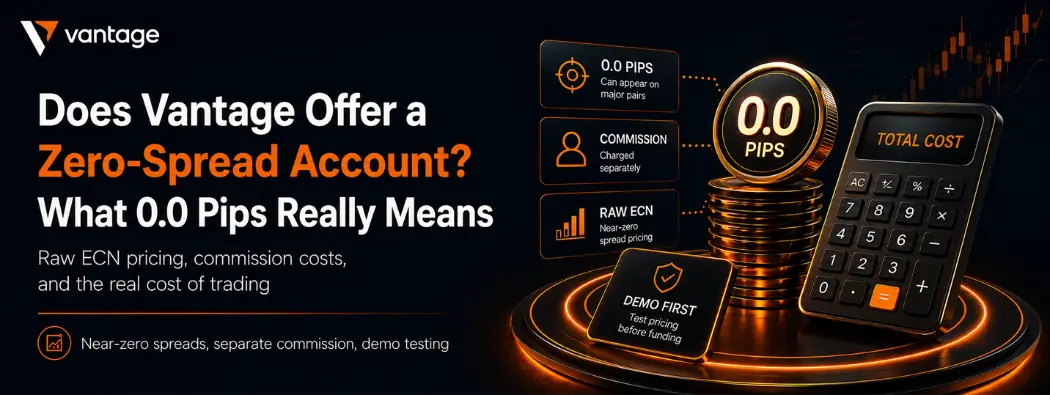
Many traders see advertisements for 0.0 pips and wonder whether the offer is real.
Others come across a zero-spread account and assume it means trading at no cost. In practice, the pricing model is more nuanced than that.
This article explains how a forex zero-spread account works, what 0.0 pips really means, and whether Vantage offers this type of account. It also explains the costs involved and how South African traders can test the account before funding it.
Quick Answer: Yes. Vantage offers a near-zero, raw-spread account through its Raw ECN pricing model. A zero-spread account means spreads can reach 0.0 pips on major currency pairs, but a separate commission applies. Zero spread does not mean free trading.
Before opening a live account, consider testing the Raw ECN pricing model on a demo account to understand how spreads, commissions, and trading costs work together.
What Is a Zero-Spread Account?
A zero-spread account is a trading account where the difference between the buy price and the sell price is zero, or very close to zero.
In practical terms, this means traders can sometimes see spreads of 0.0 pips on major currency pairs. Instead of building most of the trading cost into the spread, the broker typically charges a separate commission based on the trade size.
This pricing model is often referred to as raw spread or near-zero spread pricing.
It is important to understand that a zero-spread account does not mean trading is free. The cost is usually shifted from the spread to a commission charged per lot traded.
For example, a trader may see a spread of 0.0 pips on EUR/USD but still pay a commission when opening and closing the position.
If you are unfamiliar with how spreads work, see the guide on what spread is in forex trading.

What 0.0 Pips Really Means, the Real Cost
0.0 pips do not mean trading is free, and they do not mean costs disappear.
A spread can reach 0.0 pips when the buy and sell prices on a currency pair are the same, or nearly the same. This is most common on highly liquid major pairs during active market hours.
The cost normally included in the spread is often replaced by a separate commission. This commission is charged per lot traded and is included in the total trading cost.
It is also important to remember that spreads can widen during major news events, periods of low liquidity, or volatile market conditions. A displayed spread of 0.0 pips is not guaranteed at all times.
Consider the following illustrative example:
A trader opens a 1-lot EUR/USD position.
- Spread cost: Near zero
- Commission: Separate per-lot charge
- Swap fee: Applies only if the trade remains open overnight
In this example, the commission becomes the primary trading cost. If the position is held overnight, swap charges may also affect the total cost.
The key takeaway is simple. The real cost of trading is not the spread alone. It is the combination of spread, commission, and any applicable swap charges.
Does Vantage Offer a Zero-Spread Account?
Yes. Vantage offers a near-zero, raw-spread account through its Raw ECN pricing model.
This is the account type most closely associated with a zero-spread trading experience. Instead of building most trading costs into the spread, the Raw ECN account provides access to raw market pricing and applies a separate commission.
In simple terms, Vantage offers different pricing models for different trading preferences.
| Account Type | How Trading Costs Are Applied |
| Standard STP | Trading costs are primarily included within the spread |
| Raw ECN | Raw or near-zero spreads plus a separate commission |
| Pro ECN* | Raw-spread pricing designed for eligible higher-balance traders |
Availability and eligibility requirements should always be confirmed on the latest account documentation.
For traders researching a zero-spread style account, the Raw ECN account is the closest fit within the Vantage account lineup. It is important to understand that the lower spread is paired with a commission charge.
This is why comparing spreads alone can be misleading. The more useful comparison is the total cost of trading, including spread, commission, and any swap charges that may apply to overnight positions.
Before opening an account, review the Raw ECN account details, the spreads page, and the commission schedule to understand how pricing is structured.
Zero-Spread vs Standard Account: Which Costs Less?
Neither account type is automatically cheaper. The total cost depends on how often and how much a trader trades.
A standard account typically includes most trading costs within the spread. This creates a simpler pricing structure because traders do not need to calculate a separate commission on each trade.
A raw-spread account works differently. The spread can be much lower, sometimes reaching 0.0 pips on major pairs, but a separate commission applies.
The table below shows the main differences.
| Feature | Standard Account | Raw-Spread Account |
| Spread | Includes most trading costs | Can be near zero on major pairs |
| Commission | Usually not charged separately | Charged separately |
| Cost Visibility | Costs mainly appear in the spread | Spread and commission shown separately |
| Pricing Style | Simpler to understand | More detailed cost breakdown |
When comparing a zero spread account with a standard account, it is important to look beyond the headline spread.
For example, a trade with a wider spread and no separate commission may end up costing as much as a trade with a near-zero spread and a commission. The answer depends on trading volume, position size, and market conditions.
The most useful comparison is the total cost of completing the trade, not whether the spread or commission appears larger on its own.
Who a Zero-Spread Account Suits, and Who It May Not
A zero-spread or raw-spread account may suit traders who frequently place trades and want detailed visibility into trading costs.
Day traders and higher-volume traders often pay close attention to spreads because even small pricing differences can affect trading costs over time. A raw-spread account separates the spread and commission, making those costs easier to track.
Some automated trading systems may be designed to operate under pricing models in which spreads remain as close as possible to underlying market conditions.
That does not mean a zero-spread account is the right choice for everyone.
Beginners and lower-frequency traders may prefer a standard spread-based account because the pricing structure is simpler to understand. Instead of calculating both spread and commission, the trading cost is primarily reflected in a single figure.
Neither approach is universally better. The most suitable option depends on factors such as trading frequency, position size, strategy, and personal preference.
The key point is that different account types are designed around different pricing models. Understanding how those costs are applied is often more important than focusing on the lowest advertised spread.
How to Test a Zero-Spread Account on Demo First
A demo account is one of the easiest ways to understand how a zero-spread pricing model works before risking real money.
Rather than focusing solely on marketing claims, traders can use a demo environment to see how spreads, commissions, and execution costs play out in practice.
A useful zero spread demo account checklist might include the following:
| What to Check | What to Look For |
| Spread Behaviour | Observe major pairs such as EUR/USD during calm and busy market periods |
| Commission | Check how the commission appears on trade tickets and account history |
| Swap Charges | Review overnight costs if positions remain open beyond the trading day |
| Execution Speed | Monitor how quickly orders are filled during active market sessions |
| Total Cost | Compare the combined impact of spread and commission on a completed trade |
Testing during active market hours can provide a more realistic view of pricing conditions. Traders may also want to compare the same trade on both a Standard STP account and a Raw ECN account to understand how costs are displayed differently.
The goal is not to predict future results. The goal is to become familiar with the pricing model and understand how the total cost of a trade is calculated before funding a live account.
Risks and Costs to Keep in Mind
A zero-spread account can reduce spread costs, but it does not remove trading risk or other trading expenses.
Risk Reminder
A spread of 0.0 pips does not mean trading is free. Commission charges still apply, spreads can widen during volatile market conditions, and losses can exceed expectations if risk is not managed carefully.
Commissions can offset some of the benefits of a near-zero spread, especially for traders who trade less frequently or use smaller position sizes.
Market conditions also matter. During major economic announcements or periods of low liquidity, spreads may widen, and execution prices may change rapidly.
Slippage can occur when an order is filled at a price different from the expected price. This is a normal market risk and can affect the total cost of a trade.
Leverage is another factor to consider. It can increase both gains and losses, which makes risk management an important part of forex CFD trading.
The key point is that a zero-spread account changes how trading costs are structured. It does not remove costs or market risks.
Conclusion
A zero-spread account does not mean zero trading costs. It means the spread can be reduced to 0.0 pips on certain major currency pairs, with a separate commission charged for executing trades.
The most important takeaway is that the true cost of trading comes from the combination of spread, commission, and any applicable overnight charges.
For traders researching whether Vantage offers this type of account, the answer is yes. Vantage provides near-zero raw spread pricing through its Raw ECN account, with commissions applied separately.
Before funding a live account, take time to understand the pricing model, review the commission and spread schedules, and test the account in a demo environment.
A demo account can help you see how spreads, commissions, and total trading costs work together before you trade with real funds.
Frequently Asked Questions
What is a zero-spread account?
A zero-spread account is a trading account in which the buy and sell prices are the same or very close. Trading costs are usually charged through a separate commission rather than a wider spread.
Does Vantage offer a zero-spread account?
Yes. Vantage offers near-zero raw-spread pricing through its Raw ECN account. The account can display spreads as low as 0.0 pips on major currency pairs, with a separate commission applied.
Is zero spread really free?
No. A zero-spread account is not a zero-cost account. Even if the spread is very low or reaches 0.0 pips, commission and other trading costs may still apply.
What does 0.0 pips mean?
0.0 pips means the difference between the buy and sell price is zero at that moment. It does not mean there are no trading costs.
Are zero spread and raw spread the same thing?
They are closely related. Raw-spread accounts provide access to underlying market pricing, which can sometimes result in spreads reaching 0.0 pips on major currency pairs.
Does the Vantage zero or raw-spread account charge commission?
Yes. The Raw ECN account uses a commission-based pricing model. The spread and commission are shown separately rather than combined into one cost.
Is a zero-spread account good for beginners?
It may suit some beginners, but others may prefer a standard spread-based account because the pricing structure is simpler to understand. The choice depends on personal preference and trading style.
Can I test a zero-spread account on a demo first?
Yes. A zero-spread demo account can help traders understand how spreads, commissions, swaps, and execution costs work before funding a live account.
Who is a zero-spread account best for?
A zero-spread account may suit day traders, higher-volume traders, and some automated trading strategies. Other traders may prefer a simpler spread-based pricing model.
Risk Warning: CFDs are complex financial instruments and carry a high risk of rapid loss of money due to leverage. You should ensure you fully understand the risks involved and carefully consider whether you can afford to take the high risk of losing your money before trading.
Disclaimer: The information is provided for educational purposes only and doesn’t take into account your personal objectives, financial circumstances, or needs. It does not constitute investment advice. We encourage you to seek independent advice if necessary. No representation or warranty is given as to the accuracy or completeness of any information contained within.
This material may contain historical or past performance figures and should not be relied on. Furthermore, estimates, forward-looking statements, and forecasts cannot be guaranteed. The information on this site and the products and services offered are not intended for distribution to any person in any country or jurisdiction where such distribution or use would be contrary to local law or regulation.
References
- https://www.vantagemarkets.com/en-za/academy/what-is-spread-in-forex-trading/ – Vantage Markets: What is spread in forex?
- https://www.vantagemarkets.com/en-za/trading/accounts/raw-ecn/ – Vantage Markets: RAW ECN account.
- https://www.vantagemarkets.com/en-za/trading/fees/spreads/ – Vantage: Spreads.
- https://www.vantagemarkets.com/en-za/trading/accounts/ – Vantage: trading accounts.
- https://www.vantagemarkets.com/en-za/trading/accounts/demo/ – Vantage: Demo account trading.
- https://www.vantagemarkets.com/en-za/trading/accounts/stp/ – Vantage: Standard STP account.
- https://www.fsca.co.za/ – Financial Sector Conduct Authority (FSCA).
- https://www2.fsca.co.za/Fais/Search_FSP.htm – FSCA register.
- https://www.vantagemarkets.com/en-za/terminology/slippage/ – Vantage: Slippage.