Updated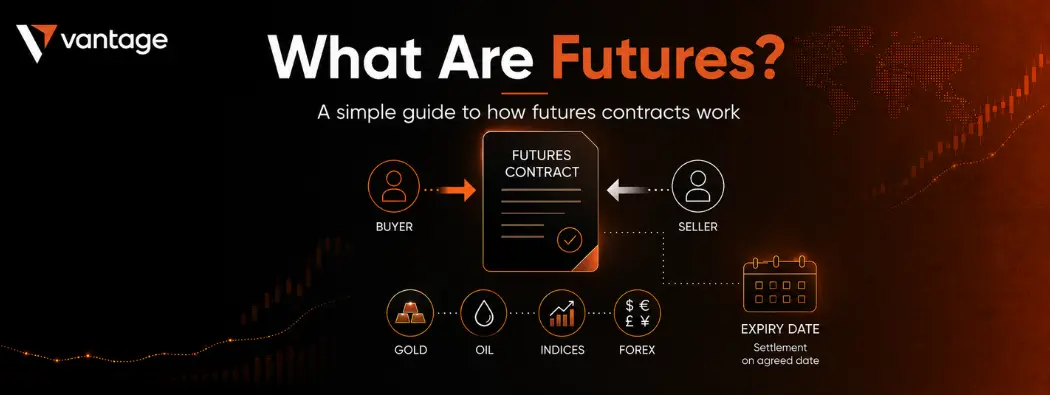
Futures can look simple from the outside. You buy if you think the price will rise. You sell if you think the price will fall.
After trading them for a while, you learn that futures are not only about direction. You also need to understand contract size, tick value, margin, expiry, liquidity, and risk. Those details can decide whether a trade is manageable or too large for your account.
A futures contract is an agreement to buy or sell an asset at a set price on a future date. The asset can be gold, crude oil, a stock index, a currency, or an agricultural product like soybeans.
Many traders use futures to speculate on price moves. Some use them to hedge risk. Others use futures CFDs to gain exposure to futures prices without trading the underlying exchange-traded contract.
In this guide, I will explain futures in a way that makes much sense. I will also show the terms I would check before entering a trade, the common mistakes beginners make, and the risks traders should respect.
Key Takeaway
Futures are contracts that track the price of an asset in the future. They allow buyers and sellers to agree on a price today for settlement at a later date.
For example, a trader may buy a crude oil futures contract if they expect oil prices to rise. Another trader may sell the same contract if they expect prices to fall. The profit or loss depends on how the market moves after the trade is opened.
Futures are often used for:
- Speculating on price moves
- Hedging against market risk
- Trading commodities, indices, currencies, and bonds
- Managing exposure before major market events
Futures can be useful, but they are not beginner-proof. Margin, contract size, and expiry can make losses grow faster than expected.
What is a futures contract and how does it work? [1]
I like to think of futures as a price agreement with rules. The agreement clearly outlines:
- What market is being traded
- How large the contract is
- How each price move is measured
- When the contract expires
- How the trade is settled
That is why futures are different from buying a normal stock. When you buy a stock, one share is one share. The price is clear.
With futures, one contract may represent a much larger value. A small move on the chart can translate into a larger gain or loss in monetary terms.
That is the first lesson every trader should learn. Never look at the chart alone. Always check what one point or one tick is worth.
A futures contract is an agreement between two parties to trade an asset at a pre-agreed price on a predetermined date.
Futures are traded via agreements between buyer and seller. The basis of a futures trade is the futures contract, which allows its participants to buy or sell a specific underlying asset at a preset price on a set future date.
The underlying asset can be a commodity, a security, or another financial instrument – the only requirement is that both buyer and seller agree on the asset.
The contract details to check before any futures trade
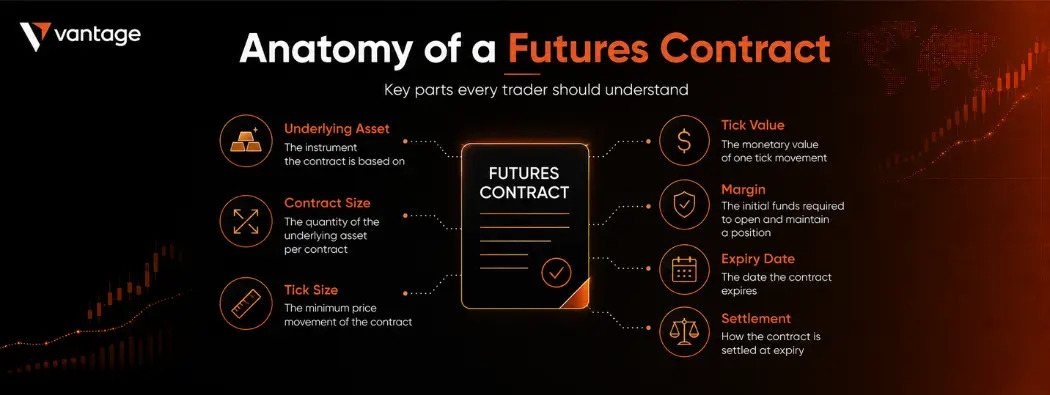
Before looking for profit, it is important to review the contract details. Many beginners skip this step. That can lead to oversized trades.
A futures contract usually includes the underlying market, contract size, contract value, tick size, tick value, margin, expiry date, and settlement method.
Contract size
A Contract size tells you how much of the asset one contract represents.
For example, a contract size may state that one crude oil futures contract represents 1,000 barrels. One gold futures contract may represent 100 troy ounces.
For index futures, the contract size is often tied to the index price and a fixed dollar multiplier. For example, the E-mini S&P 500 futures contract uses $50 as the index price multiplier. The Micro E-mini S&P 500 uses a $5 per index-point value.
Contract value
The value of a futures contract is derived by multiplying the price of the underlying asset by the contract size. For example, if you hold one contract of the E-mini S&P 500, and the index is trading at 5,200, the value of the contract is $50 x 5,200 = $260.000.
Contract value is also known as the contract’s notional value.
Tick size [2] and Tick Value
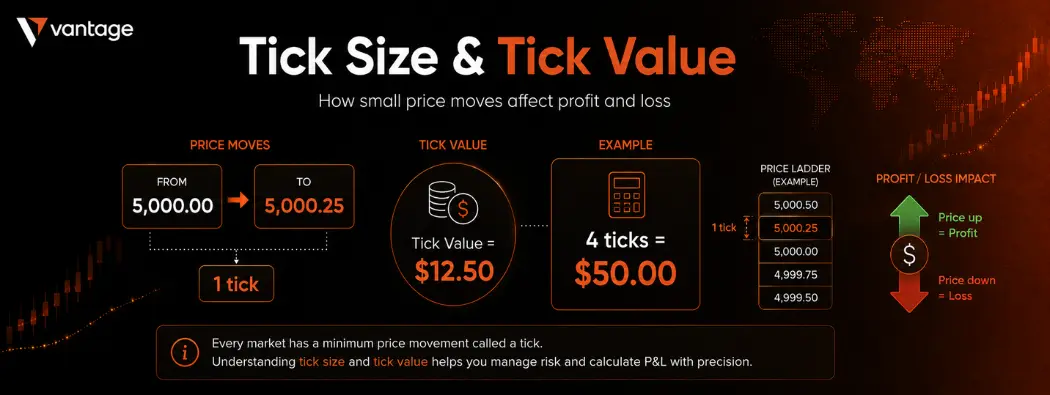
Tick size is the smallest price move a futures contract can make.
The tick value, on the other hand, tells you what that move is worth in money.
I always check the tick value before placing a trade. Without it, you may not know what a normal price move means for your account.
For example, the E-mini S&P 500 has a tick size of 0.25 index points. Since one full point is worth $50, one tick is worth $12.50.
For WTI crude oil, one tick is 1 cent per barrel. Since one standard contract represents 1,000 barrels, one tick is worth $10.
Those numbers may look small. During fast markets, prices can move many ticks in seconds.
Expiry, Settlement and Delivery
Futures contracts expire. The expiry date tells you when the contract ends. Before expiry, a trader may close the position or roll it into another contract.
Some futures contracts settle in cash. Others may involve physical delivery if held until expiry. Most active traders do not want physical delivery. They close or roll their positions before expiry.
Beginners should avoid holding futures near expiry without understanding the product rules. Pricing can change. Liquidity can shift. Spreads can widen. Rollover may also affect the trade.
Simple Futures Trading Example
Assume an index futures contract is trading at 5,000 points.
Each point is worth $10.
That means one contract has a market value of 5,000 x $10 = $50,000. A trader buys one contract because they expect the index to rise.
If the index moves from 5,000 to 5,020, the market has moved 20 points.
20 x $10 = $200 profit before costs.
If the index falls from 5,000 to 4,980, the market has moved 20 points against the trader.
20 x $10 = $200 loss before costs.
The lesson is simple. Futures exposure can exceed the amount of money used to open the trade.
A margin may reduce the upfront amount required. It does not reduce the full market risk.
Note: The example above is used for educational purposes only. It should not be taken as trading advice
Futures vs spot markets
Futures have expiry dates. Spot markets usually do not. Futures are based on standard contracts. Spot markets are based on current market prices.
Futures may trade at a different price from the spot market. The difference can stem from interest rates, storage costs, dividends, supply and demand, and time to expiry.
For example, oil futures may trade above or below the current oil price. Gold futures may also differ from the spot gold price.
A trader should not assume that futures and spot prices are always the same.
Why trade futures contracts
Diversification
It’s no exaggeration that futures contracts are among the most varied and wide-ranging instruments, covering everything from major commodities to stocks, bonds, and even indices.
Some examples of futures contracts include [3]:
- Commodity futures (commodities such as crude oil, natural gas, corn, and farmland)
- Currency futures (encompassing major currencies such as the euro and the British pound)
- Energy futures (underlying assets include crude oil, natural gas, gasoline, and heating oil)
- Equities futures (stocks and equity funds traded on the market)
- Interest rate futures (used to hedge against interest rate changes in Treasurys and other bonds, which are affected by monetary policy changes)
- Precious metal futures (eg. gold, silver, palladium, etc.)
- Stock index futures (using indices such as the S&P 500 as underlying assets)
Given this wide selection, a futures trader can conveniently and effectively diversify their portfolio by choosing appropriate positions. On the flip side, knowing how to make the right choices in a sea of different assets would require a high degree of experience and knowledge, making this strategy more suited to advanced investors.
To Hedge risk
Futures are also used for hedging.
A producer may use futures to lock in a price. A fund manager may use index futures to reduce stock market risk. A company exposed to fuel price fluctuations may use energy futures to manage cost volatility.
Hedging is not about chasing quick profit. It is about reducing price uncertainty.
Leverage
Futures contracts are traded on leverage with margin, allowing investors to control larger positions with smaller capital. This frees up capital to be deployed in other trades simultaneously, allowing greater capital efficiency. With leverage, a futures trader can take advantage of more market opportunities.
Conversely, leverage will also amplify a losing position, so traders should be aware of this possibility and make suitable adjustments. It’s essential to practise proper risk management, such as position sizing, meeting margin calls, and using stop-losses.
Extended trading hours
Many futures markets trade for longer hours than standard stock market sessions.
Longer hours do not mean risk disappears. Some markets become thin outside major trading sessions. News can also hit when liquidity is low.
That can lead to fast price moves and wider spreads.
Pros and cons of futures trading
| Potential benefit | Risk or trade-off |
|---|---|
| Access to many markets | Each market has different drivers and contract rules. |
| Ability to go long or short | The wrong direction can lead to fast losses. |
| Useful for hedging | A hedge can still lose money if sized or timed poorly. |
| Margin can improve capital use | Leverage can magnify both losses and gains. |
| Extended trading hours | Liquidity can be thinner outside major sessions. |
| Standard contract terms | Contract sizes may be too large for some accounts. |
How to trade futures? [4]
Long, short, or spread
In essence, there are three ways that a futures contract may be traded – you can go long, short, or trade the spread. This flexibility is also a main reason why futures contracts are popular among seasoned investors.
Going long on futures contracts
Going long means buying a futures contract because you expect the underlying market to rise.
If the price rises after entry, the long position may gain value. If the price falls, the position may lose value.
For example, a trader may buy an index futures contract if they expect broad stock market strength.
Going short on futures contracts
When going short on a futures contract, you sell the contract and profit when the asset’s price goes down.
To illustrate, assume you want to go short on a futures contract. You first “borrow” the futures contract (rather, the underlying assets) from your broker and sell it at the current price, collecting S$1,000 as a result. When the underlying asset’s price falls, the contract’s value drops to $700.
At this point, you buy back the contract at $700 to “return” the underlying assets to your broker, pocketing $300 in profit.
Trading the spread on futures contracts
This is a more advanced futures strategy that combines buying and selling contracts simultaneously.
To trade the spread, a futures investor would simultaneously buy different futures contracts. When the relative price difference between the two narrows or widens, the investor stands to gain a profit.
Trading the spread is highly versatile, as you can choose contracts with the same underlying assets but with different expiry dates, or choose two futures contracts in two closely related products like crude oil and gasoline.
Trade popular futures contracts with Vantage CFDs
Another way to trade futures contracts is with Contracts-for-Differences (CFDS) which are another type of financial derivative that works similarly to futures contracts.
In a CFD, you are trading on the price difference of an underlying futures contract. This allows you to gain exposure to the futures market without having to deal in actual futures contracts.
Like futures, CFDs can be traded on leverage, allowing greater capital efficiency. Furthermore, CFDs do not entail the risk of physical delivery but allow you to profit from price volatility in the futures market.
You can also trade CFDs and a wide range of futures, ranging from equities to bonds, commodities, crypto and more – this helps you diversify your trades to cushion against adverse events in specific sectors or economic periods.
Trade the world’s most popular futures with Vantage CFDs and enjoy low fees, tight spreads and transparent pricing. Enjoy the reliability and speed of our world-class trading platforms, including MT4 and MT5, and enrich your trading journey with our deep selection of blogs, guides, and educational resources.
Sign up for a live account to start experiencing the Vantage advantage today!
References
- “The Investor’s Guide to Futures – Investopedia”. https://www.investopedia.com/articles/optioninvestor/09/get-started-with-futures.asp . Accessed 9 Nov 2024.
- “Tick Movements: Understanding How They Work – CME Group”. https://www.cmegroup.com/education/courses/introduction-to-futures/tick-movements-understanding-how-they-work.html . Accessed 9 Nov 2024.
- “What Is Futures Trading – Investopedia”. https://www.investopedia.com/terms/f/futures.asp . Accessed 9 Nov 2024.
- “How to Trade Futures: Platforms, Strategies, and Pros and Cons – Investopedia”. https://www.investopedia.com/how-to-trade-futures-5214571 . Accessed 9 Nov 2024.