
 Updated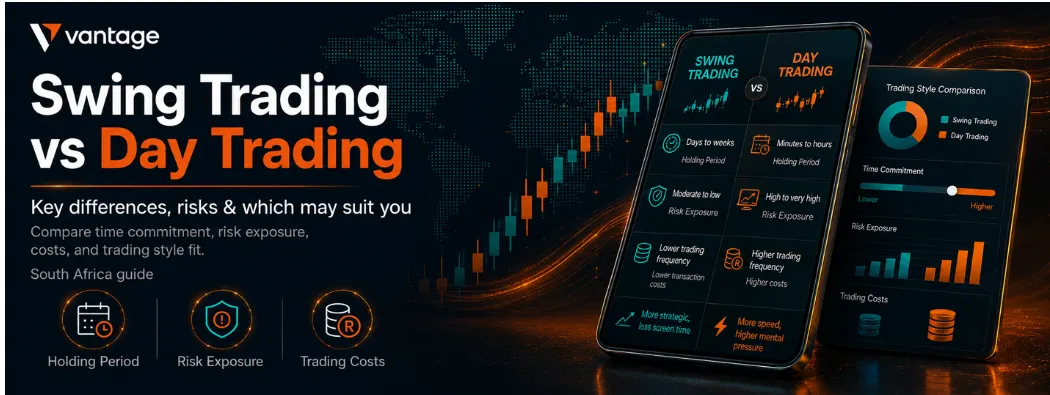
Swing trading usually involves holding positions for several days or weeks, while day trading focuses on opening and closing positions within the same trading day. Neither style is automatically better. The most suitable choice depends on factors such as available time, risk tolerance, market knowledge, trading costs, and personal discipline.
Many beginners compare swing trading vs day trading by asking a simple question: which one can make more money? In reality, that may not be the most useful place to start.
A better question is whether a trading style fits your schedule, risk tolerance, decision-making process, and learning goals. Some traders prefer to hold positions for several days and make fewer decisions. Others prefer shorter-term opportunities that require closer market monitoring.
This guide compares swing trading and day trading in terms of time commitment, risk exposure, costs, trading tools, and suitability for beginners. The goal is not to identify a winner, but to help you understand the differences before choosing what to learn next.
Key Takeaways
- The time commitment is the biggest difference: day trading requires close market monitoring. Swing trading allows more flexible trade management.
- Each style carries a different type of risk: Day traders face fast price moves and execution pressure. Swing traders face overnight gaps and weekend events.
- Trading costs affect both styles differently: Frequent day trades increase spreads, commissions, and slippage. Swing trades may attract swap and overnight fees
- Neither style is automatically more profitable: Results depend more on discipline, risk control, costs, experience, and consistent execution.
- The best choice depends on the trader’s routine: Swing trading may suit busy traders. Day trading may suit people with dedicated market hours. Testing both on a demo account can reveal the better fit
Swing Trading vs Day Trading: Quick Comparison
Both swing trading and day trading aim to take advantage of market price movements, but they differ significantly in how trades are managed, how much time they require, and the types of risks traders face.
The table below highlights the main differences.
| Factor | Swing Trading | Day Trading |
| Typical Holding Period | Several days to several weeks | Minutes to hours, usually closed before the trading day ends |
| Screen Time | Planning plus regular monitoring | High intraday monitoring |
| Trade Frequency | Fewer trades | More frequent trades |
| Main Risk Type | Overnight and weekend market moves | Fast intraday moves and execution pressure |
| Cost Focus | Spreads plus possible swaps or overnight fees | Spreads, commissions, and slippage from frequent trading |
| Analysis Focus | Trend, support and resistance, momentum, and market context | Short-term charts, momentum, volatility, and execution timing |
| May Suit | Traders who prefer fewer decisions and can wait for setups | Traders who can focus during active market hours |
Neither approach is inherently better. Swing trading may appeal to traders who cannot spend the entire day watching markets, while day trading may suit those who prefer more active participation and faster decision-making.
The key consideration is not which style appears more exciting, but which one aligns with your schedule, risk tolerance, trading goals, and ability to follow a structured plan.

What Is Swing Trading?
Swing trading is a trading style that aims to capture short- to medium-term price movements, often over several days or weeks. Instead of focusing on small intraday fluctuations, swing traders typically look for larger market swings that develop within broader trends, ranges, or breakout conditions.
Swing traders often use technical analysis, support and resistance levels, trend analysis, and momentum indicators to identify potential opportunities. Because positions may remain open overnight or through weekends, traders must also consider factors such as market gaps, swap charges, and news events.
Swing trading can be applied across forex, commodities, indices, and shares through suitable trading products.
For a more detailed explanation, readers can explore our complete guide to Swing Trading
What Is Day Trading?
Day trading is a trading style that involves opening and closing positions within the same trading day. In most cases, day traders do not hold positions overnight, which means they avoid overnight gaps and weekend market exposure.
Day traders typically focus on shorter time frames, such as 1-minute, 5-minute, 15-minute, or hourly charts. They often look for smaller price movements and may execute multiple trades during a single session.
Because markets can move quickly over short periods, day trading usually requires more active monitoring and faster decision-making than swing trading. Traders must also pay close attention to spreads, execution, volatility, and risk management.
To learn more about shorter-term trading approaches, readers can explore our guides on intraday trading and CFD day trading for beginners.
Key Differences Between Swing Trading and Day Trading
While both styles involve analysing markets and managing risk, the day-to-day experience of a swing trader can look very different from that of a day trader.
Holding Period
One of the biggest differences is how long trades remain open. Swing traders often hold positions for several days or weeks in an attempt to capture broader market movements. Day traders typically open and close positions within the same trading session.
Trade Frequency
Day traders generally place more trades because they focus on shorter-term price movements. Swing traders tend to trade less frequently, often waiting for setups that align with a larger market trend or structure.
Analysis Style
Swing traders often use daily and 4-hour charts to identify trends, support and resistance levels, and momentum shifts. Day traders usually focus on shorter time frames and may pay closer attention to intraday volatility, price action, and execution timing.
Risk Exposure
Because swing trades can remain open overnight, traders may be exposed to gaps, weekend events, and overnight financing costs. Day traders usually avoid overnight exposure but face the challenge of rapid market movements and the need for fast decision-making during active trading hours.
Trading Costs
The impact of trading costs can differ between the two styles. Day traders may feel the effect of spreads, commissions, and slippage more frequently because they execute more trades. Swing traders generally trade less often but may incur swap or overnight holding charges.
Time Commitment
Day trading often requires dedicated market hours and close monitoring of price movements. Swing trading can offer more flexibility, but it still requires analysis, planning, and ongoing trade management.
Neither approach is inherently easier. Each comes with its own demands, risks, and learning curve, which is why many traders explore both styles before deciding which one best fits their circumstances.
Time Commitment and Trading Frequency
Time commitment is one of the most important factors when choosing between swing trading and day trading.
Day trading often requires traders to monitor markets closely during active trading sessions. Because trades may be opened and closed within hours or even minutes, traders typically need to watch price movements, manage positions, and respond quickly to changing market conditions.
Swing trading generally involves less continuous screen time. Traders may spend more time analysing markets before entering a position and then monitor trades periodically as they develop over several days or weeks.
However, less screen time does not mean less effort. Swing traders still need to review charts, track market developments, manage risk, and adjust their plans when conditions change.
A trader who works full-time may find swing trading easier to fit around their schedule because it often relies on higher time frames. By contrast, day trading may be more suitable for traders who can dedicate focused time during active market hours.
The key is to choose a style that matches your availability and allows you to follow a consistent process. A trading approach that fits your schedule is often easier to maintain than one that constantly conflicts with your daily routine.
Risk Exposure: Intraday Pressure vs Overnight Risk
Both day trading and swing trading involve risk, but the nature of that risk is often different.
Day traders are typically exposed to fast-moving price action during active market hours. Because positions are managed over shorter periods, traders may need to make decisions quickly amid volatility, execution pressure, and rapidly changing market conditions. A small mistake can have a significant impact when markets move quickly.
Swing traders face a different challenge. Since positions may remain open for several days or weeks, they can be affected by overnight developments, weekend events, economic data releases, and market gaps that occur outside normal trading hours.
Leverage can increase risk in both styles. While it may increase market exposure, it can also amplify losses if the market moves against a position.
Risk Reality Check
Day trading and swing trading carry different risks, not different levels of certainty.
Day trading can expose traders to rapid losses, emotional decision-making, and overtrading. Swing trading can expose traders to overnight gaps, weekend market moves, swap charges, and longer periods of uncertainty while trades remain open.
Stop-loss orders can help manage risk, but they cannot eliminate it entirely, particularly during periods of extreme volatility or when markets gap beyond expected levels. Risk management remains important regardless of the trading style chosen.
Costs, Spreads, Swaps, and Slippage
Trading costs can affect both swing trading and day trading, but the impact may manifest differently.
Day traders often place more trades, which means spreads, commissions, and slippage can have a greater cumulative effect over time. Even small costs can become significant when positions are opened and closed frequently throughout the trading day.
Swing traders typically execute fewer trades, which may reduce the impact of frequent transaction costs. However, because positions are often held overnight, traders may incur swap charges or overnight financing costs, depending on the market, product, and position.
Slippage is another consideration for both styles. This occurs when a trade is executed at a price different from the expected one, particularly during periods of high volatility or reduced liquidity.
Market conditions can also influence costs. Wider spreads may occur during major news events, periods of low liquidity, or times of increased uncertainty.
Neither swing trading nor day trading is automatically cheaper. The overall impact of costs depends on factors such as trade frequency, holding period, market conditions, and execution quality.
For this reason, traders should include spreads, swaps, commissions, and potential slippage in their trading plans rather than focusing only on entry and exit opportunities.
Which Is More Profitable?
Many traders ask whether swing trading or day trading is more profitable. The short answer is that neither style is automatically more profitable than the other.
Results depend on a combination of factors, including market conditions, risk management, trading costs, experience, discipline, and the ability to follow a consistent plan.
Day trading may create more trading opportunities because positions are opened and closed frequently. However, more opportunities do not automatically translate into better results. Frequent trading can increase the impact of spreads, commissions, slippage, and emotional decision-making.
Swing trading may involve fewer trades and less screen time, but traders still face challenges such as overnight risk, market gaps, swap charges, and the patience required to hold positions for longer periods.
The profitability of either approach often comes down to execution rather than the style itself. A disciplined trader with a clear plan may perform better than someone using a different style without proper risk controls.
Rather than asking which style is more profitable, a more useful question may be: which style can you follow consistently while managing risk appropriately?
For most beginners, building skills, understanding risk, and developing discipline are often more important than choosing between swing trading and day trading.
Which Style May Suit Beginners?
There is no single trading style that suits every beginner. The better choice often depends on available time, decision-making preferences, risk tolerance, and willingness to learn.
The table below can help frame the decision.
Which May Suit You?
| Choose This Route to Learn First | Reader Profile | Risk Reminder |
| Start with swing trading education | You have limited screen time, prefer fewer setups, and can plan trades around wider time frames. | You may still face overnight gaps, weekend risk, swaps, and emotional pressure while positions remain open. |
| Start with day trading education | You can monitor markets closely, make quick decisions, and handle fast-moving price action. | Frequent trades can increase cost impact and emotional strain. Overtrading is a major risk. |
| Test both on demo first | You are unsure which style fits your schedule, tools, and behaviour. | Demo results do not guarantee live results, but they can help you evaluate process and discipline. |
Some beginners are attracted to day trading because it avoids overnight exposure. Others prefer swing trading because it may require less continuous screen time.
Neither style is inherently easier. Both require risk management, patience, and a structured approach. For traders who are still exploring their preferences, testing both styles on a demo account can provide valuable insight before taking on live-market risk.
Swing Trading vs Day Trading in Forex and CFDs
Both swing trading and day trading can be applied to forex and CFD markets, but the way traders interact with these markets often differs depending on the style they choose.
Day traders typically focus on shorter-term price movements that occur during active trading sessions. They may pay close attention to volatility, spreads, liquidity, and execution timing because even small price changes can influence trade outcomes over a short holding period.
Swing traders often focus on broader market moves that develop over several days or weeks. Instead of reacting to every intraday fluctuation, they may analyse trends, support and resistance levels, momentum, and larger market themes before entering a position.
In forex markets, both styles commonly involve major currency pairs because they tend to offer strong liquidity and competitive spreads. However, swing traders may be more affected by overnight financing costs and swap charges because positions remain open for longer periods.
Leverage is another important consideration. While leverage can increase market exposure, it can also magnify losses in both swing trading and day trading. Risk management remains important regardless of the chosen approach.
For traders in South Africa and across Africa, platform access, market hours, and personal schedules can also influence which style feels more practical. Someone with limited daytime availability may prefer higher-time-frame analysis, while another trader may have the flexibility to monitor markets more closely during active sessions.
Before committing to either style, many traders benefit from testing both approaches on a demo account to see how they fit their routine, risk tolerance, and decision-making process.
How to Test Both Styles on a Demo Account
If you are unsure whether swing trading or day trading is a better fit, a demo account can provide a practical way to compare the two approaches without exposing capital to live market risk.
Rather than focusing on profits, use the demo environment to evaluate how each style fits your schedule, decision-making process, and risk tolerance.
Demo Testing Checklist
- Track how much time each style requires each day
- Create a simple trading plan before entering positions
- Use stop-loss orders on every trade
- Record spreads, swaps, and other trading costs where applicable
- Keep a journal of entries, exits, and trade outcomes
- Note how you respond to wins, losses, and periods of uncertainty
- Test different chart time frames and platform tools
- Review whether the style fits your daily routine
- Focus on process and discipline rather than trade results
A trader may discover that day trading feels too time-consuming, while another may find swing trading uncomfortable because of overnight exposure. These insights can be valuable before committing real capital.
Most importantly, demo testing allows traders to compare both styles under realistic market conditions while developing familiarity with platform features, risk controls, and trade management techniques.
Remember that demo results do not guarantee live results, but they can help you understand which trading style is more practical for your circumstances.
Conclusion
When comparing swing trading vs day trading, there is no universal winner. Each style comes with different demands, risks, costs, and learning requirements.
Swing trading may appeal to traders who prefer fewer decisions and can manage positions over several days or weeks. Day trading may suit those who can dedicate time to monitoring markets closely and making faster decisions during active trading sessions.
The right choice often depends on factors such as your schedule, risk tolerance, market knowledge, discipline, and ability to follow a structured plan. It is also important to remember that both styles involve risk, particularly when trading leveraged products such as CFDs.
Before choosing a style, consider testing both approaches on a demo account. This can help you evaluate platform tools, time commitment, risk management, and emotional discipline in a practice environment before taking on live-market risk.
To continue learning, explore our guides on swing trading, day trading, demo accounts, and risk management.
Frequently Asked Questions
What is the main difference between swing trading and day trading?
The main difference is how long trades are held. Day traders usually open and close positions within the same trading day, while swing traders often hold positions for several days or weeks in an attempt to capture larger market movements.
Is swing trading better than day trading?
Neither style is automatically better. Swing trading and day trading involve different risks, time commitments, and trading approaches. The better fit depends on factors such as your schedule, experience, risk tolerance, and ability to follow a trading plan.
Is swing trading easier than day trading?
Not necessarily. Swing trading may require less screen time, but traders still face overnight risk, market gaps, and the challenge of managing positions over longer periods. Day trading avoids overnight exposure but often demands faster decisions and closer market monitoring.
Which style may suit someone with a full-time job?
Some traders with limited daytime availability may find swing trading easier to fit around their schedule because it often relies on higher time frames. However, swing trading still requires planning, analysis, and ongoing trade management.
Is swing trading or day trading more profitable?
Neither style guarantees better results. Profitability depends on market conditions, trading costs, risk management, discipline, experience, and execution. A trader’s process is often more important than the trading style itself.
Can you swing trade forex?
Yes. Forex markets are commonly used for swing trading because currency pairs often experience trends and price swings that develop over several days or weeks. Traders should still consider volatility, liquidity, leverage, and overnight exposure.
Can you day trade forex?
Yes. Many traders day trade forex because the market offers high liquidity and active trading sessions. However, spreads, slippage, execution quality, and rapid price movements can all influence outcomes.
Does swing trading involve overnight risk?
Yes. Swing traders often keep positions open overnight or over weekends. This means market gaps, economic announcements, and unexpected events can affect open trades while the trader is away from the screen.
Does day trading cost more than swing trading?
It depends on trading activity. Day traders may experience a greater impact from spreads, commissions, and slippage because they trade more frequently. Swing traders often place fewer trades but may incur swap or overnight financing charges.
Should I test swing trading and day trading on a demo account first?
Yes. A demo account allows traders to compare both styles in a practice environment. It can help assess time commitment, risk management, platform tools, trading costs, and emotional discipline before considering live trading.
Risk Warning: CFDs are complex financial instruments and carry a high risk of rapid loss of money due to leverage. You should ensure you fully understand the risks involved and carefully consider whether you can afford to take the high risk of losing your money before trading.
Disclaimer: The information is provided for educational purposes only and doesn’t take into account your personal objectives, financial circumstances, or needs. It does not constitute investment advice. We encourage you to seek independent advice if necessary. No representation or warranty is given as to the accuracy or completeness of any information contained within.
This material may contain historical or past performance figures and should not be relied on. Furthermore, estimates, forward-looking statements, and forecasts cannot be guaranteed. The information on this site and the products and services offered are not intended for distribution to any person in any country or jurisdiction where such distribution or use would be contrary to local law or regulation.