
 Updated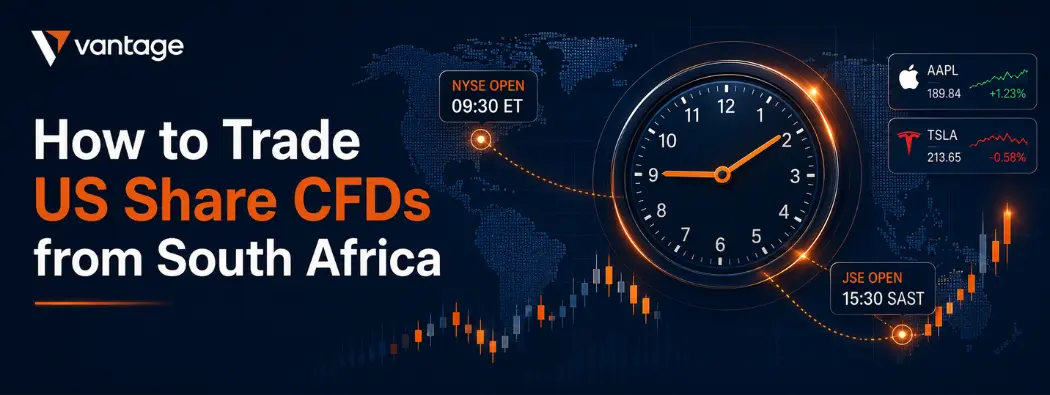
South African traders can gain exposure to companies like Apple, Nvidia, Tesla, and Microsoft through share CFDs. A CFD tracks a share’s price, but you do not own the stock or receive normal shareholder rights.
This guide covers trading US share CFDs from South Africa and how that differs from owning US shares.
Start by choosing a reputable provider. Check its exact legal entity on the FSCA register. Review its shares, margin rules, spreads, commissions, overnight fees, currency conversion, and withdrawal terms.
Before opening your first trade, you should understand how the product works. You also need a plan for leverage, timing, costs, and risk.
Key Takeaways
- South African traders can access US companies through direct share ownership or share CFDs.
- Buying whole shares gives ownership, possible dividends, and shareholder rights. CFDs provide price exposure without ownership or voting rights.
- Share CFDs allow traders to go long or short. They also use leverage, which increases both potential gains and losses.
- Traders should verify the exact broker entity, license details, fees, margin rules, and withdrawal terms before opening an account.
- US market hours change in South African time because the US observes daylight saving. The regular session opens at 15:30 or 16:30 SAST.
- Trading costs may include spreads, commission, overnight funding and ZAR-to-USD conversion effects.

Two Ways to Get US-Stock Exposure From South Africa
South Africans can access US shares through direct investment or CFDs. The right route depends on whether you want ownership or short-term price exposure.
Route 1 — Own US Shares
A local platform, such as an EasyEquities USD account, can let you buy US-listed shares. With whole shares, you own the investment, may receive declared dividends, and benefit if its price rises.
Standard cash investing has no leverage, so you generally pay the full purchase value. Money converted and transferred offshore may fall under South Africa’s exchange-control allowances. Check the current process with your platform or bank.
EasyEquities also offers fractional share rights. These provide economic benefits, but not direct ownership of the underlying fraction.
A TFSA works differently. You cannot buy individual US shares inside an EasyEquities TFSA. You can gain exposure to the US through approved ETFs that track American markets. Returns inside the TFSA receive local tax benefits, subject to contribution limits.
Route 2 — Trade US Share CFDs
A share CFD follows a US stock’s price without giving you ownership. You can go long when expecting a rise or short when expecting a fall.
CFDs use margin and leverage. That lowers the cash needed to open a trade, but can magnify losses. You receive dividend adjustments when applicable, not shareholder dividends. Overnight funding costs may also apply.
| Feature | Ownership route | Vantage share CFDs |
| Ownership | Yes, for whole shares | No |
| Direction | Mainly rising prices | Long or short |
| Leverage | Normally none | Available |
| Dividends | Paid when declared | Cash adjustments may apply |
| Holding style | Often longer term | Often active or shorter term |
| Main risk | Share and currency declines | Leverage, gaps and funding costs |
Direct share ownership and share CFDs have different features, risks and costs. The most suitable option depends on an individual’s objectives, financial circumstances, risk tolerance and investment horizon.
What is a US share CFD?
A contract for difference is an agreement between you and a CFD provider. The agreement tracks the price movement of an underlying asset. Here, that asset is a US-listed company share.
You exchange the price difference between your entry and exit.
Suppose a share trades at $200 when you open a long position. You close the position after the price reaches $210. Your gross profit comes from that $10 price increase, multiplied by your trade size.
The same rule works in reverse. A fall from $200 to $190 would produce a loss on a long trade. CFDs also let you sell first when you expect a price decline. Traders call that opening a short position.
You do not own the company through a CFD. You normally receive no voting rights or direct shareholder rights.
Dividend events may lead to cash adjustments. Their treatment depends on your position and the provider’s terms.
The JSE describes CFDs as agreements that exchange the difference in an asset’s value between the opening and closing prices. It also warns that leverage can increase both gains and losses.
Which US Shares Can You Trade on Vantage?
For active traders, the easiest approach is to group Vantage’s US share CFDs by sector.
- Mega-cap technology: Apple (AAPL)†, Microsoft (MSFT), Alphabet (GOOG), Amazon (AMZN), Meta (META) and Tesla (TSLA)†.
- Semiconductors: Nvidia (NVDA)†, Intel (INTC), Broadcom (AVGO), AMD (AMD), Texas Instruments (TXN) and Taiwan Semiconductor ADR (TSM).
- Software and cloud: Palantir (PLTR), Salesforce (CRM), Oracle (ORCL), Adobe (ADBE), Snowflake (SNOW) and ServiceNow (NOW)
- Consumer and media: Netflix (NFLX), Walmart (WMT), Costco (COST), Disney (DIS), McDonald’s (MCD), Ford (F) and General Motors (GM).
- Financials: JPMorgan (JPM), Bank of America (BAC), Morgan Stanley (MS), Goldman Sachs (GS), SoFi (SOFI), Coinbase (COIN) and PayPal (PYPL).
- Healthcare: UnitedHealth (UNH), Johnson & Johnson (JNJ), Pfizer (PFE), Eli Lilly (LLY), AbbVie (ABBV) and Moderna (MRNA).
- Energy and industrials: Exxon Mobil (XOM), Chevron (CVX), Boeing (BA), Caterpillar (CAT) and Deere (DE).
- Asian company ADRs: Alibaba (BABA), JD.com (JD), Baidu (BIDU), NIO (NIO), PDD Holdings (PDD) and TSM.
- Speculative and clean-energy shares: Rivian (RIVN), Lucid (LCID), First Solar (FSLR), Enphase (ENPH), NextEra Energy (NEE), Marathon Digital (MARA), Canopy Growth (CGC) and Roku (ROKU).
These are US-listed companies and ADRs. The availability of instruments may differ by Vantage entity and region. Some catalogues may not include JSE or South African single-share CFDs.
Extended-hours trading and pre- and after-market sessions may be available for selected instruments such as AAPL, NVDA and TSLA, depending on the trading entity and platform configuration. Extended hours are not true 24-hour trading. Check each symbol’s live specification, as access can vary by account and platform.
NB: Instrument availability may change. Search the platform or live product list for the latest symbols.
Step-by-Step: How to Trade US Share CFDs From South Africa
Trading US share CFDs is similar to forex trading, but company earnings, market gaps, and trading hours play a bigger role. Here is the process.
Step 1 — Open and Verify Your Account
Register through the relevant Vantage entity website for your region and complete the identity checks.
You will usually provide:
- A South African ID or passport
- Proof of address
- Tax and employment details
- Information about your income and trading experience
Vantage Markets (Pty) Ltd is authorised as an FSCA-regulated Financial Services Provider (FSP 51268). Product availability and trading conditions may vary by Vantage entity and jurisdiction.
Step 2 — Fund the Account in ZAR
Deposit through the client portal using a payment method available for South African clients. The funding source must normally be in your name.
Your trading account may use USD or another supported base currency. When you deposit rand into a USD account, the payment is converted into the account’s base currency.
From there, you can trade USD-denominated share CFDs. Buying a USD-priced CFD is not a second funding method. It is an investment made after your deposit has been converted or credited.
Check the conversion rate, payment costs, and withdrawal route before depositing.
Step 3 — Choose a Trading Platform
Vantage provides access through:
- MetaTrader 4
- MetaTrader 5
- Vantage mobile app
- WebTrader
MT4 may feel familiar to forex traders. MT5 usually offers more timeframes, order types, and market tools.
The mobile app is well-suited for monitoring and quick order management. WebTrader lets you trade through a browser without installing software.
Instrument availability may differ by platform or account. Check the share-CFD list before choosing.
Step 4 — Find the US Share
Open the platform’s Market Watch or instrument search. Search using the company name or ticker. Examples include:
- Apple — AAPL
- Nvidia — NVDA
- Tesla — TSLA
- Microsoft — MSFT
- Amazon — AMZN
Confirm that you selected the share CFD, not an index, ETF, or similarly named instrument. Open the contract details and check its trading hours, margin, commission, minimum size, and overnight funding rules.
Step 5 — Set Your Size and Risk Controls
Decide how much you can lose before choosing your position size. For example, risking 1% of a R50,000 account means your planned maximum loss is R500.
Set a stop-loss at the price that proves your trade idea wrong. Then size the position around that distance.
You do not simply choose maximum leverage. Each share CFD has a margin requirement that creates leveraged exposure.
Add a take-profit where the expected reward justifies the risk. Remember that stop-loss orders may execute at a price beyond your chosen level during a sharp gap.
Step 6 — Buy or Sell
Select Buy when you expect the share price to rise. This opens a long position.
Select Sell when you expect the price to fall. This opens a short position.
Before confirming, recheck:
- Direction
- Position size
- Entry price
- Stop-loss
- Take-profit
- Required margin
One wrong decimal point can turn a sensible idea into an oversized trade.
Step 7 — Monitor and Close the Position
Track company news, earnings dates, US economic releases, and price action.
Close the trade when your target is reached, your setup fails, or market conditions change. Do not keep moving the stop simply to avoid accepting a loss.
Positions held overnight may face funding charges. They can also gap after earnings or in response to unexpected news.
Before holding overnight, traders should be aware of potential funding costs, earnings-related volatility and gap risk.
Risk management is an important consideration when trading US share CFDs.
\When Can You Trade US Shares in South African Time?
The main US cash session runs from 9:30 a.m. to 4:00 p.m. Eastern Time, Monday to Friday.
| US clock setting | US cash session | South African time |
| Daylight time | 09:30–16:00 ET | 15:30–22:00 SAST |
| Standard time | 09:30–16:00 ET | 16:30–23:00 SAST |
South Africa stays on SAST throughout the year. The one-hour shift happens because the US changes its clocks.
Pre-market usually runs from 4:00–9:30 a.m. ET. After-hours normally runs from 4:00–8:00 p.m. ET. Your broker may offer only part of these sessions. Liquidity is often thinner, spreads may widen, and earnings can cause sharp moves.
US exchanges close on market holidays and sometimes finish early. Always check the broker’s holiday notice before leaving orders open.
Certain Vantage entities may offer extended 24/5 trading for selected share CFDs, including Tesla, Nvidia, Netflix, Meta, Alphabet, Amazon, Apple, Alibaba, Oracle, TSMC, Intel, Microsoft, Shopify, Boeing, IBM, Baidu, JPMorgan, Exxon Mobil, McDonald’s, and Disney. Availability depends on entity, platform, and region.
“24/5” does not include weekends and may contain short maintenance breaks. Availability can differ by account, platform, and regional entity. Confirm each symbol’s live schedule before trading.
Costs, Tax and Funding From South Africa
Your trading cost starts with the spread, the difference between the buy and sell prices. A commission may also apply, depending on the share CFD and account terms.
Hold a leveraged position beyond the broker’s rollover time, and an overnight swap or funding charge may be added. These daily charges can reduce returns on longer trades.
US share CFDs are priced in dollars. Funding a USD account with rand may trigger a ZAR-to-USD conversion cost. Your profit, loss, and withdrawal may also be subject to USD-to-ZAR conversion, so check the applied rate and markup.
For tax, frequent CFD trading aimed at short-term profit will usually look revenue-based. Net gains may therefore be taxed as ordinary income at your marginal rate. Your intent, trade pattern and records still matter.
CFDs do not give you ownership of offshore shares. However, they do not automatically bypass exchange-control allowances.
SARB says offshore trading accounts, including CFD accounts, must be funded under the single discretionary or foreign capital allowance. A locally funded ZAR account may work differently, so confirm the structure with your broker and bank.
Risks of Trading US Share CFDs
From a trader’s perspective, these are the risks that cause the most damage.
Leverage comes first – It increases your market exposure, so both gains and losses move faster. Never size a position from the margin required. Size it from the amount you can afford to lose.
Overnight and weekend gaps are another major risk – US shares can move sharply after earnings, product news or economic data. Much of that can happen while South Africa sleeps. Your stop-loss may then be triggered at a price beyond your chosen level.
Currency risk also matters. US share CFDs are priced in dollars. When your account deposit or withdrawal involves rand, changes in the USD/ZAR exchange rate can affect the final amount.
You do not own the underlying share. A CFD gives price exposure, not voting rights or legal ownership. Dividend events normally create account adjustments rather than shareholder dividends.
Finally, watch your margin level. When losses reduce available margin, the broker may issue a margin call or close positions at its stop-out level. That closure may happen at a poor price during fast markets.
Negative-balance protection may reset an eligible negative balance to zero, but terms can differ by entity and account. Check your client agreement rather than assuming protection always applies.
Managing leverage, checking earnings dates, and understanding overnight gap risk are important considerations when trading US share CFDs.
Practice on a Demo Account First
Before trading US share CFDs with real money, start on a demo account.
A demo lets you confirm which US shares are available. You can also see how prices behave during South African trading hours.
Use it to practise market, limit, stop, stop-loss and take-profit orders. Pay close attention to margin, position size and leverage.
Treat the demo like a live account. Use the same starting balance you plan to fund later. Risk only a small percentage on each trade and record every result.
A demo also helps you study spreads near the US market open. You can test how earnings announcements and overnight gaps affect prices without risking cash.
When you move live, keep the same platform, watchlist, strategy, and risk rules. The main difference is emotion. Real losses feel different.
A demo account can be used to familiarise oneself with platform features and order types before trading with real funds. Start with smaller positions than you used on the demo.
Frequently Asked Questions
Can I trade US stocks from South Africa?
Yes, you can buy US shares or trade CFDs on them through an eligible provider.
Do I own the shares with a CFD?
No, a CFD provides price exposure without ownership, voting rights or shareholder status.
What time does the US stock market open in SAST?
It opens at 15:30 in US daylight time and at 16:30 in US standard time.
How much do I need to start?
The amount depends on the provider, contract size, and margin, but it should support small, controlled positions.
Are US-stock or CFD profits taxed in South Africa?
Yes, although SARS may treat gains as income or capital, depending on your intent and activities.
Can I short US shares?
Yes, share CFDs let you sell short when you expect the price to fall.
Which US shares can I trade on Vantage?
Vantage offers over 500 US-listed share CFDs, including Apple, Nvidia, Tesla, Microsoft and Netflix.
Is MT4 or MT5 better for US shares?
MT5 is usually better because it offers more timeframes, order types and market tools.
Do I need the offshore allowance to trade US share CFDs?
You generally need it when funding an offshore CFD account, while locally funded accounts may work differently.
Should I use a demo first?
Yes, use a demo to test symbols, orders, margin, and US trading hours before risking money.
Conclusion
Trading US share CFDs from South Africa gives active traders access to major global companies without purchasing the underlying shares. It also offers short-selling and leveraged exposure.
However, easier access does not reduce risk. Leverage, price gaps, funding costs and currency movements can quickly damage an account.
Successful trading starts with choosing a suitable provider, understanding the contract terms and controlling position size. Traders should know their maximum loss before entering each position.
Direct share ownership and share CFDs have different characteristics. Direct shares provide ownership, while CFDs provide leveraged price exposure without ownership.
Start on a demo account, keep live positions small, and review earnings dates before holding trades overnight. Long-term survival depends more on discipline and risk control than on predicting every price move.
Risk Warning: CFDs are complex financial instruments and carry a high risk of rapid loss of money due to leverage. You should ensure you fully understand the risks involved and carefully consider whether you can afford to take the high risk of losing your money before trading.
Disclaimer: The information is provided for educational purposes only and doesn’t take into account your personal objectives, financial circumstances, or needs. It does not constitute investment advice. We encourage you to seek independent advice if necessary. No representation or warranty is given as to the accuracy or completeness of any information contained within.
This material may contain historical or past performance figures and should not be relied on. Furthermore, estimates, forward-looking statements, and forecasts cannot be guaranteed. The information on this site and the products and services offered are not intended for distribution to any person in any country or jurisdiction where such distribution or use would be contrary to local law or regulation.
References
- Contract for difference – https://www.jse.co.za/sites/default/files/jse_document_manager/RW/Internal/Key%20Information%20Documents/Equity%20Derivatives/JSE%20KID%20-%20%20eCFD.pdf
- Why CFDs are high risk – https://moneysmart.gov.au/investment-warnings/contracts-for-difference-cfds#why-cfds-are-high-risk.
- Tax guide for share owners – https://www.sars.gov.za/wp-content/uploads/Ops/Guides/Legal-Pub-Guide-IT11-Tax-guide-for-share-owners.pdf