 Updated
Having a proper understanding of how to trade GER30, which is another name for the German stock market index, the DAX (Deutscher Aktienindex). For many traders, the DAX is a preferred index because of its liquidity, volatility, and clear intraday price behaviour. It is one of Europe’s most actively traded stock indices. Market participants widely follow the DAX because of its liquidity, volatility, and clear intraday price behaviour.
This guide provides information about:
- What GER30 is in forex terms.
- How CFDs work, trading strategies, risk management, and common mistakes.
NOTE: CFDs and GER30 trading are high-risk; this guide is educational and not intended as financial advice.
What Is GER30 in Forex Trading?
The GER30 is a blue-chip German index weighted by market capitalisation, meaning companies with higher market capitalisation have a greater impact on its value. Given its small sample size, it doesn’t necessarily reflect the overall vitality of German companies.
DAX is equivalent to the UK FTSE 100 and the US Dow Jones Industrial Average. The prices used to calculate the GER30 index are sourced from Deutsche Börse Group’s fully electronic trading system, Xetra, in Frankfurt, and a free-float methodology is employed to determine index weightings, along with a measure of average volume.
Many trading platforms still use GER30 for consistency, even though the name changed from DAX 30 to DAX 40 in 2021.
It is also equivalent to the DAX 40 index. This index comprises 40 of the largest and most powerful German companies that are traded on the Frankfurt Stock Exchange and is also known as the “GER30 companies.” These are well-known names in the automotive, technology, finance, industrial manufacturing, health, and consumer sectors.
GER30 is not available in MetaTrader 4 (MT4) or MetaTrader 5 (MT5), but it may be available on a CFD trading platform. Some brokers place it alongside forex pairs for quick access, which can be misleading to new traders. Nevertheless, GER30 is not a currency pair; rather, it is an equity index traded on the same platform as FX pairs to facilitate access.
Key Drivers of GER30 Price – Companies, Sectors & News
The DAX 40 tracks big, blue-chip German companies. These are leaders in key parts of the German and global economy. The index is market-cap weighted. This means that larger companies have a greater impact on the index price.
The main sectors in the DAX 40 include:
- Industrials – engineering, machinery, logistics, and manufacturing giants.
- Automotive – car makers and suppliers with huge global sales.
- Financials – banks, insurers, and other financial service firms.
- Technology and software – business software, payments, and IT services.
- Consumer and healthcare – retail, pharma, and chemical companies.
Sector weighting matters because not all sectors move the same way. If auto stocks rally on strong sales, the whole index can jump. If financials fall due to bad earnings, they can drag the index lower. A trader watching GER30 is really watching sector performance. Strong trends in one primary sector can obscure weaknesses in others. This is why many traders track sector indexes and key stocks, rather than the headline index alone.
Economic and political factors that move the GER30
Some of the key economic macro drivers include:
- Inflation data – Higher inflation can push the ECB toward tighter policy.
- GDP growth – Strong growth supports company profits and can lift the index.
- Employment figures – Healthy labour markets often signal stable demand and spending.
- PMI surveys – Manufacturing and services PMIs show whether business activity is expanding or shrinking.
- ECB policy decisions – Rate hikes or cuts can move banks, borrowers, and risk appetite.
Political factor:
Elections, government disputes, or new regulations can shift market sentiment. Traders closely watch German politics and broader EU policy decisions. Global risk sentiment is another significant driver.
The GER30 often reacts to:
- US market direction – A strong or weak S&P 500 can spill over into Europe.
- European news – Banking stress, energy supply, or budget issues can hit confidence.
- Risk-on/risk-off shifts: when investors feel safe, they buy stocks.
- When fear rises, they move to cash, bonds, or gold.
Even if German data is stable, a global shock can move GER30 sharply.
This makes it vital to track both local and global news.
Using GER30 news and analysis without overreacting
GER30 traders see news and analysis all day. If you react to every headline, you risk overtrading and emotional decisions.
A better way is to use structure:
1. Follow an economic calendar
- Mark key events: ECB meetings, PMI releases, CPI, GDP, and jobs reports.
- Plan for high-impact events rather than reacting at the last second.
2. Set fixed times to review GER30 news
- For example: once in the morning, once in the evening.
- During these sessions, scan “ger30 news” and “ger30 analysis”.
- Focus on what changes the bigger picture, not every small move.
3. Build a simple, repeatable process
When forming a cautious “ger30 forecast”, you can:
- Check the price chart: trend, key levels, and volatility.
- Assess the macroeconomic context: recent data, upcoming events, and ECB policy stance.
- Note global sentiment: how the US and other European indexes are trading.
4. Write down your view before trading
- What is the primary trend? Up, down, or range-bound?
- What are the main macro drivers right now?
- What would prove your view wrong? (Levels, news, or data points.)
Setting Up to Trade GER30 – Account, Platform & Live Chart
Trading indices like GER30 (Germany 40) starts with a clean, simple setup. Your goal is to remove confusion so that you can focus on price, risk, and execution. The following explains how to set up a trading platform to access GER30 CFDs with Vantage.
Opening and funding a trading account
First, open a live account with Vantage. Account types differ in features and costs. Consider which account features meet your personal circumstances. Newer traders commonly use standard accounts, although suitability depends on individual circumstances. Raw accounts are suitable for experienced traders who understand spreads and commissions.
Complete the KYC process by uploading your ID and proof of address. This keeps your account compliant and secure. Once verified, you can fund your account using your preferred method in the secure client portal.
Leverage magnifies gains and losses and may not be suitable for all traders. From the first day, think in terms of risk per trade, not “how big can I go?”
Selecting a trading platform and finding GER30
Next, log in to MT4, MT5, TradingView, the Vantage App, or the Vantage WebTrader.
Open the Market Watch or symbol list, and enter “GER30” or “GER40” in the search bar. Right-click and select “Show” or add it to your favourites list, so it is always easy to find. Then right-click again and choose “Chart Window” to open the GER30 chart.
Many traders also monitor the GER30 using tools such as “GER30 trading view” for additional chart layouts. You can use those for visual ideas, but place and manage trades through your regulated Vantage platform.
Using a GER30 live chart for analysis and decisions
With the symbol open, you now set up a Ger30 live chart. Switch the chart to candlesticks. Adjust the zoom so you see enough candles to read the swing structure, but not so many that it looks cluttered.
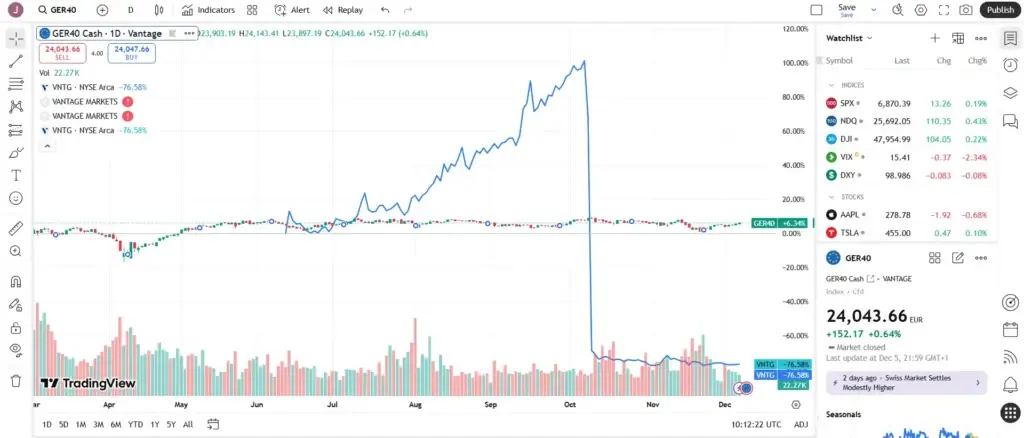
With the symbol open, you now set up a Ger30 live chart. Switch the chart to candlesticks. Adjust the zoom so you see enough candles to read the swing structure, but not so many that it looks cluttered.
Pick timeframes that fit your approach.
For intraday trading, focus on M15–H1 with H4 as your higher-timeframe guide.
For swing trading, study the daily chart first, then fine-tune entries on the H4 or H1 charts.
Typical Trading Hours and Higher-Activity Periods for GER30
GER30 CFD pricing tends to show higher activity during European trading hours, particularly when the Frankfurt market is open, although volatility can vary day to day. Major economic announcements may also influence price movements, and market participants sometimes monitor economic calendars for reference.
Traders often prefer to trade during periods of higher liquidity, tighter spreads, and steady volatility. That usually happens during the European session, with a second burst around major news.
Strong timing helps, but it won’t fix weak risk control. Keep your size modest, protect your balance, and wait for clean setups rather than chasing every move.
Choosing a GER30 Trading Style That Fits You
Intraday GER30 trading in the European session
Intraday GER30 trading means opening and closing trades on the same day.
Most activity centres on the Frankfurt open and key Eurozone news releases.
Price can move quickly, so you need a clear plan and no hesitation.
Pros of intraday GER30 trading:
- Strong, clear volatility windows during the main European session
- No overnight risk; you close trades before the session ends
- Frequent setups if you stay patient and focused
Cons of intraday GER30 trading:
- Requires complete focus during your chosen hours
- Easy to overtrade when the price moves fast
- Slippage and spread spikes around major news
Swing trading GER30 over several days
Swing trading GER30 means holding trades for days, not minutes.
You mainly use H4 and Daily charts to map structure, levels, and trend.
You look for clean swings and let the trade play out over time.
Pros of swing trading GER30:
- Less screen time; you plan and check at set times
- Price noise on small timeframes matters less
- Clear swing highs and lows for stop and target placement
Cons of swing trading GER30:
- You hold through overnight gaps and weekend risk
- Macro events can hit your position while you sleep
- Requires strong patience and tolerance for open profit swings
Event-driven GER30 trading (advanced)
Event-driven trading focuses on big moments.
Think ECB decisions, central German or Eurozone data, or key corporate news.
You trade the move caused by new information. This style can bring strong moves, but also sharp slippage and wild price spikes.
It is better for experienced traders who use strict risk per trade, wider stops, and accept that fills will not always be perfect.
GER30 for traders in South Africa and Africa
European trading hours line up well with many African time zones. That makes GER30 accessible during normal daytime or early evening for many traders. More information on trading hours is available in the platform product details.
Which type of traders commonly monitor GER30?
GER30 may suit traders who:
- Are comfortable with index volatility
- Can watch markets during key European hours
- Follow a written risk plan and stick to it
GER30 may not suit traders who:
- Cannot monitor the market during European times at all
- Want very slow, low-volatility products
- Dislike holding through gaps or significant news risk
Example GER30 Trading Strategies (Educational Only)
The following is a general educational example only and should not be interpreted as trading advice or a recommendation.
European open breakout strategy (example)
Start by marking the pre-open range. Many traders use the swing high and low formed just before the main European session. Keep the lines simple. When price breaks above the high or below the low, this may be a potential trigger.
You wait for a clear break, not a tiny poke through the level. Some traders want a candle close beyond the range. Others use a fixed number of points. Pick one method and stay consistent.
Place your stop on the other side of the range. This keeps risk neat and fixed. Avoid tight stops during the open because spreads can jump.
For targets, use a set risk-reward. Many traders test 1:1.5 or 1:2 to see how the idea behaves over time.
The objective of this example is to illustrate how some traders approach this scenario: follow clear rules, avoid guessing, and protect their account.
Trend-following GER30 strategy on H1
A simple trend approach to H1 begins with the question: Is the index trending up, down, or drifting sideways?
You check for higher highs and higher lows in an uptrend, or lower highs and lower lows in a downtrend. If the price is inside a messy range, stand aside.
In a clear uptrend, wait for a pullback into a strong area. This can be a prior swing level or a simple moving average used as a guide. When price shows a clean bounce, you look for an entry in the direction of the trend.
Place your stop beyond the most recent swing. This gives the trade room to breathe.
Avoid setting stops inside noise zones where random moves can hit your level.
Some traders avoid trading against a strong trend. GER30 can move fast. Fighting the move often leads to sharp losses. The best trades tend to follow momentum, not battle it.
Combining technical structure with GER30 news
GER30 reacts to new information. German and Eurozone news, ECB events, and major corporate developments can shift prices within minutes.
Your plan should balance technical detail with awareness of upcoming developments.
You start by marking key levels: support, resistance, and major swing points. Then check the news calendar. If something significant is due soon, decide whether to defer it or wait until it’s due.
A simple rule: If you do not handle fast spikes well, it may be safer to let the first move pass. Many traders wait until the initial burst settles. This enables the structure to rebuild, allowing you to trade with greater clarity.
If you choose to trade after news, work with a smaller size and wider stops. Slippage is common when volatility jumps.
You may get better results by standing aside during the wild part and letting the chart settle into a clean pattern.
The main idea is control: blend levels, timing, and risk. When the chart is clear, execute your plan. When it is messy, wait.
Risk Management for GER30 CFD Trading
GER30 moves faster than many forex pairs. A small candle on EURUSD can be a large burst on this index. Using the same lot size you use in forex can create massive swings in your account. That is why you size your trades around risk, not habit.
Here is a simple example:
- Pick a fixed risk per trade. Many traders allocate 1–2% of their account size.
- Check your stop distance. Let’s say your stop is 40 points away.
- If your account is $1,000 and you risk 1%, your per-trade risk is $10.
- Position size = Risk amount ÷ Stop distance. In this case: $10 ÷ 40 points = $0.25 per point.
This step helps you manage your risk when GER30 moves fast.
Setting stops, targets, and daily loss limits.
Always use a stop-loss order. GER30 can jump through levels, and you need a clear exit to protect your account. Targets should be grounded in structure, not in hopes or fear. Let the chart show you where clean levels sit. Set a daily loss limit. Many traders stop trading for the day after losing 2–3% of their account. You can also set a max number of trades per day. This cuts down revenge trading and keeps your decisions calm.
Overnight risk, gaps, and holding GER30 over news
GER30 can gap on the market’s reopening. If you hold overnight or over the weekend, the price may open far from your stop. This can result in greater-than-anticipated losses. Major German and Eurozone news events can cause quick spikes. Some traders reduce their size during significant events. Others close trades before the release. The goal is to avoid getting caught in a position you cannot control.
Reviewing your GER30 trades and learning from data
- Keep a trading journal. This helps with data collection
- Record entries, exits, screenshots, and the reason for each trade. This shows you what you actually do, not what you think you do.
- Track your results by time of day, setup type, and direction.
You may notice you trade better in specific sessions or with certain patterns.
Use your data to adjust your rules.
Make decisions based on what works, not on feelings after a win or loss.
A steady review cycle supports systematic review and follows your predefined approach.
Placing Your First GER30 Trade: Step-by-Step
- Log in to your trading platform: Use MT4, MT5, the Vantage App, or Vantage WebTrader. Make sure your feed is live.
- Find GER30 in the symbol list: Open Market Watch, search “GER30” or “Germany 40,” and show the symbol.
- Open a live chart: Right-click the symbol, choose “Chart Window,” and switch to candlesticks.
- Mark basic levels: Draw key support, resistance, and recent swing points. Keep the chart clean.
- Check the economic calendar: Look for German or Eurozone news that could spike prices.
- Determine your trading direction: use structure, trend, and levels. Avoid guessing during chaos.
- Calculate your lot size: Pick a fixed risk percentage, then size the trade based on the stop distance.
- Set your stop-loss and take-profit: Place the stop-loss beyond natural levels and set a target that aligns with your plan.
- Record the trade in your journal: Add screenshots, the reason for the entry, and the result after it closes.
- Place the order: Use a market or pending order. Double-check your size and stop before clicking.
Always practise these steps on a demo account before trading live. This builds confidence and helps you avoid costly mistakes.
Common Mistakes New GER30 Traders Make (and How to Avoid Them)
Avoiding these mistakes takes discipline, not exceptional talent. Keep your size small, follow your rules, and let your journal guide your improvements.
1. Using too much leverage: New traders often open oversized positions because GER30 moves fast.
Fix: Set a strict per-trade risk cap. Keep risk at 1–2% of the account value.
2. Trading GER30 like a forex pair: Forex lot sizes do not match index volatility. A “normal” size in forex can be huge on GER30.
Fix: Always size positions based on stop distance, not habit.
3. Ignoring trading hours and liquidity: Price behaves differently outside the main European session. Spreads can widen, and moves get messy.
Fix: Plan your trades during cleaner hours and avoid thin periods.
4. Chasing every news spike: Sharp news moves tempt traders into bad entries. Slippage and whipsaws follow.
Fix: Decide in advance how you will handle news. Many traders wait until the spike settles.
5. Moving stops further away: When the price goes against them, beginners often drag stops out of fear. Losses grow fast.
Fix: Set your stop and leave it in place. Take the loss and move on with a clear head.
6. Changing strategies every week: Switching methods after a few losses prevents real growth.
Recommendation: Commit to a single clear plan and journal every trade. Review after a set number of trades, not after emotions flare.
7. Relying too much on external “ger30 signals: Following signals blindly creates stress and poor risk control.
Fix: Use any signal as a study tool, not a decision maker. Build your own rules and understand your risk.
Tools & Resources for Ongoing GER30 Analysis
A GER30 live chart is your primary tool. Keep it open when you trade and review it often. Use clean levels, simple layouts, and alerts for key areas so you don’t miss essential moves.
Pair your chart with a reliable economic calendar. This helps you track German and Eurozone data releases, ECB events, and other events that can rapidly affect prices. Knowing what’s ahead keeps you from getting caught by surprise.
Follow quality news sources that cover Europe. Strong fundamentals help you understand why the index moves the way it does. You can also check Vantage research and market commentary for extra insight and trading ideas.
Set alerts for significant events and key levels, both on your platform and on any charting tools you use. This cuts down screen time and keeps your focus sharp.
Keep practising on a demo account until your process feels steady. When you move to live trading, increase the size slowly. Let skill and experience guide your growth, not excitement or pressure.
FAQs About Trading GER30 Index CFDs
Note: The information relates to CFDs and is provided for general educational purposes only. It does not constitute trading advice.
Is GER30 a forex pair or a stock index?
It is a stock index. It shows how Germany’s most prominent companies are performing collectively.
What does DAX40 mean, and which companies are included?
DAX 40 reflects 40 major German companies. These include well-known names in tech, industry, finance, and consumer goods. The list can change as companies rise or fall in value.
RISK WARNING: CFDs are complex financial instruments and carry a high risk of losing money rapidly due to leverage. You should fully understand the risks involved and carefully consider whether you can afford to take the high risk of losing your money before trading.
Disclaimer: The information is provided for educational purposes only and doesn’t take into account your personal objectives, financial circumstances, or needs. It does not constitute investment advice. We encourage you to seek independent advice if necessary. The information has not been prepared in accordance with legal requirements designed to promote the independence of investment research.
No representation or warranty is given as to the accuracy or completeness of any information contained within. This material may include historical or past performance figures and should not be relied on. Furthermore, estimates, forward-looking statements, and forecasts cannot be guaranteed. The information on this site and the products and services offered are not intended for distribution to any person in any country or jurisdiction where such distribution or use would be contrary to local law or regulation.
References
- https://www.investopedia.com/terms/d/dax.asp. What Is the DAX Index? Top 40 German Companies Explained
- https://www.itcmarkets.com/european-central-bank-ecb-meeting-schedule. European Central Bank (ECB) Meeting Schedule
- https://tradeciety.com/how-to-review-your-trading-data-6-simple-steps How to Review Your Trading Data – 6 Simple Steps
- https://en.wikipedia.org/wiki/DAX DAX.