
 Updated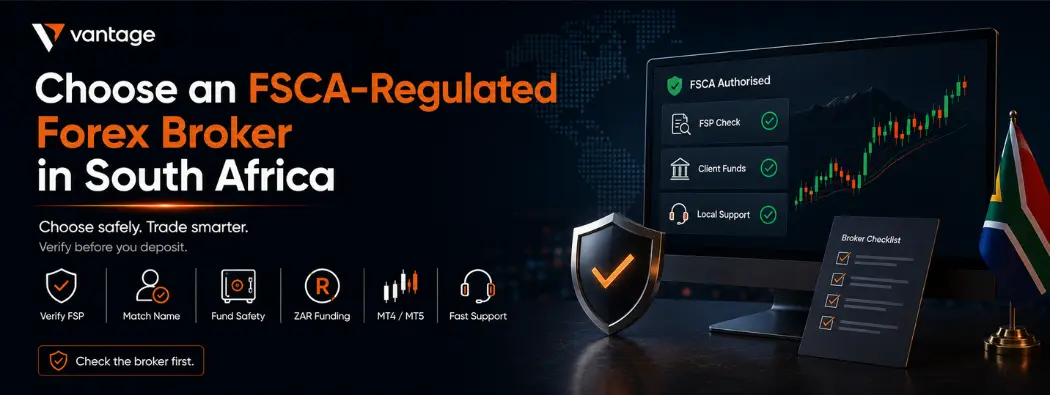
Choosing a forex broker is not only about finding tight spreads or a popular trading app. You are choosing the company that will receive your money, maintain your trading account, execute your orders, and process your withdrawals.
That decision deserves more care than most traders give it. A polished website does not prove that a broker is safe. Neither does a well-known trading platform, a local phone number, or an FSP number appear in the website footer.
Even the words “FSCA-regulated” do not tell you everything. You must confirm which company holds the licence, what services it may provide, and whether that company will operate your account.
Key Takeaways
- Vantage Markets is one of the top FSCA-regulated brokers in South Africa; this gives it local accountability and a regulator you can call.
- Verify a broker yourself: match the FSP number to the registered company name on the FSCA register, and confirm the status is authorised.
- Find out whether the local entity actually issues your trades as an ODP, or is only an intermediary with your real counterparty offshore, which decides where your money lives.
- South Africa has no compensation scheme for trading accounts, so segregated client funds are your main protection if a broker fails.
- Once a broker clears the safety checks and weighs trading costs, platform, Rand funding, and execution, the broker then matches the account to how you trade.
- CFDs are high-risk, and most retail traders lose money, so use a stop on every trade and never risk more than you can afford to lose.
What Does FSCA Regulation Mean for South African Traders?
Many beginners treat “FSCA-regulated” as a guarantee that nothing can go wrong. It isn’t. But it does mean something real, and knowing what helps you trade as a beginner with your eyes open.
The role of the FSCA
The Financial Sector Conduct Authority (FSCA) is South Africa’s market conduct regulator. It sits inside the Twin Peaks system and replaced the old Financial Services Board in 2018. Its job is to assess whether firms treat you fairly and advertise honestly under the Financial Advisory and Intermediary Services Act (FAIS).
A broker offering forex or CFD services in South Africa generally requires the appropriate FSCA authorisation to operate lawfully. When a firm is authorised, the regulator can fine it or revoke its licence if it breaks the rules. That gives you something an offshore-only broker cannot: local accountability and a regulator you can actually phone.
What regulation protects
Regulation mostly protects your relationship with the broker, not your trades. Licensed firms are generally required to keep client money separate from the firm’s own funds in accordance with applicable regulatory requirements.
They have to follow conduct rules and handle complaints through a proper process. If something goes wrong, you have local recourse that an unregulated platform simply cannot offer.
Here is what it does not do. It does not protect you from losing money in the market, because that risk is always yours. And South Africa has no compensation scheme for trading accounts, so if a broker collapses, no national fund repays you.
Bank deposit insurance does not cover trading money either. People tend to assume that a licence equals a safety net for their balance. It does not, and that gap is where the painful surprises happen.

Who regulates forex brokers?
There is no single global regulator for forex. Each country runs its own, and the broker you use may answer to several. Knowing who stands behind a broker tells you how much protection you actually have.
The FSCA in South Africa
Any broker legally serving South African clients needs a Financial Services Provider (FSP) licence. A firm that issues your CFDs as the principal also needs a separate ODP authorisation.
You can check both for free on the FSCA register before you deposit a cent. One benefit of choosing an FSCA-regulated broker is local accountability and a regulator you can phone.
International regulators in context
Globally, regulators fall into rough tiers. Among the better-known regulators are the FCA in the United Kingdom, ASIC in Australia, the CFTC and NFA in the United States, and CySEC in Cyprus. Regulatory requirements differ between jurisdictions, including rules on client protection, leverage, and disclosure. The United Kingdom operates the Financial Services Compensation Scheme (FSCS), which may compensate eligible clients if an authorised firm fails, subject to applicable limits and eligibility criteria.
Investor compensation arrangements differ by jurisdiction. The UK operates the Financial Services Compensation Scheme (FSCS) for eligible clients of authorised firms, while compensation and client-protection arrangements vary in other jurisdictions. Traders should review the protections available under the specific entity with which they open an account.
The FSCA regulates financial services in South Africa, while CySEC regulates investment firms in Cyprus under the European Union’s MiFID framework. The protections available to clients depend on the specific regulated entity with which they open an account.
Then there are lighter-touch offshore regulators, such as Vanuatu, the Seychelles, Mauritius, and the Cayman Islands. They are easier to register with and offer thinner protection.
Most large global brokers hold several licences through different entities. What protects you is the entity your account actually sits under, not the most impressive logo on the homepage.
So before you trade, find out which entity holds your money and which regulator backs it.
How to Verify a Broker on the FSCA Register
Checking whether a broker is genuinely licensed takes about five minutes. It is the cheapest insurance you will ever buy in this business. Many people skip it and pay for that shortcut later. Here is exactly how to do it, step by step.
Find the FSP number
Every broker properly licensed in South Africa has a Financial Services Provider number, usually abbreviated as FSP. Your first job is to find it on the broker’s own website.
Look in the footer at the bottom of the homepage first, since that is where most firms put it. If it is not there, check the “About”, “Legal”, or “Regulation” page, or open the client agreement.
You are looking for two things, not one. The FSP number itself, which is a string of digits, and the registered legal company name attached to it.
The legal name is often different from the brand. A broker might trade under a snappy name while its licensed entity is something like “Example Markets (Pty) Ltd”.
Write both down. You will need them in the next step.
If you cannot find an FSP number anywhere, or all you see is the word “regulated” with nothing to back it, stop right there. A licensed broker has no reason to hide its number.
Search the FSCA public register
Now go to the source. The FSCA keeps a public register of authorised providers, searchable at fsca.co.za under “Search Authorised and Applied FSPs”.
Do not rely on any link a salesperson or a WhatsApp contact sends you. Type the broker’s details into the official site yourself.
Search using the FSP number, as it is the most precise way to find the right record. Then check the result against what you wrote down. The registered name on the FSCA record must match the legal entity on the broker’s website.
A matching brand name is not enough. The actual company name has to line up. Check that the status reads authorised or active, and not lapsed or withdrawn.
Check that the approved categories cover what you plan to trade, which, for forex and CFDs, means derivative instruments.
One more layer if you want to be thorough. If the broker claims to issue your CFDs itself, look for an Over-The-Counter Derivative Provider (ODP authorisation).
If the South African entity is only an intermediary, your actual counterparty sits offshore, which is worth knowing before you fund anything. When something does not add up, phone the FSCA directly on 0800 110 443 and ask.
Check the homepage disclosure.
A broker that takes its license seriously says so plainly on its own site. Somewhere on the homepage, usually in the footer, you should see the broker’s legal entity name and FSP number displayed in text, with a clear risk warning nearby.
A shiny “regulated” badge is not a disclosure. You want the real company name and number, and they must match what you just confirmed on the register.
Watch for clone sites here, too. Fraudsters copy a real broker’s name and FSP number onto a near-identical page with a slightly different web address.
The disclosure looks perfect because it was stolen from a legitimate firm. The defence is simple: you searched the register yourself, so you already know the genuine entity behind that number.
What you should know when choosing a forex broker
The broker decision trips up more beginners than any chart pattern. The trouble is that most of what you need to know isn’t on the broker’s marketing page.
A poor broker can make trading harder, even when your strategy is sound. Before signing up for an account, compare brokers using the following key factors.
1. Regulation and fund safety
The first thing to understand is that “regulated” is a starting point, not a guarantee. A license indicates that the FSCA regulates a broker and that the broker can be held to account. It does not, by itself, mean your money is safe.
So look past the word. Check the FSP number on the FSCA register, then ask where client funds are held. Segregated accounts keep your money apart from the company’s own.
2. Trading costs: spreads and commissions
What beginners miss is that the advertised spread is rarely the full cost. You pay through the spread, and sometimes a separate commission on top of that. A swap fee also applies when you hold a position overnight.
A headline “zero commission” account can quietly carry a wide spread that costs you more. The number that matters is your total cost per round trade, and it scales with how often you trade. Work that out before you are seduced by one tempting figure.
3. Trading platform: MT4 and MT5
Most traders know MetaTrader 4 and MetaTrader 5 by name. What they often miss is that the broker’s setup matters as much as the platform itself.
The same MT4 can feel fast and stable with one broker and laggy with another, depending on the servers behind it. MT4 suits straightforward forex, while MT5 adds more markets and tools.
Whichever you lean towards, open a demo and feel how this particular broker runs it before you commit real money.
4. Funding your account in rand
Here is a cost most people never notice. If your broker’s accounts are held in US dollars, funding in rand means a conversion every time money moves, and that drag adds up over a year.
So check for genuine ZAR funding through local methods like EFT and bank cards. Then look harder at withdrawals than deposits. Any broker will happily take your money.
The real test is how cleanly it lets you withdraw your money.
5. Execution, support, and account types
You should understand how your broker actually makes money. Different execution models, including market maker, STP, and ECN, operate differently and may manage potential conflicts of interest in different ways. Traders should understand how their broker executes orders before opening an account.
Support feels unimportant until the moment it is the only thing that matters, so test the response before you fund anything. And account tiers exist to match your capital and style, not to push you into the biggest one.
Pick the level that fits you, and start on a demo. The thread running through all of this is simple. What a broker advertises and what actually protects you are two different things. Learn the second.
Understanding the risks of CFD trading
Let me be straight with you. CFDs are popular for one reason: leverage, and leverage is exactly what makes them dangerous.
A small deposit lets you control a much larger position, so even a small price move is magnified into a big gain or a big loss. The same tool that doubles your good day can wipe out your account on a bad day.
Most retail traders lose money trading CFDs. Where brokers are required to publish client loss statistics, the percentage of retail investor accounts that lose money varies across brokers and jurisdictions. Prospective traders should review the risk disclosure published by their chosen broker. That is not bad luck. It is the maths of leverage meeting human emotion.
The costs work against you, too. You pay the spread every time you open a trade, and if you hold a position overnight, financing charges quietly chip away at it. Hold long enough, and those small fees add up to real money.
Then there is speed. Markets can move violently around news, and prices can gap straight through your stop loss, closing you out worse than you planned.
If your account cannot cover the loss, the broker will automatically close your positions, usually at the worst possible moment.
None of this means CFDs are a scam. They are a legitimate tool, but a sharp one. Treat leverage with respect.
Use a stop on every trade, and never risk money you cannot afford to lose. Size your positions so a run of losses cannot end your trading. Understand the risk first, and you will last long enough to learn.
How Vantage fits these criteria
The following information explains how Vantage addresses the considerations discussed above.
Regarding regulation and fund safety, Vantage Markets (Pty) Ltd is authorised by the FSCA under FSP 51268, providing South African clients with a locally regulated point of contact.
The wider Vantage brand includes independently operated entities authorised and regulated in their respective jurisdictions, including by the FCA in the United Kingdom and ASIC in Australia.
Client funds are held in segregated accounts in accordance with applicable regulatory requirements.
Vantage offers different account types, including Raw ECN accounts that combine variable spreads with commission-based pricing.
Raw and Pro accounts provide access to pricing sourced from external liquidity providers, subject to the applicable account execution model.
Vantage provides access to MetaTrader 4, MetaTrader 5, the Vantage App and the TradingView-powered ProTrader platform.
Vantage supports funding in rand through local South African bank transfer methods, subject to availability and applicable terms.
Account-wise, there is a range to match your stage, from a low-deposit Cent account for beginners to Raw and Pro ECN accounts for active traders.
Conclusion
Choosing a broker comes down to one habit: checking for yourself instead of trusting the marketing. Look up the FSP number and the legal name on the FSCA register, and find out whether your real counterparty is local or offshore.
Confirm where your money is held before you fund anything, because those few minutes are the cheapest protection you will ever buy.
Get the safety checks right first, then let cost and platform decide between the brokers that pass. Prioritising regulation, transparency and operational reliability over promotional offers may help when comparing brokers.
It will be the one that survives the checks and pays your withdrawals without drama. Carefully approaching broker selection and understanding the risks of leveraged trading may help traders make more informed decisions.
Frequently Asked Questions
What are the key advantages of choosing a forex broker regulated by the FSCA?
You get local accountability: a South African regulator that can fine or pull a broker’s licence, and a body you can complain to if things go wrong. FSCA-licensed brokers must also comply with conduct rules and keep client money in segregated accounts.
How can I verify if a forex broker holds a valid FSCA licence?
Look up the broker’s Financial Services Provider (FSP) number on the FSCA register, and check that the registered company name matches the one on its website and that the status shows as authorized. If anything looks off, confirm directly with the FSCA.
Where can I find a list of FSCA-licensed forex brokers?
There is no single “forex brokers” list, but you can search every authorised provider on the FSCA’s FSP register at fsca.co.za, and check derivative or ODP licences on its List of Regulated Entities and Persons.
What criteria should I use to choose an FSCA-regulated forex broker?
Put regulation and fund safety first, then weigh trading costs and the platform against how easily you can fund and withdraw in rand. Match the account type to your capital and the way you actually trade.
Which FSCA-regulated brokers offer low minimum deposit requirements?
Minimum deposit requirements vary between brokers, account types and jurisdictions. Prospective clients should check the broker’s current account terms before opening an account. Vantage’s minimum deposit requirements are set out on its website and may vary depending on the account type and applicable jurisdiction.
What are common red flags when selecting an FSCA-regulated forex broker?
Watch for pressure to deposit quickly or bonuses that scale with your deposit, and treat any guaranteed-return promise as a hard no. Walk away, too, if the FSP number or company name does not match the FSCA register, or if an account manager keeps getting in the way of a withdrawal.
Risk Warning: CFDs are complex financial instruments and carry a high risk of rapid loss of money due to leverage. You should ensure you fully understand the risks involved and carefully consider whether you can afford to take the high risk of losing your money before trading.
Disclaimer: The information is provided for educational purposes only and doesn’t take into account your personal objectives, financial circumstances, or needs. It does not constitute investment advice. We encourage you to seek independent advice if necessary. No representation or warranty is given as to the accuracy or completeness of any information contained within.
This material may contain historical or past performance figures and should not be relied on. Furthermore, estimates, forward-looking statements, and forecasts cannot be guaranteed. The information on this site and the products and services offered are not intended for distribution to any person in any country or jurisdiction where such distribution or use would be contrary to local law or regulation.
References
- National government of South Africa – FSCA: https://nationalgovernment.co.za/units/view/98/financial-sector-conduct-authority-fsca
- How regulators are closing in on retail prop trading – https://theindustryspread.com/retail-prop-trading-regulation-2026-my-forex-funds-cftc/
- FSCA debars 2 people from unauthorised trading – https://www.citizen.co.za/business/personal-finance/fsca-fines-two-people-r2-1-million-debars-them-for-unauthorised-forex-trading/
- ESMA CFD intervention – https://brokerchooser.com/education/investing/cfd-intervention-new-regulations
- Confirming deposit insurance excludes trading and investment accounts: https://www.resbank.co.za/en/home/what-we-do/Deposit-insurance/CODI-Frequently-Asked-Questions