
 Updated
As the prices of food, fuel, rent, and school continue to skyrocket, South Africans fear their savings will not keep up. Some South Africans may consider government bonds as a way to seek steadier returns and potentially lower risk compared to other options. They are typically seen as longer-term, more stable instruments rather than short-term ‘quick win’ investments.
So in this article, we will delve into minute details, all that you need to know about government bonds, how they work, where to find RSA bonds, government retail bonds, risks and common mistakes, and what differentiates a corporate bond from a government bond.
What is a Government Bond?
A government bond refers to a debt-based investment where you loan money to the government in return for an agreed interest in the form of maturity. Usually, the government uses them to raise funds that can be spent on new infrastructure.
In South Africa, you will hear “RSA bonds” often. “RSA” just means the Republic of South Africa. These bonds sit at the core of local markets.
How RSA government bonds work in South Africa
In a budget year, the South African Government, via the National Treasury, has to borrow money through the issuance of securities in the debt market to finance the overall Budget deficit. The majority of governments generate revenue through the tax system.
But to raise enough money to account for total government spending, the tax rate would be so high that it is not politically or economically tenable.
To finance a deficit in its budget, the government can borrow funds by selling bonds. The bonds are in the domestic currency and are represented as the safest form of investment in that currency.
RSA bond as issued by the Asset and Liability Management (ALM) Division of the National Treasury. They are listed on the Bond Exchange of South Africa. In the capital market, they trade at the yield to maturity. Yield to Maturity: is the rate your investment will produce throughout the lifetime of the Bond.
So, when you buy a government bond, you are lending money to the government for an agreed period of time. The government pays you interest during the bond’s life. When the bond reaches its end date, it repays your starting amount.
Primary market vs secondary market
The primary market is where new RSA bonds are first sold directly, and it’s usually held until they mature. It should be noted that this often happens through government auctions. The secondary market is where investors trade existing bonds among themselves, often on the Johannesburg Stock Exchange (JSE). Most day-to-day price moves happen in the secondary market.
Where RSA bonds are listed and traded
RSA bonds are listed on the JSE Debt Board. RSA here stands for the Republic of South Africa. In 2009, the JSE Limited acquired the Board Exchange of South Africa (BESA), which was further rebranded as the JSE Debt Market.
The entity now operates through the JSE Limited, which operates and regulates the debt securities and interest rate derivatives market in South Africa.
Where to find an official list of South African government bonds
Here are three reliable places to check;
1. JSE Stock Exchange: The JSE lists all government bonds traded on the Debt Board.
- Website: jse.co.za
- Information: Provides details on more than R1 trillion worth of listed government debt.
2. South African Reserve Bank: The SARB provides daily and monthly data on key interest rates and bond yields, which serve as a secondary official source for active bonds.
- Website: resbank.co.za/en/
3. Retail Savings Bond: Retail Savings Bond is for individual investors looking for specialized government savings bonds (not traded on the market). The official retail site provides a list of available fixed-rate and inflation-linked bonds.
- Website: rsaretailbonds.gov.za
- Options: 2, 3, and 5-year fixed-rate bonds, and 3, 5, and 10-year inflation-linked bonds.
4. National Treasury Investor Website: This website provides the primary source for technical information, auction data, and lists of outstanding bonds.
- Website: investor.treasury.gov.za
- Key Data: The site provides information on Fixed Rate Bonds (e.g., R186, R2030, R2048), Inflation-Linked Bonds (CPI bonds), and Variable Rate bonds.
Yields, prices, and interest rates
Government bonds pay a fixed cash interest, known as a coupon. The bond has a price, too, which can fluctuate day by day. The yield is the return you would earn at today’s price. Yields rise and fall over time as market interest rates push them up or down.
Example
For illustrative purposes, assume a bond has a face value of R1,000, pays a 10% coupon, and matures in 2 years. This example is for educational purposes only and does not constitute a recommendation to buy or sell any bond.
Case A: Market yield is 10%
The bond price is about R1,000. It happens because the coupon matches the market yield.
Ways to get bond exposure in South Africa: invest vs trade
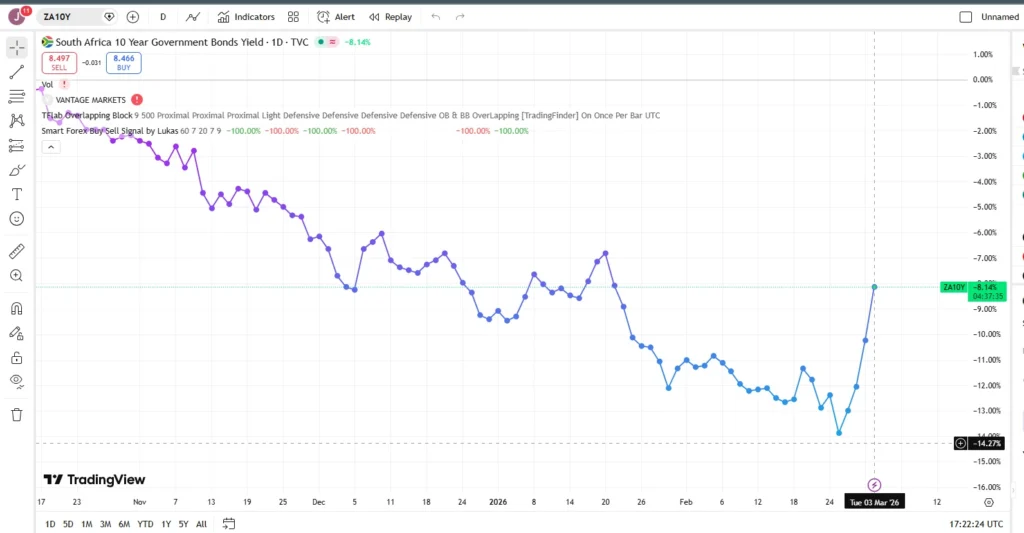
There are two clear paths. You can invest and hold onto something a little more reliable over time. Or you can exchange bond price movements for short-term trades.
Both routes use the same drivers. Bond prices are moved by rates, views on inflation, and the mood for risk. It has to be aligned with your objective and your time frame.
Invest and hold exposure.
This approach may be considered by those interested in longer-term exposure and less frequent monitoring, depending on individual goals and circumstances.
Direct government bonds
You buy a South African government bond and hold it. You have ownership of the bond. And may receive coupon interest, based on the bond terms. If you hold it until the maturity date, you target the full bond payout.
Holding bonds until maturity may align with longer-term financial plans. Individual outcomes will vary depending on market conditions and personal circumstances.
Bond funds
A bond fund collects money from many investors. A fund manager buys a basket of bonds. You own units in the fund, not each bond. Returns come from interest earned and price changes. Funds can spread risk across many bonds. But they still drop in value when yields rise.
Bond ETFs
A bond ETF is a fund that trades on the exchange. It usually tracks a bond index or a bond basket. You can buy and sell it during market hours. This makes it easier to adjust your exposure.
ETFs still carry market risk, like any listed product. They also add trading costs like spreads and brokerage.
Comparison table: invest and hold options
| Option | What you own | Income feature | How easy is it to sell | Typical costs | Good for |
| Direct bonds | The bond | Coupon interest (if applicable) | Varies by bond type and access | Broker fees (listed), admin costs | Clear goals and hold-to-maturity plans |
| Bond funds | Units in a fund | Distributions or reinvested income | Usually easy, based on fund rules | Ongoing fund fee | Hands-off exposure and broad diversification |
| Bond ETFs | Units in an ETF | Distributions or reinvested income | Easy during trading hours | ETF fee + brokerage + spread | Simple access and flexible sizing |
2) Trade exposure
This approach may be considered by those interested in short-term price movements and who are able to monitor risk frequently. Individual outcomes will depend on personal circumstances.
Bond CFDs (no ownership, no coupon)
A bond CFD is a trading contract with a broker. It tracks the price movement of a bond or bond index. You do not own the bond itself. So you do not receive coupon interest.
CFDs often use margin. Margin can magnify gains and losses. Costs often include the spread and overnight financing. This makes CFDs more suitable for shorter holding periods.
Government Retail Bonds in South Africa
Retail Savings Bonds are bonds issued by the South African government for individual investors. To encourage households to start saving alongside the business and government. The National Treasury developed a retail bond that can be bought for as low as R1000 and carries no commission, agency, or service fees.
Who They Are Meant For
- Everyday savers who want a clear plan: These bonds are for people who prefer fixed periods of time and clear outcomes. They may be used by individuals looking to save toward a specific goal, depending on personal circumstances.
- People who want steady interest: They may cater to investors who like a pacifier of steady interest rather than growth swings. These bonds may appeal to those seeking a more predictable income profile, although outcomes will vary.
- Beginners who want a simpler bond option: You can get started without studying trading screens and daily pricing. You concentrate on the term and rate and block out market noise.
Risks and Common Mistakes with Government Bonds in South Africa
Although Government bonds can feel “safe,” they often are steadier than shares. But that does not mean “no risk. Your return and your access to cash can still change. Here are key risks to know;
1. Interest rate risk: When market rates rise, bond prices often fall. This matters most if you may sell before maturity. The rule of thumb here is that a 1% change in interest rate contributes to an approx 1% chnage in the price of a bond.
Long-duration bonds typically have higher interest rate sensitivity and also experience larger drawdowns than shorter maturity bonds.
2. Inflation risk: Inflation can cut the buying power of your interest income. A fixed rate can look good, then feel weak after price rises. A fixed coupon may pay on time, yet your spending power can fall.
It is common for inflation to rise faster than your bond’s interest rate. Inflation-linked bonds can reduce this risk, but they still have market moves.
3. Liquidity risk: Liquidity means how easily you can get your money back early. Some bond options are harder to exit early. If you need cash before the bond term ends, you may face penalties, delays, or a worse price.
It perfectly explains why bonds should match your time horizon from day one. Both Primary and secondary domestic bonds trade with good liquidity and price discovery.
In the primary market, the bid cover ratios give a sense of appetite for government bonds and help investors assess investor demand for debt maturities being issued.
In secondary markets, bid offer spreads indicate the price/yield at which buyers and sellers are prepared to trade. Large (small) spreads reflect that buyers and sellers are being relatively too far apart (too close) in their perceptions of what a reasonable trade price would be.
Five Common Mistakes Beginners Make
1. Confusing Coupon with Yield: The coupon is the interest rate at which the goodwill-bearing bond can be redeemed for its face value. The yield is the return on an investment in a bond or any other security based on the price you pay today.
If you buy the bond at a price above face value, your yield can be less than the coupon. Buy it below face: And, yes, if you buy one for less than its $1,000 face value, your yield can exceed the stated coupon.
2. Using short-term money to buy long-term bonds: Bonds with longer-term maturities tend to jump around a lot more than shorter-term bonds when rates move.
If you think there’s some chance you may need the money in a year or two, long-duration exposure could be counterproductive. You may be forced to sell during a drop in price and take a loss.
3. Chasing the highest advertised rate without checking the “real” return: A high rate can look attractive in isolation. But inflation can reduce the true value of what you earn.
Tax can also cut your net interest income. A lower rate with better inflation protection can work out better.
4) Ignoring costs and pricing friction
Funds and ETFs charge ongoing fees that reduce returns over time. Trading products add spreads and, often, daily financing charges. Even listed bonds can have bid-offer spreads that hurt you on entry and exit. If your expected return is modest, costs matter even more.
5) Treating a bond like a savings account
Unlike savings accounts, bonds traded on an exchange can fluctuate in price. Selling before maturity may result in receiving less than the initial investment, even if the issuer is the government.
Government bonds vs corporate bonds
The state issues government bonds to raise funding for various public projects and infrastructural development, alongside managing internal debt.
Corporate bonds are issued by companies, not the government, to raise funding for future expansion, new projects, debt consolidation, and various other purposes.
The table below shows the key differences between the two bonds.
| Feature | Government bonds | Corporate bonds |
| Issuer | National government (e.g., South Africa) | Private company or bank |
| Default risk | Usually lower than most companies | Usually higher than the government |
| Typical yield | Often lower because the risk is lower | Often higher to compensate for added risk |
| Key risk | Interest rate and inflation risk | Credit risk plus interest rate risk |
Frequently Asked Question
Are government bonds risk-free?
No. They can lose value when yields rise, and inflation can cut real returns.
Are government bonds taxable in South Africa?
Yes. Bond interest is generally taxed as interest income, after any SARS interest exemption applies.
Why does the 10-year yield matter?
It’s a key benchmark for long-term borrowing costs and pricing across loans, bonds, and the rand risk view.
Where can I find SA government bond lists?
Check the JSE Government Bonds page and the National Treasury’s investor site, debt schedules, and auction resources.
What is the difference between the coupon rate and the yield?
The coupon rate is the fixed interest set on the bond’s face value; yield is the return based on the price you pay today.
Can I buy government bonds with a small amount?
Yes. Retail Savings Bonds allow smaller starting amounts, and ETFs can be bought in small units through a broker.
What is the difference between investing in bonds and trading bond CFDs?
Investing means you own bonds or fund units and may earn income; CFDs track price moves only, offer no ownership or coupons, and often use leverage.
RISK WARNING: CFDs are complex financial instruments and carry a high risk of losing money rapidly due to leverage. You should ensure you fully understand the risks involved and carefully consider whether you can afford to take the high risk of losing your money before trading.
Disclaimer: The information is provided for educational purposes only and doesn’t take into account your personal objectives, financial circumstances, or needs. It does not constitute investment advice. We encourage you to seek independent advice if necessary.
The information has not been prepared in accordance with legal requirements designed to promote the independence of investment research. No representation or warranty is given as to the accuracy or completeness of any information contained within.
This material may contain historical or past performance figures and should not be relied on. Furthermore, estimates, forward-looking statements, and forecasts cannot be guaranteed. The information on this site and the products and services offered are not intended for distribution to any person in any country or jurisdiction where such distribution or use would be contrary to local law or regulation.
References
- https://www.investopedia.com/investing/primary-and-secondary-markets/ Primary Vs Secondary Market: What is the Difference
- https://www.jse.co.za/trade/debt-market/bonds/government-bonds Government bonds
- https://en.wikipedia.org/wiki/Bond_Exchange_of_South_Africa Bond Exchange of South Africa
- https://www.gov.za/about-government/rsa-retail-savings-bonds Government Retail Savings Bond in South Africa
- https://www.cover.co.za/news/disentangling-risk-in-s-a-government-bonds Disentangling Risks in S.A Government Bonds
- https://groww.in/blog/corporate-bonds-vs-government-bonds Differences Between Government and Corporate Bonds