
 Updated
This guide offers a clear look at how forex liquidity providers operate. It also explains how market activity can be tracked using simple charts and indicators. In a liquidity provider forex setup, certain firms and institutions stream buy and sell quotes into the broader market. Those quotes then flow through trading venues and broker systems, which help determine the prices displayed on a trader’s platform.
The sections that follow describe who these providers are, where they sit in the pricing chain, and which basic tools can indicate changes in liquidity during the day. Common signals include shifts in the bid–ask spread, changes in trading volume, and available market depth when a platform shows it. This article builds on the broader Forex Liquidity article, but keeps the focus on providers and indicators.

What Liquidity Providers Do and How Traders Watch Liquidity
Large institutions help keep forex prices flowing. A forex liquidity provider sends a steady stream of bid and ask quotes (buy and sell) to brokers and trading venues. That constant quoting contributes to more continuous price updates, especially when many participants are active simultaneously.
Retail traders typically cannot access the whole pool of orders that underlie the market. Still, liquidity often manifests in how prices behave on a platform. Spreads often appear tighter during periods of higher activity and may widen when market participation is lower.
What liquidity providers do
- Stream bid and ask quotes to brokers
- Offer tradable size across price levels (depth)
- Support smoother fills in high-activity pairs
What traders can watch
- Spreads and how often they widen or tighten
- Volatility, including sudden jumps around events
- Simple tools such as ATR, session markers, and volume-style proxies as a forex liquidity indicator
Price updates may also feel faster and more “connected” during busy hours. In addition, a forex liquidity indicator on a chart can serve as a simple signal of changing market conditions, even though it cannot capture the entire market.
What is a Liquidity Provider in Forex Trading
A forex liquidity provider is usually a bank, a large financial institution, or a specialised pricing firm that streams buy and sell quotes to brokers across many currency pairs. Put simply, it is a source of bid and ask prices that keeps quotes coming through the day. The core question is: What is a forex liquidity provider?
In most setups, brokers do not “invent” prices. Instead, they pull quotes from one or more providers, combine them into a usable feed, and display that feed on the trading platform. When markets become active, this flow often leads to frequent price updates and steadier trading conditions in major pairs such as EUR/USD and USD/JPY.
The term “liquidity provider forex” also refers to order filling. When an order is placed, the broker’s execution process may rely on the pricing and available size coming from its providers, depending on the broker’s model. The provider’s role is not always visible, but it helps explain how a platform can continue to show prices even as conditions change.
What Liquidity Providers Mean for Spreads and Execution
Forex prices look clean on a trading screen, yet the pricing chain has layers. At the wholesale end, large banks and other major institutions quote two-way prices. They show where they are willing to buy and where they are eager to sell. Those quotes form the base level of pricing that moves through the market.
Alongside banks are liquidity providers. They also stream bid and ask quotes, often across many currency pairs. In liquid pairs, this steady quoting supports a market that feels “always on,” with frequent updates and fewer empty price levels. This is why the question of what a forex liquidity provider is usually refers to the source of raw quotes that brokers rely on.
Brokers sit between these wholesale price sources and the retail platform. A broker may connect to a single provider, but many connect to multiple providers. With multiple feeds, the broker can compare prices in real time. The platform quote is then built from the best available inputs.
In practice, a broker may take the highest bid from one source and the lowest ask from another. That process can affect the spread displayed on the platform relative to individual source quotes. This process is typically automated. It runs continuously as quotes refresh, often in fractions of a second. In very active markets, competition between feeds can affect how spreads and price updates behave.
Even so, broker setups differ. Some brokers rely more on external pricing, while others mix pricing sources and internal handling based on market conditions. The exact details vary, but the general structure stays similar:
- Banks and liquidity providers: supply wholesale bid/ask quotes
- Brokers: connect to one or more sources and build a usable price feed
- Traders: see the final streamed quote and the spread on the platform
So the core idea is simple. Liquidity providers and banks supply the inputs, and brokers deliver a compiled price stream to the trader’s screen.
Risk note: Trading forex and CFDs involves significant risk and can result in rapid losses. Access to live trading accounts is typically restricted to adults under broker policies and local regulations
What Traders Can and Cannot See About Market Liquidity
Retail forex platforms show prices, not the full market. The global FX market is spread across many banks, venues, and liquidity providers, so there is no single order book that contains every order in one place.
As a result, most retail traders do not see the full bid-ask flow for each currency pair. What they typically see is a broker’s price feed, which reflects the quotes the broker receives and how it builds the final bid and ask on the platform.
Some platforms also offer additional tools, such as depth-of-market (DOM) or Level II-style panels. When available, that data usually represents the broker’s own liquidity pool or venue connections, not the entire global market. It can still be helpful, but it works best as a partial snapshot rather than a complete map.
What traders can often watch includes:
- Spread changes (tight versus wide) and how quickly the spread shifts
- Update speed and how “smooth” prices look during busy hours
- Tick frequency, meaning how often the price prints new quotes
- Depth-of-market / Level II tools, if the broker offers them
These signals can help describe when the market is more active or quieter. Even so, they remain approximations of liquidity. They do not reveal every resting order, every internal bank quote, or every off-platform transaction happening elsewhere.
In other words, retail tools can indicate market conditions, but they do not provide a comprehensive view of all orders across the forex market.
Forex Liquidity Indicators and Charts: Key Tools Traders Use
In retail forex, the full market is not displayed on a single screen. The FX market is spread across many banks, venues, and liquidity pools. Because of that structure, most platforms display a broker’s price feed rather than a single, global order book.
In this setting, forex liquidity indicators are often used as simple proxies for market activity, even without seeing every order. A forex market liquidity indicator rarely directly measures “true liquidity”. Instead, it watches signals that often change when activity rises or falls.
On a forex liquidity chart, these shifts are easier to spot. It may highlight busy periods, quieter periods, and the transitions between them, which provides helpful context for interpreting price behaviour.
Common liquidity-style tools seen on charts
Spread tracking
Many platforms show the live spread, and some add tools that record spread movement over time. When activity is high, spreads often look tighter and more stable. When activity fades, spreads may widen and change more often.
Tick volume (quote activity)
Spot forex does not have a single central volume number, unlike some exchanges. As a result, many charts use “tick volume,” which counts how many price updates occur in a time bar. More ticks can line up with busier sessions, while fewer ticks often appear during quieter hours.
Volatility-based indicators
Volatility tools are often treated as activity gauges. ATR (Average True Range) is a common measure that quantifies the average price range over a set period. When ATR rises, price moves more than usual, often during session overlaps or major news. When ATR falls, price movement may look slower and more compressed.
What indicators can and cannot show
These tools are best seen as approximations built from platform data. They do not capture every order from every bank or liquidity provider. Even so, they can add context by showing when conditions appear active versus inactive, which helps explain why spreads and price behaviour change throughout the day.
Observing Liquidity Signals on MT4/MT5 Platforms
MT4 and MT5 show a broker’s quotes, not a single global order book. That matters because forex pricing is derived from multiple sources rather than a single exchange.
Even so, changes in liquidity often show up in simple, visible ways on the platform.
One basic signal is the spread, the difference between the bid and ask. On many setups, the Market Watch area can display spread values. During busy periods, spreads often look tighter and change less often. During quiet periods, spreads may widen or flicker more frequently.
Another cue is quote activity, often called “ticks.” A tick is a price update.
When markets are active, ticks tend to appear more often on the chart. When markets slow down, tick prints often become less frequent. In MetaTrader, “tick volume” typically refers to the count of these updates, not to accurate market volume.
Chart candles can also hint at liquidity conditions. In active windows, candles may form with steadier ranges and fewer sudden jumps. Around major session changes or high-impact news, candles can expand quickly. That shift often appears alongside short-term spread changes.
MT5 may also show Depth of Market (DOM) for some instruments. DOM can display nearby bid and ask levels in the broker’s environment. It is a partial snapshot, not a complete view of global liquidity.
Some traders add a forex liquidity indicator MT4 to visualise tick activity or volatility. These tools describe platform behaviour, not total market orders. Practice environments can be used to observe platform features without using real funds.
Common Myths and Mistakes About Liquidity Providers and Indicators
Liquidity providers and indicators are often discussed in simple terms. However, the real picture is more mixed, so a few myths are worth clearing up.
1. Liquidity providers always hunt stops
Liquidity providers mainly quote prices and supply tradable depth to brokers.
Price spikes can happen for many reasons, including news and thin hours.
So a sudden move is not proof of a planned “stop hunt.”
2. One indicator can show perfect liquidity
A chart tool is built from platform data, not the whole global market. A “liquidity” signal often tracks spread, tick activity, or volatility. Those are helpful clues, but they are still partial views.
3. Good liquidity means no slippage.
Slippage can happen even in active pairs during fast moves. News releases, session opens, and sudden jumps can change fills. Liquidity helps, but it does not remove execution risk.
Common mistakes that raise cost and confusion
- One mistake is relying on a single indicator as the final answer.
- Ignoring spread behaviour before major news. Spreads can widen quickly when liquidity pulls back.
- Assuming major pairs stay liquid every hour. Daily liquidity changes, so quiet periods still exist.
A balanced approach often uses market knowledge, simple chart tools, and clear risk rules. That includes position sizing and defined exits, not only “liquidity signals.
Types of Forex Liquidity Providers: Tier-1 Banks vs Non-Bank LPs
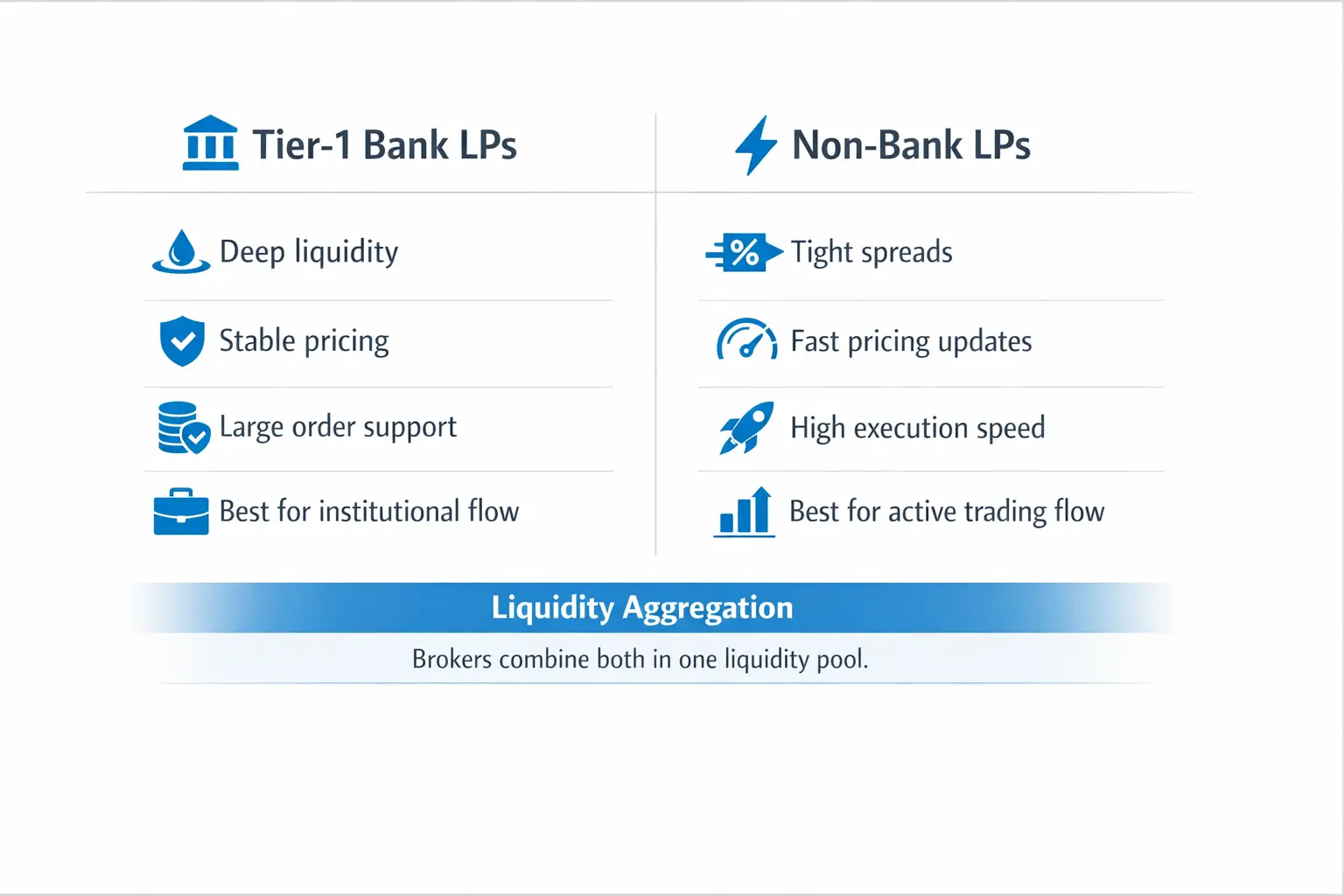
Forex liquidity providers stream bid and ask prices into the FX market. They power spreads, execution speed, and depth of market for brokers.
In practice, LPs fall into two main categories. Tier-1 banks provide depth, while non-banks provide speed and tight pricing. Most brokers blend the two through liquidity aggregation and smart order routing.
To summarise:
- Tier-1 bank liquidity providers are global banks that stream deep FX prices.
- Non-bank liquidity providers are electronic market makers that price FX at high speed.
Tier-1 Bank Liquidity Providers (Bank LPs)
Historically, Tier-1 bank LPs are major banks (J.P. Morgan and Goldman Sachs) with a global presence. They quote prices to large FX participants and support deep liquidity, especially on major currency pairs.
They also handle large order sizes with less price impact. As a result, brokers use them for depth, not just tight spreads.
Tier-1 bank LP strengths
- offer strong depth during normal trading sessions.
- support institutional flow, including real money demand.
- reduce price jumps when brokers execute larger tickets.
- improve pricing stability during slower market conditions.
However, access is not always simple. Many banks require prime brokerage, credit checks, and minimum volumes.
Top 10 Tier-1 Bank Forex Liquidity Providers
These names appear frequently in institutional pricing and broker liquidity pools. Ranks can change by region, product, and client type.
- JPMorgan
- Citi
- Deutsche Bank
- UBS
- Goldman Sachs
- Bank of America
- Barclays Bank
- HSBC
- BNP Paribas
- Morgan Stanley
Why these banks matter
Tier 1 LPs are known to combine strong market depth with reliable pricing during liquid hours. They also anchor pricing for many prime and prime-of-prime networks.
Non-Bank Liquidity Providers (Electronic Market Makers)
Non-bank LPs are trading firms that price FX using fast electronic systems. They often run algorithms that update quotes in milliseconds.
They focus on top-of-book liquidity and fast execution. Therefore, brokers use them to tighten spreads and improve fill speed.
Non-bank LP strengths
- deliver tight pricing during liquid sessions.
- refresh quotes quickly during fast price moves.
- handle high trade counts across multiple pairs.
- support brokers running STP and ECN-style execution.
Still, non-bank pricing can shift quickly in response to news. That change protects the LP from sudden risk and toxic flow.
Top 10 Non-Bank Forex Liquidity Providers
These firms are widely known for streaming prices and making markets in FX. They support many brokers through aggregation platforms and PoP access.
- XTX Markets
- Citadel Securities
- Jump Trading
- Flow Traders
- Virtu Financial
- Jane Street
- Tower Research Capital
- Hudson River Trading (HRT)
- Optiver
- IMC Trading
How brokers combine both inside one liquidity pool
Most brokers use multi-LP pricing rather than a single provider. They route orders using smart order routing rules.
For example, banks support depth on major pairs during steady sessions. Meanwhile, non-banks compete tightly and sharpen top-of-book spreads. As a result, brokers improve pricing, execution, and overall fill quality.
Real-world execution note (Based on real trader experience)
I judge liquidity quality based on three signals, not on marketing promises. I track slippage, reject rate, and spread stability across market sessions. Those metrics reveal real execution performance under pressure.
Our Key Takeaways
- Tier-1 banks deliver depth and stability for larger FX order sizes.
- Non-bank LPs deliver speed and tighter spreads in liquid conditions.
- Liquidity aggregation blends both for better fills and pricing.
A-Book vs B-Book Brokers: How Trades Connect to Liquidity Providers
A-Book and B-Book describe how a broker handles client orders. They do not describe the liquidity provider itself.
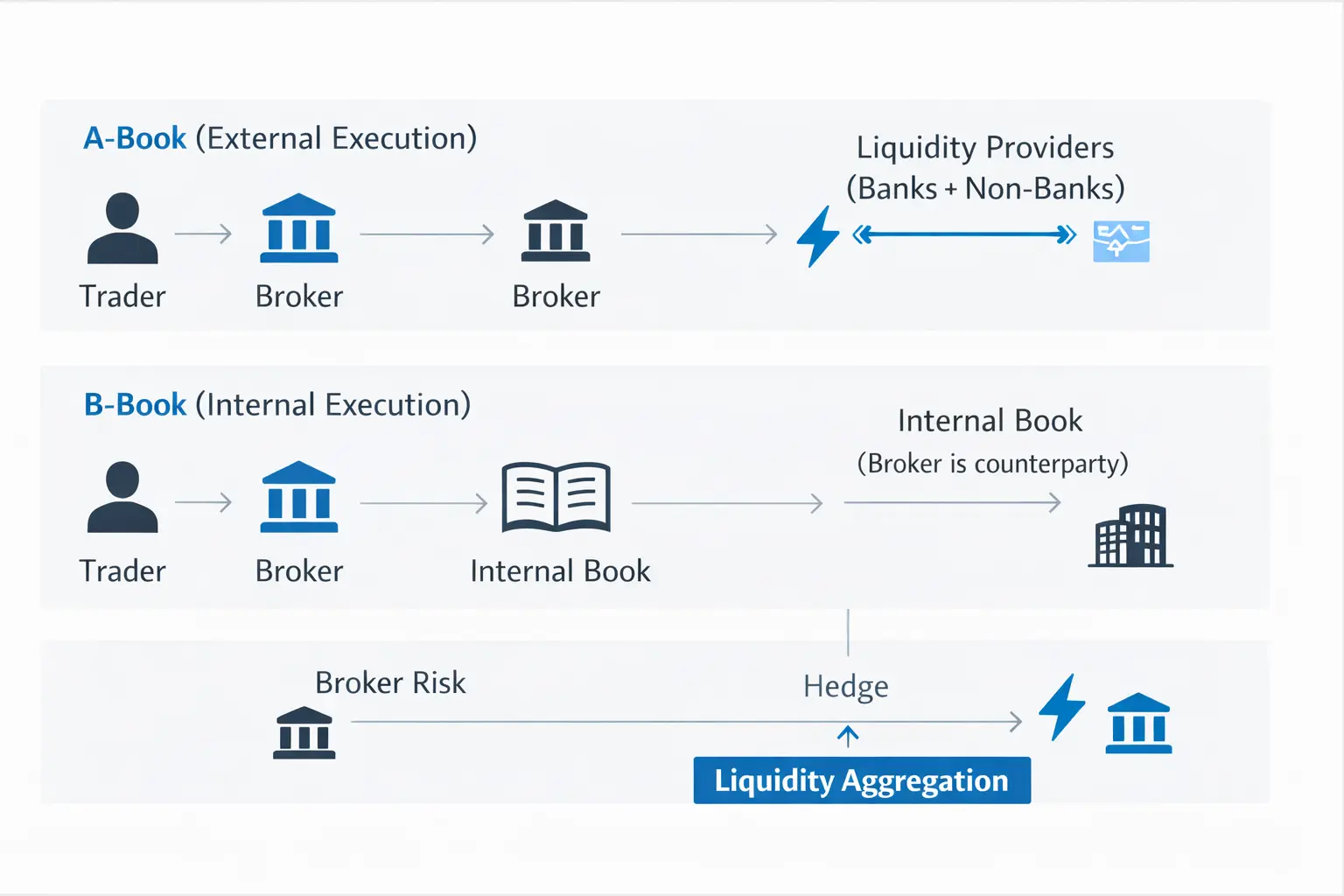
In simple terms, an A-Book routes trades to LPs for execution. Meanwhile, B-Book fills trades internally and manages exposure in-house. Most brokers use a hybrid model because it improves risk control.
In summary:
- A-Book brokers route trades to external liquidity providers for execution.
- B-Book brokers fill trades internally, then hedge exposure when needed.
What an A-Book broker means
An A-Book broker sends your trade to external liquidity providers. This setup often appears under STP execution or ECN-style routing.
A-Book routing usually follows this flow:
- The client places an order with the broker.
- The broker routes the order to a liquidity pool.
- An LP fills the order based on available market depth.
- Broker earns from spreads, commissions, or markups.
So, where do the two LP categories fit in?
A-Book brokers can route to Tier-1 banks and non-bank market makers. They combine both to improve spread quality and reduce order rejections.
What a B-Book broker means
A B-Book broker fills your trade internally, without external routing. The broker becomes the counterparty and keeps the position on its book.
B-Book execution usually works like this
- Client order enters the broker’s dealing system.
- The broker fills the order at internal pricing.
- A broker manages risk through limits and exposure controls.
- Broker profits when clients lose, and pays when clients win.
However, B-Book brokers still use liquidity providers sometimes.They hedge exposure when risk grows too large.
For example, many clients buy EUR/USD during a sharp trend move. Then the broker may hedge part of that net exposure with LPs. That hedge can hit Tier-1 banks, non-banks, or both.
Hybrid brokers: the most common model today
Hybrid brokers use both the A-Book and the B-Book simultaneously. They choose routing rules based on flow type and risk profile.
Typical hybrid routing rules
- New or small accounts often route to B-Book first.
- Large orders often route to A-Book for safer fills.
- Consistent winners often move toward A-Book routing.
- News-time flow often triggers faster hedging or A-Book routing.
This model reduces risk while maintaining stable execution. It also supports different trader styles across the client base.
STP vs ECN vs DMA (Order Routing)
These terms appear on many broker execution pages. They often overlap, so you should read the broker’s execution policy.
- STP: Broker routes orders directly to external liquidity providers.
- ECN: Broker uses a pooled-pricing model across multiple market participants.
- DMA: Broker offers direct routing through a specific market access setup.
In reality, many brokers mix these models behind the scenes. Therefore, real performance matters more than labels.
How to spot A-Book or B-Book behavior in real trading
You cannot always know the true routing path from the front-end. Still, execution behavior can reveal useful clues.
Signs often linked with A-Book routing
- Spreads widen during major news and fast market moves.
- You see more slippage when the price moves quickly.
- The broker allows more strategies with fewer trade blocks.
Signs often linked with B-Book routing
- You see re-quotes or “off quotes” more often.
- Orders fill more slowly during periods of high volatility.
- The broker restricts scalping and news trading strategies.
- Traders report unusual stop-loss hits and delayed execution.
Best practice:
Read the broker’s execution policy and order handling terms.
Why this matters for execution quality
Liquidity affects spreads, but execution affects your real cost. A cheap spread with bad fills still ends up being expensive trading.
So, focus on these execution metrics:
- average slippage in fast markets
- rejection rate and partial fills
- spread stability across market sessions
- speed during news events and liquidity gaps
Those signals reveal a broker’s true quality over time. They also show how well the broker manages its liquidity pool.
Our Key Takeaways:
- A-Book brokers route trades to bank and non-bank liquidity providers.
- B-Book brokers internalize trades but sometimes hedge risk with LPs.
- Hybrid routing is common because it balances cost and risk.
Frequently Asked Questions
What is a liquidity provider in forex trading?
A liquidity provider is usually a bank, financial institution, or pricing firm that streams bid and ask quotes into the market. In simple terms, it helps brokers keep prices available across currency pairs.
How do forex liquidity providers affect my spreads and execution?
Brokers often build their price feed from one or more sources, including a liquidity provider forex connection. In active markets, competitive quotes can support tighter spreads and smoother fills. During quiet hours or fast news, spreads can still widen, and fills can change.
Can I see liquidity providers directly on my trading platform?
Most retail platforms do not display the full network of banks and providers that powers the feed. Traders usually see the final bid/ask quote and, in some cases, partial depth-of-market for the broker’s own pool. So the provider’s role is visible mainly through spreads, price updates, and execution quality.
What is a forex liquidity indicator, and how does it work?
A forex liquidity indicator is a charting tool that tracks signals associated with market activity. Common inputs include spread changes, tick activity, or volatility measures. It describes platform conditions, not every order in the global market.
Do I need a specific indicator to determine whether the market is liquid or thin?
Not always. Spread behaviour, tick frequency, and candle formation around major sessions are commonly discussed indicators of changing market activity. An indicator can add structure, but it remains an approximation.
Can liquidity providers or indicators remove trading risk?
No. Liquidity can improve pricing conditions, yet sharp moves and slippage can still happen, especially around major events. Indicators help with context, but they cannot guarantee outcomes.
RISK WARNING: CFDs are complex financial instruments and carry a high risk of rapid capital loss due to leverage. You should fully understand the risks involved and carefully consider whether you can afford to take the high risk of losing your money before trading.
Disclaimer: The information is provided for educational purposes only and doesn’t take into account your personal objectives, financial circumstances, or needs. It does not constitute investment advice. We encourage you to seek independent advice if necessary. The information has not been prepared in accordance with legal requirements designed to promote the independence of investment research.
No representation or warranty is given as to the accuracy or completeness of any information contained within. This material may include historical or past performance figures and should not be relied on. Furthermore, estimates, forward-looking statements, and forecasts cannot be guaranteed. The information on this site and the products and services offered are not intended for distribution to any person in any country or jurisdiction where such distribution or use would be contrary to local law or regulation.