
 Updated
Let’s be honest: in this market, no currency is actually doing its own thing. Between the Fed’s latest move and whatever is happening with global trade, everything is connected by invisible threads. This is exactly why you have to pay attention to forex correlation pairs.
If you understand which Forex pairs tend to move together and which tend to move in opposite directions, this may help you better understand how different currency pairs are related. This may help highlight instances of similar exposures across different positions. It may also highlight differences among similar currency-pair setups.
This guide breaks down commonly observed Forex correlation relationships, how correlation works, why it matters, and how to use it in a simple, practical way.
What is Forex Correlation?
Forex correlation is the statistical measure of how two currency pairs move in the same direction or in opposite directions over a period of time. This can be in different forms.
A positive correlation occurs when two pairs tend to move in the same direction, for instance, the EUR/USD and GBP/USD pairs. This is due to their close economic ties and geographical proximity.
A negative correlation occurs when two pairs move in opposite directions; for example, the USD/JPY and EUR/JPY pairs are influenced by monetary policies and economic indicators.
A weak or low correlation means the pairs do not move in a steady relationship. e.g., AUD/USD and GBP/JPY pairs are influenced by commodity prices (gold/iron) and risk appetite.
Traders often measure correlation on a scale from +1.00 to -1.00.
- +1.00 means two pairs move almost the same way
- -1.00 means they move almost exactly opposite
- 0.00 means there is no clear link
You do not need to be a math expert to use this. You only need to understand one idea: if two pairs are strongly linked, opening trades in both may increase your risk more than you think.

Why Forex correlation matters before you place a trade
Many traders learn this lesson after a loss. They buy EUR/USD. Then they also buy GBP/USD because both charts look strong. The market turns. Both trades lose at once. The trader thought they had two different positions. In truth, they had one broad U.S. dollar idea placed twice.
That is the real value of correlation. It helps you answer key questions before you enter:
- Am I adding a new trade or repeating the same trade?
- Are my positions truly spread out?
- Which pair gives the better setup with less overlap?
- Am I doubling my risk without knowing it?
Forex correlation is not a perfect signal, but it is often used as a risk awareness tool. It may be used to:
- avoid overexposure
- improve trade selection
- manage position size
- reduce emotional decision-making
- supports a more structured approach to analysing positions
Forex correlation pairs to know before you trade
Below are some of the most useful pair relationships traders should know. There are common correlations between currency pairs.
1. EUR/USD and GBP/USD
This is one of the best-known positive correlations in Forex. Based on a 1-month lookback, it displays approximately (+0.95) as both the Eurozone and the UK economies are closely linked through trade, and they tend to be affected by similar economic factors.
Both pairs include the U.S. dollar as the quote currency. Also, both reflect major European economies.
2. AUD/USD and NZD/USD
This is another strong positive pair relationship (about +0.95, based on a 1-month lookback). Australia and New Zealand have close economic ties. Their currencies often respond similarly to changes in risk sentiment, China-related growth ideas, and commodity demand. In other words, the factors that impact the AU (AUD/USD) market will naturally impact the NZD/USD market.
For more than 10 years, this pair had an 80%+ positive correlation. This strong positive correlation remained steady through several significant market events. During the period 2014- 2016, the correlation dropped to a low of 15%, due to several factors.
3. EUR/JPY and GBP/JPY
These two pairs demonstrate a strong positive correlation (Based on a 1-month lookback, approx +0.90). They both include the Japanese yen as the quote currency. They also respond to market risk sentiment, shifts in bond yields, and broad moves in European currencies. When investors seek safe-haven assets, both currency pairs tend to decline because money flows into the Japanese yen.
4. EUR/USD and USD/CHF
This is one of the most useful negative correlations in Forex. Based on a 1-month lookback, its correlation is around -0.95. EUR/USD often moves in the opposite direction to USD/CHF. The Swiss National Bank sometimes aligns its monetary policy with the ECB; this correlation remains fairly stable.
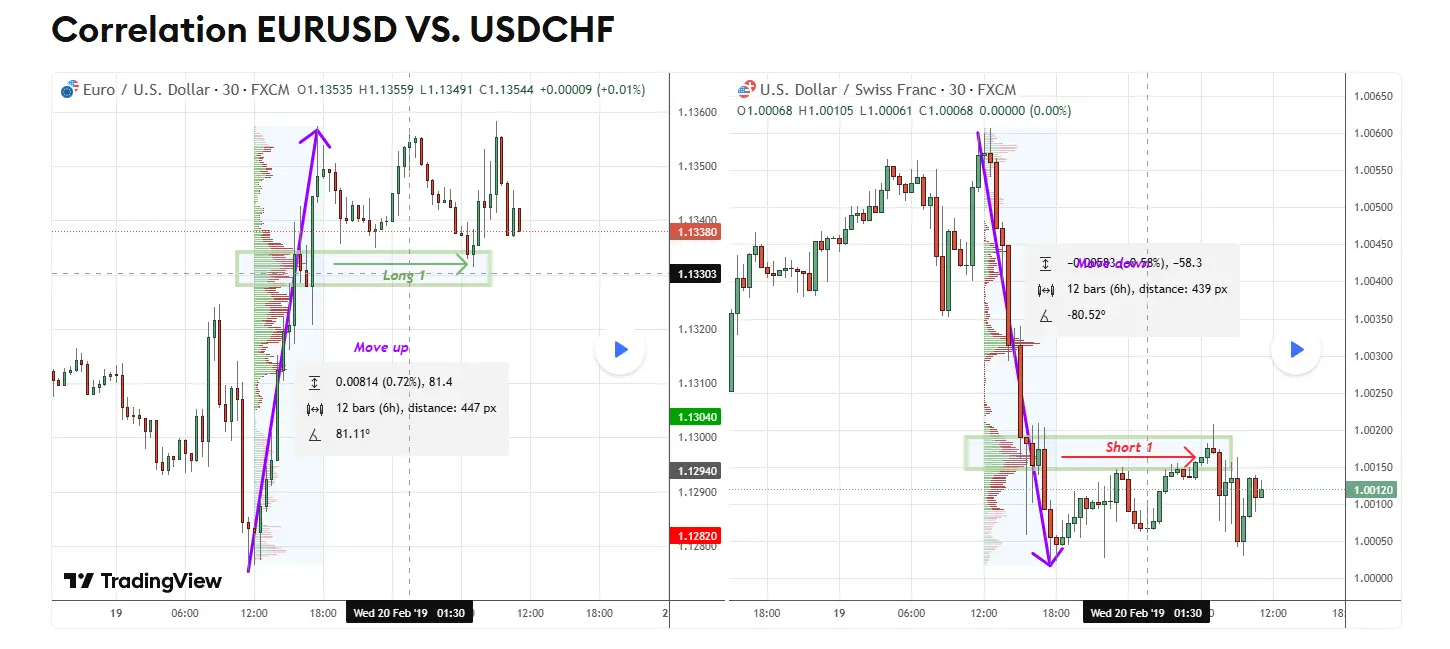
Let me give a brief explanation of the Euro/US dollar and the US dollar/Swiss Franc, as both are negatively correlated. If one pair in a negatively correlated relationship declines, the other may move in the opposite direction, although this relationship is not guaranteed.
5. USD/CAD and AUD/USD
This relationship is not always as strong as the classic pairs above, but it is still useful. AUD/USD often reflects demand for risk and growth. This shows a negative correlation (around -0.85) over a 1-month lookback. The Canadian dollar is mostly influenced by oil, while the Australian dollar is affected by metal and mineral prices.
USD/CAD can react to U.S. dollar strength and changes in commodity demand, especially oil, through the Canadian dollar.
A Simple Table for Currency Pair Correlation
| Pair 1 | Pair 2 | Common Relationship | Why It Matters |
| EUR/USD | GBP/USD | Positive | Both often react to broad USD moves |
| AUD/USD | NZD/USD | Positive | Both are risk-sensitive and linked to regional growth |
| EUR/JPY | GBP/JPY | Positive | Infrastructure damage reports |
| EUR/USD | USD/CHF | Negative | One of the clearest inverse relationships |
| AUD/USD | USD/CAD | Often negative | Can reflect the risk mood and commodity influence |
How to Use Correlation in Real Trading
In real trading, correlation should be used as a risk-management tool, not as a reason to enter a trade on its own. In finance, correlation measures how closely two assets move relative to each other, typically on a scale from -1 to +1.
Traders use this to see whether two currency pairs are likely to move in the same direction, in opposite directions, or with no strong link at all. This matters because correlation can help you avoid redundant trades, improve diversification, and control exposure more effectively.
Some traders review correlation before opening additional positions
This is the first practical step, as many traders mistakenly look at two different charts and assume they are taking two separate positions. That is often false in Forex because the U.S. dollar still dominates the market. According to the BIS Triennial Survey, the U.S. dollar was on the counterparty side in 89.2% of all FX trades in April 2025.
So if you buy EUR/USD and buy GBP/USD, you may not be adding variety at all. It looks like you’re increasing the same broad USD view in two places.
It is common for traders to think in terms of exposure, rather than just pair names.
If two pairs are strongly positively correlated, some market participants may choose to focus on one setup rather than multiple highly correlated positions. This may involve comparing factors such as trend structure, entry levels, stop distance, and spreads based on individual preferences.
Diversification works best when positions are not perfectly positively correlated. In other words, opening several trades only helps if they do not all depend on the same market move. Otherwise, one wrong call can damage the whole set of trades at once.
Correlation also helps with position sizing.
If you still want to hold two highly related trades, they may not behave as fully separate risks. This is where hedging logic becomes useful. CFI defines the hedge ratio as the size of a hedge relative to the main position, indicating that risk should be adjusted rather than guessed.
At the same time, CFI notes that hedging carries basis risk, meaning the hedge may not move exactly as expected. So if two pairs are linked, combined exposure may be affected when positions are taken in both. That keeps one market theme from becoming too large in your account.
Recheck correlation often
Currency relationships are not fixed. Investopedia notes that pair correlations should be updated regularly because they can shift with central bank policy, oil prices, and wider political or economic changes. That means a pair relationship that looked strong last month may be much weaker today.
In practice, traders may review current relationships, assess overall exposure, and consider how overlapping positions could interact. Used this way, correlation does not replace analysis. It provides additional context when analysing market relationships.
Commodity Correlations in Forex
The value of some currencies is correlated not only with other currencies but also with commodity prices.
Commodity correlations in forex refer to the relationship between commodity prices and certain currencies. The logic is simple. When a country exports a large share of oil, metals, or farm goods, changes in those prices can affect export income, trade flows, growth, inflation, and demand for that country’s currency. Central banks also point to these channels.
The Bank of Canada says demand for the Canadian dollar is shaped mainly by demand for Canadian goods and services. In contrast, the Reserve Bank of Australia says Australia’s terms of trade and commodity prices have long had a close link with the Australian dollar.
This is why traders often group some currencies as “commodity currencies.” The Canadian dollar is tied most closely to oil. The Australian dollar is often linked to iron ore, base metals, and broad commodity demand. The New Zealand dollar is watched through the lens of agricultural exports, especially meat and dairy.
The Reserve Bank of New Zealand said in February 2026 that higher prices were lifting farm output and exports, with growth expected to continue, “particularly for meat and dairy.”
Below are some commodities and their correlations in the forex markets.
1. Crude oil and the Canadian dollar (CAD)
One of the clearest commodity links in forex is oil. The Bank of Canada states that many commodities in the country are exported, including oil and gas, and higher commodity prices add more and more money to the economy.
It also indicated that the Canadian dollar would appreciate due to rising commodity prices. In market terms, this means that stronger oil prices move the CAD higher, while weaker demand has a negative impact.
2. Crude oil and Norwegian Krone
Oil, too, is closely tied to the Norwegian krone because oil remains a linchpin of Norway’s economy. High oil prices are supporting the krone, and the development of the petroleum sector, combined with those prices, has helped strengthen the krone over a longer period, Mr. Jale Bergo, Deputy Governor of Norges Bank, says. It was also reported that oil prices had increased and the krone had appreciated further.
3. Iron ore, natural gas, and base metals with the Australian dollar (AUD)
In 2020, the AUD ended the year with about 12 per cent growth. Strong commodity prices, high export volumes, and overall positive global growth drove this growth.
It adds that when copper prices rise, so do AUD/USD prices, thereby spurring global economic growth. Copper is increasingly a significant contributor to the Australian dollar’s value, serving as a key commodity alongside iron ore. China is the largest consumer of refined Copper and a major buyer of Australian exports.
When copper prices rise, the AUD tends to appreciate against the USD, with recent trends showing the currency is highly responsive to shifts in copper market supply, such as Chinese smelter production cuts.
4. Gold and the US dollar (USD)
Gold has a different kind of forex link. The World Gold Council says gold acts as a natural hedge to the US dollar and is significantly influenced by it. In practice, that makes gold useful as a read on dollar strength or weakness. When gold rises, the move may be telling you more about a softer dollar, lower real yields, or safe-haven demand than about any single commodity currency.
Below is a table that shows currency correlation with their commodities:
| Commodity | Pair | Correlation |
| Oil | USD/CAD | Negative |
| Oil | USD/NOK | Negative |
| Iron Ore | AUD/USD | Positive |
| Diary | NZD/USD | Positive |
| Gold | USD majors | Negative to USD |
Frequently Asked Questions
Which Forex pairs are commonly negatively correlated?
A classic example is EUR/USD, and another is USD/CHF. These pairs often move in opposite directions because of the positions of the U.S. dollar in each pair. When the dollar strengthens, EUR/USD may fall while USD/CHF may rise.
Can I trade two correlated pairs at the same time?
Yes, although risk considerations are important. If two pairs are strongly positively correlated, taking full-size positions in both may be like placing the same trade twice. Some traders may choose a single setup, while others may adjust their overall exposure.
What are the most reliable platforms for tracking forex correlation pairs?
Investing.com provides time frame-based correlation tools, while OANDA offers correlation heatmaps and matrix-style views.
How can I use forex correlation pairs to improve my trading strategy?
A positive correlation may indicate that similar underlying factors influence pairs, and a negative correlation may indicate that pairs move in opposite directions under certain conditions. One key consideration is exposure control: correlation helps you avoid placing two trades that are really the same macro bet, and it works best when you check the relationship on the timeframe you actually trade.
How to use currency correlation for risk management in trading.
It is common to consider total exposure rather than just the number of positions. For example, holding two highly correlated pairs may increase overall exposure to similar market movements, while negatively correlated pairs may move differently under certain conditions.
Are there any free tools for tracking forex pair correlations?
Yes. Investing.com offers free web-based correlation tools that allow users to view relationships between currency pairs.
What are the most common positively correlated forex pairs?
The classic examples are EUR/USD and GBP/USD, which Investopedia often describes as highly positively correlated currency pairs. Another common positive pair is AUD/USD, and another is NZD/USD.
RISK WARNING: CFDs are complex financial instruments and carry a high risk of rapid loss of money due to leverage. It is important to ensure you fully understand the risks involved and carefully consider whether you can afford to take such a high risk of losing your money before trading.
Disclaimer: The information is provided to serve educational purposes only and doesn’t take into account your personal objectives, financial circumstances, or needs. It does not constitute investment advice. We encourage you to seek your independent advice if necessary, from a qualified financial analyst or expert. The information has not been prepared in accordance with legal requirements designed to promote the independence of investment research.
No representation or warranty is given as to the accuracy or completeness of any information contained within. This material may contain historical or past performance figures and should not be relied on. Furthermore, estimates, forward-looking statements, and forecasts cannot be guaranteed. The information on this site and the products and services offered are not intended for distribution to any person in any country or jurisdiction where such distribution or use would be contrary to local law or regulation.
References
- https://www.investopedia.com/terms/c/currencypair.asp Understanding Currency Pairs: Major, minor, and exotic examples
- https://www.tradingview.com/chart/GBPUSD/SjzyWZ0r-Unlocking-The-Power-Of-Correlation-In-Forex-Trading/ Power of Correlation in Forex Trading
- https://www.tradingview.com/chart/AUDUSD/augit0NA-How-to-Trade-Correlations-for-New-Traders-AUD-USD-vs-NZD-USD/ How To Trade Correlations for New Traders: AUD/USD Vs NZD/USD
- https://www.tradingview.com/chart/USDCHF/UmJdxWhS-Correlation-EURUSD-VS-USDCHF/ Correlation between EUR/USD and USD/CHF
- https://www.bankofcanada.ca/2022/05/how-commodity-prices-affect-our-economy/ How Commodity Prices Affect the Canadian Economy
- https://au.finance.yahoo.com/news/aud-2021-000723930.html? Aussie Dollar is Booming: Here is What To do With Your Money
- https://www.investopedia.com/trading/using-currency-correlations-advantage/? Mastering Currency Correlations: Boost Forex Profit and Manage Risk
- https://www.bis.org/statistics/rpfx25_fx.htm OTC Foreign Exchange Turnover in April 2015