
 Updated
If you have spent any time in the forex market, you have likely noticed that some currencies move in a more calm and steady way, while others can swing unpredictably in a short time. That is often where emerging market currencies come in.
Many traders first hear about them when the news is about a stronger US dollar, rising inflation, higher interest rates, falling commodity prices, or political stress in developing economies. They may see the South African rand, Mexican peso, Brazilian real, Turkish lira, or Indian rupee in market updates and wonder why these currencies seem to react so sharply to global events.
This provides a useful starting point for understanding how these currencies behave.
Emerging market currencies matter because they sit at the intersection of local growth, global capital flows, central bank policy, and investor fear. They can exhibit strong price movements, but they also carry more risk than many major currencies.
This guide explains what emerging market currencies are, why they move as they do, what sets them apart from major currencies, and what traders should watch before trading them.
What Are Emerging Market Currencies?
Emerging market currencies are the national currencies of countries whose economies are still growing, industrializing, and building out their financial systems. These countries are not as mature or as stable as developed economies, but they are often larger and more advanced than frontier markets.
In simple terms, these are currencies from economies that are still developing but already play a meaningful role in global trade and investment.
Emerging Market Currencies List
Examples of emerging market currencies for forex trading include:
- South African Rand (ZAR). Pairs: USD/ZAR
- Mexican peso (MXN). Pairs: USD/MXN, JPY/MXN
- Brazilian real (BRL). Pairs: USD/BRL
- Turkish lira (TRY). Pairs: USD/TRY
- Indian rupee (INR). Pairs: EUR/INR, USD/INR
- Indonesian rupiah (IDR). Pairs: USD/IDR
- South Korean Won(KRW). Pair: USD/KRW
- Hong Kong Dollar(HKD). Pair: USD/HKD
- Russian Ruble(RUB). Pair: USD/RUB
- Singapore Dollar(SGD). Pair: USD/SGD
- Taiwan Dollar(TWD). Pair: USD/TWD
These currencies are part of the wider forex market, but they tend to behave differently from major currencies such as the US dollar, euro, Japanese yen, British pound, and Swiss franc.
What is an Emerging Market Economy?
An emerging market economy is one that is transitioning to a developed market economy. An emerging market country is usually one that has:
- High Growth Rates: EM typically see their economies grow between 6% – 7% annually, and their economic growth rates will consistently outperform those of developed economies.
- High Investment Potential: Compared with developed economies, Emerging Markets may exhibit different risk-return characteristics, but they are accompanied by greater uncertainty and risk as economies transition from more closed economies, often based on sectors such as mining and agriculture, to more open economies that facilitate international trade.
- Growing access to global capital: Emerging economies are becoming more engaged with international trade, attracting foreign direct investment, and expanding their role in the global supply chains.
- Developing financial markets: There are evolving capital markets and evolving bank systems.
- Instability and volatility: EM economies are vulnerable to fluctuations in commodity prices, such as oil and food, and in currencies like the US dollar and the Euro. Inflation levels and interest rates are also contributing factors.
These economies often show strong growth potential. That growth can attract foreign investors seeking higher returns. At the same time, these countries may still face weaker institutions, uneven policy decisions, lower market liquidity, higher debt pressure, or political instability.
That mix of promise and risk is what gives emerging market currencies their special place in forex.

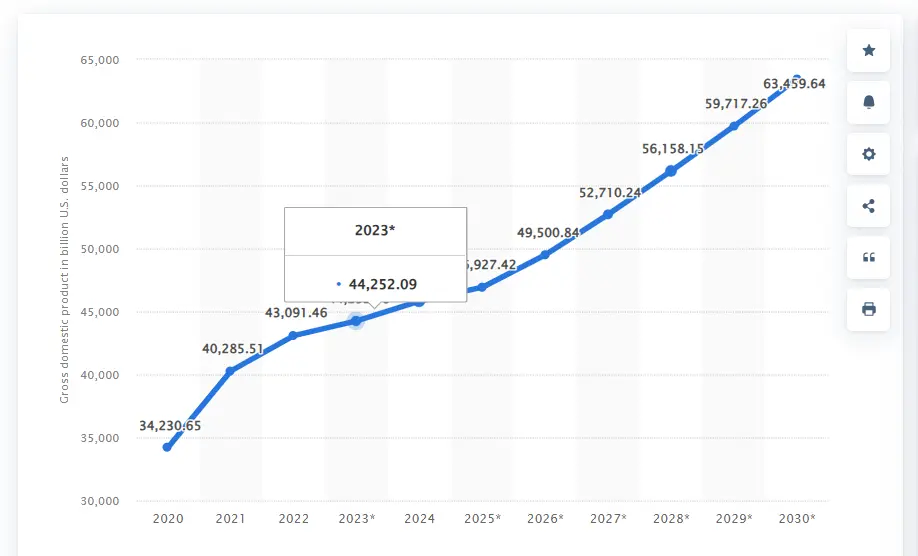
GDP of Emerging Market Currencies
A 2025 Statista report shows that the GDP of emerging markets and developing economies amounted to 45.83 trillion USD in 2024.
The Gross Domestic Product (GDP) in this context denotes the aggregate value of all goods and services produced within a country in a given year. Also, the GDP is seen as an indicator of a country’s economic power.
Emerging Market Currencies and Major Currencies
Major currencies are by far the most widely traded and the most stable in the global foreign exchange market. They come from large, developed economies with strong financial systems, deep liquidity, and broad global use in trade and investment.
The comparison between the two currencies is:
| Feature | Emerging Market Currencies | Major Currencies |
| Definition | Currencies from developing or growing economies | Currencies from large, developed economies |
| Market size | Smaller share of global FX trading | Lager share of global FX trading |
| Liquidity | Lower liquidity in many pairs | Very high liquidity |
| Volatility | Usually more volatile | Usually more stable |
| Risk level | Higher risk | Lower risk |
| Political influence | Often more affected by politics and policy shocks | Usually less affected by sudden local shocks |
| Reaction to global events | Stronger reaction to dollar strength, risk-off mood, and capital outflows | More balanced reaction to global events |
| Central banks credibility | Varies widely by country | Usually stronger and more trusted |
| Examples | ZAR, MXN, BRL, INR, TRY | USD, EUR, GBP, JPY, CHF |
Practice analyzing FX markets with a demo account.
What Moves The Emerging Market Currencies
Emerging market currencies often move more than major currencies because they are more sensitive to both local and global pressure. Here are some of the main reasons.
1. Global risk sentiment
When markets feel calm and investors are willing to take more risk, money often flows into emerging markets in search of higher returns. That can support emerging market currencies.
When fear rises, investors often pull money out and move into safer assets such as the US dollar, the Swiss franc, or US Treasuries. That can push emerging market currencies lower, even when local data is not especially bad.
This is why emerging market currencies can fall quickly during periods of market stress.
2. US dollar strength
The US dollar has a significant impact on emerging-market currencies. When the dollar strengthens, many emerging-market currencies come under pressure. This can happen because:
- Investors prefer dollar assets
- Borrowing in dollars becomes more costly
- Imported goods become more expensive
- Countries with dollar debt face more strain
A stronger dollar can tighten financial conditions across many emerging economies at once.
3. Interest rates
Interest rate changes matter everywhere, but they can matter even more in emerging markets. Higher local interest rates may attract foreign capital and support a currency. But if inflation is high or policy trust is weak, higher rates may not be enough.
US interest rates also matter. When US rates rise, investors may pull funds from emerging markets and return to dollar assets. That can hurt emerging market currencies.
4. Inflation
High inflation can reduce confidence in a currency. If prices rise too fast and the central bank fails to respond well, traders may expect the currency to weaken. Inflation also affects real returns, household spending, and business confidence.
In some emerging markets, inflation can become a major driver of exchange rate swings.
5. Commodity prices
Many emerging economies depend heavily on exports such as oil, copper, gold, coal, agricultural products, or industrial metals.
If a country exports many commodities, rising global prices can boost national income and support its currency. Falling prices can do the opposite.
That is why some emerging market currencies are closely tied to the commodity cycle.
6. Politics and policy
Political stress can hit emerging market currencies hard. Elections, unrest, weak governance, policy confusion, corruption concerns, or sudden regulatory changes can cause foreign investors to pull back. Even rumors can trigger sharp moves if trust is already low.
Central bank independence also matters. If traders believe a central bank is under political pressure, confidence in the currency may fall.
Main Risks of Trading Emerging Market Currencies
This is an area where additional caution is often warranted, particularly for less experienced participants. People often focus on the size of the move, but not on the structure behind the move.
This is a commonly observed oversight.
1. Volatility risk
Price swings can be larger and faster than expected. A position can move sharply on central bank headlines, political news, inflation data, or global risk shocks.
2. Liquidity Risk and High Transaction Cost
Some emerging-market currency pairs do not trade as smoothly as major currency pairs. Lower liquidity can lead to wide bid-ask spreads and more slippage. This thereby increases transaction costs and makes it difficult to enter or exit a position without impacting prices.
This is a key point many traders overlook. Even where a market view appears valid, outcomes may be affected by trading costs and execution conditions.
3. Policy risk
Unexpected policy changes can catch traders off guard. Capital controls, rate shocks, currency intervention, or sudden changes in market rules can have a fast impact.
4. Event risk
Emerging market currencies are often more exposed to surprise events. One data release or one political headline can shift sentiment quickly.
Strategies to Trade Emerging Market Currencies
Different approaches are commonly discussed by market participants, depending on market conditions, the currency, and market liquidity. Commonly discussed approaches in emerging-market FX include trend-following with a macro filter, carry trades in calmer market conditions, and event-driven approaches in response to central bank or inflation developments. That view fits how EM currencies trade today: the US dollar remains on the other side in 89.2% of global FX trades, and EM currencies often weaken when their interest-rate advantage over the US narrows.
1. Trend-following with macro support
This is an approach often discussed as a starting point. This approach involves trading in the direction of the broader market move, typically where macroeconomic conditions appear aligned. In EM FX, the cleanest trends usually happen when the dollar is moving strongly, US rate expectations are shifting, and the local country has its own pressure or support story. IMF analysis indicates that EM currencies have tended to weaken when the rate gap with the US narrows and the dollar firms.
2. Carry trades
Carry means owning the higher-yielding currency against a lower-yielding one. This approach is commonly referenced in EM FX discussions, as many EM currencies have historically offered higher interest rates than developed-market currencies. It is generally associated with conditions where global risk sentiment is stable, the local central bank is perceived as credible, and yield differentials remain relatively wide. IMF work points to narrowing rate differentials as a key reason EM currencies came under pressure, which is the flip side of why carry works when those differentials stay attractive.
3. Range Trading
Range trading is typically associated with conditions where an emerging-market currency pair moves sideways between clear support and resistance levels. This approach is often associated with the need for stricter risk controls in emerging-market FX. The Bank of International Settlements finds that U.S. dollar strength has become a major driver of capital flows into emerging-market local-currency assets, and that its effect can outweigh interest-rate differentials in local-currency bond flows.
4. Event-driven trades
These approaches focus on scheduled releases or decisions, such as inflation data, policy meetings, or major political events. EM currencies can react sharply to these events, leading to significant price movements and increased risk. It also raises risk. Around major events, spreads can widen, and slippage can increase. That means smaller size and stricter planning matter more than usual.
Frequently Asked Questions
What is an emerging market currency?
An emerging market currency is the currency of a developing or fast-growing economy whose FX market is usually less mature, less liquid, and more fragmented than the market for major currencies.
Which currencies count as emerging market currencies?
Common examples include the Brazilian real (BRL), Mexican peso (MXN), South African rand (ZAR), offshore Chinese renminbi (CNH), and Indian rupee (INR).
Why are they more volatile?
They tend to be more volatile because of shallow liquidity, market fragmentation, and sudden shifts in global capital flows, which can move them much faster than major currencies.
What drives their exchange rates?
The biggest drivers are U.S. dollar strength, interest-rate differentials relative to the United States, global risk appetite, and country-specific factors such as politics and fiscal concerns.
Can beginners trade them?
These instruments are generally considered more complex and may be less suitable for less experienced traders due to higher risk and more abrupt price movements.
Which indicators matter most?
The most useful indicators are the U.S. dollar trend, the local-versus-U.S. interest rate differential, central bank signals, inflation trends, and measures of global risk sentiment.
RISK WARNING: CFDs are complex financial instruments and carry a high risk of rapid loss of money due to leverage. You should ensure you fully understand the risks involved and carefully consider whether you can afford to take the high risk of losing your money before trading.
Disclaimer: The information is provided for educational purposes only and doesn’t take into account your personal objectives, financial circumstances, or needs. It does not constitute investment advice. We encourage you to seek independent advice if necessary. The information has not been prepared in accordance with legal requirements designed to promote the independence of investment research. No representation or warranty is given as to the accuracy or completeness of any information contained within.
This material may contain historical or past performance figures and should not be relied on. Furthermore, estimates, forward-looking statements, and forecasts cannot be guaranteed. The information on this site and the products and services offered are not intended for distribution to any person in any country or jurisdiction where such distribution or use would be contrary to local law or regulation.
References
- https://en.wikipedia.org/wiki/Emerging_market What are Emerging Markets?
- https://www.investopedia.com/terms/e/emergingmarketeconomy.asp Emerging Market Economies: Growth and Key Players
- https://www.imf.org/en/blogs/articles/2023/07/19/emerging-market-economies-bear-the-brunt-of-a-stronger-dollar Emerging Market Economies Bear The Brunt of A Stronger Dollar
- https://www.statista.com/statistics/805546/gross-domestic-product-gdp-in-the-emerging-market-and-developing-economies/ xEmerging markets and developing Economies
- https://www.esca.finance/blog/navigating-currency-volatility-in-emerging-markets Navigating Currency Volatility In Emerging Markets
- https://www.investopedia.com/articles/basics/11/risks-investing-in-emerging-markets.asp Risks of Investing in Emerging Markets