
 Updated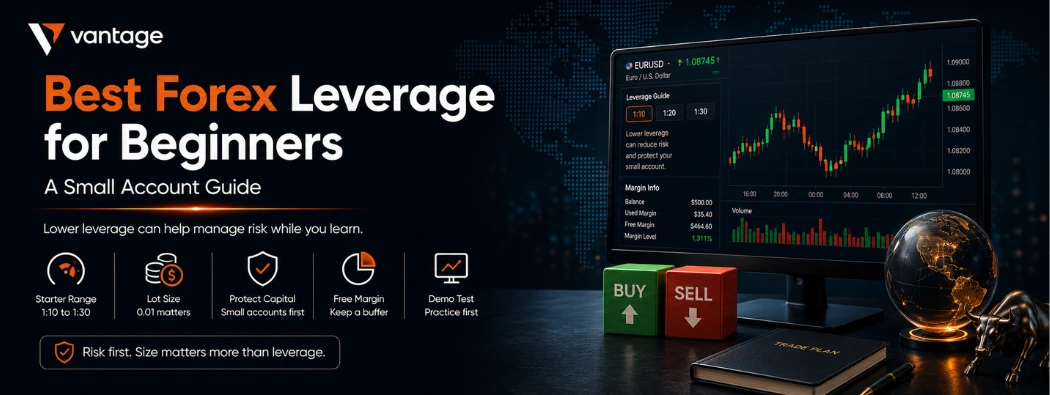
CFD Risk Warning: Forex CFDs are complex instruments (trading products that can be difficult for beginners to understand) and carry a high risk of rapid loss of capital due to leverage (a feature that lets you control a larger trade with a smaller amount of money). This article is educational only and does not constitute financial advice.
Key Takeaways
- Many traders search for the best forex leverage for beginners. Many new traders use leverage ratios of 1:10 to 1:30 because they make risk management easier when learning.
- Lot size(the size of your trade) controls real risk exposure more directly than the leverage ratio itself. Focusing on trade size helps traders feel capable of managing their risk effectively, which is essential for building confidence in their trading approach.
- Small trading accounts have less room for error as they can run out of money quickly if several trades go wrong. Thus, making capital preservation a priority.
- Higher leverage reduces margin requirements (the amount of money you need in your account to open a trade) but can increase the speed of losses if the trade moves against you.
- Testing different leverage settings on a demo account can help traders understand their exposure (the amount of money they have at risk in the market) before trading live.
- Free Margin (money available for new trades or to absorb losses) and position sizing(deciding how large your trade will be) are crucial for maintaining control over your trading account.
When I first started trading, I noticed a pattern that repeatedly appeared among new traders. Most focused on finding the “right” leverage ratio, while very few paid attention to position sizing. In practice, position sizing (how large your trade will be) often has a greater impact on survival than leverage alone.
This guide focuses on forex CFDs, not ownership of physical currencies. When trading forex CFDs, traders speculate on price movements without owning the underlying currency.

How Much Leverage a New Trader Needs
Many new traders use lower leverage, around 1:10 to 1:30, as it is easier to manage and may help discourage oversized positions while learning. Some use it as the best leverage for beginners.
The leverage ratio determines the maximum exposure(the largest trade you can open with your account and leverage) available to a trader. It does not automatically determine risk. Risk comes from:
- Position size: How big your trade is.
- Stop-loss placement: The price level at which your trade will automatically close to limit losses.
- Account management: How much of your account balance are you willing to risk on a trade?
For example:
You have $100 in your account.
- Position size: You choose a small trade of 0.01 lot instead of a large trade of 0.10 lot.
- Stop-loss placement: You set a stop-loss to close the trade if the price moves against you.
- Account management: You set a rule to limit losses to $1 or $2 per trade.
A higher leverage ratio allows you to make larger trades using less money in your account. That creates more flexibility, but it also means losses can accumulate faster when trades move against the account.
Many new traders find lower leverage easier to manage because it can discourage oversized trades and help maintain more free Margin (money available in the account after opening a trade).
Illustrative Starter Ranges by Account Size
| Account Size | Many New Traders Find It Easier While Learning | Example Trade Size | Why This Can Be Easier to Manage |
| $5-$50 | Around 1:10 | 0.01 lot (the smallest standard trade size available at many brokers) | Small accounts have very little room for losses because a few losing trades can quickly reduce the account balance. Keeping trade sizes small can help prevent a few losing trades from quickly draining the account. |
| $100 | Around 1:10 to 1:20 | 0.01 lot | Small losses still have a noticeable impact on the account balance. Many beginners focus on keeping trade sizes small and preserving capital while learning. |
| $500 | Around 1:20 | 0.01-0.02 lot | The account has more room to handle normal market fluctuations, but larger trade sizes can still lead to meaningful losses if risk is not controlled. |
| $1,000+ | Around 1:20 to 1:30 | 0.01-0.05 lot (depending on strategy) | A larger balance can absorb more market movement, but position size and risk management remain more important than the leverage ratio itself. |
These examples are for illustration only. The appropriate leverage depends on factors such as trading strategy, stop-loss distance, the market being traded, and broker rules.
What Regulators Allow
FSCA regulates financial service providers that offer trading services to South African traders. Similarly, regulators around the world impose leverage limits to manage risk, as does the FSCA. For example, retail traders in the European Union can use up to 1:30 leverage on major currency pairs, while traders in the United States can use up to 1:50.
These limits provide useful context but are not a strict guide to how much leverage a trader should use. Instead, traders should consider their own risk tolerance, account size, and trading strategy when choosing leverage, rather than relying solely on regulatory maximums.
How much forex leverage should beginners use?
Many new traders use lower leverage ratios, often around 1:10 to 1:30, simply because it is easier to manage losses when learning. Lower leverage can limit the size of a trade, helping traders keep more free Margin (available money in the account) if a trade moves in the wrong direction.
The appropriate leverage level depends on:
- Account size (because smaller accounts can absorb fewer losses),
- Risk per trade (because risking more money on each trade increases the impact of losses),
- Stop distance (because wider stop-losses can lead to larger losses unless trade sizes are reduced).
Why a Small Account Changes the Leverage Decision
A small account shifts the priority toward capital preservation rather than buying power. This means that with a small account, protecting your money becomes more important than opening larger trades.
A trader with a $100 account cannot absorb losses in the same way as a trader with a $10,000 account. A single oversized position (a trade that uses a large share of the account balance) can quickly reduce available equity (the account’s current value).
This is why many beginners use cent accounts or micro accounts while learning. Because the trade sizes are smaller, losing trades usually have a smaller impact on the account balance, giving traders more room to learn from mistakes.
The mathematics of drawdowns becomes increasingly difficult as losses grow.
Drawdown and Recovery Table
A drawdown (a decline in account value after losses) becomes harder to recover from as it grows. The table below shows the amount of gain needed to return an account to its starting balance after a loss.
| Loss From Balance | Gain Needed to Recover |
| 10% | 11.1% |
| 20% | 25% |
| 30% | 42.9% |
| 50% | 100% |
| 70% | 233% |
| 90% | 900% |
For example, a trader who experiences a 50% drawdown (a loss of half the account balance) must achieve a 100% gain on the remaining balance to return to break-even.
This is one reason many traders focus on capital preservation (protecting the account balance from large losses). On a small account, large drawdowns (declines in account value) can be difficult to recover from, which is why controlling risk often matters more than increasing exposure (the size of a trade and the amount of money at risk to market movements).
What leverage suits a small trading account?
On a small balance, capital preservation (reducing losses in your account balance) should take precedence over buying power (the ability to execute larger trades). Lower leverage can limit position size (how large a trade can be), which may slow the rate at which a series of losses depletes the account. Lot size (the amount being traded) rather than the headline leverage ratio often determines real exposure (how much money is at risk when prices move).
For example, a trader using a 0.01 lot will usually gain or lose less from the same market move than a trader using a 0.10 lot, even if both have the same leverage.
Lot Size and Pip Value on a Small Balance
Lot size determines actual market exposure (how much money is affected by market movements). A lot represents the size of a forex position (a forex trade).
Common forex lot sizes include:
Lot Type Units of Currency
Standard Lot 100,000
Mini Lot 10,000
Micro Lot 1,000
A pip is generally the fourth decimal place movement in most currency pairs.
Micro-Lot Example
Let us assume a trader opens a micro-lot position (0.01 standard lot) in EUR/USD. Which is 0.01 x 100,000 = 1000
- Position size: 1,000 units
- Approximate pip value: 1,000 × 0.0001 = $0.10 = $0.10 per pip
- Stop-loss distance: 30 pips
Potential risk:
30 pips × $0.10 = $3
If the account balance is $300, that represents approximately 1% risk.
Now, assume the trader widens the stop-loss to 60 pips. Because the trade has more room to move before the stop-loss is triggered, the potential loss increases. To keep the potential loss constant, the position size would need to be reduced.
Example:
- 0.01 lot with a 30-pip stop-loss = about $3 risk
- 0.01 lot with a 60-pip stop-loss = about $6 risk
The risk doubles because the stop-loss is twice as far away.
To keep the risk near $3, the trader would need to reduce the position size. For example:
- 0.005 lot with a 60-pip stop-loss = about $3 risk
This example shows a simple principle:
Lot size controls real exposure (how much money can be gained or lost when the market moves). The leverage ratio only determines the maximum exposure available (the largest trade size that can be opened).
Margin, Free Margin, Margin Calls, and Stop-Outs
Broker thresholds (margin call and stop-out levels set by the broker) vary depending on account type (the kind of trading account), instrument (what you are trading, such as major or minor forex pairs), jurisdiction (the country or regulator), and trading conditions (market volatility and liquidity at the time).
For example, in a more volatile market or with a higher-risk account setup, small price movements can erode equity more quickly. Thus increasing the likelihood that positions are closed automatically.
In a lower-volatility environment with stricter risk control, the account has more room to absorb temporary losses. Then, before hitting broker thresholds.
On a small account, large positions (trades that are large relative to the account size) can quickly use up Margin (money the broker locks in to keep a trade open). This causes margin levels (a safety percentage comparing equity to used Margin) to decline more quickly.
This increases the risk of a margin call (a warning that funds are running low). Or a stop-out (the automatic closure of trades), especially in volatile markets (when prices move quickly and unpredictably).
Is high leverage suitable for beginners?
High leverage reduces the Margin needed to open positions (the amount of money required to open a trade). However, it also increases exposure (the amount of money affected by price movements).
As a result, losses can grow more quickly if the market moves against the trade. For traders who are still learning position sizing (how large a trade should be), this can be challenging. Many traders test higher leverage ratios on a demo account (a practice account with virtual funds) before using them in a live account.
Example:
Assume a trader has $100 in their account.
- With 1:10 leverage, opening a $1,000 position requires about $100 margin.
- With 1:100 leverage, opening the same $1,000 position requires about $10 margin.
Higher leverage requires less Margin to open a trade.
However, if the trader uses the extra buying power to open a larger position:
- $1,000 position falls by 1% = $10 loss
- $10,000 position falls by 1% = $100 loss
The market moved by the same amount in both cases, but the larger position produced a much larger loss.
Testing a Starter Ratio on a Demo Account First
A demo account allows traders to evaluate leverage settings without risking real capital.
Many traders compare two or three leverage ratios while using the same trading strategy.
For example:
- Test 1:10 leverage
- Also test 1:20 leverage
- Test 1:30 leverage
Monitor:
- Drawdowns: declines in account value after a series of losses
- Free Margin: money available in the account after Margin has been set aside for open trades
- Position sizes: how large each trade is
- Emotional reactions to losses: how a trader responds mentally and emotionally when trades lose money
Treat the demo account as if it were funded with real money. Large position sizes that seem acceptable on demo can feel very different when real capital is at stake.
A trading journal can also provide useful feedback.
Record:
- Leverage ratio: the amount of leverage used, such as 1:10 or 1:30
- Lot size: the size of the trade and how much currency is being traded
- Stop-loss distance: how many pips the stop-loss is from the entry price
- Result: the profit you get or the loss you incur from a trade
- Notes on trade management: observations about how the trade was managed, including entries, exits, risk control, and emotions
A demo account allows traders to practice trading without risking real money, but results on a demo account do not guarantee the same results in a live account.
Starter-Leverage Checklist
Before selecting a leverage ratio, consider:
- Account balance is clearly defined because the amount of money in the account affects the risk that can be taken and the size of trades.
- Risk per trade is established because knowing how much money can be lost on a single trade helps prevent large losses.
- The stop-loss distance is planned because it determines where a losing trade will be closed and affects potential risk.
- Lot size matches risk tolerance: because larger lot sizes can increase profits and losses, while smaller lot sizes can help keep risk under control.
- A free-margin buffer is maintained by keeping available funds in the account, so if you incur losses, they won’t wipe out your account entirely.
- Demo testing has been completed to help traders understand how leverage and risk behave before using real money.
- A trading journal is an active tool that lets you record trades to identify mistakes, track progress, and improve decision-making over time.
- Margin-call and stop-out terms are understood. This is what you need to know about when a broker may issue a warning about closing your account or trade, or automatically close positions, if account funds fall too low.
Frequently Asked Questions
Is 1:100 leverage suitable for a beginner?
There is no single leverage ratio that is suitable for every beginner. Many new traders find lower leverage easier to manage while learning. A 1:100 leverage reduces the amount needed to trade, but can increase exposure and the speed of losses. For that reason, traders find a lower range, around 1:10 to 1:30, easier to manage while learning. Lot size, not the ratio, determines real risk.
What leverage should I use for a $10 account?
With a $10 balance, the key is to avoid losing too much to preserve capital. Many traders with very small accounts choose lower leverage to discourage oversized positions and support capital preservation while learning. As lower leverage keeps position or trade sizes small, it may slow the rate at which losses reduce your account balance. Micro-lot trading and strict risk control usually matter more than the ratio itself.
Is 1:100 or 1:500 leverage better for a small account?
Neither is automatically better. 1:500 requires less Margin (money needed to open a trade) and makes it easier to open larger trades. Larger trades can lead to larger losses, which is why position sizing (trade size) remains a key part of risk management.
How much leverage suits a $5 account?
A $5 account is very small. Losing just $1 represents 20% of the account balance, which shows how quickly losses can have a significant impact on very small accounts. Many traders choose lower leverage, often around 1:10 to 1:30, together with smaller trade sizes while learning. The appropriate leverage depends on individual circumstances and risk management. Many traders test strategies on demo accounts first.
How much leverage suits a $100 account?
A $100 account often benefits from small trade sizes and keeping enough free Margin (available money in the account after a trade is opened) to absorb temporary losses. Leverage sets the maximum trade size, while lot size and stop-loss distance determine the actual risk per trade.
How much leverage suits a $1,000 account?
A larger account offers more room to absorb losses and open trades. But you need to consider risk-management principles. Many traders continue using moderate leverage while maintaining strict position-sizing rules.
What leverage is suitable for a small forex account?
Suppose you are asking which leverage is best in forex for beginners using s small account. Then, as a beginner trader, you need to understand leverage first. Even if it means trading on a demo account, lower leverage can slow the impact of losses during difficult periods. But what matters is your position size and risk per trade.
Can you trade forex without leverage?
Yes. Trading without leverage reduces exposure to losses, especially when prices do not move in your favour. Trading the same position size using leverage requires more capital.
Does higher leverage mean higher profit?
Not really. Higher leverage does not guarantee profitability afterwards. You can still lose when the market moves against you. Profitability depends on a combination of factors, including position sizing, risk management, trading discipline, market conditions, and individual trading decisions.
Risk Warning: CFDs are complex financial instruments and carry a high risk of rapid loss of money due to leverage. You should ensure you fully understand the risks involved and carefully consider whether you can afford to take the high risk of losing your money before trading.
Disclaimer: The information is provided for educational purposes only and doesn’t take into account your personal objectives, financial circumstances, or needs. It does not constitute investment advice. We encourage you to seek independent advice if necessary. No representation or warranty is given as to the accuracy or completeness of any information contained within.
This material may contain historical or past-performance figures and should not be relied upon. Furthermore, estimates, forward-looking statements, and forecasts cannot be guaranteed. The information on this site and the products and services offered are not intended for distribution to any person in any country or jurisdiction where such distribution or use would be contrary to local law or regulation.