
 Updated
Explore the best ETF South Africa, build a diversified portfolio with a handful of local equity funds, a global core, some income, and selective commodity exposure for a rand hedge. Explore the best ETFs South Africa with us. South African investors have a great ETF choice right now.
In this guide, we’ll explore 10 popular ETFs available on the JSE in 2026, how each could fit into different portfolio types, and what investors typically consider when evaluating fees, liquidity, and tax.
If you’re searching for the best ETF in South Africa, the idea isn’t to crown a one-size-fits-all winner. It’s to match the right fund to the right goal.
Quick summary: The shortlist
Here is a brief list of the 10 funds and their corresponding roles.
Table: Top 10 ETFs South Africa 2026, roles and reasons
| Ticker | Fund | What is covers | Role in Portfolio | Why pick it |
| STX40 | Satrix40 | JSE Top 40 shares | Core SA equity | Low cost, broad, liquid |
| STXWDM | Satrix MSCI World Feeder | Core developed markets | Core global equity | Simple wide reach |
| SYG500 | Sygnia Itrix S&P 500 | Use large caps | US tilt | Clear, efficient access |
| STXDIV | Satrix Divi Plus | SA high-dividend shares | Income | Payout focus, local name |
| STXPRO | Satrix property | SA REITs | Property income | Diversify income source |
| STXILB | Satrix ILBI | SA inflation-linked bonds | Defensive bonds | Inflation guard, steady |
| STXRES | Satrix RESI 10 | SA resource major | Cyclic tilt | Commodity upside |
| ETFGLD | 1nvest Gold | Physical Gold | Hedge | Rand and shock hedge |
| ETFPLT | 1nvest Platinum | Physical Platinum | Metals sleeve | Industrial and PGM mix |
| ETFRHO | 1nvest Rhodium | Physical Rhodium | High-risk satellite | High upside, high swing |
STX40 (Satrix 40): the JSE Top 40 ET
What it tracks
The Satrix 40 ETF (STX40) tracks the FTSE/JSE Top 40 Index, which comprises the 40 largest listed companies on the JSE. This broad basket includes banks, miners, retailers, and telecoms. It’s the most-traded Top 40 ETF on the JSE. See the factsheet here for current holdings.
Why it’s a popular local starting point
Among locally listed ETFs, STX40 is often cited as one of the most popular options. It’s a simple, low-cost, and liquid way to gain local exposure in one trade. Because it’s a passive investing product, you don’t pay for active management.
Learn how ETF fees work and why TER(Total Expense Ratio) matters.
Start Trading ETFs with a free Live Trading Account. It takes just 2 minutes of your time.
Role in a portfolio
This is the core South African equity ETF for many long-term investors. It fits nicely inside a tax-free savings account or a standard brokerage account. Pair it with a global core, such as the Satrix MSCI World Feeder, to balance offshore and local markets. If you’re new to what ETFs are, STX40 is a clean first step.
What to watch
- Concentration risk: A few large companies can dominate returns.
- Resource swings: Miners often push performance up or down.
- Market cycles: Like all equity funds, values rise and fall.
Who should pick it
- Beginners who are exploring the JSE Top 40 ETF.
- Long-term savers looking for a low-cost local base.
- Investors who want simple exposure to South Africa’s biggest companies.
STXWDM (Satrix MSCI World Feeder): The best global ETF in South Africa
What it tracks
The Satrix MSCI World Feeder ETF (STXWDM) offers South Africans access to the MSCI World Index, comprising over 1,500 companies across developed markets. This includes the US, Europe, Japan, and more. The fund invests in the iShares Core MSCI World UCITS ETF and trades locally in rands. See the factsheet here. You can also check the MSCI World Index page for details on the index itself.
Why it’s a strong global choice
STXWDM is often regarded as the best global ETF for South African investors to buy on the JSE. It spreads risk across multiple developed markets and provides immediate offshore exposure. Unlike opening an overseas account, you can buy a specific product directly in South Africa. This makes it one of the simplest offshore ETFs available to retail investors in South Africa.
Role in a portfolio
Use STXWDM as your core global holding. Many investors pair it with Satrix 40 for a balanced mix of local and international. Because it’s a passive investing product, costs are clear. Refer to the ETF costs guide to understand how TER impacts long-term returns. It’s also a JSE global ETF that can be held within a tax-free savings account.
What to watch
- Currency risk: You earn in rands, but global moves drive returns.
- US weight: The MSCI World leans heavily toward American tech giants.
- No payouts: Dividends are reinvested rather than paid out in cash.
Who should pick it
- Investors want a JSE-listed global ETF.
- Those asking, “How do I invest globally from South Africa?”
- Beginners looking for the easiest way to hold developed markets.

SYG500 (Sygnia Itrix S&P 500): direct US exposure

What it tracks
The Sygnia Itrix S&P 500 ETF (SYG500) tracks the S&P 500 Index, which includes the 500 largest US companies. It is listed on the JSE and trades in rands. You can see the fund’s details on Sygnia.
Why do people pick it?
SYG500 provides straightforward access to the US market. Many South Africans use it to gain exposure to large-cap US companies, including technology firms.
Role in a portfolio
Use SYG500 as your US growth satellite or as your global core if you prefer a US focus. It’s narrower than STXWDM, so it complements other ETFs. For performance data and metrics, check the StockAnalysis SYG500 page.
What to watch
- Market concentration: Big tech and large-cap names dominate.
- Currency risk: Gains are denominated in rands, so movements in the USD/ZAR exchange rate matter.
- Volatility: US markets can swing hard.
Who should pick it
- Investors wanting US-only exposure via the JSE.
- People who believe the US markets will beat expectations.
- Those who want a straightforward way to access US shares locally.
STXDIV (Satrix Divi Plus): the best dividend ETF in South Africa
What it tracks
The Satrix Divi Plus ETF (STXDIV) follows the FTSE/JSE Dividend Plus Index, which includes South African companies with strong, consistent dividend records. It’s listed on the JSE and trades in rands.
Why it stands out
For those seeking dividend-focused exposure, this is one of the more established dividend ETFs in South Africa. It focuses on companies that pay above-average dividends. The mix includes banks, insurers, and a few miners, giving you broad local exposure with an income tilt.
Role in a portfolio
STXDIV works as an income satellite around a core fund such as STX40 or STXWDM. It suits investors who want regular cash flow and prefer local shares. Dividends are paid quarterly into your brokerage or tax-free savings account, making it a solid choice for long-term savers.
If you’re learning how to earn from dividend investing, read Vantage’s guide on building passive income with ETFs.
What to watch
- Income can vary: dividends depend on a company’s profits.
- Sector bias: Financials often dominate the index.
- Tax note: Dividends may be subject to withholding tax outside a TFSA.
Who should pick it
- Investors who want local dividend income.
- TFSA users building an income-focused plan.
- Long-term savers who like predictable payouts.
STXPRO (Satrix Property): Property income made simple
What it tracks
The Satrix Property ETF (STXPRO) follows the S&P South Africa Composite Property Capped Index. It holds listed property and REIT companies that earn from offices, malls, and warehouses. You can check holdings and costs on Satrix’s official page.
Why does it appeal to income investors?
STXPRO provides access to South Africa’s real estate market without requiring the purchase of physical property. It is a commonly used property ETF in South Africa, offering exposure to REITs that may provide income through dividends. Payouts usually come twice a year.
Role in a portfolio
Use STXPRO as an income satellite alongside your core funds, such as STX40 or STXWDM. Property income can help smooth out returns when shares are volatile. For most investors, a small allocation, 5% to 15%, adds variety and potential income growth.
If you want to understand how REITs generate cash flow, see Vantage’s guide on how ETFs earn income.
What to watch
- Interest rates: Rising rates can reduce property values and payouts.
- Debt levels: REITs borrow money, which can affect stability.
- Vacancies: Weak demand for office space may limit growth.
Who should pick it
- Investors who want local property income.
- Those seeking income without owning physical property.
- Long-term savers looking to diversify their ETF mix.
STXILB: Satrix Inflation-Linked Bond ETF
There’s a kind of ETF that doesn’t chase headlines.
It just sits quietly, protecting your funds while others fluctuate.
That’s what STXILB does.
This fund invests in South African inflation-indexed government bonds. When prices rise, both your interest and your capital value adjust upward. It’s simple protection. No hype, no guesswork. You can check the full details on Satrix’s official page.
Why it works
Inflation erodes savings over time. STXILB helps you keep up. It’s one of the few ETFs designed to protect buying power rather than chase growth. That’s why many retirees, cautious investors, and steady planners keep it as their “anchor” holding.
Where it fits
If you already own STX40 or SYG500, this ETF balances the risk. It’s calm when markets panic. You can hold it in a tax-free savings account or your regular brokerage account.
Keep this in mind
It is not designed for rapid growth but to preserve purchasing power over time.
STXRES (Satrix RESI 10): South Africa’s heartbeat in metal and energy
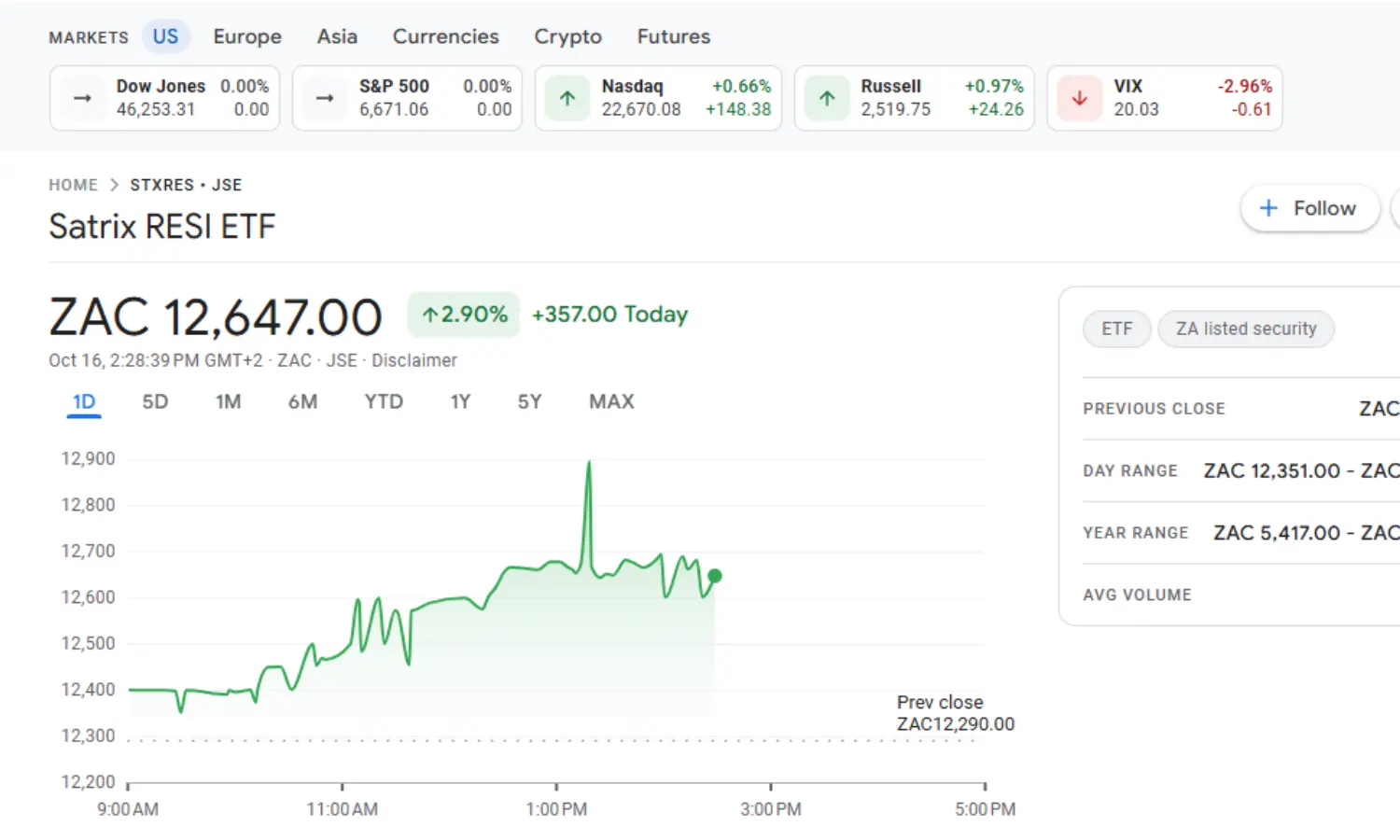
Mining built much of South Africa’s economy, and that legacy still runs deep. The Satrix RESI 10 ETF captures that story in a single investment, tracking the FTSE/JSE Resources 10 Index, which comprises the country’s largest mining and energy companies.
Why it still matters
Resources remain the backbone of the country’s exports. When global demand for copper, platinum, or coal rises, local mining often surges, and STXRES follows. It’s the ETF that moves with the price of the earth’s essentials. For some investors, it’s not about speculation; it’s about owning a slice of what South Africa still does best.
Where it fits
Most portfolios hold a core of broad equities such as STX40 or STXWDM. STXRES adds the natural-resource layer that those funds miss. Because commodity prices and currencies move in their own rhythm, this ETF can lift returns when other assets stall. Many investors keep a small portion, 5 to 10 per cent, to capture that cycle.
Points to weigh
- Commodity cycles: Booms can last years, but they always fade.
- Rand exposure: A weaker rand often boosts results.
- Operational strain: Power supply and infrastructure constraints continue to affect mining output.
The bottom line
STXRES tends to move with global demand for South Africa’s key export commodities, leading to periods of both growth and decline. For patient investors who understand cycles, this adds depth and texture, reminding them that sometimes growth is still dug from the ground.
TFPLT (1nvest Platinum ETF): a quieter play on South Africa’s precious strength

Few metals define South Africa as much as platinum. It’s used in car engines, jewellery, and now clean-energy technology. The 1nvest Platinum ETF (ETFPLT) gives investors a simple way to hold physical platinum without the risks of mining shares. Each unit is backed by real platinum held in vaults.
Why investors hold it
Platinum prices move with global manufacturing and green-energy trends. Demand for catalytic converters, hydrogen fuel cells, and industrial use all influence returns. While gold is a haven, platinum is a working metal; its price rises when economies build, not when they hide.
For South African investors, ETFPLT offers two layers of exposure: a stake in a valuable export commodity and a partial hedge against a weaker rand. When global industry expands, platinum often follows, and this ETF gives you access without company-specific risks.
How it fits in a portfolio
ETFPLT may be used as a small satellite around a core of equity and bond ETFs such as STX40 or STXILB. A 3% to 5% slice can add diversification. It rarely moves in sync with broader markets, making it useful for balancing volatility.
Things to consider
- Industrial demand: Platinum is tied to manufacturing cycles.
- Volatility: Prices can swing with global production trends.
- Storage costs: Fees are built into the ETF’s total expense ratio.
ETFRHO (1nvest Rhodium ETF): high risk, rare rewards
Rhodium behaves differently from most metals.
It’s rare, volatile, and often unpredictable. But when it moves, it does so fast. The 1nvest Rhodium ETF (ETFRHO) gives investors a direct way to hold physical rhodium in South Africa. Each unit represents a fraction of real metal held in custody.
Why investors take the chance
Rhodium is used mainly in vehicle catalytic converters, which control emissions. Supply is limited, and small shifts in demand can send prices soaring or falling. This scarcity attracts investors who prefer asymmetric opportunities: limited downside and large upside.
When industrial demand rises, ETFRHO can outpace almost every other commodity ETF in South Africa.
Where it fits
ETFRHO is generally considered a higher-risk investment and may be suitable only for investors comfortable with significant price volatility. Most investors keep it as a small speculative slice, no more than 2% to 3% of their total portfolio.
It doesn’t move with traditional markets, making it useful for tactical exposure when precious metals rally. If you’re exploring commodity ETFs or want to learn how metals behave under inflation and supply shocks, read our complete educational guide on ETF trading strategy.
Things to weigh
- Extreme volatility: Rhodium prices can rise or fall sharply within weeks.
- Liquidity: Fewer buyers and sellers mean wider spreads.
- Timing risk: It performs best in short bursts rather than steady climbs.
Final Thoughts: Building your 2026 ETF portfolio with balance and purpose
A Clear First Step To Start Trading ETFs is to Register a Live Trading Account
Selecting ETFs in South Africa isn’t about chasing what’s popular. It’s about matching your goals to the right mix of funds.
Each ETF on this list plays a role. Some bring growth, others bring income, and a few exist purely to protect what you’ve built.
If you’re new to this, read Vantage Academy’s guide on how to invest in ETFs in South Africa.
It breaks down the basics so you can build confidence before committing money.
RISK WARNING: CFDs are complex financial instruments and carry a high risk of losing money rapidly due to leverage. You should fully understand the risks involved and carefully consider whether you can afford to take the high risk of losing your money before trading.
Disclaimer: The information is provided for educational purposes only and doesn’t take into account your personal objectives, financial circumstances, or needs. It does not constitute investment advice. We encourage you to seek independent advice if necessary. The information has not been prepared in accordance with legal requirements designed to promote the independence of investment research.
No representation or warranty is given as to the accuracy or completeness of any information contained within. This material may include historical or past performance figures and should not be relied on.
Furthermore, estimates, forward-looking statements, and forecasts cannot be guaranteed. The information on this site and the products and services offered are not intended for distribution to any person in any country or jurisdiction where such distribution or use would be contrary to local law or regulation.
References
- ‘Bloomberg South Africa – ETF Market Updates (2025)‘ – https://www.bloomberg.com/africa
- ‘TradingView – Metals & Currency Charts (Gold, Platinum, Rhodium, ZAR/USD)’ – https://www.tradingview.com/
- ‘ETFSA.co.za – Monthly Performance Survey (Aug 2025)‘ – https://www.etfsa.co.za/
- ‘JSE.co.za – ETF Listings Data’ – https://www.jse.co.za/
- ‘MSCI – World Index Factsheet’ – https://www.msci.com/our-solutions/indexes/world-index/