
 Register
 Login
Login Register


ASX Outlook 2H 2025: Are Australian Stocks Ready to Break New Highs?

Hebe Chen >
Senior Market Analyst
Hebe Chen >
Senior Market Analyst
 Updated Mon, 2025 June 30 06:52

ASX has delivered everything but calm in the first half of 2025. Onshore, Cooling inflation finally gave the RBA the runway to act—triggering long-anticipated rate cuts in February and May. Offshore, markets were rattled by a rare wave of global shocks. The sharpest came on April 7, when Trump’s so-called “Liberation Day” sparked a 4.3% plunge on the ASX—its worst single-day fall since COVID.
ASX Half-Year Review: What Drove the Market in H1 2025
RBA and Inflation Shift
The inflation surge that defined recent years has meaningfully cooled.
As the chart below shows, all key measures of price growth—headline CPI, core CPI (ex. volatiles), and the trimmed mean—have steadily cooled since their 2022–23 peaks. By May 2025, the trimmed mean dropped to 2.4% and headline CPI hit 2.1%, both comfortably inside the RBA’s 2–3% target range.
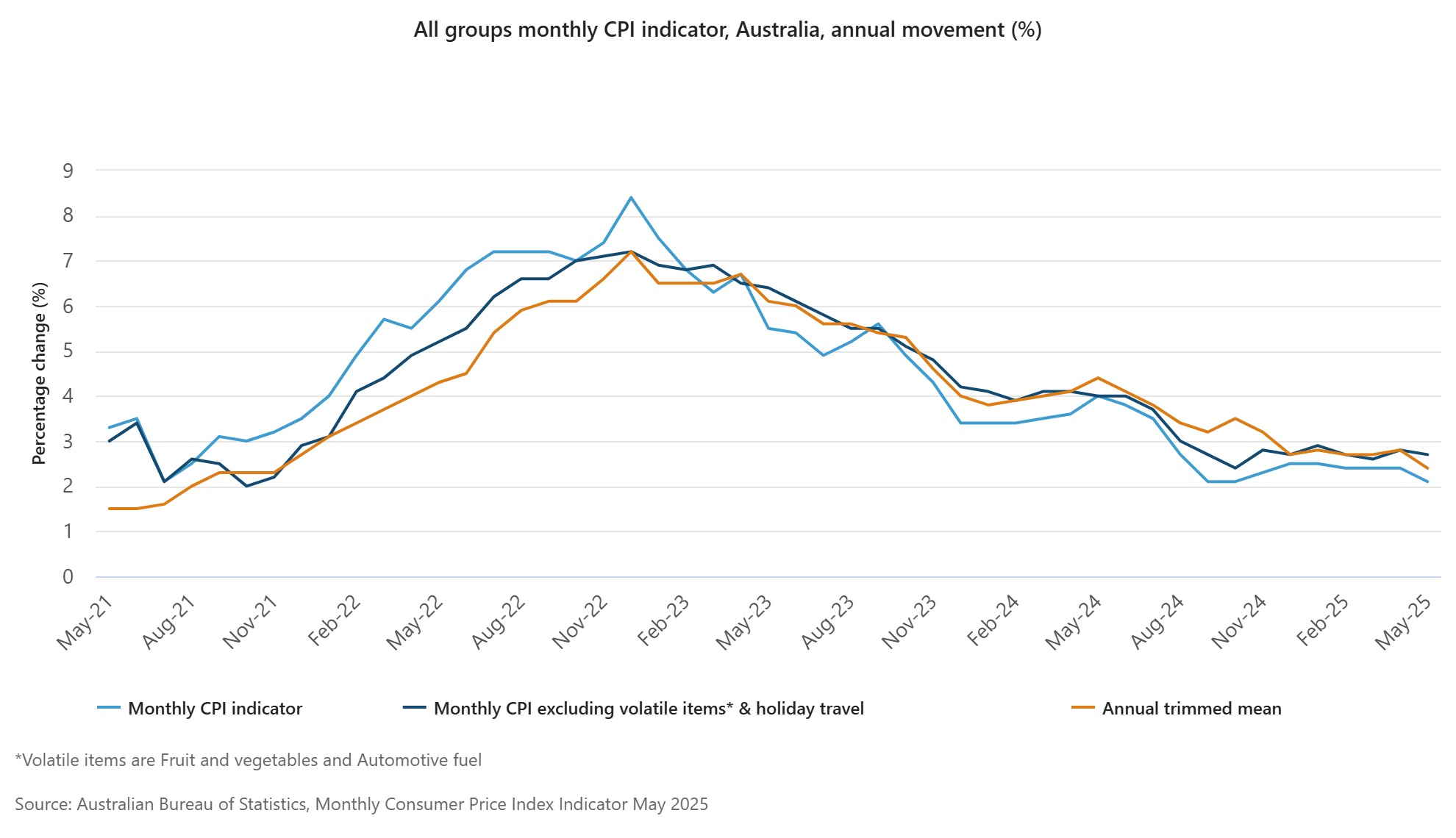
This consistent disinflation trend has given the RBA breathing space. It acted decisively with two 25bps cuts—first in March, then again in May—bringing the cash rate down to 3.85%. The pivot marks a turning point, aiming to support a soft landing while offering relief to borrowers.
While May’s federal election added a layer of political noise, it hasn’t disrupted the RBA’s policy trajectory or market confidence so far. The focus remains squarely on inflation’s trajectory—and for now, the trend is finally working in the RBA’s favour.
Global Volatility and Trade Tensions
Beyond Australia’s borders, geopolitical and trade headwinds have dominated the global macro narrative in H1 2025. Tensions in the Middle East, surprisingly directly involved by Washington, and disruptions across key shipping routes have weighed heavily on investor sentiment. Australia hasn’t been spared. Slower global growth and weaker demand from major trading partners are starting to filter through to domestic activity.
GDP growth in Q1 2025 softened further, expanding just 0.2%—the weakest quarterly print since early 2023. As the chart below shows, contributions from private demand remain anaemic, while net trade posted another drag on growth. Public demand offered only a modest offset. It’s a clear signal that external volatility is dampening momentum just as the domestic cycle is pivoting.

ASX Sectors: Cyclicals and financials lead the gain

The ASX sector performance in H1 2025 paints a broadly constructive picture, with 9 of 11 sectors in the green. Leading the gains is Telecommunication, up 12.37%, as strong earnings upgrades and appetite for defensive growth fueled the rally. Financials (+11.88%) followed closely, lifted by resilient credit trends and CBA’s robust rally.
Industrials (+8.44%) gained on infrastructure tailwinds, while Real Estate (+5.35%) benefited from easing bond yields and rate-cut optimism. Discretionary (+5.10%) and Staples (+3.32%) signalled a stabilising consumer pulse, even as cost-of-living pressures linger. Tech (+4.54%) saw renewed interest, despite a sharp fall in the early months, helped by softening inflation and AI enthusiasm.
At the lower end, Utilities (+1.87%) and Energy (+0.64%) struggled with weak demand and price volatility. Materials (-2.95%) faced pressure from China’s uneven recovery and sliding metal prices, especially cloudy by the tariff uncertainty. Health Care extended its losing streak from the previous years, down 7.30%, weighed by valuation drag and subdued biotech earnings.
Investors’ rotation into cyclicals and financials underscores a cautious belief in a soft-landing scenario, even as defensives lose favour.
ASX Second Half of 2025 Outlook: Eyes on More Cuts, Trade, and Commodities
The road ahead for the Australian equities will be largely shaped by a trio of forces into the second half of the year: RBA policy, global trade shifts, and commodity market volatility.
RBA Expectations
Thanks to recent inflation and job market development, markets are firmly pricing in more easing ahead. As shown in the ASX 30-Day Interbank Cash Rate Futures chart below, traders are betting on a continued downtrend in rates through year-end, with the implied yield falling below 3.1% by December—down from 3.85% currently. That trajectory hinges on inflation staying contained and growth remaining sluggish. If those conditions hold, the RBA could cut up to three times in the Q3 and Q4.

Global Trade Dynamics
On the external front, uncertainty remains elevated. Trade frictions between the U.S. and China continue to rattle supply chains and weigh on sentiment. For Australia, its relationships with both giants—especially amid shifting policy and economic trajectories—will be critical to watch in the months ahead.
Commodity Markets
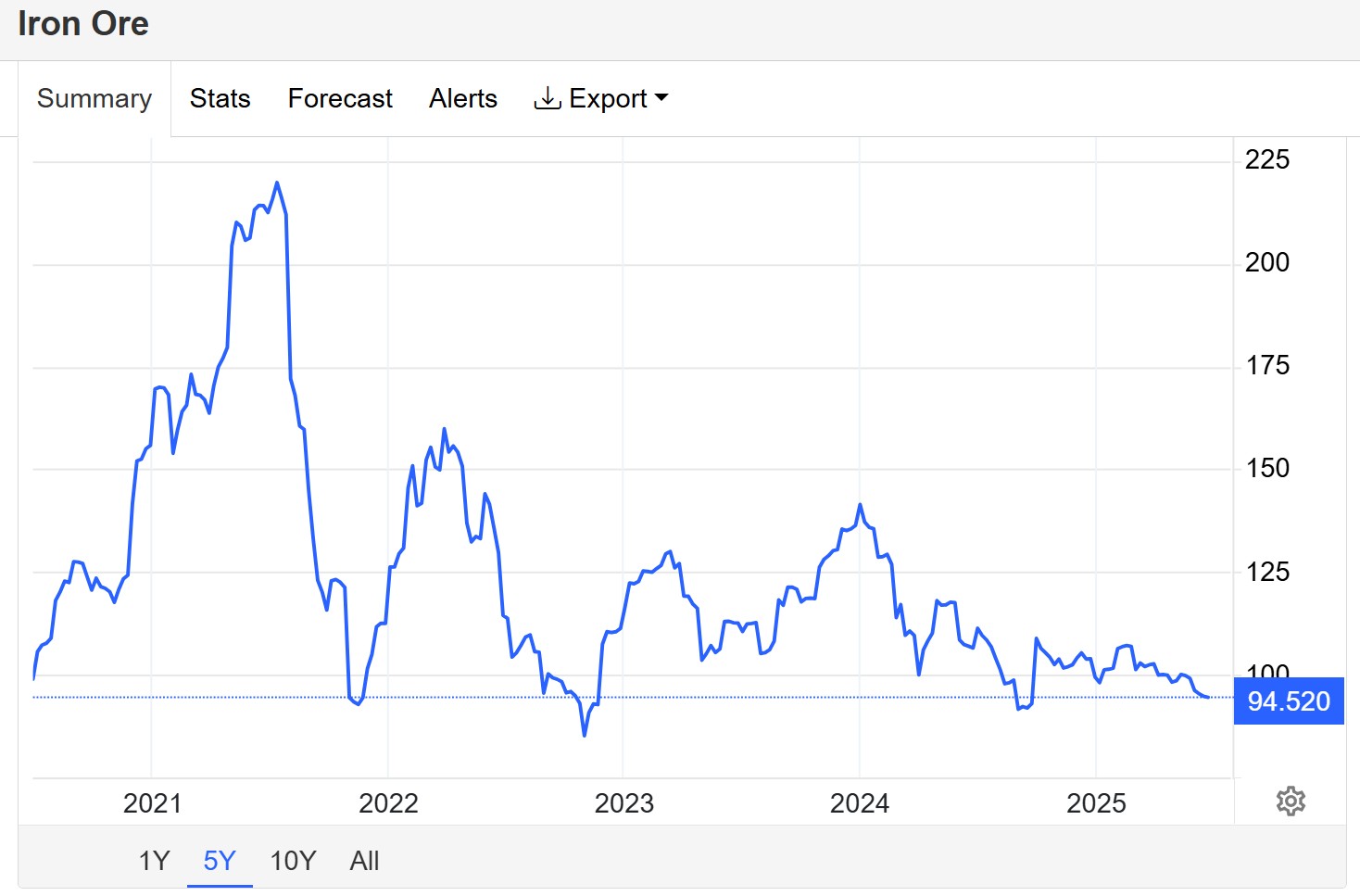
Australian miners are expected to remain under pressure. While geopolitical shocks and supply disruptions could spark short-term rallies, the bigger picture points to softer demand—especially as China enters a new phase of economic malaise and trade tensions with the U.S. intensify. Iron ore and energy prices look particularly vulnerable, posing headwinds for Australia’s resource-heavy sectors and trade surplus. UBS forecasts iron ore to average around US$100/tonne this year, with a gradual tapering to US$95 in 2026 and US$90 in 2027—signalling the tail end of the boom cycle.
Conclusion
As we head into the second half of 2025, the ASX isn’t short on moving parts. The backdrop of cooling inflation and likely further RBA cuts offers some breathing room—but it’s far from smooth sailing. Global volatility, from trade tensions to commodity swings, will keep investors on edge. Australian miners, in particular, may struggle under the weight of weaker Chinese demand and a shifting trade landscape. With iron ore prices expected to trend lower over the next few years, the tailwind for resources looks to be fading.
In this kind of market, agility is everything. Staying ahead means tracking macro shifts, sector fundamentals, and the global currents shaping domestic risk.
Disclaimer: The material provided here has not been prepared in accordance with legal requirements designed to promote the independence of investment research and as such is considered to be a marketing communication. Whilst it is not subject to any prohibition on dealing ahead of the dissemination of investment research we will not seek to take any advantage before providing it to our client. No representation or warranty is given as to the accuracy or completeness of this information and therefore it shouldn’t be relied upon as such. Any research provided does not have regard to specific financial situations, needs or investment objectives. Vantage accepts no responsibility for any use that may be made of these comments and for any consequences that result. Consequently, any person acting on it does so entirely at their own risk. We advise any readers of this material to seek professional advice where necessary. Without the approval of Vantage, reproduction or redistribution of this information isn’t permitted.
-

Open Trading Account
Discover the endless trading possibilities with our cutting-edge platform, designed to empower our traders. Practice trading the markets with a free demo account today.
-

Download Vantage App
Trade on the go with the Vantage All-In-One Trading App, where smooth execution and market access come together in the palm of your hand.
-

Start Trading
Are you an existing user? Login to your account to start trading 1,000+ CFD products including forex, indices, gold, shares and more.
