Register
 Login
Login Register


Oil is one of the most actively traded raw materials in the world. Its price is driven by forces that are both global and immediate. From decisions made in OPEC boardrooms to the geopolitical flashpoints that disrupt supply overnight.
For traders who want exposure to crude oil’s price movements without taking physical ownership of the commodity, oil CFDs are one of the most accessible tools available.
This guide explains how oil CFDs work, what drives oil prices, and how you can build a structured approach to trading them — with specific context for Australian retail traders operating under ASIC regulation.
Key Takeaways
- Oil CFDs let you speculate on crude oil price movements without owning physical oil.
- You can profit or incur losses based on the difference between your entry and exit price.
- In Australia, ASIC caps commodity CFD leverage at 10:1 for retail traders.
- The two main oil benchmarks are Brent Crude and WTI (West Texas Intermediate).
- Effective risk management, especially with leveraged products essential.
What Is an Oil CFD?
A Contract for Difference (CFD) is a financial derivative that allows traders to speculate on the price movement of an underlying asset. In this case, crude oil – without buying or selling the physical commodity itself.
When you trade an oil CFD, you agree to exchange the difference in the price of crude oil between the point at which you open your position and the point at which you close it. If you open a long (buy) position and the price rises, you may profit from the difference. If the price falls, you incur a loss. Equally, you can open a short (sell) position if you expect prices to decline — but if prices rise instead, you will incur a loss.
Because oil CFDs are leveraged products, you are only required to deposit a fraction of the total trade value upfront — known as the margin. Leverage amplifies both potential gains and potential losses relative to your initial deposit. It is possible to lose your entire deposited margin.
ASIC Regulation — Australian Traders
In Australia, ASIC (Australian Securities and Investments Commission) regulates CFD trading under its product intervention order, which has been in effect since 29 March 2021 and was extended for five years in 2022. For commodity CFDs — including oil — ASIC limits the maximum leverage for retail clients to 10:1. ASIC also mandates negative balance protection, which means your losses cannot exceed the funds in your trading account. These rules apply to all ASIC-regulated brokers.
How Oil CFD Trading Works
The following is a simplified hypothetical example to illustrate the mechanics of an oil CFD trade. It does not reflect actual oil market conditions or guaranteed outcomes.
Any examples provided are hypothetical and for illustrative purposes only. They do not reflect actual trading results or client experiences.
- Brent crude is hypothetically trading at USD 85.00 per barrel.
- A trader opens a long CFD position on 10 barrels (total position value: USD 850).
- With ASIC’s 10:1 leverage cap, the required margin is 10% — USD 85.
- Scenario A: price rises to USD 88.00: the position has gained USD 30 (10 barrels × USD 3.00). The trader closes and receives this gain.
- Scenario B: price falls to USD 82.00: the position has lost USD 30. This loss is deducted from the account. If the price continued to fall further, losses could exceed the initial margin deposit unless a stop-loss is in place.
Relevant for Australian Traders
Australian traders face an additional currency consideration: oil is priced in US dollars, but your account is likely held in AUD. The AUD/USD exchange rate therefore, affects your net return. If the AUD strengthens against the USD while your position is open, your USD-denominated profit is worth less when converted back to AUD — and losses can be larger in AUD terms if the AUD weakens.
The Two Main Oil Benchmarks: Brent and WTI
When trading oil CFDs, you will typically trade one of two major crude oil benchmarks:
Brent Crude Oil
Brent crude oil is extracted from the North Sea and is the global benchmark for oil pricing. It is used to price the majority of the world’s internationally traded crude oil and is the more relevant benchmark for Australian traders, since Australia’s oil imports and the export pricing of local energy companies such as Woodside (ASX: WDS) are typically referenced against Brent.
WTI (West Texas Intermediate)
WTI crude oil is the primary benchmark for the US oil market, sourced from fields in Texas, North Dakota, and Louisiana. WTI is slightly lighter and sweeter than Brent. It is more directly influenced by US-specific factors such as domestic inventory data, pipeline constraints, and shale production levels. Australian traders typically monitor WTI as a leading indicator for global oil sentiment.
| Benchmark | Key Characteristics |
| Brent Crude | Global benchmark; North Sea origin; used in ~78% of global oil trade; more responsive to geopolitical events |
| WTI Crude | US benchmark; lighter and sweeter; influenced by US domestic supply data; trades at a slight discount to Brent |
▶ Vantage Video: Crude Oil — WTI vs Brent
New to WTI and Brent? This Vantage explainer video covers the key properties of each benchmark, how they are priced, and the three main instruments used to trade them — a useful two-minute primer before diving into the sections below.
Watch on YouTube: https://www.youtube.com/watch?v=LgO6jUlqhKo
What Drives Oil Prices?
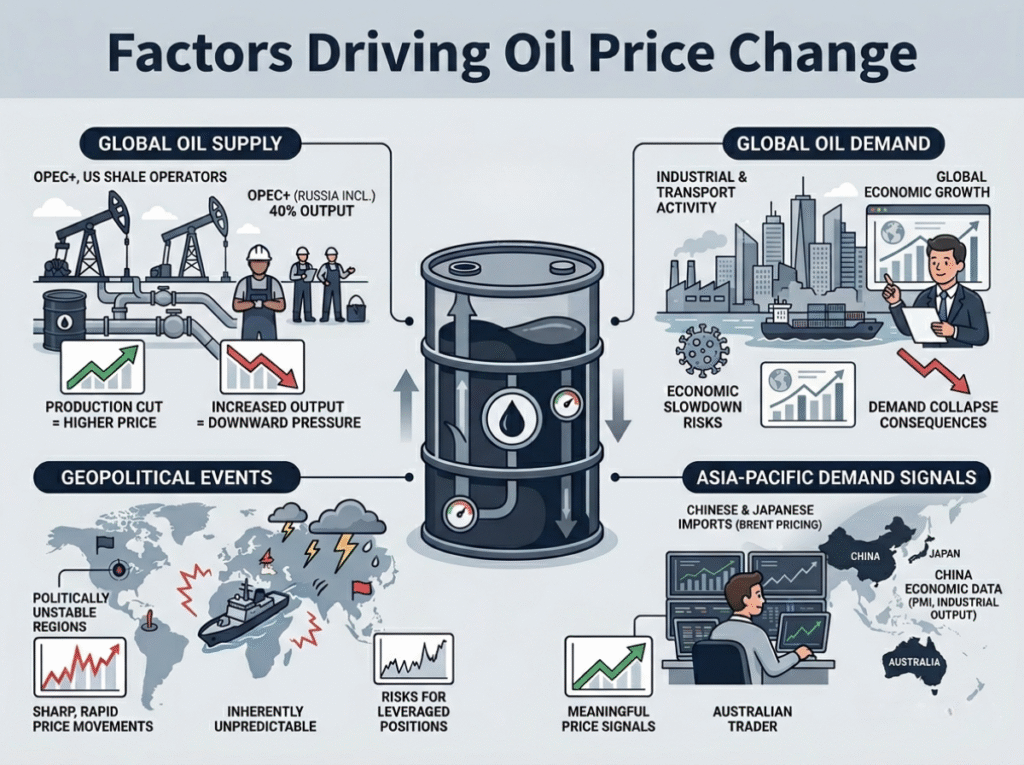
Understanding what moves oil prices is fundamental to trading oil CFDs. Three primary forces drive price changes:
Supply
The volume of crude oil produced globally — by OPEC member nations, US shale operators, and other producers — determines supply levels. OPEC+, which includes Russia and accounts for roughly 40% of global oil output, actively manages production to influence price. A decision to cut production typically sends prices higher; increasing output puts downward pressure on prices. However, markets can be unpredictable, and supply changes do not always produce expected price outcomes.
Demand
Global economic growth is the biggest driver of oil demand. When major economies are expanding, industrial production, transport, and energy consumption all rise, pushing oil demand higher. Conversely, economic slowdowns — as seen during the COVID-19 pandemic in 2020 — can cause demand to collapse dramatically and rapidly, with severe consequences for oil prices and leveraged positions.
Relevant for Australian Traders
For Australian traders, Asia-Pacific demand is particularly relevant. China and Japan are among the world’s largest crude oil importers, both priced primarily off Brent. Economic data from China — including manufacturing PMI and industrial output — can be meaningful signals for Brent crude price direction. However, past relationships between indicators and price movements are not guaranteed to repeat.
Geopolitical Events
Because much of the world’s oil is produced in or transported through politically unstable regions, geopolitical events can cause sharp, rapid price movements in either direction. These events are inherently unpredictable and can result in swift losses for leveraged positions.
How to Trade Oil CFDs: A Step-by-Step Guide
- Choose your oil benchmark — Brent or WTI (or both). Brent is more relevant to Australian traders given its role as the global pricing standard.
- Open a trading account and deposit funds. Ensure you understand margin requirements under ASIC’s 10:1 leverage cap for commodity CFDs and the risks of trading on leverage.
- Decide your position direction — go long if you expect prices to rise, short if you expect them to fall. Both directions carry the risk of loss.
- Set your risk management parameters before entering — including stop-loss orders to cap potential losses and take-profit levels to manage your exit.
- Monitor your position and stay updated on key market news: OPEC decisions, weekly EIA inventory data, and significant geopolitical developments.
- Close your position when your target price is reached or your stop-loss is triggered.
Risk Management When Trading Oil CFDs
Crude oil is one of the most volatile commodity markets in the world. Effective risk management is not optional — it is a prerequisite for any responsible approach to trading.
Trade sizing
The standard guideline is to risk no more than 1–2% of your total account capital on any single trade. This limits the damage from any single losing trade, but does not eliminate the risk of loss.
Leverage discipline
ASIC caps commodity CFD leverage at 10:1 for Australian retail traders. Even at this limit, leverage significantly amplifies both gains and losses. Many traders choose to use leverage well below the regulatory maximum. A 10% adverse price move at 10:1 leverage would eliminate the full margin deposit.
Stop-loss orders
A stop-loss automatically closes your position at a predetermined price, limiting how much you can lose on a single trade. Set your stop-loss level before you enter the trade, and resist the urge to move it further away if the market moves against you.
Take-profit orders
A take-profit closes your position once a target price is reached. This removes emotion from the exit decision and helps prevent giving back gains in a market reversal.
Oil CFD Trading Strategies
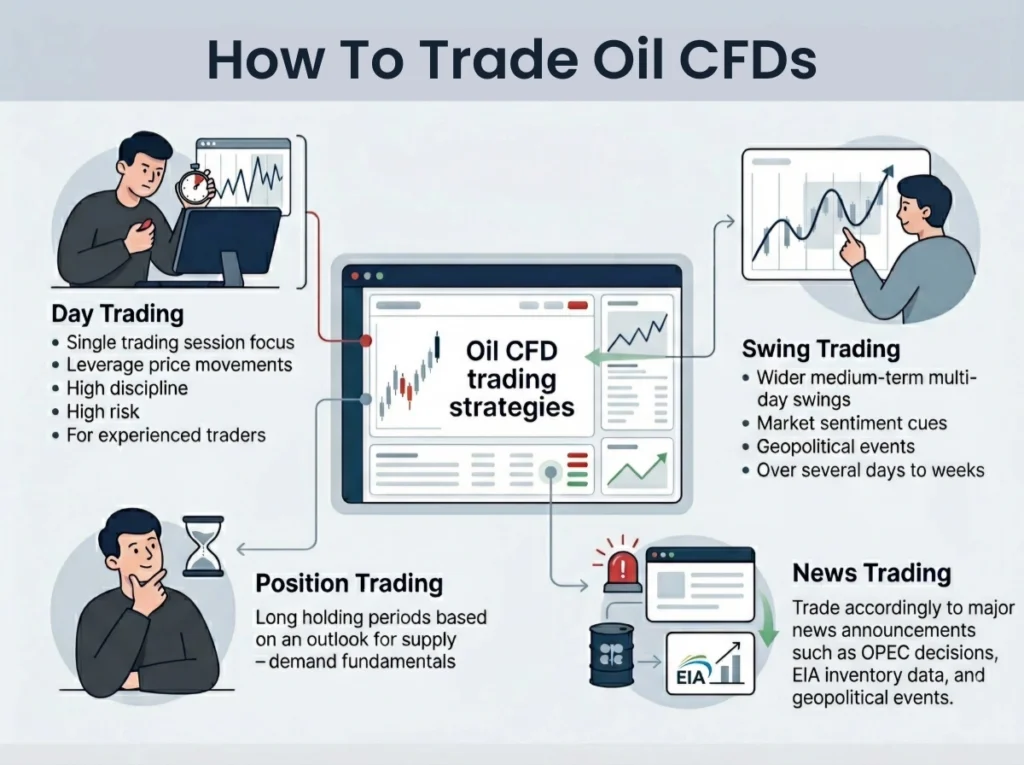
The following strategies are general educational frameworks. They do not constitute personalised advice. All trading strategies carry risk, and past results in any strategy do not guarantee future outcomes.
Day trading
Day traders open and close positions within a single trading session, aiming to capture price movements using leverage. This is a high-discipline, high-risk approach that is generally more suitable for experienced traders. The use of leverage in fast-moving markets significantly increases the risk of rapid and substantial losses.
Swing trading
Swing traders hold positions for several days to weeks, targeting price swings driven by shifts in market sentiment, geopolitical events, or macroeconomic data. This approach also carries risk, particularly when held through unexpected news events.
Position trading
Position traders hold trades for weeks or months based on their outlook for supply-demand fundamentals. This strategy requires strong conviction and the ability to tolerate sustained drawdowns without closing prematurely.
News trading
News traders react to major announcements — OPEC decisions, EIA inventory data, geopolitical events. Speed of execution is important, but does not guarantee a profitable outcome. Markets can move against the apparent implication of news, particularly in highly leveraged environments.
Start Trading Oil CFDs
Oil CFDs offer Australian traders a practical way to gain exposure to one of the world’s most actively traded commodities — without taking ownership of physical barrels. Whether you’re drawn to the global reach of Brent crude or the US-centric dynamics of WTI, the mechanics are the same: you’re trading the price movement, not the asset itself.
But crude oil is a volatile market, and leverage — even at ASIC’s capped 10:1 ratio for retail traders — amplifies both gains and losses quickly. The traders who approach oil CFDs most responsibly are those who treat risk management as non-negotiable: sizing positions carefully, setting stop-losses before entering a trade, and never risking more than they can afford to lose.
If you’re new to oil CFDs, the most sensible starting point is a demo account — where you can trade live market conditions with virtual funds, test your strategy, and build familiarity with how crude oil moves before committing real capital.
When you’re ready to trade live, Vantage offers both Brent and WTI oil CFDs under ASIC regulation, with negative balance protection in place for retail clients.
Risk Warning
CFDs are complex financial instruments and carry a high risk of losing money rapidly due to leverage. You should ensure you fully understand the risks involved and carefully consider whether you can afford to take the high risk of losing your money before trading.
Frequently Asked Questions (FAQs)
What is the difference between Brent and WTI crude oil CFDs?
Brent CFDs track the global oil benchmark priced in the North Sea. WTI CFDs track the US benchmark. Both are tradeable as CFDs on the Vantage platform. For a full comparison, see our Brent vs WTI guide.
What happens to my oil CFD if the oil price goes up?
If you hold a long (buy) position and the oil price rises, your position gains in value. If you hold a short (sell) position and the oil price rises, your position incurs a loss. The reverse applies if the price falls. All positions carry the risk of loss.
What is the maximum leverage for oil CFDs in Australia?
Under ASIC’s product intervention order, the maximum leverage for retail traders on commodity CFDs (including oil) is 10:1. This means a $1,000 deposit can control a $10,000 position — but losses are also calculated on the full position value.
Can I lose more than I deposit when trading oil CFDs in Australia?
Under ASIC’s negative balance protection rules, your losses cannot exceed the funds in your trading account when trading with an ASIC-regulated broker. However, you can lose your entire deposited amount.
What is the best way to practise oil CFD trading?
A demo account allows you to trade with virtual funds under real market conditions. This is recommended before committing real capital; however, demo trading does not involve real financial risk, so it may not fully replicate the psychological experience of live trading.