Register
 Login
Login Register


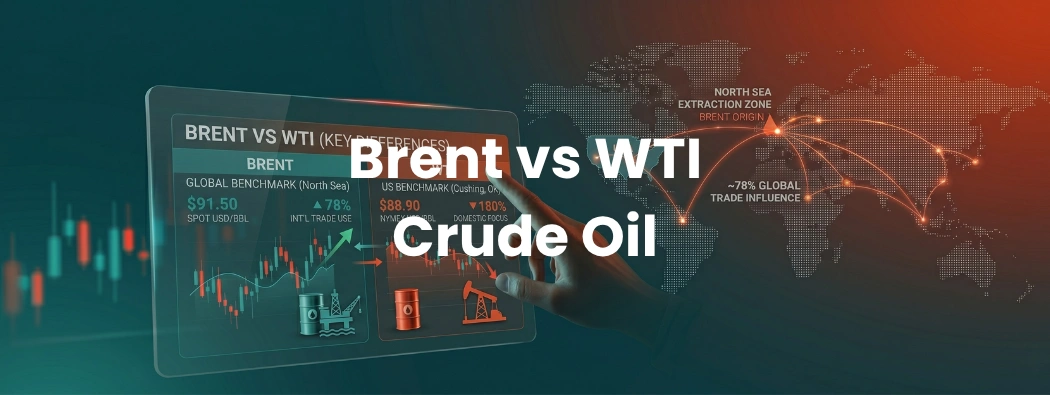
When you start trading crude oil, you quickly encounter two names: Brent and WTI. These are not just different oil products — they are the two reference benchmarks that define how crude oil is priced across the entire global market.
Understanding the distinction between them and knowing which is more relevant to your trading strategy is one of the foundational skills in commodity trading.
This guide breaks down what separates Brent and WTI, how their prices interact, and what Australian traders specifically need to know when choosing between them.
Key Takeaways
- Brent Crude (North Sea) is the global oil benchmark, used in ~78% of internationally traded crude.
- WTI (West Texas Intermediate) is the US benchmark, traded on the NYMEX in Cushing, Oklahoma.
- Both benchmarks are available to trade via CFDs, ETFs, and stocks.
- Brent is generally more relevant to Australian traders; WTI serves as an important global sentiment indicator.
- ASIC caps commodity CFD leverage at 10:1 for Australian retail clients.
- All trading involves risk. You may lose all of your invested capital.
▶ Watch: Crude Oil — WTI vs Brent
This short video from Vantage walks through the key differences between WTI and Brent crude oil — covering types and properties, how each benchmark is priced, what factors drive their prices, and the three main ways to trade them (futures, CFDs, and ETNs). Watch it for a quick visual overview before reading the detailed comparison below.
Watch on YouTube: https://www.youtube.com/watch?v=LgO6jUlqhKo
Note: Oil trading carries risk. It is essential to conduct thorough research before making any investment decisions.
What Is Brent Crude Oil?
Brent Crude is extracted from several oil fields in the North Sea — including Brent, Forties, Oseberg, Ekofisk, and Troll (collectively known as BFOET). It is classified as ‘light’ and ‘sweet’, meaning it has relatively low density and a sulphur content below 0.5%. These qualities make it straightforward and cost-efficient to refine into high-value products like gasoline, diesel, and jet fuel.
Brent is traded on the Intercontinental Exchange (ICE) and serves as the pricing benchmark for oil exported from Europe, Africa, and the Middle East. Approximately 78% of globally traded physical crude oil is priced with reference to Brent, making it the dominant international standard.
Relevant for Australian Traders
Brent crude is the more directly relevant benchmark for Australian traders. Australia’s oil imports are priced off Brent, and the revenues of ASX-listed energy producers like Woodside Energy (ASX: WDS) and Santos (ASX: STO) are closely tied to Brent pricing. When Brent prices rise, ASX energy stocks have historically tended to follow — though past correlations do not guarantee future performance, and individual company results can diverge significantly from commodity price movements.
What Is WTI Crude Oil?
West Texas Intermediate (WTI) is extracted primarily from the Permian Basin and other fields across Texas, North Dakota, and Louisiana. It is physically traded and settled at Cushing, Oklahoma — a major US crude oil storage and distribution hub — and is the underlying commodity for the New York Mercantile Exchange (NYMEX) oil futures contract.
WTI is classified as slightly lighter and sweeter than Brent, with a sulphur content of 0.24% compared to Brent’s 0.40%. This makes it marginally easier to refine, though both grades are considered premium quality.
While WTI is primarily a US market benchmark, it is closely watched globally as a leading indicator of oil market sentiment. WTI and Brent tend to move in the same direction, though the size of the gap between them — the Brent-WTI spread — reflects differences in regional supply, transportation logistics, and local market dynamics.
Brent Vs WTI Comparison
| Category | Brent Crude | WTI Crude |
| Origin | North Sea (UK/Norway) | Texas, North Dakota, Louisiana (USA) |
| Exchange | ICE (Intercontinental Exchange) | NYMEX (New York Mercantile Exchange) |
| API Gravity | 38° (slightly denser) | 39.6° (slightly lighter) |
| Sulphur Content | 0.40% (less sweet) | 0.24% (sweeter) |
| Transport | Tanker (sea — global access) | Pipeline (inland US — more regional) |
| Global Role | International benchmark (~78% of global trade) | US benchmark; global sentiment indicator |
| AU Relevance | High — prices Australia’s oil imports and ASX energy revenues | Moderate — global sentiment indicator; less direct AU impact |
What Drives the Price of Each Benchmark?
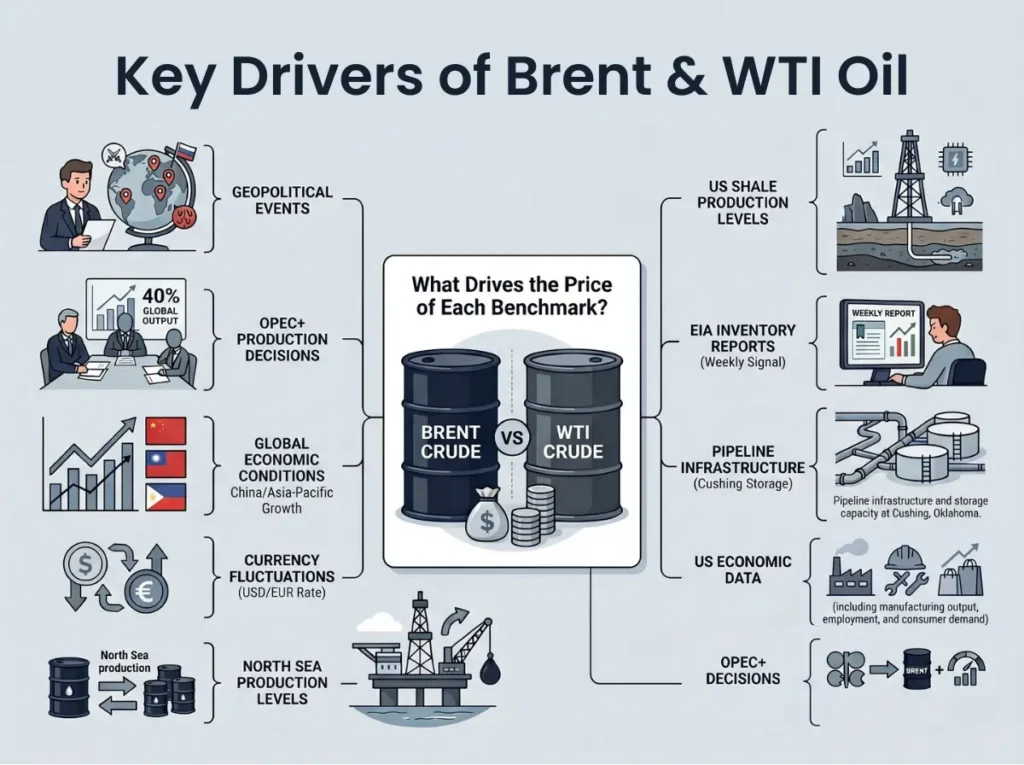
Brent crude price drivers
Brent is more exposed to international forces. Key drivers include:
- Geopolitical events in oil-producing regions (Middle East, Russia, North Africa)
- OPEC+ production decisions — the cartel controls roughly 40% of global output
- Global economic conditions — particularly demand growth from China and the Asia-Pacific region
- Currency fluctuations, particularly the USD/EUR rate
- North Sea production levels and field decommissioning trends
WTI crude price drivers
WTI is more sensitive to US-specific conditions. Key drivers include:
- US shale production levels, which can shift rapidly with technology and breakeven costs
- Weekly EIA inventory reports — the most closely watched short-term price signal for WTI
- Pipeline infrastructure and storage capacity at Cushing, Oklahoma
- US economic data, including manufacturing output, employment, and consumer demand
- OPEC+ decisions (via their effect on global sentiment and Brent, which WTI tends to follow)
The Brent-WTI Spread
The price difference between Brent and WTI — known as the Brent-WTI spread — is actively monitored by traders as a market signal. Historically, Brent has traded at a slight premium to WTI, typically in the range of USD 2–5 per barrel, reflecting its broader global accessibility. However, this historical pattern is not guaranteed to persist.
The spread can widen or narrow significantly in response to:
- US supply gluts (which weigh on WTI specifically)
- Middle Eastern geopolitical tensions (which push Brent higher)
- Infrastructure bottlenecks at Cushing, Oklahoma (which trap WTI supply)
Relevant for Australian Traders
For Australian traders, the Brent-WTI spread serves as a macro context signal. A widening spread can indicate that global supply concerns are dominating; a narrowing spread may reflect US domestic supply pressure. Tracking the spread adds context to trading decisions — but it is not a trading signal in isolation and should be considered alongside other analysis.
How Each Benchmark Can Be Traded
CFDs (Contracts for Difference)
CFDs allow you to trade price movements in both Brent and WTI without owning the physical commodity. You can take long or short positions on either benchmark. On the Vantage platform, Brent CFDs are available via UKOUSD (spot) and UKOUSDft (futures); WTI CFDs via USOUSD (spot) and CL-OIL (futures). CFD trading involves significant risk and may not be suitable for all investors.
ASIC Regulation — Australian Traders
Under ASIC’s product intervention order, commodity CFD leverage for retail clients in Australia is capped at 10:1. This applies to both Brent and WTI CFDs. ASIC also requires negative balance protection — you cannot lose more than the funds in your account when trading with an ASIC-regulated broker.
ETFs
Exchange-traded funds offer a more passive route to crude oil exposure. In Australia, the key option is:
- BetaShares Crude Oil Index ETF (ASX: OOO) — Australia’s only ASX-listed crude oil ETF. It tracks crude oil futures performance with AUD currency hedging.
- US-listed options such as BNO (Brent) and USL (WTI) are also available through international brokerage accounts. ETFs are subject to market risk, and returns are not guaranteed.
ASX Energy Stocks
ASX-listed energy companies provide indirect oil price exposure through equity markets. Past correlations between these stocks and oil prices are not guaranteed to continue, and company-specific factors also influence their performance:
- Woodside Energy (ASX: WDS) — Australia’s largest listed oil and gas producer
- Santos (ASX: STO) — significant LNG and oil production
- Beach Energy (ASX: BPT) — smaller producer with higher price sensitivity and correspondingly higher risk
- Ampol (ASX: ALD) — downstream refiner; exposure to refining margins rather than raw crude price
Past performance is not a reliable indicator of future results. Dividend yields and returns referenced are historical and not guaranteed.
Brent or WTI: Which Should You Trade?
The choice between Brent and WTI depends on your trading goals, knowledge base, and risk tolerance. Neither benchmark is inherently better — both carry significant risk. The following is general information only and does not constitute personalised investment advice.
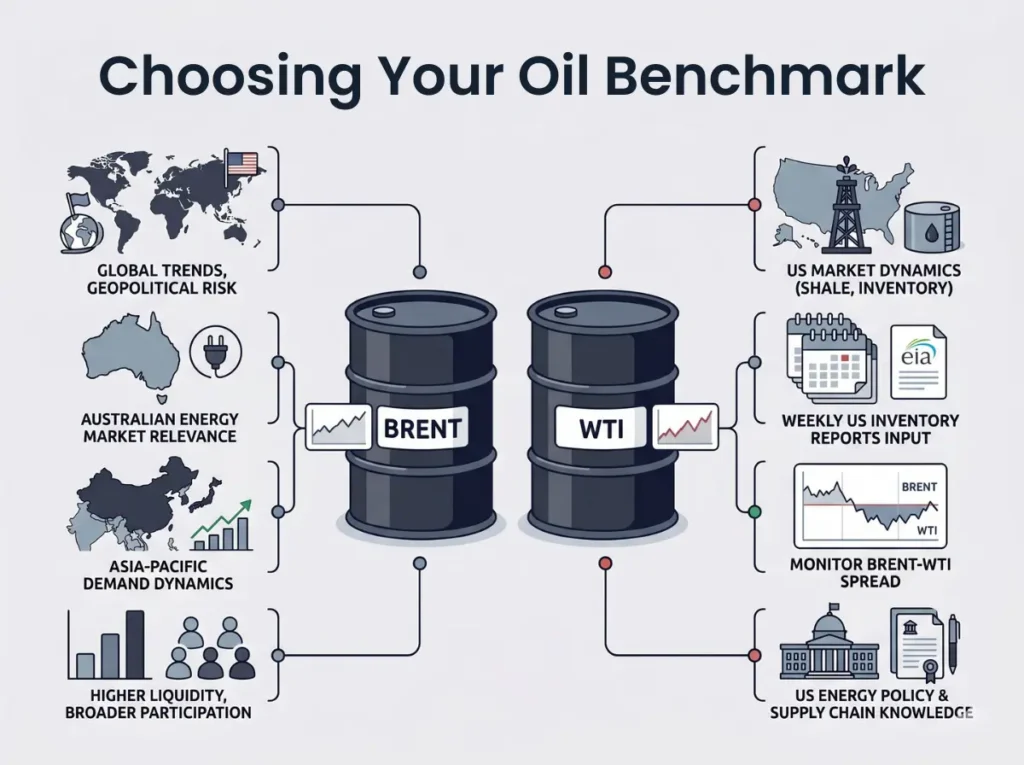
Consider Brent if:
- You are focused on global macroeconomic trends and geopolitical risk
- You want the benchmark most relevant to Australian energy markets
- You are watching Asia-Pacific demand dynamics (China, Japan, South Korea)
- You prefer higher liquidity and broader market participation
Consider WTI if:
- You are focused on US market dynamics — shale production, EIA inventory data, pipeline infrastructure
- You use weekly US inventory reports as a primary analysis input
- You want to monitor the Brent-WTI spread as a macro context indicator
- You have strong knowledge of US energy policy and domestic supply chain factors
Note for Australian traders:
Brent crude is the benchmark that most directly affects Australian energy import costs and ASX energy company revenues. WTI is an important global sentiment indicator. Most Australian oil CFD traders find Brent the more intuitive starting point — but this general observation does not constitute advice specific to your situation.
Start Trading Brent or WTI Crude Oil with Vantage
There is no universally better benchmark between Brent and WTI — the more relevant choice depends on your trading focus, knowledge base, and risk tolerance. Brent is the more directly applicable benchmark for Australian traders, pricing local energy imports and underpinning ASX energy company revenues. WTI, while US-centric, remains a critical global sentiment indicator that can set the tone for Brent and broader energy markets.
Understanding how the two benchmarks relate to each other — and what drives them apart — gives you a more complete picture of the global crude oil market than following either benchmark in isolation. But whether you trade Brent, WTI, or both, the risks are the same: oil is one of the most volatile commodity markets in the world, and leverage amplifies losses as quickly as it amplifies gains.
If, after reading this guide, you feel Brent or WTI crude oil CFDs may suit your trading approach, you can explore CFD trading in more detail, practise first with demo trading, or open a live account when you are ready.
Frequently Asked Questions
Is Brent or WTI more expensive?
Brent has historically traded at a modest premium to WTI. However, this relationship is not constant and has inverted in the past. Past price relationships are not a guarantee of future pricing.
Do Brent and WTI move together?
Brent and WTI are broadly correlated but can diverge, particularly when US-specific factors (shale output, Cushing storage levels) cause WTI to move independently for a period. Correlation is not guaranteed and can change significantly during market stress.
How does the oil price affect Australian consumers?
Rising oil prices can feed through to higher petrol prices and increased costs for goods relying on transport and logistics. Falling oil prices may reduce costs for consumers but can also adversely impact revenues and employment in the domestic energy sector.