Updated
To learn forex trading step by step, work through a clear sequence: build the theory, choose a regulated broker, learn technical and fundamental analysis, set your risk rules, write a trading plan, and practise on a demo account before any real capital is involved. Forex, short for foreign exchange, is the world’s largest financial market, with average daily turnover reaching $9.6 trillion in April 2025 [1].
Most beginners access it through forex CFDs (Contracts for Difference), which track currency price movements without owning the underlying currency. The scale can feel daunting, and no shortcut removes the risk. What follows is a practical roadmap — what to study, in what order, and how to turn reading into skill — so the learning curve becomes manageable rather than overwhelming.
Key Points
- Learning forex trading step by step means following a structured sequence — theory, analysis, risk management, a written trading plan, and demo practice — rather than searching for a single winning strategy.
- A demo account lets you apply what you have learned using simulated funds; a widely cited benchmark is at least six months of consistent demo results before considering live trading.
- Leverage magnifies both gains and losses in forex CFD trading and can result in significant losses, which is why risk rules are learned before live capital is involved, not after.
What Is Forex Trading, and What Are You Learning?
Forex trading is the exchange of one currency for another to seek opportunities from changing exchange rates. In practice, most retail traders access the market through forex CFDs, which allow them to speculate on price movements without physically exchanging currencies. The forex market runs 24 hours a day, five days a week, spanning major financial centres around the world.
Its scale is genuine: daily turnover rose 28% from $7.5 trillion in April 2022 to $9.6 trillion in April 2025, according to the Bank for International Settlements [1].
Prices move constantly in response to economic data, central bank decisions, geopolitical events, and shifts in market sentiment, which is what makes currency markets both dynamic and complex. Learning forex is less about predicting those moves perfectly and more about understanding how the pieces fit together.
Currency Pairs, Pips, and Spreads
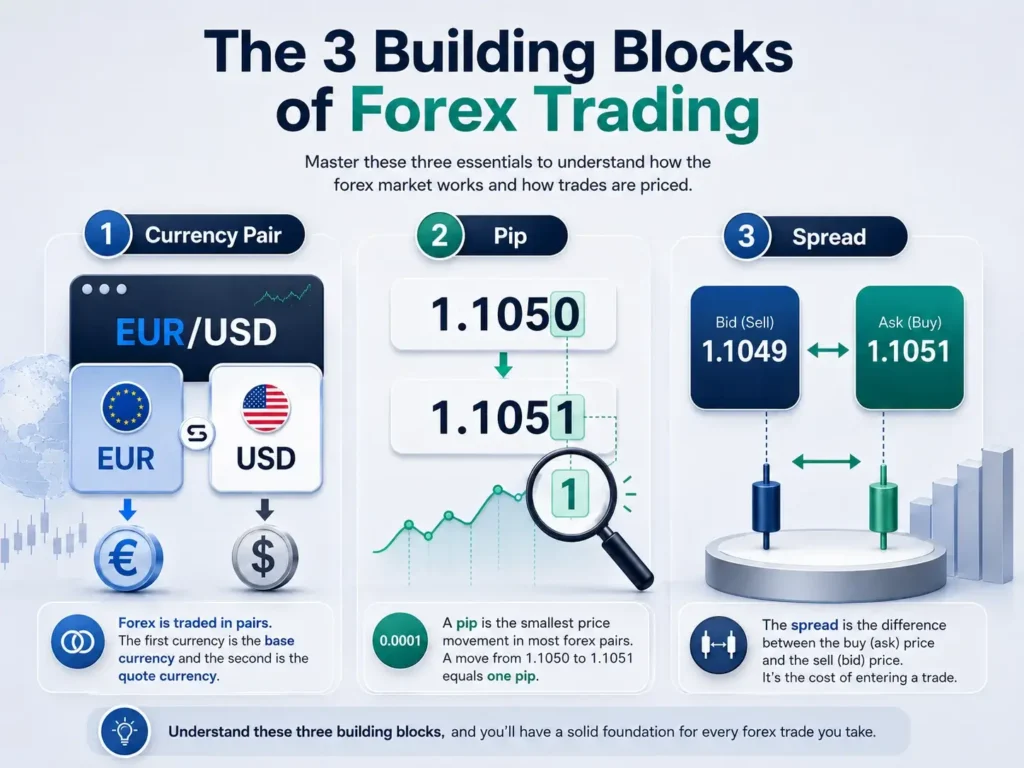
Three foundational concepts underpin almost everything else, so it helps to get comfortable with them early.
- Currency pairs: Forex CFDs are quoted in pairs, such as EUR/USD (the euro against the US dollar). The first currency is the base; the second is the quote. Pairs are commonly grouped as majors, minors, and exotics, and you can read more about the major, minor, and exotic pairs that most beginners start with.
- Pips: A pip is the smallest standard price movement in a currency pair. For most pairs this is the fourth decimal place, so a move from 1.1050 to 1.1051 represents one pip.
- Spread: The spread is the difference between the buy (ask) and sell (bid) price, and it is one of the primary costs of trading forex CFDs. At the time of writing, EUR/USD CFD spreads on Vantage’s Raw ECN account can start from 0.0 pips with a commission of $3.00 per standard lot per side. Refer to the latest product specifications for current pricing. A spread-only Standard STP account builds the cost into a wider spread instead. Either way, the spread and any commission are costs a trade has to overcome before it moves into profit.
Getting these building blocks right early makes the more advanced material considerably easier to absorb.
How to Learn Forex Trading Step by Step
There is no single correct path, but a structured progression keeps the learning focused. The five steps below give beginners a practical order to work through.
Step 1: Build the Foundational Theory
Start with the fundamentals before touching a platform: what forex CFDs are, how currency pairs are priced, what drives exchange rates, and how leverage works alongside margin. Reputable financial-education websites, introductory books, and structured broker-run courses are useful starting points, and many are free. The goal at this stage is comprehension, not action.
Pay particular attention to leverage. It lets you control a larger position with a relatively small margin deposit, which increases market exposure but equally amplifies potential losses, and can result in significant losses. Treating leverage as a source of risk to manage, rather than a way to trade bigger, is one of the more useful mindsets to form early.
Step 2: Choose a Regulated Broker
Before practising on a demo account or trading live, you need a broker. Look for one regulated by a recognised financial authority, and consider reviewing several providers to compare trading platform usability, fee structures, and the quality of their educational tools.
Regulatory oversight matters because a regulated broker is subject to conduct rules designed to promote standards relating to client money handling, conduct and fair trading conditions. It is worth verifying any broker’s status directly on the relevant authority’s official register, and being able to recognise the warning signs of an unregulated broker is part of learning to navigate the market safely.
Step 3: Learn Technical and Fundamental Analysis
Analysing the forex market generally falls into two broad approaches, and most traders develop a working knowledge of both.
- Technical analysis: This focuses on historical price data and chart patterns to identify potential opportunities. The core skill is learning to read a price chart: candlestick charts are widely used, and traders often look for support and resistance levels, trend lines, and oscillators such as the Relative Strength Index (RSI).
- Fundamental analysis: This examines macroeconomic indicators — interest rate decisions, inflation data, employment figures, and GDP reports — to assess the relative strength of a currency. Tracking the economic events on an economic calendar is a common way to stay oriented.
Technical analysis tends to be more relevant for short-term decisions, while fundamental analysis provides broader context for why a currency may be trending. Many beginners find it easier to focus on one approach first, then gradually fold in the other. The table below summarises the differences.
| Feature | Technical Analysis | Fundamental Analysis | Common For |
| Focus | Price action and chart patterns | Economic data and news events | — |
| Tools | Indicators, trend lines, candlestick charts | Economic calendars, central bank statements | — |
| Time horizon | Short to medium term | Medium to long term | — |
| Best for | Identifying entry and exit points | Understanding broader market direction | Combining both approaches |
Step 4: Set Your Risk Management Rules
Risk management is arguably the most important discipline in forex trading, and the one most commonly underestimated by beginners. A few principles do most of the work.
- Position sizing: This is deciding how much of your account to expose on any single trade. As a general reference point, some traders risk between 1% and 2% of account equity per position, though the right amount varies by individual circumstances. This is general information only and does not constitute financial advice. Working through position sizing and risk-to-reward on a demo account makes the maths concrete.
- Stop-loss orders: These are pre-set instructions to close a position once price moves a set distance against you, which helps limit a loss, though they do not guarantee execution at the exact level in fast markets.
- Risk-to-return ratio: This weighs the potential downside of a trade against the potential upside before entering, so the decision is made deliberately rather than in the moment.
No approach eliminates the possibility of losses. A defined framework of risk management techniques simply keeps a single losing trade from having a disproportionate effect on the account.
Step 5: Practise on a Demo Account
A demo account lets you trade forex CFDs with simulated funds in live market conditions, so you can apply what you have learned without risking real capital. Use it to test your chart reading, practise placing and managing trades, and start building consistency. The habits formed here tend to carry forward, so it helps to treat a demo as seriously as a live account.
A short, hypothetical example shows how the mechanics fit together. Suppose a beginner opens a 0.10-lot EUR/USD CFD position on a demo account. At that size, each one-pip move is worth roughly $1, so a 20-pip move for or against the position changes the balance by about $20. If the trader has decided to risk no more than 1% of a $2,000 demo balance — $20 — then a stop-loss placed around 20 pips away keeps the potential loss within that limit.
This example is hypothetical and for illustrative purposes only. It does not reflect actual trading results or client experiences.
Some educational sources suggest spending around six months on a demo account before considering live trading, although the appropriate timeframe varies between individuals. Consider moving to a live account only once you are recording consistent outcomes over a sustained period.
Build a Trading Plan
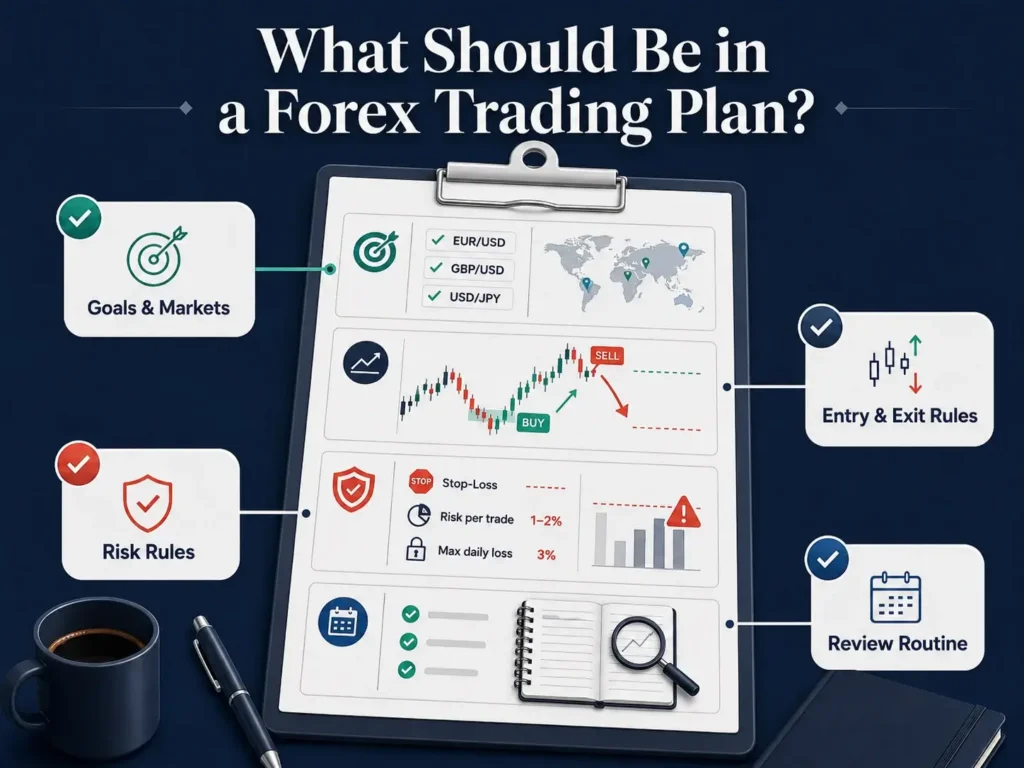
A trading plan is a written set of rules that defines what you trade, when you enter and exit, how much you risk, and how you review results. It is what turns scattered decisions into a repeatable process, and it is a step many beginners skip. A trading plan does not need to be elaborate; it needs to exist and be followed.
A workable plan usually covers four areas.
- Goals and markets: What you are trying to learn, how much time you can commit, and which currency pairs you will focus on to start.
- Entry and exit criteria: The specific conditions under which you will open and close a position, so trades are taken by rule rather than on impulse.
- Risk rules: Your maximum risk per trade, where stop-losses sit, and any cap on losses within a single day or week.
- Review routine: How and when you will look back over your trades to see what is working and what is not.
Written down, these rules give you something concrete to test on a demo account and to refine as you learn, rather than a set of instincts you cannot evaluate.
Keep Practising and Reviewing: How Skill Develops
Skill in forex trading develops through repetition and honest review, not through reading alone. Once the theory is in place, most of the progress comes from doing, recording, and reflecting.
A trade journal is the simplest tool for this. Recording each trade — the pair, your entry and exit, the reason you took it, the outcome, and how you felt at the time — turns a series of one-off decisions into data you can learn from. Reviewing that journal periodically often reveals patterns that are invisible in the moment, such as consistently exiting winners too early or breaking your own risk rules when a trade goes against you. Managing those tendencies is where trading psychology becomes as important as chart reading.
Progress is rarely linear. A useful marker is not a run of winning trades but consistency: applying your plan without deviation, understanding why individual trades performed as they did, and managing losing periods without abandoning your approach. That is the point at which reading has genuinely become skill.
How Long Does It Take to Learn Forex Trading?
There is no fixed answer. It depends on the time you invest, the resources you use, and how consistently you practise. A general timeline can still help set realistic expectations.
A Realistic Six-Month Benchmark
A six-month demo trading period is commonly referenced in forex education as a useful learning benchmark, although the appropriate timeframe varies between individuals. Consider moving to a live account only once you can demonstrate consistent performance over time. It is not an arbitrary figure. It takes time to become comfortable reading charts, to understand how economic events move currency pairs, and to manage the psychological pressures that trading introduces.
| Phase | Timeframe | Focus Area | Goal |
| Foundation | Month 1 | Theory, terminology, platform familiarisation | Understand how forex CFDs work |
| Analysis | Months 2–3 | Technical and fundamental analysis | Identify patterns and interpret economic data |
| Strategy | Month 4 | Develop and test a trading plan | Apply a consistent method on a demo account |
| Risk management | Month 5 | Position sizing, stop-losses, journaling | Manage exposure and review performance |
| Consistency | Month 6+ | Continued demo practice and review | Show consistent outcomes before going live |
Some concepts will click quickly and others will need revisiting. The aim is not speed; it is building genuine competence before live capital is involved.
Choosing How to Learn: Online Resources vs Books
Online resources and traditional books both have a place in a structured forex education, and the strongest approach usually combines them.
- Online resources: These offer immediacy and interactivity. Broker academies, reputable financial-education platforms, and video tutorials can walk you through concepts visually, and many provide free access to economic calendars, market news, and webinars. A large share of the best beginner material costs nothing, so a limited budget is rarely the barrier.
- Books: These provide depth. Works on technical analysis, trading psychology, and risk management, written by experienced practitioners, offer a level of structured thinking that short-form online content rarely matches. Reading slowly and reflecting tends to reinforce retention.
Whatever the format, weigh the author’s credentials, check that the content is genuinely educational rather than promotional, and confirm the source draws a clear line between education and investment advice.
Common Pitfalls for New Forex Traders
Understanding what tends to go wrong can be as valuable as knowing what to do. A few patterns recur among traders who struggle early on.
- Overusing leverage: Applying the maximum available leverage sharply increases the size of potential losses. Beginners are often better served by starting with lower leverage until position management feels familiar.
- Trading without a plan: Entering trades with no defined entry criteria, exit strategy, or risk rules tends to produce inconsistent outcomes. This is exactly what the trading plan above is designed to prevent.
- Ignoring the emotional dimension: Fear and overconfidence can both undermine a sound approach. Losses may prompt impulsive decisions, and a run of gains can encourage excessive risk. Awareness of these tendencies is part of what a demo period helps develop.
- Moving to live trading too quickly: Real capital introduces a psychological dynamic that simulated trading does not fully replicate. Rushing this transition is one of the most common sources of early losses.
- Focusing only on potential gains: Every trade carries the possibility of a loss. Keeping a realistic view of both outcomes, and planning for the downside, is fundamental to staying in the market.
Key Takeaways for New Traders
Learning forex trading is a process, not an event. The traders who build lasting discipline are generally those who take time to understand the market, practise before committing live capital, and treat risk with consistent seriousness. The roadmap in this guide gives that process a structure:
- Build the foundational theory of forex CFD markets.
- Choose a regulated broker with a platform that suits you.
- Develop a working knowledge of technical and fundamental analysis.
- Set your risk rules and write a trading plan before you need them.
- Practise on a demo account, journal your trades, and review until performance is consistent.
The forex market does not reward impatience. With structured learning and a clear understanding of both the opportunities and the risks, it is possible to develop a more informed and disciplined approach to participating in the forex CFD market.
FAQ
How do I learn forex trading step by step?
Work through a structured sequence rather than jumping straight to live trades. Begin with the theory — currency pairs, pips, spreads, leverage, and margin — then choose a regulated broker and learn the basics of technical and fundamental analysis. Set your risk rules, write a simple trading plan, and practise everything on a demo account. Only consider live trading once you are seeing consistent results over a sustained period.
Can I learn forex trading for free?
Much of the best beginner material is free. Reputable financial-education websites, broker academies, and introductory video tutorials cover the fundamentals at no cost, and a demo account lets you practise with simulated funds rather than real money. Paid books and courses can add depth on topics such as risk management and trading psychology, but they are a supplement to free resources, not a prerequisite for starting.
How long does it take to learn forex trading?
There is no fixed timeline, since it depends on how much time you invest and how consistently you practise. A commonly referenced benchmark is at least six months on a demo account before considering live trading, and only once you can show consistent outcomes. Some concepts are absorbed quickly while others need revisiting, so competence, rather than the calendar, is the better measure of readiness.
Can I teach myself to trade forex CFDs?
Yes, self-directed learning is a viable path given the volume of quality educational content available. Broker academies, reputable education platforms, and well-regarded books can all support independent study. The main challenge is discipline: with no external structure, it can be tempting to skip demanding topics such as risk management in favour of trading sooner. A staged, structured approach tends to produce more durable results.
How can I learn forex trading on my phone?
Most regulated brokers offer mobile trading apps that include live charts, economic calendars, demo accounts, and educational content. Some also provide video tutorials and market commentary in-app. Mobile tools are useful for staying informed and practising on the go, though a desktop or laptop is generally better suited to detailed chart analysis, particularly during the learning phase.
Do I need a trading plan to start learning forex?
A trading plan is one of the more valuable things to develop early, even in the demo stage. It defines what you trade, your entry and exit criteria, your risk limits, and how you review results, which turns trading into a process you can actually evaluate and improve. It does not have to be complex to be useful, but trading without one tends to lead to inconsistent, impulse-driven decisions.
How do I know when I am ready to move to a live account?
A useful indicator is consistent, documented performance on a demo account over a sustained period, commonly referenced as at least six months. Consistency here does not mean winning every trade; it means applying a defined plan without deviation, understanding why individual trades performed as they did, and managing losing periods without abandoning your approach. Moving to live trading before those conditions are in place is a common source of early difficulty.
RISK WARNING: CFDs are complex financial instruments and carry a high risk of losing money rapidly due to leverage. You should ensure you fully understand the risks involved and carefully consider whether you can afford to take the high risk of losing your money before trading.
Disclaimer: The information is provided for educational purposes only and doesn’t take into account your personal objectives, financial circumstances, or needs. It does not constitute investment advice. We encourage you to seek independent advice if necessary. The information has not been prepared in accordance with legal requirements designed to promote the independence of investment research. No representation or warranty is given as to the accuracy or completeness of any information contained within. This material may contain historical or past performance figures and should not be relied on. Furthermore estimates, forward-looking statements, and forecasts cannot be guaranteed. The information on this site and the products and services offered are not intended for distribution to any person in any country or jurisdiction where such distribution or use would be contrary to local law or regulation.
Reference
- “Global FX trading hits $9.6 trillion per day in April 2025 and OTC interest rate derivatives surge to $7.9 trillion: Triennial Survey – BIS” https://www.bis.org/press/p250930.htm Accessed 2 July 2026