


[DAILY TRADING] GBP/USD Analysis 25 June 2026 – Sterling Climbs to 1.3196 as PMI Contracts and BoE Splits

Vantage Editorial Team >
Vantage Editorial Team >
Vantage is a global, multi-asset broker with a team of in-house writers and market analysts who produce educational and insightful trading content for traders of all levels.
 Updated Thu, 2026 June 25 09:29
![[DAILY TRADING] GBP/USD Analysis 25 June 2026 – Sterling Climbs to 1.3196 as PMI Contracts and BoE Splits](https://www.vantagemarkets.com/wp-content/uploads/2026/06/GBPUSD_Hero_Image.webp)
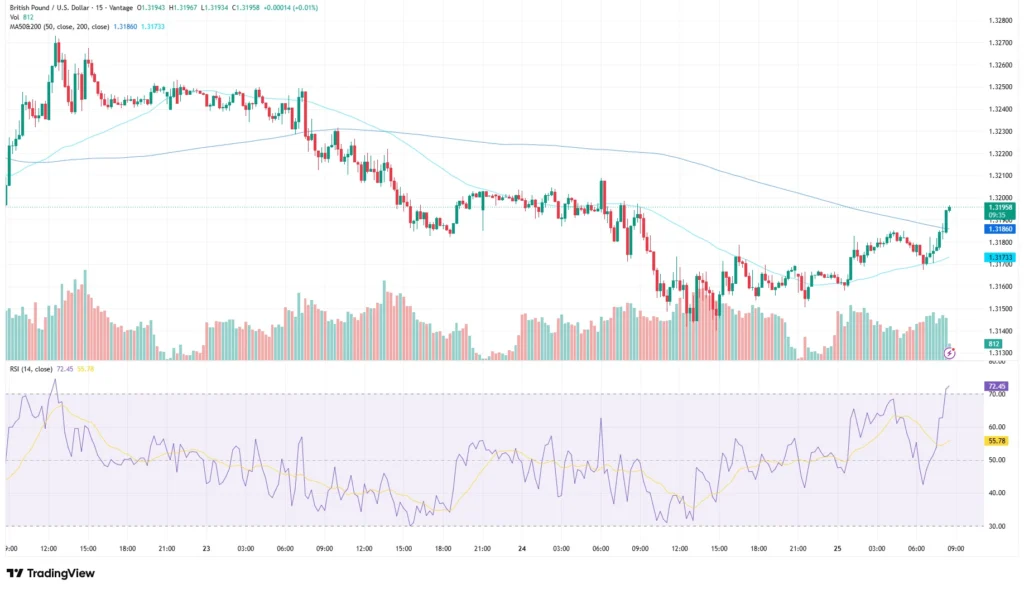
GBP/USD (the Vantage GBPUSD CFD) was trading near 1.31958 as of 09:15 GMT+8 (01:15 UTC) on 25 June 2026. The pair staged a sharp intraday recovery from session lows near 1.3130 recorded on 24 June, climbing back above both the 50-period moving average (MA) at 1.31860 and the 200-period MA at 1.31733 visible in the chart header.
The Relative Strength Index (RSI) per the TradingView setup used for this analysis reads 72.45, its first reading above the 70 threshold since the multi-session slide began on 22 June. The recovery comes against a backdrop of weak UK economic data and ongoing political uncertainty following the resignation of Prime Minister Keir Starmer. See all trading products available at Vantage Markets here.
All price references below are as of 09:15 GMT+8 (01:15 UTC), 25 June 2026.
Key Points
- The Vantage GBPUSD CFD traded near 1.31958 as of 09:15 GMT+8 on 25 June 2026, recovering from multi-session lows near 1.3130 on 24 June, with both the 50-period MA (1.31860) and 200-period MA (1.31733) now below price.
- UK political uncertainty remained a key sterling driver after Prime Minister Keir Starmer announced his resignation on 22 June 2026, with Andy Burnham the frontrunner and leadership nominations opening 9 July. Gilt markets were watching the fiscal policy outlook more closely than the pound itself, per Societe Generale analysts.[1]
- The June flash UK composite Purchasing Managers’ Index (PMI) fell to 49.4 from 49.7 in May, a second consecutive month of contraction, per S&P Global. The Bank of England (BoE) meanwhile voted 7-2 to hold Bank Rate at 3.75% on 18 June, with Huw Pill and Megan Greene voting for a rise to 4.00%.[2,3]
What the chart is showing
The 15-minute GBPUSD chart covers approximately 22-25 June 2026. Three phases are visible.
From the start of the chart through the morning of 22 June, GBP/USD was consolidating in the 1.3230-1.3280 range with both MAs flat and price oscillating around them.
A sustained slide then took hold from the afternoon of 22 June through 24 June. Price fell well below both MAs, reaching lows around 1.3130. The RSI briefly fell into the low-to-mid 30s during this phase, approaching oversold territory, suggesting the selling pace was notable without reaching extreme oversold territory.
From the early hours of 25 June, GBP/USD recovered. Price has climbed back above both MAs, and the RSI at 72.45 per the TradingView setup used for this analysis is now above 70. The RSI moving-average overlay sits at 55.78, well below the RSI line, confirming the momentum shift is recent and sharp.
The fundamental backdrop: politics, PMI and central banks
Three forces shaped GBP/USD over the past week.
- First, UK political uncertainty. Starmer announced his resignation on 22 June 2026 [1] after sustained internal Labour pressure following Andy Burnham’s Makerfield by-election win. The immediate reaction in sterling was relatively contained, suggesting much of the political uncertainty had already been reflected in market pricing. What is less certain is the fiscal direction under a new leader. As analysts at Societe Generale noted, gilt markets are watching fiscal policy more closely than the pound. The 10-year gilt yield was trading near 4.85% in the days after the announcement, with earlier spikes toward 5.1% during the peak of political pressure in May.[1]
- Second, weak UK economic data. The S&P Global June flash composite PMI fell to 49.4 from 49.7 in May [2], marking a second consecutive month of contraction. Services activity slipped to 48.7 against a 50.0 consensus estimate. Rising input costs alongside falling output have put the BoE in a difficult position. The MPC voted 7-2 to hold Bank Rate at 3.75% at its meeting ending 17 June 2026, with Huw Pill and Megan Greene voting to raise to 4.00%. [3] UK CPI held at 2.8% in May, below the 3.0% markets had expected, but services inflation rose to 3.7%, the figure the BoE watches most closely for domestic wage-driven pressure.[3]
- Third, a hawkish Fed signal. At Kevin Warsh’s first FOMC meeting on 17 June 2026, the Fed held rates at 3.50%-3.75% unanimously but the dot plot showed nine of 18 participants projecting at least one hike in 2026. The FOMC statement also removed its prior easing bias. Markets read the outcome as hawkish: two-year Treasury yields rose sharply after the decision, strengthening the US dollar broadly.[4]
Key levels to watch
The table below reflects levels visible on the 15-minute chart and referenced against recent price action. These are reference zones, not signals.
| Level | Price | Note |
| Resistance 2 | 1.3250 | 22-23 June consolidation ceiling |
| Resistance 1 | 1.3200 | Psychological round number; intraday cap |
| Current price | 1.31958 | 09:15 GMT+8, 25 June 2026 |
| 50-period MA | 1.31860 | Near-term dynamic support (chart header) |
| 200-period MA | 1.31733 | Longer-term MA (chart header) |
| Support 1 | 1.3160-1.3170 | Session base, early 25 June |
| Support 2 | 1.3130 | Multi-session low, 24 June |
Table 1: Key GBPUSD reference levels as of 09:15 GMT+8 (01:15 UTC), 25 June 2026. Source: TradingView, Vantage GBPUSD CFD. Indicative only.
The 1.3200 level was acting as nearby intraday resistance at the chart cutoff, with price at 1.31958 yet to test it cleanly. The 50-period MA at 1.31860 and 200-period MA at 1.31733 are both below the current price, giving the move a degree of near-term structural support. On the downside, 1.3160-1.3170 marked the intraday base before the recovery. Below that, 1.3130 is the multi-session low from 24 June.
What to watch
- UK Labour leadership nominations, 9 July 2026: Any early fiscal signals from Andy Burnham or other candidates could move sterling and gilts. Spending and borrowing commitments are the key market focus.[1]
- BoE next meeting, 30 July 2026: With the June vote already at 7-2 in favour of a hold, the next meeting carries a new Monetary Policy Report. Markets will watch whether the hawkish minority grows further.[3]
- Fed communication and US data: Nine of 18 FOMC members projected a 2026 hike in June’s dot plot. Any softening in US inflation data would reduce USD support across pairs.[4]
- UK PMI and inflation data: A composite PMI below 49.4 in the next reading would reinforce the contraction signal. Services CPI at 3.7% in May remains the BoE’s primary concern.
Risk and exposure
GBP/USD moved roughly 40 pips from its session low to the 09:15 GMT+8 reference price in a short window, against a backdrop of elevated political event risk. Standard Stop Loss placement should account for that intraday volatility range rather than rely on fixed-pip assumptions. The 9 July 2026 leadership nomination deadline is a near-term event-risk date that could produce gap moves in GBP/USD and UK gilt instruments. Positions held across that window carry additional exposure.
Leverage amplifies both gains and losses in fast-moving, event-driven conditions like the current GBP/USD setup. Position sizing relative to account equity is worth reviewing ahead of politically sensitive dates. Leverage in CFD trading is a double-edged instrument and should be understood fully before use.

RISK WARNING: CFDs are complex financial instruments and carry a high risk of losing money rapidly due to leverage. You should ensure you fully understand the risks involved and carefully consider whether you can afford to take the high risk of losing your money before trading.
Disclaimer: The information is provided for educational purposes only and doesn’t take into account your personal objectives, financial circumstances, or needs. It does not constitute investment advice. We encourage you to seek independent advice if necessary. The information has not been prepared in accordance with legal requirements designed to promote the independence of investment research. No representation or warranty is given as to the accuracy or completeness of any information contained within. This material may contain historical or past performance figures and should not be relied on. Furthermore estimates, forward-looking statements, and forecasts cannot be guaranteed. The information on this site and the products and services offered are not intended for distribution to any person in any country or jurisdiction where such distribution or use would be contrary to local law or regulation.
References
[1] “Keir Starmer resigns: What it means for GBP, gilts and UK markets — XTB” https://www.xtb.com/en/education/keir-starmer-resigns-what-it-means-for-gbp-gilts-and-uk-markets Accessed on 25 June 2026.
[2] “United Kingdom flash S&P Global Services PMI unexpectedly arrives lower at 48.7 in June — FXStreet” https://www.fxstreet.com/news/united-kingdom-flash-sp-global-services-pmi-unexpectedly-arrives-lower-at-487-in-june-vs-500-estimates-202606230835 Accessed on 25 June 2026.
[3] “Bank Rate maintained at 3.75% — June 2026 Monetary Policy Summary and Minutes — Bank of England” https://www.bankofengland.co.uk/monetary-policy-summary-and-minutes/2026/june-2026 Accessed on 25 June 2026.
[4] “Fed interest rate decision June 2026: Fed holds rates steady — CNBC” https://www.cnbc.com/2026/06/17/fed-interest-rate-decision-june-2026.html Accessed on 25 June 2026.
[5] “British pound: exchange rate data, June 2026 — Trading Economics” https://tradingeconomics.com/united-kingdom/currency Accessed on 25 June 2026.
