Updated
Gold is one of the few heavily traded markets that can move while most local exchanges are asleep.
If you’re asking when does the gold market open, the practical answer is Sunday evening in New York time, then almost continuously until Friday afternoon.
Take note that the word ‘almost’ matters here. CME Group lists Gold Futures on CME Globex from Sunday to Friday, 10:00pm to 9:00pm (GMT), with a 60-minute daily break.1 In GMT terms, this shifts by an hour depending on daylight saving, so always check the current conversion rather than relying on a fixed GMT figure.
For traders, the opening time is only the first layer. Liquidity, spreads, and volatility change throughout each session. Keep scrolling to find out more details about gold market open times, session windows, market closures, and the periods traders usually watch most closely.
Key Points
- Gold commonly trades nearly 23 hours a day, five days a week, depending on the broker and instrument.
- CME Gold Futures trade Sunday to Friday, with a 60-minute daily break.
- XAU/USD liquidity is usually stronger during the London session and London-New York overlap.
- Gold markets close (or halt) for the weekends, daily breaks, exchange holidays, some platform maintenance windows, and in the event of significant trading suspensions like stock market circuit breakers.
- Exact gold trading hours can shift because of daylight saving time (DST) and public holidays.
When Does The Gold Market Open?
The gold market open time is usually from Sunday at 6:00 pm (ET) to Friday at 5:00 pm (ET) for CME Gold Futures. In GMT or UTC terms, that broadly means a Sunday open around 22:00 or 23:00, then a Friday close around 21:00 or 22:00, depending on US daylight saving time.
For gold trading through Contracts for Difference (CFDs), platform hours often track the main weekday cycle, but the final schedule is set by the broker’s product specification. Always check the symbol details and instrument type (like XAU/USD and GLD) before holding a position through rollover or a holiday.
| Core Rule: Gold is not open 24/7 under standard weekday market access. It’s closer to 23 hours a day, five days a week. |
What Are Popular Gold Trading Sessions By Timezone?
Gold trades through the same global electronic market that underpins forex, so traders typically divide the day into Sydney, Tokyo, London, and New York sessions. As gold reacts to various factors—ranging from real yields to central bank activity—what matters during each session differs from a typical currency pair. Vantage Markets’ trading time zones guide follows this global sequence from Sydney through New York.
| Session | Approximate Trading Window | What Usually Matters For Gold |
| Sydney | 22:00-07:00 (GMT) | Trading week reopens for XAU/USD, but liquidity is typically thinner, so gaps from weekend news are more likely here than tight ranges. |
| Tokyo | 00:00-09:00 (GMT) | Asian physical demand (notably from China and India) and regional risk sentiment can influence gold, though price action is often quieter than later sessions. |
| London | 08:00-17:00 (GMT) | London is a major physical gold trading and pricing hub, and the session often sets the first clearer directional move of the day for XAU/USD. |
| New York | 13:00-22:00 (GMT) | US data releases, Treasury yield moves, and US dollar strength tend to drive the sharpest XAU/USD volatility, since gold is priced in USD and sensitive to real rates. |
| London-New York Overlap | 13:00-17:00 (GMT) | Both major gold trading centres are active simultaneously, which can potentially improve spreads and price discovery on XAU/USD. |
Sydney Session
Sydney is where the trading week reopens for gold after the weekend close. If major geopolitical or economic news breaks while the market is shut, XAU/USD can gap at the Sunday open before fuller liquidity returns later in the week.
Tokyo Session
Tokyo can matter for gold when Asian physical demand or China-linked risk sentiment shifts, since China and India are among the largest sources of physical gold demand globally. Lower trading activity during this session does not remove risk, especially as spreads can widen.
London Session
London is historically one of the most significant centres for gold trading and price-setting, alongside its role in forex. Traders commonly watch whether XAU/USD breaks or rejects the range established during the Asian session.
New York Session
New York matters for gold because XAU/USD is priced in US dollars and highly sensitive to US monetary policy. Federal Open Market Committee (FOMC) decisions, Consumer Price Index (CPI) releases, and Non-Farm Payroll (NFP) data can all move gold prices quickly, particularly through their impact on real interest rates and the US dollar.

What Are the Best Times To Trade Gold?
The best times to trade gold should be judged by liquidity and execution conditions, not potential returns. For example, the London-New York overlap is widely regarded as the most active window for gold traders, as it is when XAU/USD’s daily high or low is most often established, with spreads typically at their tightest.
High-impact US data can change the character of that window. Gold traders can consider using Vantage Markets’ Economic Calendar for tracking scheduled events before trading time-sensitive XAU/USD setups on a Live Account.
The daily rollover period and other thin-liquidity windows, like the hour after the New York close, deserve particular care. Gold traders and investors should note that spreads on XAU/USD can widen by several times their typical level during these periods. Liquidity thins and sudden volatility can make stop placement harder, especially on leveraged gold CFDs.
For a more comprehensive read, visit Vantage Markets’ guide on “What’s the Best Time to Trade Gold?”.
Does The Gold Market Close?
Yes, the gold market closes. The main weekly closure runs from Friday afternoon in New York until Sunday evening, and there is also a daily break in standard CME Globex hours.
Holiday schedules can also interrupt normal hours. For gold traders and investors interested in changes to Vantage’s gold trading hours, they can check out the latest updates here.
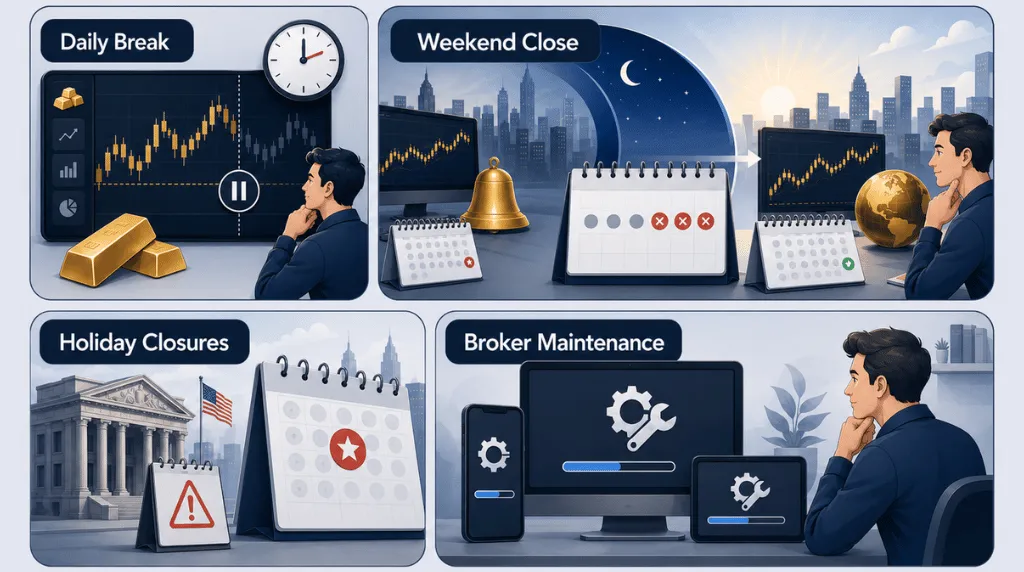
| Closure Type | When It Happens | Why It Matters |
| Daily Break | Around the New York close | Orders may pause, and spreads can change around rollover. |
| Weekend Close | Friday close to Sunday open | Weekend news can create opening gaps. |
| Holiday Closures | Exchange-specific | Liquidity may thin before and after the holiday. |
| Broker Maintenance | Platform-specific | The platform specification should be treated as final. |
Standard XAU/USD access is different from selected extended-hours products. For example, Vantage Markets offers XAUUSD247 for 24/7 gold trading (product availability varies by region) via a Live Account.
Know When the Gold Market Opens & Closes to Plan Your Next Trade
Knowing the gold market open times can potentially help you avoid dead zones, but it does not automatically make a setup tradable. Instead, gold traders and investors need to factor in liquidity, spread quality, and event risk.
Use an economic calendar, check gold trading session overlaps, and apply XAU/USD risk management before trading gold instruments like gold CFDs and gold ETFs. To practise first, open a Vantage Demo Account before trading with real capital.
Frequently Asked Questions (FAQs)
What Time Does the Gold Market Open?
Gold futures (COMEX/CME) open Sunday at 6:00 pm (ET), with the GMT equivalent shifting between roughly 22:00 and 23:00 depending on daylight saving. Spot and CFD gold (XAU/USD) typically follow a similar near-24-hour weekly cycle, but exact access can vary by broker and product. Always check the exact gold symbol specification before placing or holding a trade.
When Does the Gold Market Close?
Gold futures close for the week on Friday at 5:00 pm (ET). There’s also a recurring 60-minute daily maintenance break, from 5:00 pm to 6:00 pm (ET), Sunday through Thursday. CFD providers generally mirror this schedule for XAU/USD, though exchange holidays and broker-specific maintenance can change the usual hours.
Is the Gold Market Open 24 Hours?
No, the standard gold market is not open 24 hours a day, seven days a week. It’s commonly available for nearly 23 hours a day during the trading week. The daily break and weekend close still matter.
Can I Trade Gold On Weekends?
Usually one cannot trade gold on the weekends, at least not under standard XAU/USD or traditional gold CFD trading hours. Some providers may offer separate extended-hours products in selected regions, such as Vantage Markets’ XAUUSD247 that allows traders to trade gold CFDs 24/7. Treat those as different instruments and check their fees, funding rules, and trading conditions before opening a position.
What Are XAU/USD Trading Hours?
XAU/USD trading hours commonly follow the near-24-hour weekday gold cycle, broadly mirroring the COMEX futures schedule from Sunday evening to Friday evening in New York time. Exact access depends on the broker’s platform, server time, holiday schedule, and product type. The platform specification should be treated as the final reference.
When Is Gold Trading Typically Most Active?
The London-New York overlap is often the most active period because both European and US liquidity are present. That can support tighter spreads and stronger price discovery, but it can also produce faster moves. Higher activity never removes trading risk.
RISK WARNING: CFDs are complex financial instruments and carry a high risk of losing money rapidly due to leverage. You should ensure you fully understand the risks involved and carefully consider whether you can afford to take the high risk of losing your money before trading.
Disclaimer: The information is provided for educational purposes only and doesn’t take into account your personal objectives, financial circumstances, or needs. It does not constitute investment advice. We encourage you to seek independent advice if necessary. The information has not been prepared in accordance with legal requirements designed to promote the independence of investment research. No representation or warranty is given as to the accuracy or completeness of any information contained within. This material may contain historical or past performance figures and should not be relied on. Furthermore estimates, forward-looking statements, and forecasts cannot be guaranteed. The information on this site and the products and services offered are not intended for distribution to any person in any country or jurisdiction where such distribution or use would be contrary to local law or regulation.
References
- “Gold Futures Contract Specs — CME Group”. https://www.cmegroup.com/markets/metals/precious/gold.contractSpecs.html. Accessed on 24 June 2026.