Updated
The New Zealand dollar versus the US dollar, ticker NZDUSD and nicknamed the “Kiwi” after the bird on New Zealand’s $1 coin, is one of the more unpredictable pairs in the forex market. It combines a small, commodity-driven economy with the world’s reserve currency, which means it can swing sharply on dairy prices, Chinese demand, and shifts in global risk appetite — not just on domestic New Zealand news. For traders who want exposure to commodity-currency dynamics without trading an emerging-market pair, NZDUSD is a popular choice. This guide explains what NZDUSD is, what moves it, and how traders approach it.
What Is NZDUSD?
NZDUSD is the currency pair that expresses how many US dollars one New Zealand dollar is worth. In this pair, the New Zealand dollar (NZD) is the base currency and the US dollar (USD) is the quote currency. A price of 0.6000, for example, means 1 NZD buys 0.60 USD.
When the price rises, it means the New Zealand dollar is strengthening against the US dollar — each Kiwi dollar buys more US cents. When the price falls, the New Zealand dollar is weakening relative to the US dollar. Because NZD is a smaller, commodity-linked currency and USD is the world’s most traded currency, this pair often reflects the broader tug-of-war between “risk-on” sentiment (favouring NZD) and “risk-off” sentiment (favouring USD).
Why Trade NZDUSD
NZDUSD attracts traders for a mix of practical and strategic reasons:
- Liquidity: as one of the more actively traded commodity currency pairs, NZDUSD generally offers reasonable liquidity and tighter spreads than many exotic pairs, particularly during Asia-Pacific trading hours.
- Volatility: NZDUSD volatility tends to run higher than major pairs like EURUSD, which can appeal to traders looking for larger intraday price swings.
- Commodity currency exposure: New Zealand’s economy leans heavily on dairy and agricultural exports, so NZDUSD often moves in tandem with commodity currencies like AUD and, at times, global dairy price trends.
- Risk sentiment barometer: because NZD is considered a higher-risk, higher-yield currency, NZDUSD is sensitive to shifts in global risk appetite — it tends to be sold off in “risk-off” periods and bought during “risk-on” rallies.
Whether NZDUSD is a good pair to trade depends on your strategy: its volatility can create opportunity, but it also demands tighter risk management than calmer major pairs. Many traders also watch NZDUSD tradingview charts to track how these dynamics play out visually across timeframes.
What Affects NZDUSD?
NZDUSD is shaped by a combination of New Zealand-specific and global forces. Here are the main drivers to understand.
RBNZ and Federal Reserve Interest Rates
Interest rate differentials are one of the biggest drivers of any currency pair, and NZDUSD is no exception. When the Reserve Bank of New Zealand (RBNZ) raises interest rates while the Federal Reserve holds steady or cuts, New Zealand dollar assets become relatively more attractive to yield-seeking investors, which tends to push NZDUSD higher.
The reverse is also true: if the Fed hikes rates faster than the RBNZ, capital tends to flow toward higher-yielding US dollar assets, pulling NZDUSD lower. Traders watch both central banks’ policy statements closely for clues about the future direction of this rate differential.
USD Strength (DXY Impact)
Because USD is the quote currency, broad-based US dollar strength or weakness — often tracked via the US Dollar Index (DXY) — has a direct mechanical effect on NZDUSD. A rising DXY, reflecting a stronger dollar across the board, typically pushes NZDUSD down, even if nothing has changed in New Zealand. A falling DXY tends to lift NZDUSD.
This is why NZDUSD analysis often starts with a look at the dollar’s broader trend, not just New Zealand-specific news.
New Zealand Economic Data (GDP, Inflation, Employment)
Domestic data releases — GDP growth, CPI inflation, and employment figures — shape expectations for RBNZ policy. Stronger-than-expected New Zealand data can fuel expectations of tighter monetary policy, supporting NZD. Weaker data can do the opposite, raising the odds of rate cuts and weighing on the currency.
Commodity Prices (Dairy Exports)
Dairy is New Zealand’s largest export category, and global dairy prices have a meaningful influence on the country’s trade balance and currency. Rising dairy prices generally support NZD by improving New Zealand’s terms of trade, while falling dairy prices can weigh on the currency.
China Economic Performance
China is one of New Zealand’s largest trading partners, particularly for dairy and other agricultural exports. Strong Chinese economic growth and demand tend to be positive for NZD, while signs of a Chinese slowdown often weigh on the New Zealand dollar — even before any New Zealand-specific data changes.
NZDUSD: Live Chart Analysis
To see how these drivers can play out in practice, consider this hypothetical scenario: the RBNZ unexpectedly raises interest rates while the Fed signals it may pause hikes. NZDUSD, trading around 0.6000 beforehand, begins to climb as traders reprice expectations for a wider rate differential in New Zealand’s favour.
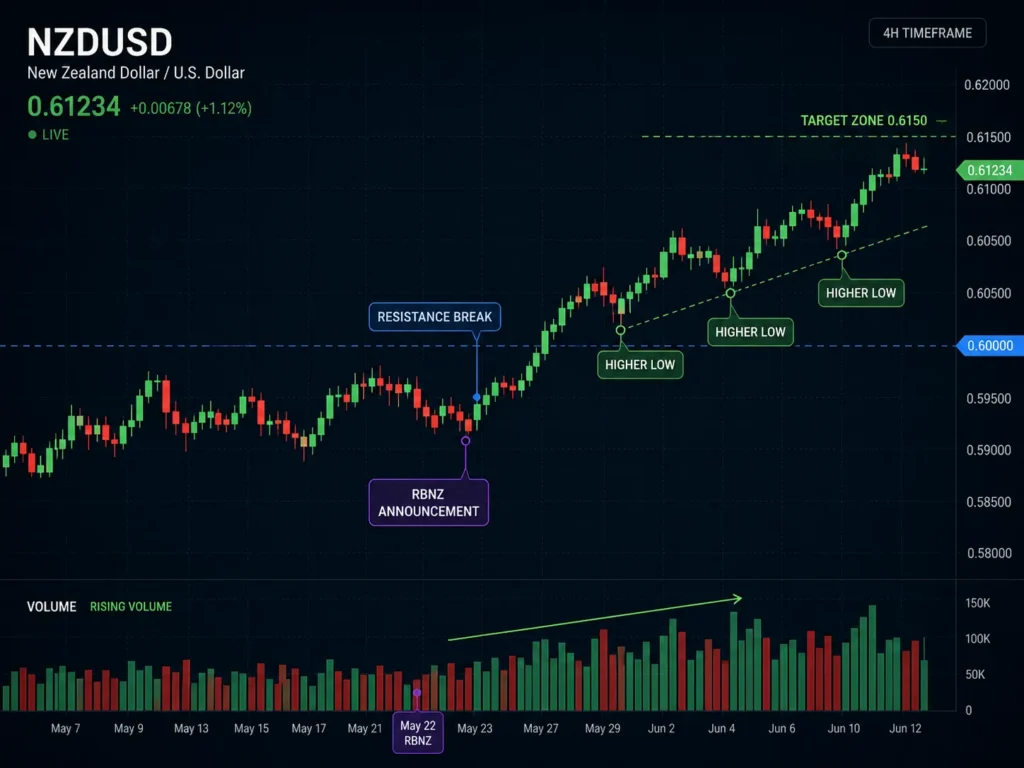
A trader monitoring the pair might have noticed the price breaking above a recent resistance level shortly after the RBNZ announcement, with rising volume confirming the move. As momentum built, NZDUSD extended from 0.6000 toward 0.6150 over the following sessions, with each pullback finding support at progressively higher levels — a classic sign of an uptrend forming after a fundamental catalyst.
How to Trade NZD/USD
There’s no single “right” way to trade NZDUSD, but most approaches combine three elements: technical analysis, fundamental analysis, and risk management.
Technical Analysis
Technical traders watch NZDUSD chart patterns, along with key support and resistance levels, to time entries and exits. Trend lines, moving averages, and momentum indicators (like RSI or MACD) are commonly used to gauge whether the pair is trending or ranging, and whether a breakout is likely to hold.
Fundamental Analysis
Fundamental traders focus on the data releases and events most likely to move NZDUSD: RBNZ policy meetings, US Non-Farm Payrolls (NFP), US CPI inflation data, and New Zealand’s own GDP and employment reports. Because NZDUSD trades most actively during the overlap of the Asia-Pacific session and London open, many traders also pay close attention to liquidity conditions around this window.
Risk Management
Given NZDUSD’s volatility, disciplined risk management is essential. This typically includes placing stop-loss orders at logical technical levels (such as beyond recent swing highs/lows) and sizing positions so that no single trade risks an oversized portion of the account. Combining a clear stop-loss strategy with sensible lot sizing helps manage downside risk in a pair known for sharp, news-driven moves.
Ready to put this into practice? You can open a demo account with Vantage to test NZDUSD strategies in a risk-free environment before trading live.
Key Risks of Trading NZD/USD
NZDUSD’s appeal — volatility and liquidity — comes with real risks that every trader should understand before getting involved.
Leverage Risk
Leverage can magnify both gains and losses. Because NZDUSD can move quickly on news, over-leveraged positions can be closed out by a broker’s margin call far faster than in calmer, less volatile pairs.
News-Driven Volatility Spikes
RBNZ decisions, Fed announcements, and Chinese economic data can trigger sudden, sharp moves in NZDUSD. Traders caught on the wrong side of a surprise announcement can see rapid, significant price swings.
Liquidity Shifts During Off-Peak Hours
Outside of the Asia-Pacific and London session overlap, NZDUSD liquidity can thin out, which may lead to wider spreads and choppier price action — conditions that can be harder to trade cleanly.
Spread Widening Around Data Releases
Around major data releases or central bank announcements, spreads on NZDUSD can widen significantly as liquidity providers adjust for uncertainty, increasing the effective cost of entering or exiting a trade at that moment.
Trading forex carries no guarantee of profit, and past patterns don’t guarantee future results.
Is NZDUSD Good for Beginners?
NZDUSD has both advantages and drawbacks for newer traders. On the plus side, it’s a well-known pair with reasonable liquidity and relatively clear, well-documented drivers (interest rates, dairy exports, China exposure), which makes it easier to build a fundamental view than with more obscure currency pairs.
On the other hand, its volatility and sensitivity to Chinese economic conditions mean price moves can be sharper and less predictable than in major pairs like EURUSD. Beginners who trade NZDUSD should generally start with smaller position sizes, use stop-losses consistently, and take time to understand the pair’s key drivers before trading it with real capital.
Conclusion
NZDUSD is a distinctive currency pair that blends commodity-currency characteristics with global risk sentiment. Its price is shaped by interest rate differentials between the RBNZ and the Fed, broader US dollar strength, New Zealand economic data, dairy export prices, and the health of the Chinese economy. That mix creates both opportunity and volatility, so traders approaching NZDUSD should combine technical and fundamental analysis with disciplined risk management.
Trading forex involves risk and may not be suitable for all investors.
Ready to explore NZDUSD for yourself? Open a demo account with Vantage or start trading NZD/USD with a live account today.
FAQ
What is NZDUSD?
NZDUSD is the currency pair representing how many US dollars one New Zealand dollar (nicknamed the “Kiwi”) is worth. NZD is the base currency and USD is the quote currency.
Is NZDUSD a major currency pair?
NZDUSD is often classed as a minor pair rather than one of the traditional “majors” (which typically pair USD with EUR, JPY, GBP, CHF, CAD, and AUD). It’s sometimes grouped alongside AUD/USD as a commodity currency pair, though liquidity is generally lower than the true majors.
Why does NZDUSD move?
NZDUSD moves in response to RBNZ and Federal Reserve interest rate decisions, broad US dollar strength, New Zealand economic data, dairy export prices, and China’s economic performance, among other factors.
Is NZDUSD good for beginners?
It can be, thanks to relatively clear fundamental drivers and decent liquidity, but its volatility means beginners should use conservative position sizing and consistent risk management.