Soft US CPI boosts bonds and stocks, USD slides

Jamie Dutta >
Jamie Dutta >
Jamie Dutta is a Market Analyst for Vantage. He comes with extensive experience as a full-time trader and financial market commentator, having worked as a trader in top tier investment banks and trading houses.
 Updated Wed, 2026 July 15 04:27

- Trump backs away from plans to charge fees in Hormuz Strait
- Easing US price pressures dampen imminent Fed rate hike talks
- Dollar down on soft CPI, gold and silver up as Treasury yields fall
- Big US investment banks beat estimates, Goldman & JPM post record profits
Forex
USD reversed its recent bullish momentum which had been building as Gulf escalation started to be taken more seriously. Also helping was President Trump who backed off planned Hormuz fees for shipping. Of course, the latest inflation data severely dented the markets’ hawkish pricing for Fed rate hikes. The breadth of the softening was particularly encouraging, aside from the headline grabbing 9.7% fall in gas prices. For instance, shelter, the biggest component in the basket, rose just 0.1%. As a result, Fed rate hike bets dwindled with a one in ten chance of a July move now, versus a near coin flip before the data. Markets will now look to today’s PPI input figures for more soft signals. Fed Chair Warsh’s first semi-annal Congress testimony didn’t give markets much to chew on, with zero forward guidance different to the June FOMC.
EUR firmed to a high at 1.1462 but again that looks like a resistance area as prices fell back through the day after the weaker than expected US CPI figures. Prices are trading around the downward trendline from the May high, with the 50-day SMA well above at 1.1547. ECB messaging has been modestly less hawkish recently though is subject to energy price developments. The spike in gas prices is likely some concern as it weighs on the zone’s terms of trade more than oil. Rate expectations remain firm, extending their hawkish repricing with a 45bps of tightening now priced by December, up from 37bps on Monday.
GBP spiked up to 1.3443 immediately on the US inflation publication before paring gains through the US session. Prices closed around the long-term SMAs (50,100 and 200-day) at 1.3384/94. Sterling lagged the rest of its peers apart from the yen, even as bets on BOE tightening firmed to just under two 25bp rate hikes by year end. This pricing seems somewhat aggressive to us, and along with potential political change coming with new PM Burnham in place on July 20, could see some GBP volatility.
JPY strengthened versus the greenback, essentially after the soft CPI release. That said, the yen underperformed its peers while Japan’s official currency management appears to have shifted from explicit currency-related comments to focus on capital repatriation. The recent top sits at 162.83.
Stocks
US stocks: The S&P 500 added 0.38% to close at 7,544, the Nasdaq closed up 1.1% at 29,586 and the Dow Jones settled higher by 0.02% at 52,513. Sectors were largely in the green, with Health and Consumer Staples the clear laggards, with Tech, Communications and Energy sitting at the top of the pile. Today marked the start of earnings season, and the big banks issued largely excellent reports, but did see mixed price action. All reported earnings that beat expectations on strong revenue from equities trading. JPMorgan posted its strongest profit ever, pushing 2% higher while Goldman Sachs surged 7.5% after beating earnings estimates. The SOXX semi index rebounded 2.7% as chip producers rebounded from Monday’s sell-off. Micron and Sandisk moved over 4% higher tracking memory producers, with Nivida rising more than 2%. On the flip side, IBM plunged 26% after issuing a profit warning citing shifting spending from clients to chips and memory from software.
Asian Stocks: Futures are mixed. APAC stocks were softer following the negative lead from Wall Street as Middle East tensions escalated. The ASX 200 closed lower with weakness in tech and financials though energy and utilities gains offset some downside. The Nikkei 225 slid below 67,000 with higher oil prices and tech weakness causing selling, but dip buyers helped steady the index. The Shanghai Comp and the Hang Seng conformed to the tech-related weakness and ultimately failed to benefit from the better-than-expected Chinese trade data.
Gold
Gold rebounded more than 2% on softer inflation data and Fed rate hike bets being pared back. See more below.
Day Ahead – Bank of Canada Meeting
The BoC is expected to keep rates steady at 2.25%. Benign inflation figures, mixed jobs data and muted business surveys are expected to keep policymakers on hold for a sustained period. Middle East and trade-related uncertainty also mean a patient stance is likely. Rates are at the lower end of the neutral range and that has allowed the central bank to adopt a wait-and-see approach amid the volatility. There’s currently around 16bps of rate hikes priced in by year-end.
Concerns over rising inflation have eased following the most recent data, given the fall in oil prices back to pre-war levels. However, renewed tensions in the Middle East leave the Governing Council uncertain about the inflation outlook. Governor Tiff Macklem has said there has not been much pass-through from higher oil prices to the prices of other goods and services. On trade, the USMCA has shifted to rolling talks rather than renewal, but any bad headlines could mean a drag on the loonie. Carry appeal remains low for CAD though a bottoming out in oil prices could support it, if risk sentiment picks up.
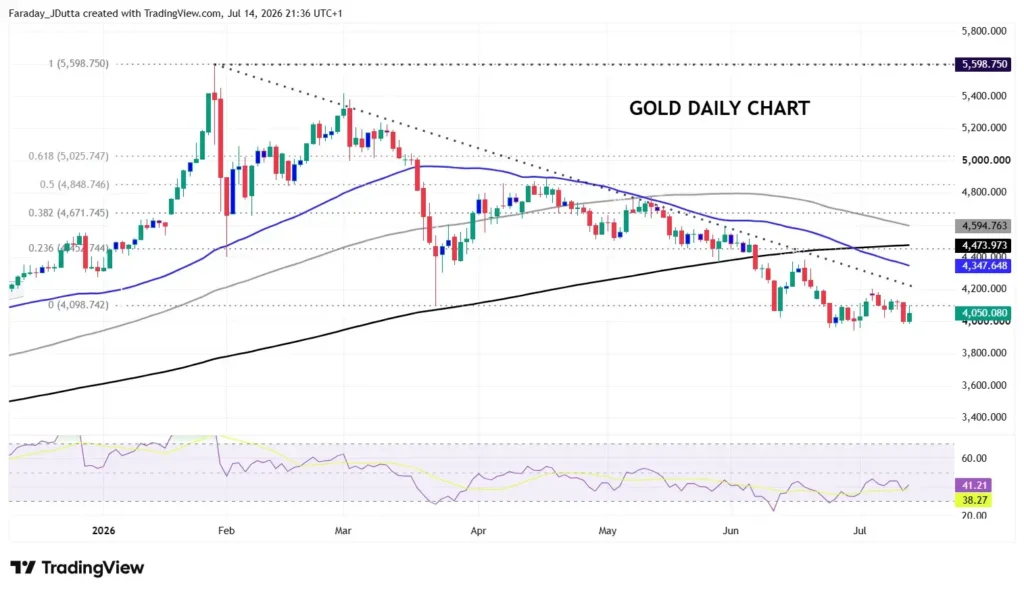
Chart of the Day – Gold big support around $4,000
Gold fell sharply on Monday, with silver also under pressure, as renewed tensions in the Middle East drove oil prices higher. This reinforced worries that inflation could remain elevated and keep the Federal Reserve on a tighter policy path. Higher US yields and a stronger dollar have weighed on precious metals as non-yielding assets. The market is closely watching developments around the Strait of Hormuz and the impact for energy prices, inflation and interest rates.
Of course, yesterday’s CPI figures showed that inflation risks are easing, which means the Fed could be less inclined to tighten policy. Money markets now see a much smaller chance of a move at the end of the month which could stabilise prices after the recent sell-off. $4,000 is a big psychological and significant area of support. Below is the October low at $3,886. Bugs need to get above the falling trendline above $4,200 and then the 50-day SMA at $4,348 and preferably the 200-day SMA at $4,474 to stop the downtrend.