Updated
In forex trading, the spread in forex refers to the difference between the bid (sell) and ask (buy) prices quoted for a currency pair, serving as a transaction cost built into every trade. This bid/ask spread fluctuates in increments called pips, which denote changes in the fourth decimal place of a currency pair, or the second decimal place for the currency pair.
The total cost of your trade is influenced by both the spread and the lot size. Forex brokers present two prices for a currency pair: the bid price for selling the base currency and the ask price for buying it.
Key Points
- The spread in forex is the cost difference between the bid and ask prices of a currency pair, expressed in pips.
- Fixed spreads offer stability and predictability in costs, while variable spreads adjust with market conditions, providing cost efficiency but less predictability.
- Platforms like MetaTrader 4 and MetaTrader 5 offer tools for effective trading, with differences in features and spread costs impacting trader experience and expenses.
Types of Spreads in Forex
In forex trading, spreads are categorised into two main types: variable and fixed. Each type offers distinct advantages and disadvantages, crucial for traders to understand when navigating the currency markets.
Here’s a breakdown of both spread types:
| Spread Type | Advantages | Disadvantages |
| Fixed Spread | Spreads can widen significantly during major economic announcements or periods of market volatility, thereby increasing trading costs.Less predictable, making budgeting and planning more challenging. | Typically higher than variable spreads under normal market conditions. Fixed spreads offer limited flexibility, as they remain constant even when market conditions could allow for a narrower spread. |
| Variable Spread | Lower average costs compared to fixed spreads during less volatile periods.More transparent as it reflects real market conditions and liquidity. | Spreads can widen significantly during major economic announcements or periods of market volatility, thereby increasing trading costs. Less predictable, making budgeting and planning more challenging. |
Understanding these helps traders decide which spread in their trading approach fits their strategy.
Calculating Forex Spreads
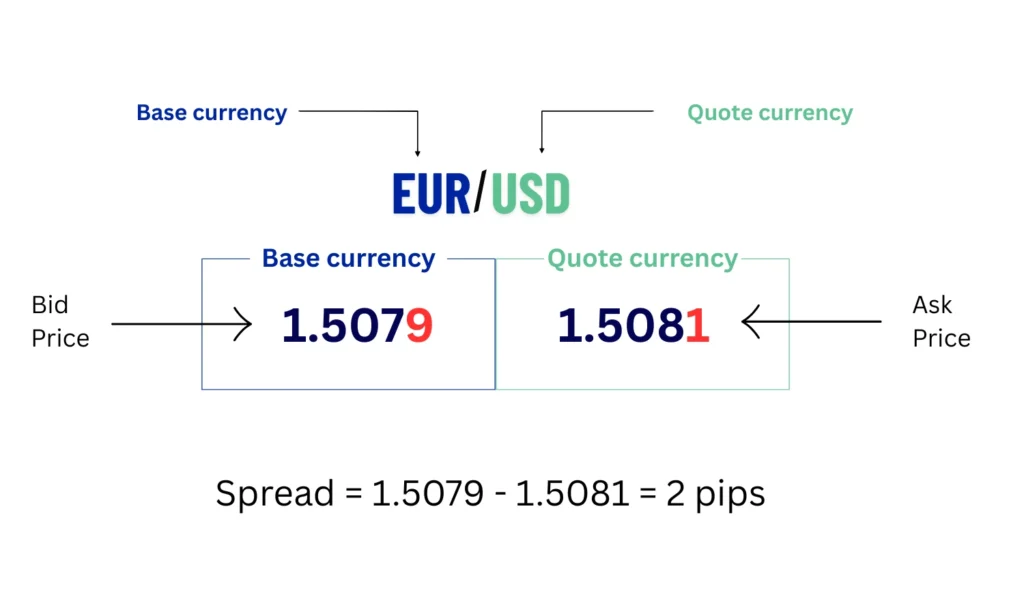
Before diving into how to calculate forex spread, it’s important to understand the different forex terms:
- Bid Price
The price at which buyers are willing to purchase a currency pair in the foreign exchange (forex) market.
- Ask Price
The price at which sellers are willing to sell a currency pair in the foreign exchange (forex) market.
- Tight Spread / Low Spread
A small difference between the bid and ask prices indicates low trading costs and high liquidity.
- Wide Spread / High Spread
A large difference between the bid and ask prices signifies higher trading costs and lower liquidity.
- Pip
A “pip” represents the smallest price movement in a forex currency pair and stands for “percentage in point.”
Typically, forex currency pairs are quoted to four decimal places, with a pip referring to a change in the fourth decimal place. This can be represented by the bolded numbers in the table below.
| EUR (Base Currency)/USD (Quote Currency) | |
| Bid Price | Ask Price |
| 1.0630 | 1.0635 |
To calculate the spread, which is the difference between the buy and sell prices expressed in pips, we can use the following formula:
Spread = Ask price – Bid price = 1.0635 – 1.0630 = 0.0005 (5 pips)
This illustrates how to calculate spread in forex for your trades.
Forex Trading Platforms
There is a wide variety of forex trading platforms for traders to choose from, including popular platforms such as MetaTrader 4 and MetaTrader 5.
MetaTrader 4
MetaTrader 4 (MT4), developed by MetaQuotes in 2005, is a widely used trading platform that can be installed on both desktop and mobile devices. It offers a flexible trading system with advanced market analysis tools, customizable charts, and support for Expert Advisors (EAs) for algorithmic automation, enhancing the precision and efficiency of trading strategies.
The platform’s user-friendly interface ensures that even novice traders can easily understand and utilize its comprehensive functionalities. Learn more about the platform here.
MetaTrader 5
MetaTrader 5 (MT5) is the advanced successor to MetaTrader 4, developed by MetaQuotes for trading forex, futures, and other assets. This multi-asset platform is renowned for its sophisticated features, including the latest enhancements such as fully activated Expert Advisors (EAs), signal trading, and comprehensive hedging capabilities.
Learn more about the MT5 platform or read our article covering the differences between MT4 and MT5 to help traders understand better.
Vantage
Traders can also choose to trade CFD products, such as Forex, using the Vantage trading platform, which offers clients ultra-competitive spreads starting at 0.0 pips for RAW ECN accounts and 1.0 pips for Standard STP accounts.
Start trading with Vantage today by opening a live trading account!
Summary
In summary, the forex spread represents the transaction cost and is defined as the difference between the bid (sell) and ask (buy) prices of a currency pair. Both fixed and variable spreads have pros and cons, and some traders use forex spread betting as an alternative way to take positions on currency pairs.
Trading platforms like MT 4 and MT 5 provide robust tools for analysis and trading, featuring customizable charts and algorithmic trading capabilities through EAs.
FAQ
1. What are spreads in forex?
Spreads in forex are the difference between the bid (sell) and ask (buy) prices of a currency pair, measured in pips. They represent the trading cost and can vary with market conditions, liquidity, and volatility.
2. What is a good spread in forex?
A good forex spread is typically 1–3 pips on major currency pairs, such as EUR/USD or GBP/USD, where liquidity is high. Tight spreads reduce trading costs, while wider spreads increase expenses during volatile conditions.
3. How to calculate spread in forex?
To calculate a spread in trading, subtract the bid price from the ask price. For example, if EUR/USD is 1.0630 (bid) and 1.0635 (ask), the forex spread is 5 pips, which reflects the transaction cost.